As an Amazon Associate I earn from qualifying purchases. Links in this article may be affiliate links. How we choose gear
Picking the wrong off the grid air conditioner costs four figures and shows itself on the first hot afternoon, when the panels fall behind the compressor or the inverter trips on its start-up surge. The cure is arithmetic done before the purchase: watt-hours, panel output, surge, and what happens after sunset. This 2027 guide walks through that arithmetic, the mistakes that send units back, and three units that cover the realistic routes to an off the grid air conditioner setup.
The figures below rest on maker spec sheets, specialist-press reviews, owner threads on the EG4 and DIY Solar forums, and retailer listings. One number frames everything else: Jackery’s sizing guide puts a 12,000 BTU air conditioner at roughly 900 to 1,400 running watts, while an inverter-driven mini-split can run as low as 700.
Three routes to off grid air conditioning, and what each one needs
Every working setup falls into one of three routes. Each answers the night question differently, and that difference decides the budget.
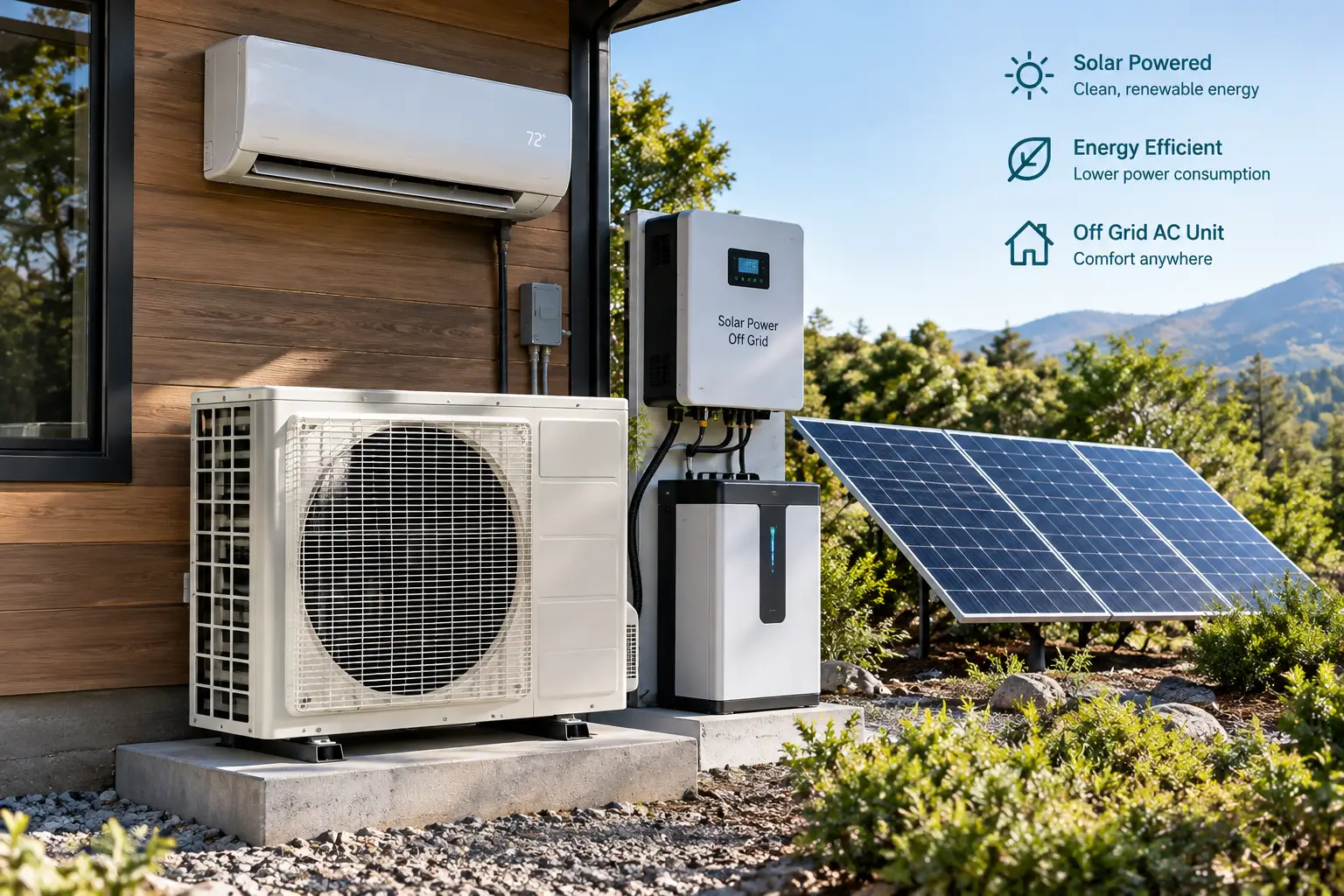
The first is a hybrid mini-split wired straight to solar panels. Makers of these units say no battery, inverter or charge controller is needed, and the cooling is free while the sun shines. After dark it needs AC power. EG4’s support staff have said on the company forum that the hybrid line does not integrate a battery.
The second is a standard inverter mini-split fed by a solar array, a battery bank and an inverter. It handles nights, but SlashGear notes that off-grid systems tend to be the most expensive way to power an air conditioner because of the storage they require.
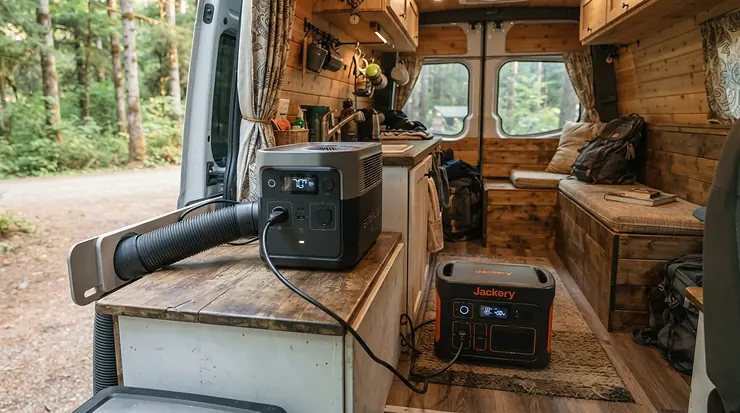
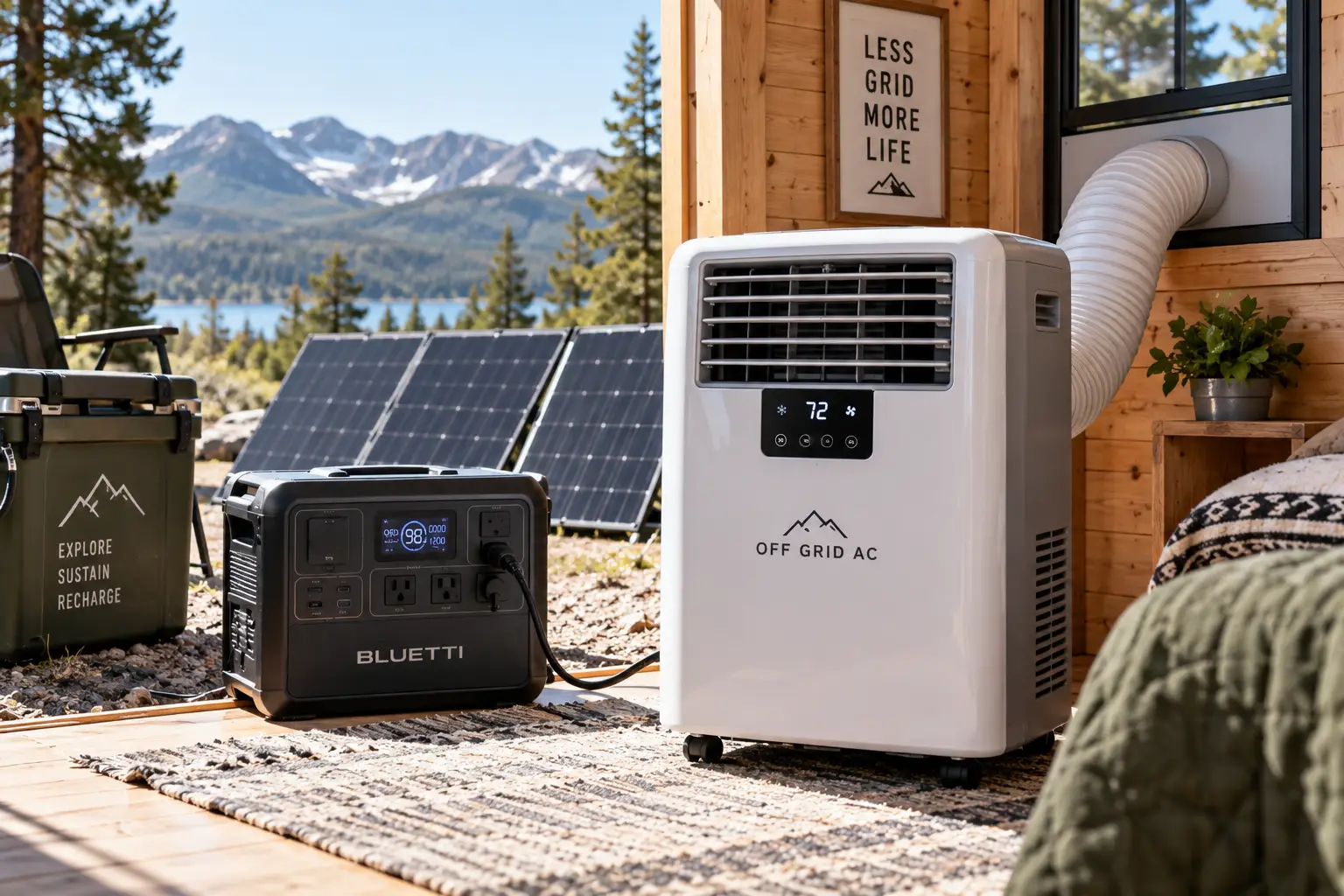
The third is a battery-powered portable unit for one small space, such as a tent, van or sleeping loft. It needs no installation, and its limits are runtime and room size.
The best off grid power source for any of the three is whichever one supplies the watt-hours your cooling hours demand: panels for the daytime share, storage for the rest, and an AC backup when weather turns. The off grid power options that follow in this guide are built around that split.
Working out the watt-hours before choosing a unit
Start from hours of cooling, not from BTUs
Sample calculation, with stated assumptions: a 12,000 BTU inverter mini-split averaging 900 watts and running six hours a day uses 5,400 watt-hours (900 × 6). SlashGear uses the same 900-watt average for a mini-split and arrives at 7.2 kilowatt-hours over eight hours.
Put that beside Sungold Solar’s range for a basic remote cabin, which is 2,000 to 4,000 watt-hours a day for everything. One air conditioner can outspend the rest of the cabin combined, which is why cooling hours are the first number to settle.
Efficiency trims the total. The Department of Energy’s ductless mini-split page says ductless units can reach ratings between 15.2 and 35 SEER2, so a high-SEER2 inverter model is the starting point for any off grid air con.
Turn watt-hours into panels
TheGreenWatt’s formula divides daily watt-hours by peak sun hours, panel wattage and a 0.83 loss factor. With five peak sun hours and 400-watt panels, each panel delivers about 1,660 watt-hours a day (5 × 400 × 0.83), so 5,400 watt-hours needs a little over three panels, rounded up to four.
Other sources land higher because they assume longer runs. Costway’s guide pairs a 12,000 BTU mini-split drawing 950 to 1,300 watts with seven or eight 400-watt panels and adds that off-grid systems often need 10 to 40 percent extra capacity for battery charging and losses. TheGreenWatt’s cabin guide gives 4 to 8 panels of 400 watts for 5 to 10 kilowatt-hours a day. Sizing the solar panels for off grid cabin cooling is therefore a range, and the run hours you choose move it.
Direct-to-panel units have their own rules. The HotSpot Energy ACDC12C calls for at least three panels, each rated at 36 volts or more at maximum power, with the string kept below 325 volts open-circuit, and suggests one extra panel for daytime off-grid use. EG4’s listing recommends 1,000 to 1,600 watts of panels for its 12,000 BTU unit.
Check surge before checking price
Surge decides whether a battery-and-inverter route works at all. Jackery’s guide says a conventional 12,000 BTU unit can spike to 2,400 to 3,500 watts at start-up, while inverter-driven mini-splits stay near 1,500. MRCOOL’s off-grid guide lists about 1,200 running and 1,800 start-up watts for a 12,000 BTU unit and advises an inverter 20 to 30 percent above the running figure, pure sine wave.
A DIY Solar Forum poster says an inverter-driven mini-split has no start-up surge because its motor and compressor ramp up slowly. That is one owner’s report, and the two guides above still show a rise, so the safe plan is an inverter with clear headroom over 1,800 watts.
Plan the night separately
Direct-DC units are daytime machines. HotSpot’s page states that the HotSpot Energy ACDC12C runs at night only with an AC connection, and that without AC power it will not run at night or in low sun. HotSpot says batteries can be added but does not recommend that use, and it points buyers who need round-the-clock cooling with no AC power to a separate 48-volt all-DC line.
Night storage for a standard mini-split is plain arithmetic. Four night hours at 900 watts is 3,600 watt-hours (900 × 4) before inverter losses, so the usable battery needs to exceed that.
Install it properly
EG4’s listing includes a 16.4-foot pre-charged line set with quick-connect valves, which avoids vacuuming the lines. PickHVAC’s overview of mini-split heat pumps says refrigerant handling, evacuation, electrical work and code compliance all matter, and that most installations benefit from a qualified HVAC professional. The Department of Energy’s air-source heat pump page adds that too much or too little refrigerant reduces performance and efficiency.
Where off grid cooling setups go wrong, and the fix for each
Expecting the panels to carry the night
A direct-to-panel unit with no AC input goes quiet at sunset. One EG4 forum thread shows an owner who wired four 400-watt panels to a hybrid mini-split and a separate battery bank through a Victron inverter, expecting the unit to switch to batteries after dark. It did not. The fix is to feed the AC side from an inverter and battery bank, as EG4 staff describe, or to choose a standard inverter mini-split built for that route.
Wiring a battery into the DC input
EG4 support answered a question about running the hybrid’s DC input from a 96-volt battery with a flat no, saying the unit works only from solar or AC. The solar input is meant for a panel string between 90 and 380 volts. Batteries belong on the inverter that feeds the AC input.
Trusting the runtime on the box
PickHVAC reports that Zero Breeze Mark 2 claims about five hours of battery life, while verified reviews put it near three hours at full power. CleanTechnica’s reviewer of the EcoFlow WAVE 2 saw the advertised eight hours apply to Eco mode in mild weather and expects shorter runs in the hottest weather. Plan around the weaker figure.
Sizing the inverter from running watts
An inverter rated just above 900 watts will run the unit and then trip at start-up. Use the surge figures above, and keep the inverter’s continuous rating and its 10-second surge rating both above the air conditioner’s numbers.
Mismatching the panel string
Direct-DC units take a voltage window, not a wattage. HotSpot’s 325-volt open-circuit ceiling and EG4’s 90 to 380 volt window mean panels wired in series must land inside the range on a cold, bright morning. When a 24,000 BTU EG4 unit did not draw DC power on its forum, the support reply began by asking for the voltage at the DC input. An owner of a 12,000 BTU unit reported a solar-only install that blew room-temperature air while the app showed about 120 watts from the panels, which is the kind of symptom that makes the string voltage the first thing to measure.
Solar air conditioning for a storage facility off grid: the latest direct-DC units
A storage building, workshop or garage is a natural fit for the direct-DC design because it needs cooling mostly while the sun is up and has no one inside at night. The latest units are larger than the 12,000 BTU class. A Signature Solar listing for the EG4 24K Hybrid Mini-Split describes up to 1,000 square feet of coverage and up to 2,200 watts of DC solar input, with no inverter needed for off-grid or hybrid setups. The 18,000 BTU HotSpot Energy ACDC18C calls for six 72-cell panels when there is no grid connection.
The Solar Lab’s year-long review is a useful real-use record for this class. The reviewers ran the 24,000 BTU EG4 unit daily in a three-car garage on a 15-kilowatt array and an off-grid battery bank, reported no performance problems, described the indoor noise as mild and the outdoor unit as noisy, and noted that the unit throttles down and draws little once it reaches the setpoint. They also flagged that the solar-first mode needs a version with solar input plugs and that the 24,000 BTU unit wants 240-volt AC input. That is one team’s experience on an unusually large array, so treat it as proof that the design works and not as a benchmark for a small setup. The same site recommends about 2,500 watts of panels for daytime loads on a smaller system, with batteries added over time.
Three units that cover the three routes
The routes above need different gear, and each of the three picks below stands for one route. The table lines them up before the details.
Route
Unit
Daytime power
After sunset
Main limit
Direct to panels
EG4 Hybrid Solar Mini-Split 12000 BTU AC/DC
Panels, 90 to 380 VDC
AC power only
No battery integration
Battery cooling
EcoFlow WAVE 3 Portable Air Conditioner
Add-on battery or other source
Same battery
Small spaces only
Storage for 120V gear
EcoFlow DELTA 2 Max Portable Power Station
Up to 1,000 W solar input
2,048 Wh stored
About two hours at 900 W
The EG4 Hybrid Solar Mini-Split cools a permanent space from panels alone, but it hands the night to AC power. The EcoFlow WAVE 3 removes installation and covers a single small room. The EcoFlow DELTA 2 Max is the only one that stores energy for other loads, at the cost of limited cooling hours on its own.
A cabin or workshop with strong daytime sun is where this unit earns its price. The Shop Solar listing describes 12,000 BTU of cooling and 12,500 BTU of heating at 22 SEER2 for spaces up to 650 square feet, taking 90 to 380 volts DC directly from a panel string, with no inverter, battery or charge controller. AC input is 115 volts, an adjustable grid limiter runs from 0 to 600 watts, and the listing quotes 32 to 37 dB(A) indoors and 52 dB(A) outdoors under a five-year limited warranty.
Owner reports are mostly positive with one structural limit. A DIY Solar Forum owner who bought the 12,000 BTU kit with panels said it worked as advertised, saw a peak draw just over 1,000 watts, and warned that the panels are large and heavy enough to need a second person. Another poster there compared it with a 120-volt Pioneer unit, which the poster said costs around $700 to $800 and might draw 300 watts during the day, and found the EG4 line set short and the price higher.
The trade is clear: the hybrid needs no storage, while a standard inverter mini-split like the Pioneer can run at night from batteries. A solar-kit retailer lists the EG4 between roughly $1,500 and $2,000 depending on the sale. Check the current price on Amazon.com.
EG4 Hybrid Solar Mini-Split 12000 BTU AC/DCSee current price, sizes and reviews on Amazon.
Room size is the first limit with this one. Notebookcheck’s review calls it suitable only for smaller rooms and notes that the unit is relatively noisy while charging. StorageReview reports cooling raised from 5,100 to 6,100 BTU against the WAVE 2, with 6,800 BTU of heating, and RV.com cites 1,800 watts at the 6,100 BTU rating. A retailer spec table lists 44 to 58 dB, IPX4 splash resistance and 2 to 8 hours of runtime with the add-on battery, depending on mode. The Gadgeteer’s review gives the unit at 33.7 pounds and the battery at 21.4 pounds.
The predecessor’s off-grid record is the best guide to what a solar-fed WAVE behaves like. CleanTechnica’s reviewer cooled a large Shiftpod shelter quickly and kept it comfortable for sleeping, but the unit shut down when solar could not keep up after clouds and a thermal inversion, and the reviewer recommends planning for 500 to 600 watts of continuous draw in poor conditions. Light also leaked through the hoses until a towel covered them. One reviewer’s experience is a single data point, though it matches the runtime caution earlier in this guide.
Notebookcheck puts the unit alone near $1,300 and the add-on battery near $900 as a separate purchase, while reviews of the bundle cite between about $1,300 and $1,450, so the listings differ in what they include.
Pros:
No installation required
Heats as well as cools
Battery can come off and be charged separately
Cons:
Needs the add-on battery or a power station for cordless use
Suited to one small room, per Notebookcheck
EcoFlow WAVE 3 Portable Air ConditionerSee current price, sizes and reviews on Amazon.
Price sat around $1,700 when StorageReview reviewed it, and it buys the only pick here that stores energy for other loads. The specifications list a 2,048 watt-hour LFP battery, 2,400 watts of 120-volt output with 4,800 watts of surge, and X-Boost output quoted at 3,100 to 3,400 watts depending on the listing. Solar input reaches 1,000 watts across two ports at 11 to 60 volts, capacity expands to 6,144 watt-hours with two extra batteries, and Outbound Power lists a five-year warranty. The unit weighs 50 pounds.
The arithmetic is the honest limit. A 900-watt mini-split drains 2,048 watt-hours in about 2.3 hours before conversion losses, so overnight cooling needs the expansion batteries or a lighter load. A UK retailer’s table for the WAVE 2 lists 11 hours in Eco mode from a DELTA 2 and 14 hours from the older DELTA Max, against 8 hours from the WAVE 2’s own battery, which shows how much longer a power station can stretch a portable unit.
Sam’s Club shows the DELTA 2 Max at 4.8 out of 5 across 93 ratings, and one buyer there says it runs a WAVE 2 in a home office almost entirely off-grid. The 2,400-watt output clears the 1,800-watt start-up figure that MRCOOL lists for a 12,000 BTU unit. Check the current price on Amazon.com.
EcoFlow DELTA 2 Max Portable Power StationSee current price, sizes and reviews on Amazon.
Panels, batteries, and runtime: quick answers for off grid cooling
How many solar panels do I need to run an air conditioner off grid?
It depends on run hours. A 12,000 BTU mini-split averaging 900 watts for six hours uses 5.4 kilowatt-hours, which works out to about four 400-watt panels after system losses at five peak sun hours, while retailer guides that assume longer runs suggest seven or eight.
Can an air conditioner run off grid without batteries?
Yes, during the day, if it is a direct-to-panel hybrid mini-split. The makers of those units say no battery, inverter or charge controller is needed, but without AC power they will not run at night or in low sun.
What size inverter does a 12,000 BTU mini-split need?
MRCOOL's off-grid guide lists about 1,200 watts running and 1,800 watts at start-up for a 12,000 BTU unit and advises sizing the inverter 20 to 30 percent above running watts. Choose a pure sine wave model with comfortable headroom over the start-up figure.
How long can a battery run an air conditioner?
A 2,048 watt-hour power station running a 900-watt load lasts about two hours before conversion losses. Portable units built around their own batteries quote two to eight hours depending on mode, and hot weather shortens that.
Is a mini-split or a portable air conditioner better for off grid use?
A mini-split is usually the more solar-friendly choice for a permanent space because its inverter compressor throttles down at the setpoint, while a portable unit needs no installation and moves with you.
Choosing your off the grid air conditioner
Start with the cooling hours you need, multiply by the unit’s real draw, and let that number choose the route. Daytime-only cooling in a cabin, shed or storage building points to a direct-to-panel hybrid. Nights without AC power point to an inverter mini-split on a battery bank. A single tent, van or sleeping loft points to a portable unit with its own battery, and a power station adds storage for everything else.
For most permanent spaces with decent sun, the hybrid mini-split is the lowest-cost off the grid air conditioner on this list, provided AC power is available after dark or a battery-fed inverter is added to the AC side. Whichever route you pick, size to the weaker runtime figure, not the box. Compare the exact model number before buying, since 12,000 BTU units are sold in both 115-volt and 240-volt versions and the DC input window differs by line.