
In This Article
What Is a Hybrid Solar Power System (and Why It Matters in 2026)?
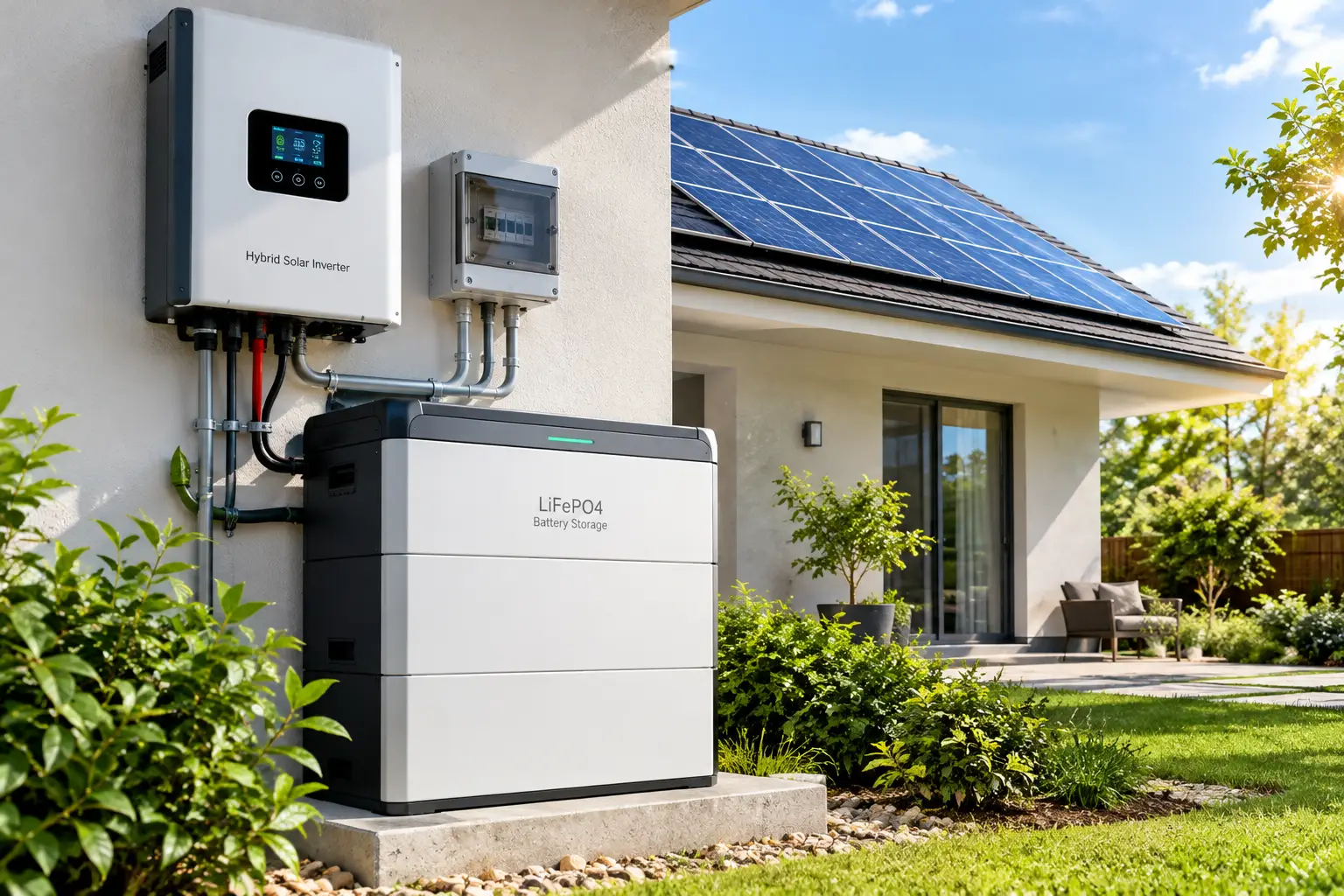
A hybrid solar power system combines solar panels, a battery bank, and a connection to the utility grid, all coordinated by a hybrid inverter. It uses solar first, stores the surplus, and pulls from the grid only when needed, so you get lower bills during normal days and backup power during outages.
That’s the textbook answer. Here’s the real-world one: a hybrid solar power system is what you buy when you’re tired of choosing between “cheap solar that dies in a blackout” and “off-grid independence that costs a fortune.” It’s the middle path, and in 2026 it’s the path most American homeowners are actually walking.
Why now? Three things changed. First, LiFePO4 batteries got dramatically cheaper and safer, so storage is no longer a luxury add-on. Second, utilities in many states have cut what they pay you for exported solar, which means storing your own power is often worth more than selling it. Third, the federal 30% residential solar credit ended for systems installed after December 31, 2025 — so every dollar now has to justify itself without a tax-credit cushion.
If you’re new to the basics of panels, permits, and utility interconnection, the Department of Energy’s Homeowner’s Guide to Going Solar is a solid, vendor-neutral starting point.
In this guide, we’ll compare seven real products — from DIY-friendly hybrid solar inverter units to plug-and-play power stations — and translate their spec sheets into what they mean for your electric bill, your fridge during a storm, and your weekend. No invented “tests,” no fake reviews: just honest analysis of published specs, real aggregated buyer feedback, and the math that actually matters.
Hybrid Solar Power System Picks at a Glance
| Product | Type | Continuous Output | Storage / Battery | Approx. Price Range | Best for |
|---|---|---|---|---|---|
| EG4 18kPV | Hybrid inverter (grid export capable) | 12,000W | Bring your own 48V bank | $4,800–$5,700 | Large homes, net-metering households |
| SunGoldPower SPH10048P | All-in-one inverter/charger | 10,000W | Bring your own 48V bank | $1,600–$2,400 | Whole-home backup on a budget |
| EcoFlow DELTA Pro Ultra | Modular battery + inverter | 7,200W | 6kWh, expandable to 90kWh | $4,500–$6,000 | Plug-and-play whole-home backup |
| Anker SOLIX F3800 Plus | Portable power station | 6,000W | 3.84kWh, expandable to 53.8kWh | $2,700–$4,000 | Adding storage to existing rooftop solar |
| Jackery Explorer 5000 Plus | Portable power station | 7,200W | 5.04kWh, expandable | $3,000–$4,300 | Storm-prone areas, RV + home dual use |
| EG4 6000XP | Off-grid inverter with grid assist | 6,000W | Bring your own 48V bank | $1,400–$1,600 | Cabins, shops, grid-assist backup |
| ECO-WORTHY 6KW Split-Phase Inverter | Budget all-in-one inverter | 6,000W | Bring your own 48V bank | $650–$850 | First-time DIYers, sheds, small homes |
Prices are approximate ranges at the time of writing and change frequently — check the current price on Amazon.
Looking at the table, the split is clear: the EG4 18kPV, SunGoldPower SPH10048P, EG4 6000XP, and ECO-WORTHY 6KW Split-Phase Inverter are “bring your own battery” building blocks, so their price covers only the brain of the system. The EcoFlow DELTA Pro Ultra, Anker SOLIX F3800 Plus, and Jackery Explorer 5000 Plus include storage, which is why they look pricier at first glance but often cost less in total once you add batteries, racks, and installation labor to the DIY options.
💬 One click helps other shoppers make an informed choice too! 😊
Top 7 Hybrid Solar Power System Picks: Expert Analysis
1. EG4 18kPV — the whole-home heavyweight with grid sell-back
The EG4 18kPV is the most complete hybrid solar inverter on this list, because it does all three jobs — off-grid, grid-assist, and true grid-tied export — in one box.
It accepts 18kW of PV (with a recommended ceiling of 21kW) across three MPPTs at up to 600VDC, and it outputs 12kW continuously at 120/240V split-phase. In practice, the high-voltage input lets you run long panel strings with thinner wire and skip a combiner box, while 12kW comfortably covers a central AC, a well pump, and an electric range at the same time. It can also run with no battery at all, so you can install it now and add storage later.
Who is it for? Homeowners with a large roof, real energy demand, and a utility that still credits exported power fairly. EnergySage lists its efficiency at 97.5% with a 10-year warranty, and it carries UL 1741 and UL 9540 listings when paired with compatible EG4 batteries — paperwork that matters a lot at permit time.
Reviews consistently praise its touchscreen compared with older EG4 units and note that it handles big appliances without drama. Independent reviewers also point out that its idle draw is surprisingly low for its size.
Pros:
- ✅ True grid export for net-metering households
- ✅ Three MPPTs simplify multi-roof-plane layouts
- ✅ Outdoor-rated IP65 enclosure with 10-year warranty
Cons:
- ❌ Professional installation is realistically required
- ❌ Overkill for small homes or cabins
Expect roughly $4,800–$5,700 for the inverter alone — premium money, but strong value if you’ll use most of its 12kW.
2. SunGoldPower SPH10048P — the most watts per dollar
The SunGoldPower SPH10048P delivers a 10kW split-phase inverter for roughly a third of the premium-tier price, which is why it shows up in nearly every budget whole-home build.
It packs two MPPTs (500VDC open-circuit), a 200A battery charger, and native 120/240V output, and you can parallel up to six units for 48kW. The feature most buyers overlook is time-slot charging and discharging: you can tell it to fill the battery during cheap off-peak hours and drain it during expensive evening peaks. On a time-of-use plan, that alone can shave real money off your bill.
Based on comparing the specs, this is a self-consumption and backup machine, not a sell-back machine — SunGoldPower markets a separate “grid feedback” 10kW model for export. The published battery-inverter efficiency of 92% is also a few points below premium hybrids, so expect slightly more energy lost as heat.
We couldn’t verify a large body of independent long-term reviews for this exact model, but buyer roundups consistently highlight its true split-phase output and the value of its capacity per dollar. Treat it as a capable workhorse that rewards careful setup.
Pros:
- ✅ 10kW split-phase at a mid-range price
- ✅ Time-of-use scheduling built right in
- ✅ UL1741 listing helps with inspections
Cons:
- ❌ Not designed to export power to the grid
- ❌ Lower efficiency than premium hybrid inverters
At roughly $1,600–$2,400, it’s the strongest value pick for whole-home backup if you don’t need grid export.
3. EcoFlow DELTA Pro Ultra — whole-home backup without a wiring degree
The EcoFlow DELTA Pro Ultra turns a hybrid solar system for home into something closer to an appliance: stack an inverter on a battery, connect a panel, and you’re running.
Each battery holds 6kWh, and the system scales to 90kWh, with 7,200W of 120/240V output and up to 5.6kW of solar input. What that means in practice: one battery runs a fridge, lights, internet, and a window AC for most of a day, while two or three batteries plus a decent solar array can stretch outages into weeks. Paired with EcoFlow’s Smart Home Panel 2, the switchover from grid to battery happens in under 20 milliseconds — fast enough that most electronics won’t notice.
It’s built for homeowners who want reliability without commissioning a custom 48V battery bank. The trade-off is cost per kWh, which is higher than DIY server-rack batteries.
Reviewers consistently report that it performs as advertised during real outages; the most common complaint is sheer weight, which makes solo assembly a challenge.
Pros:
- ✅ Massive 90kWh expansion ceiling
- ✅ Very fast automatic switchover with Smart Home Panel 2
- ✅ Mobile on casters, no permanent wall mounting
Cons:
- ❌ Heavy modules need two people to move
- ❌ Higher cost per kWh than DIY batteries
The starter kit typically lands around $4,500–$6,000; fair value if you’d otherwise pay an installer for a permanent system.
4. Anker SOLIX F3800 Plus — the smart retrofit for existing solar
The Anker SOLIX F3800 Plus is the clever choice for homes that already have grid-tied panels but no storage.
It holds 3,840Wh of LFP storage with 6,000W of 120/240V output and 3,200W of solar input, expandable to 53.8kWh and 12kW by pairing two units. Its standout trick is AC coupling: with Anker’s Smart Home Power Kit, it can work alongside your existing rooftop system instead of replacing its inverter. Translation — you keep the solar you already paid for and simply add a battery brain to it.
Its “Storm Guard” feature automatically tops off the battery when severe weather is forecast, which is the kind of thing you won’t care about until the night it saves you. Anker also says about 1.5 hours of generator runtime fully recharges it.
Reviews are positive about usability and app control, but we couldn’t verify a deep pool of long-term ownership data yet, so treat durability claims as manufacturer-stated (backed by a 5-year limited warranty).
Pros:
- ✅ AC coupling works with existing rooftop solar
- ✅ Storm Guard pre-charges before severe weather
- ✅ Expands to 12kW with a second unit
Cons:
- ❌ Smaller base capacity than rivals at this price
- ❌ Best features require the Home Power Panel
Typically between $2,700 and $4,000 depending on bundle — strong value specifically for retrofits.
5. Jackery Explorer 5000 Plus — the most capacity in a rolling box
The Jackery Explorer 5000 Plus packs 5,040Wh into a single wheeled unit, the most base capacity among the portable options here.
It delivers 7,200W continuous and 14,400W surge at 120/240V, accepts up to 4,000W of high-voltage solar (4,300W combined), and expands with Battery Pack 5000 Plus modules — up to 60kWh with two parallel units. The surge rating matters more than people think: it’s what lets a well pump or central AC compressor start without tripping the inverter. A NEMA L14-30 outlet means it can feed a transfer switch directly.
It suits storm-belt households that also want something to roll into an RV or job site. The UPS function (under 20ms, or 0ms in online mode via the app) keeps routers and computers from rebooting during a blink.
Retailer listings describe the expansion battery as rated for over 4,000 cycles to 70% capacity. Independent review volume is still modest, so we’d weight the published specs and warranty — a 5-year standard plus 2-year extension on registration — more than early star ratings.
Pros:
- ✅ Largest base capacity among portable picks
- ✅ Strong surge for motor-driven appliances
- ✅ Dual role for home backup and RV use
Cons:
- ❌ Lower solar input than the EcoFlow
- ❌ Bulky despite wheels and handle
Expect roughly $3,000–$4,300 for the unit alone; good value per kWh in the portable category.
6. EG4 6000XP — the efficient grid-assist workhorse
The EG4 6000XP isn’t a sell-back hybrid, but it’s one of the most popular grid-assist inverters for people who want solar-first power with the grid as a safety net.
It provides 6,000W of split-phase output, 8,000W of PV input across two MPPTs (up to 480V), and can parallel up to 16 units for 96kW. Its idle draw of roughly 50–60W is notably low, which matters because an inverter that sips power 24/7 quietly eats your battery overnight. It switches to battery in under 15ms and handles about 12,000W of surge for a few seconds.
This is the right pick for cabins, shops, and homes that want backup plus solar self-consumption without utility interconnection paperwork for export. It cannot back-feed the grid — important if net metering is your goal.
Real buyer feedback is notably consistent: owners report easy setup and smooth operation with mini-split AC units. The recurring complaints are a clunky app, the need for Wi-Fi to see detailed data, and no load balancing, so a heavily unbalanced 120V leg can trigger overloads.
Pros:
- ✅ Very low idle power consumption
- ✅ Scales to 16 units in parallel
- ✅ Runs without a battery in off-grid mode
Cons:
- ❌ No grid export or net metering
- ❌ Overloads possible on unbalanced 120V legs
Usually around $1,400–$1,600, it’s excellent value for grid-assist builds.
7. ECO-WORTHY 6KW Split-Phase Inverter — the budget doorway into 240V
The ECO-WORTHY 6KW Split-Phase Inverter is the cheapest way on this list to get true 240V split-phase from a 48V battery.
It pairs a 6,000W inverter with a 9,000W MPPT charge controller that accepts up to 500V of PV, plus built-in Wi-Fi monitoring. It offers three charging modes — solar plus grid (the default), limited solar, and solar-only — so you can decide how much you lean on the utility. For a small home, workshop, or detached garage, 6kW at 240V is enough to run a well pump, a mini-split, and a washer.
It’s best for first-time DIYers who want to learn on lower-stakes equipment. Like the EG4 6000XP, it’s designed for self-consumption and backup, not export.
Honestly, we couldn’t verify a large set of detailed independent reviews for this specific model, so we’d lean on its published specs and budget-tier positioning. Expect the usual trade-offs at this price: fewer premium certifications and less hand-holding support than EG4 or EcoFlow.
Pros:
- ✅ Lowest entry price for split-phase power
- ✅ Generous 9kW solar charge controller
- ✅ Built-in Wi-Fi monitoring included
Cons:
- ❌ Limited verified long-term reliability data
- ❌ No grid export capability
Around $650–$850 at the time of writing — unbeatable value if you accept budget-tier risk.
✨ Don’t miss these top-rated picks!
🔍 Take your home energy setup to the next level with this carefully curated lineup. Click a highlighted product to check current pricing and availability on Amazon. The right system will keep the lights on — and your bills down — when it matters most!
Hybrid Solar Inverter vs. All-in-One Power Station: Spec Comparison
| Product | Max Solar Input | Grid Export | Expandable To | Warranty | Best for |
|---|---|---|---|---|---|
| EG4 18kPV | 18kW (21kW rec. max) | Yes | 10 units in parallel | 10 years | EG4 18kPV: net-metering homes |
| SunGoldPower SPH10048P | 2 MPPTs, 500V Voc | No | 6 units / 48kW | Check listing | SunGoldPower SPH10048P: TOU savers |
| EcoFlow DELTA Pro Ultra | 5.6kW | No (backup/self-use) | 90kWh | 5 years | EcoFlow DELTA Pro Ultra: turnkey backup |
| Anker SOLIX F3800 Plus | 3.2kW | No (AC-coupled) | 53.8kWh / 12kW | 5 years | Anker SOLIX F3800 Plus: solar retrofits |
| Jackery Explorer 5000 Plus | 4.3kW combined | No | 60kWh (2 units) | 5 + 2 years | Jackery Explorer 5000 Plus: storm + RV |
The spec comparison shows why “hybrid” means different things to different brands. Only the EG4 18kPV offers genuine grid export, so it’s the only pick here that fully exploits net metering. The EcoFlow DELTA Pro Ultra leads the turnkey units on solar input, which shortens recharge time between outages, while the Anker SOLIX F3800 Plus trades raw input for its unique ability to work with panels you already own.
Getting Started: Your First 30 Days With a Hybrid Solar System for Home
Unboxing a hybrid solar system for home is exciting; the first month is where good habits form. Here’s a practical roadmap that no product listing gives you.
Week 1: Measure before you trust
Install the manufacturer’s app and record baseline numbers: daily solar harvest, battery state of charge at sunrise, and overnight consumption. Whether you own the EG4 18kPV or the Anker SOLIX F3800 Plus, these three numbers tell you if your system is sized correctly.
Week 2: Set your priorities
Most hybrid units let you choose solar-first, battery-first, or grid-first. Start with solar-first and a battery reserve of 20–30%, so you always have outage insurance. On the SunGoldPower SPH10048P, configure time-slot discharging to cover your utility’s peak window.
Week 3: Run a planned “blackout drill”
Flip your main breaker (or unplug the grid input on a portable unit) on a sunny afternoon. Watch which circuits stay live, whether anything trips, and how fast the battery drains. It’s far better to discover a missing circuit on a Tuesday afternoon than during a January ice storm.
Week 4: Fine-tune and maintain
- ✅ Clean panels if dust or pollen visibly coats them.
- ✅ Update firmware — inverter updates often fix real bugs.
- ✅ Check battery terminal torque on DIY 48V banks.
- ✅ Note your typical winter vs. summer harvest gap.
Common first-month mistake: setting the battery reserve to 0% to “maximize savings.” You’ll squeeze out a few cents, then face an outage with an empty battery.
Real-World Scenarios: Matching the System to Your Household
Specs are abstract until you put a real family behind them. Here are three common US profiles, with reasoning.
The suburban family on a time-of-use plan (California, Arizona)
Budget: $8,000–$15,000 in equipment. Usage: 25–35kWh per day, AC-heavy summers. Best match: the EG4 18kPV with 15–20kWh of 48V batteries. Its export capability earns credit where available, and its 12kW output handles central air. If export credit in your area is weak, the SunGoldPower SPH10048P with time-slot scheduling covers peak hours for far less.
The storm-belt homeowner (Gulf Coast, Southeast)
Budget: $4,000–$7,000. Usage: mainly outage resilience, with 3–5 multi-day outages a year. Best match: the EcoFlow DELTA Pro Ultra or the Jackery Explorer 5000 Plus with a transfer switch. No custom battery bank, no permit-heavy rewiring, and both can be expanded after the first hurricane season shows you how much you really need.
The rural cabin or workshop owner (Mountain West, Midwest)
Budget: $1,500–$4,000. Usage: weekends or daytime tools, sometimes no utility service at all. Best match: the EG4 6000XP for reliability and low idle draw, or the ECO-WORTHY 6KW Split-Phase Inverter for the tightest budgets. Both run 240V tools and well pumps, and both tolerate gradual battery additions as cash allows.
The common thread: match the product to the job your solar battery backup system must do most days, not the rare worst-case scenario.
Troubleshooting: Common Problems and Fixes
Even well-built systems throw curveballs. These are the issues owners report most often, with practical fixes.
Problem 1: The inverter trips when the AC or well pump starts. Motor loads draw several times their running wattage for a split second. Check your inverter’s surge rating against the appliance’s locked-rotor amps. A soft-start kit on the AC compressor often solves this for under $300 and is a smarter fix than upsizing the inverter.
Problem 2: “Overload” on one leg even though total watts look fine. This is a known pattern on split-phase units without load balancing, including the EG4 6000XP. Have an electrician redistribute heavy 120V circuits evenly across both legs of the panel.
Problem 3: The battery drains overnight with nothing running. Idle draw is the usual suspect. A 50–60W idle inverter uses over 1kWh per night just to stay awake. Enable power-saving or search mode if your model supports it.
Problem 4: Solar harvest is far below expectations. Verify string voltage is inside the MPPT window, check for partial shading after 2 p.m., and confirm panel tilt. Seasonal sun angle alone can cut winter production in half in northern states.
Problem 5: The app shows no data. On EG4 units, detailed monitoring depends on the Wi-Fi dongle staying online. Place your router or a Wi-Fi extender within reliable range of the inverter.
How to Choose a Hybrid Solar Power System
Picking a hybrid solar power system comes down to seven decisions, made in this order:
- Define the goal. Bill savings, outage backup, or both? Savings favor export-capable units; backup favors capacity and surge.
- Measure daily usage. Pull 12 months of utility bills and find your average and peak kWh per day. Everything else scales from this number.
- Check your utility’s export rules. If exported solar earns little, skip paying extra for grid sell-back.
- Size the inverter to your biggest simultaneous load. Add up what must run at once, then leave 20–25% headroom.
- Size the battery to your critical overnight load. A typical critical-loads household needs 10–15kWh to bridge one night comfortably.
- Decide DIY vs. professional. Modular power stations suit DIYers; 48V wall-mounted inverters usually need a licensed electrician.
- Verify certifications. UL 1741 for grid interaction and UL 9540 for the battery system make permits and insurance far easier.
To estimate production for your specific roof, NREL’s free PVWatts solar calculator gives month-by-month output estimates by ZIP code — a far better input than any generic “sun hours” chart.
Grid-Tied Solar With Battery Backup vs. Grid-Tied vs. Off-Grid
To understand why grid-tied solar with battery backup has become the default recommendation, compare it with the two traditional alternatives.
| System Type | Works in an Outage? | Upfront Cost | Bill Savings | Best for |
|---|---|---|---|---|
| Grid-tied only | No (shuts down for safety) | Lowest | Good with fair net metering | Budget savers in stable-grid areas |
| Hybrid (grid + battery) | Yes | Moderate to high | Strong, especially with TOU rates | Most homeowners — e.g., EG4 18kPV or EcoFlow DELTA Pro Ultra |
| Fully off-grid | Yes (always) | Highest | Total, but no grid fallback | Remote sites — e.g., EG4 6000XP builds |
The key insight from this table is the outage row. A standard grid-tied system shuts itself off during a blackout to protect utility line workers, so your panels sit useless exactly when you’d want them most. A hybrid setup keeps both doors open: the grid when it’s cheap and available, the battery when it isn’t.
Whether the grid side pays off depends heavily on your state’s net metering policy. In states that have shifted to lower “avoided cost” export rates, storing midday solar for evening use is often worth two to three times more than exporting it — which is precisely the job a hybrid system was built for.
Off-grid only makes financial sense where bringing in utility service would cost tens of thousands of dollars. For everyone else, the hybrid model offers most of the independence for a fraction of the battery bank.
Solar Battery Backup System Sizing: What to Expect in Everyday Performance
Spec sheets speak in kW and kWh; your life runs on hours and appliances. Here’s how to translate a solar battery backup system into everyday reality.
Capacity (kWh) is your fuel tank. A refrigerator uses roughly 1–2kWh per day, Wi-Fi and lights about 1kWh, and a window AC can use 5–8kWh on a hot day. A 5kWh unit like the Jackery Explorer 5000 Plus therefore covers essentials for about a day, longer with solar recharge.
Output (kW) is your engine size. It decides how many things run simultaneously. With 7.2kW, the EcoFlow DELTA Pro Ultra can run a central AC plus the kitchen; at 6kW, the Anker SOLIX F3800 Plus handles most homes if you avoid running the dryer and oven together.
Solar input decides recovery speed. During a multi-day outage, your battery is only as useful as its next recharge. A 5.6kW solar input can theoretically refill 6kWh in around a sunny afternoon, while a 3.2kW input takes noticeably longer.
Switchover time decides whether you notice outages. Under 20ms generally keeps desktops, routers, and smart-home hubs running without a reboot.
What the spec sheets don’t say, but owner feedback reveals: real-world usable capacity is usually 85–95% of the rated number once inverter losses and reserve settings are counted. Plan for that gap from day one.
Long-Term Cost, ROI, and the 2026 Tax Credit Reality
Let’s talk money honestly, because 2026 changed the math. The federal 30% Residential Clean Energy Credit (Section 25D) was terminated for installations after December 31, 2025, according to the IRS Residential Clean Energy Credit page. Systems installed in 2025 may still be claimed on 2025 returns, but a 2026 install has to stand on its own.
| Product | Approx. Price Range | Battery Included? | Est. Cost per Usable kWh Stored | Best for |
|---|---|---|---|---|
| EcoFlow DELTA Pro Ultra | $4,500–$6,000 | Yes (6kWh) | Higher | EcoFlow DELTA Pro Ultra: convenience buyers |
| Jackery Explorer 5000 Plus | $3,000–$4,300 | Yes (5.04kWh) | Mid-high | Jackery Explorer 5000 Plus: portable value |
| EG4 6000XP + DIY 48V bank | $1,400–$1,600 + batteries | No | Lowest | EG4 6000XP: hands-on DIYers |
The value table shows the classic trade-off: convenience costs more per kWh. The EcoFlow DELTA Pro Ultra buys you simplicity and a polished app, while the EG4 6000XP paired with server-rack LiFePO4 batteries typically delivers the cheapest stored energy — if you’re comfortable with wiring or hiring an electrician.
Total cost of ownership beyond the sticker:
- ✅ Battery lifespan: LiFePO4 is commonly rated for 3,000–6,000+ cycles, roughly 10–15 years of daily cycling.
- ✅ Inverter replacement: budget for one inverter replacement over a 25-year panel life.
- ✅ Maintenance: minimal — firmware updates, panel cleaning, and annual connection checks.
- ✅ State and utility incentives: many still exist; check your utility’s battery and demand-response programs before buying.
Payback periods vary enormously, from under 8 years in high-rate, time-of-use markets to “never, in pure dollars” where electricity is cheap. In low-rate areas, the honest justification is resilience — what an outage costs you in spoiled food, lost work, or a flooded basement.
Features That Actually Matter (and Ones That Don’t)
Marketing pages love big numbers. Here’s what deserves your attention, and what you can safely skim.
Features that actually matter
- ✅ Battery chemistry (LiFePO4): safer and longer-lasting than older lithium chemistries; every turnkey pick here uses it.
- ✅ Surge rating: decides whether motor loads start reliably.
- ✅ Idle consumption: quietly drains your battery every night.
- ✅ Closed-loop battery communication: lets the inverter and battery coordinate charging precisely, extending battery life.
- ✅ Certifications: UL 1741 and UL 9540 smooth permits and insurance.
Features that matter less than they seem
- ❌ Peak “max” output figures: a two-second surge number isn’t your continuous capacity.
- ❌ Theoretical maximum expansion: 90kWh sounds great, but few households will ever buy 15 batteries.
- ❌ App bells and whistles: a clean dashboard is nice; reliable hardware matters more.
- ❌ Fast AC charging claims: useful occasionally, irrelevant if solar is your main source.
The bottom line: if two units look similar, compare idle draw, surge, and warranty length before anything else.
Safety, Regulations, and Standards
A hybrid solar power system stores a lot of energy, so standards aren’t red tape — they’re your protection.
Key US standards to look for:
- UL 1741: certifies inverters for safe grid interaction, including anti-islanding (shutting off export during outages so line workers aren’t energized).
- UL 9540 / UL 9540A: cover energy storage systems and their fire-safety testing; many jurisdictions require them for permits.
- NEC Article 690 and 706: National Electrical Code rules for PV systems and energy storage; rapid shutdown requirements apply to rooftop arrays.
- NFPA 855: sets installation rules for residential energy storage, including location limits and capacity thresholds.
Practical safety rules:
- ✅ Never back-feed your home through a dryer outlet (“suicide cord”) — use a proper transfer switch or interlock.
- ✅ Pull permits for permanently wired systems; insurers can deny claims on unpermitted work.
- ✅ Keep batteries in a ventilated, temperature-stable space away from living areas where codes require it.
- ✅ Notify your utility before interconnecting an export-capable inverter like the EG4 18kPV.
Portable units like the Jackery Explorer 5000 Plus produce no fumes, which makes them safer indoors than gas generators — but they still need proper transfer-switch connections to power home circuits.
Common Mistakes to Avoid When Buying a Hybrid Solar Power System
Most regrets come from a handful of predictable errors:
- Sizing to your average day, not your worst week. Winter production can be half of summer’s. Size batteries for the season that actually stresses your system.
- Assuming “hybrid” means grid export. As we’ve seen, the SunGoldPower SPH10048P, EG4 6000XP, and ECO-WORTHY 6KW Split-Phase Inverter are designed for self-consumption, not sell-back. Read the spec sheet.
- Ignoring 240V needs. Well pumps, dryers, and central AC need split-phase output. All seven picks here provide it, but many cheap 120V units don’t.
- Mixing incompatible batteries. Pairing an inverter with a battery it can’t communicate with leads to inaccurate charge readings and shorter battery life.
- Budgeting only for hardware. Wire, breakers, racks, permits, and an electrician can add 20–40% to a DIY build.
- Counting on a tax credit that’s gone. Plan 2026 purchases without the former 30% federal credit.
Avoid these six, and you’ve skipped the most expensive lessons owners learn the hard way.
Frequently Asked Questions
❓ How much does a hybrid solar power system cost in 2026?
❓ Can a hybrid solar inverter run without batteries?
❓ How many batteries do I need for whole-home backup?
❓ Is a portable power station a real hybrid solar system?
❓ Do I need a permit to install a hybrid solar system?
Conclusion: Choosing the Right Hybrid Solar Power System for You
A hybrid solar power system is no longer a niche upgrade — in 2026, it’s the most practical way for most US homeowners to cut bills and stay powered through outages, especially now that the federal residential credit is gone and every dollar must pull its weight.
Here’s the quick recap:
- ✅ Best overall for large homes: EG4 18kPV — 12kW output and genuine grid export.
- ✅ Best value for whole-home backup: SunGoldPower SPH10048P — 10kW split-phase with time-of-use scheduling.
- ✅ Best turnkey system: EcoFlow DELTA Pro Ultra — expandable to 90kWh with fast switchover.
- ✅ Best for existing solar: Anker SOLIX F3800 Plus — AC coupling keeps your current panels working.
- ✅ Best portable capacity: Jackery Explorer 5000 Plus — 5kWh base and strong surge.
- ✅ Best grid-assist inverter: EG4 6000XP — low idle draw and massive scalability.
- ✅ Best budget entry: ECO-WORTHY 6KW Split-Phase Inverter — 240V power for a few hundred dollars.
Start with your utility bills, your outage history, and your export rules. Those three facts will point you to the right category faster than any spec sheet. Then size for your toughest season, verify certifications, and give yourself a 30-day learning curve. Do that, and your system won’t just sit on a wall — it’ll quietly earn its keep every single day.
🌞 Ready to power up your home?
⚡ Take control of your energy future with one of these proven picks. Click a highlighted product to check current pricing and availability on Amazon — and turn the next blackout into a non-event for your whole family!
Recommended for You
- Electric Generator Brands: 7 Best Picks You Can Trust in 2026
- Generator for Travel Trailer AC: 7 Best Picks That Won’t Trip (2026)
- Generator for RV Air Conditioner: 7 Best Picks That Won’t Quit (2026)
Disclaimer: This post contains affiliate links. As an Amazon Associate, I earn from qualifying purchases made through these links, at no additional cost to you.
✨ Found this article helpful? Share it with someone who needs it! 💬🤗
