In this article
As an Amazon Associate I earn from qualifying purchases. Links in this article may be affiliate links. How we choose gear
Introduction: Why a 3 Phase Portable Generator Is a Different Animal
Most generator buying guides are written for homeowners who want to keep the fridge cold during a storm. This one isn’t. If you’re shopping for a 3 phase portable generator, you’ve probably got a concrete grinder, a pivot irrigation motor, a commercial compressor, or a jobsite that’s still waiting on its utility hookup — and a standard 120/240V box from the hardware store simply won’t spin that equipment.
What Is a 3 Phase Portable Generator?
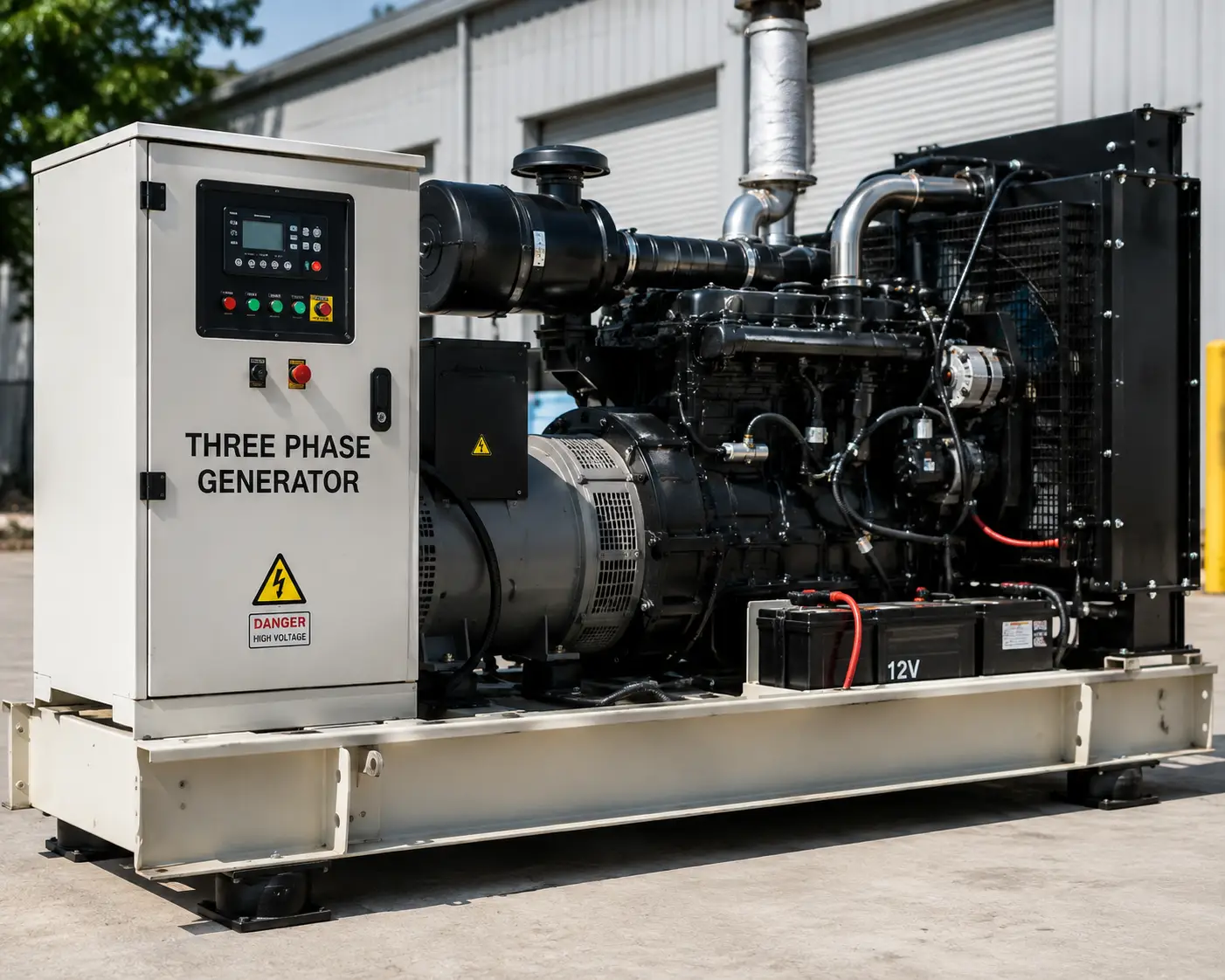
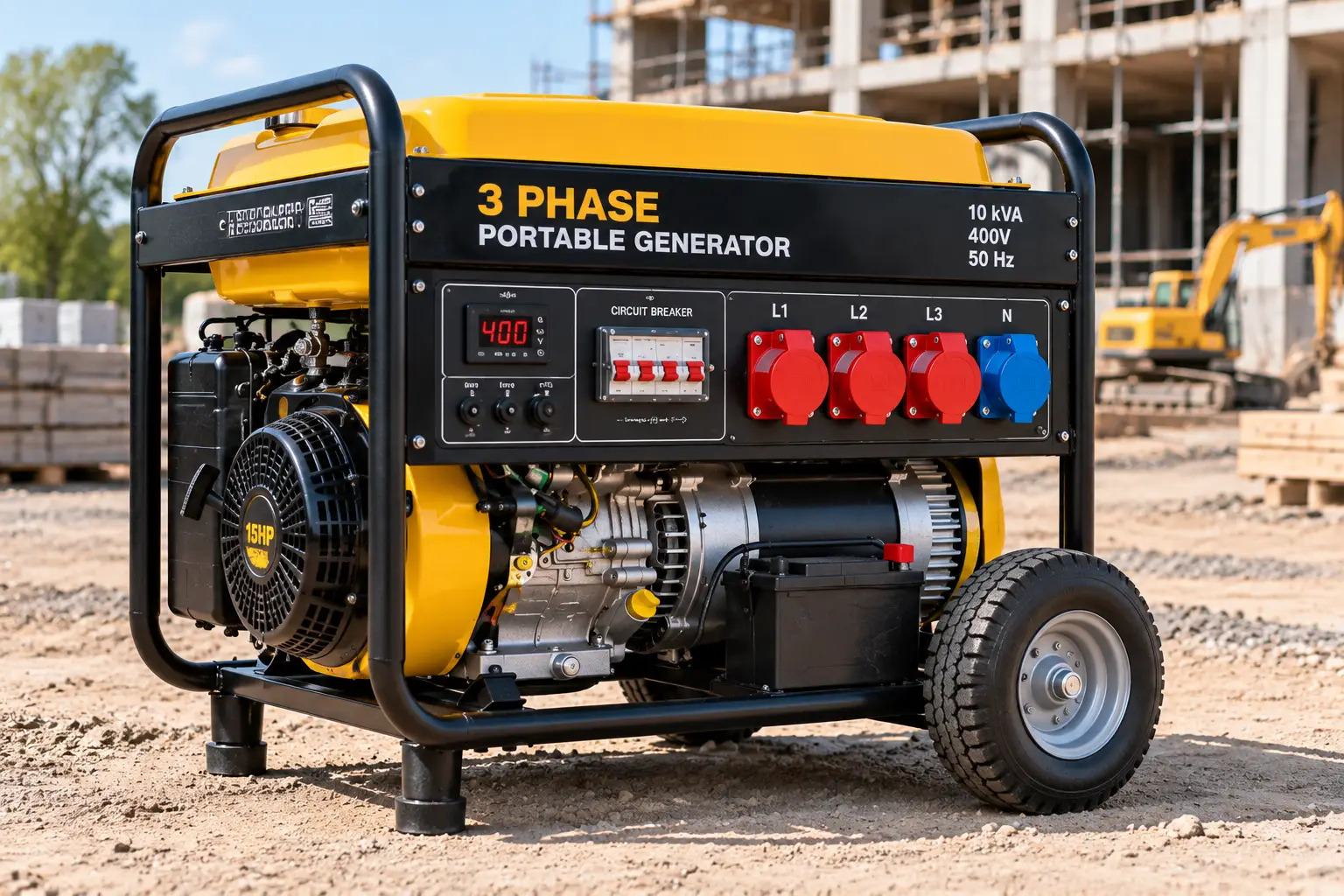
A 3 phase portable generator is a movable engine-driven generator that produces three alternating currents offset by 120 degrees, typically at 120/208V, 240V, or 277/480V in the US. That steady, overlapping power runs three-phase motors smoothly and efficiently, making it ideal for jobsites, farms, and light industrial equipment.
If you want the deep electrical background, the three-phase electric power overview on Wikipedia explains why three overlapping waves deliver constant power instead of the “pulsing” you get from single-phase. The short version for buyers: three-phase motors start easier, run cooler, and are physically smaller for the same horsepower.
Here’s the catch, though. The portable three-phase market is small, specialized, and full of traps. Many listings you’ll see online are built for 380V/50Hz overseas grids and are flat-out wrong for American equipment. Others list “dual voltage” when they mean single-phase 120/240V. And the genuinely good units — from Winco, Gillette, Makinex, and Miller — are sold mostly through industrial dealers, with Amazon availability that comes and goes through third-party sellers.
So in this guide, we’ll do the hard filtering for you. You’ll get seven real, US-voltage machines, an honest read on who each one suits, a voltage-matching framework, and the long-term cost math that dealer spec sheets conveniently skip. Let’s plug in.
Quick Comparison: The 7 Best 3 Phase Portable Generators at a Glance
| Model | 3-Phase Output (running) | Voltage | Fuel / Engine | Approx. Weight | Best for |
|---|---|---|---|---|---|
| Winco WL12000HE-04/A | 10,800 W | 120/208V | Gas / Honda GX630 | ~412 lb | Winco WL12000HE-04/A: all-around commercial jobsites |
| Winco W6010KE-04/A | 5,000 W | 120/208V | Diesel / Kohler KD440 | ~268 lb | Winco W6010KE-04/A: diesel-only fleets and long run days |
| Gillette GPE-75EH-3-2 | 5,500 W | 120/208V | Gas / Honda 13 HP | Compact frame | Gillette GPE-75EH-3-2: entry-level single machines |
| Gillette GPE-125EH-3-2 | 10 kW | 120/208V | Gas / Honda 22 HP | ~365 lb | Gillette GPE-125EH-3-2: shop and service-truck power |
| Makinex 16kW 240V Dual Phase | 15,000 W | 120/240V + 240V 3-ph | Gas / Honda GX690 | ~342 lb | Makinex 16kW 240V Dual Phase: floor grinding crews |
| Makinex 23kW 480V Dual Phase | 23 kW | 480V 3-ph + single-phase | Gas / Vanguard 40 HP EFI | ~625 lb | Makinex 23kW 480V Dual Phase: heavy 480V tools without a towable |
| Miller Bobcat 3 Phase | 10,000 W continuous | 480V 3-ph + 120/240V | Gas / Kohler 23 HP | ~495–540 lb | Miller Bobcat 3 Phase: farms needing power and a welder |
Looking at the table above, the first thing to notice is that voltage — not wattage — is the real dividing line. Four of these units output 120/208V, which matches most US commercial buildings, while the Makinex 23kW 480V Dual Phase and Miller Bobcat 3 Phase target 480V equipment like irrigation pivots and big grinders. Pick your voltage first, then narrow by wattage and fuel; doing it in the other order is how people end up with a beautiful generator that can’t run their machine.
Top 7 3 Phase Portable Generators
1. Winco WL12000HE-04/A — best all-around 120/208V workhorse
The Winco WL12000HE-04/A is the closest thing this niche has to a “default answer” for US commercial power. It delivers 12,000 starting and 10,800 running watts of 120/208V three-phase power from a Honda GX630 V-twin, with a 15-gallon tank rated for roughly 9.4 hours of runtime.
What that means in practice: 208V three-phase is exactly what most American commercial buildings use, so tools spec’d for a shop wall outlet will plug straight in. The automatic voltage regulation is rated at ±1%, which matters if you’re running motor controllers or VFD-equipped equipment that hates voltage sag. The near-full-day tank also means one fill-up covers a typical shift.
Based on comparing the specs, this is the pick for general contractors, rental fleets, and mechanical subs who need one machine that handles mixed loads. It’s also assembled and load-tested in the USA with a 3-year commercial warranty, which reduces the gamble on a five-figure purchase. Winco offers sister models (-17 for 132/230V and -18 for 277/480V) if your voltage differs.
Public owner reviews for this specific three-phase SKU are scarce; Winco’s three-phase versions are relatively new, and most feedback online concerns the single-phase WL12000HE, where owners mainly praise the scrolling meter that shows voltage, frequency, and run hours.
Pros:
- Matches standard US 120/208V commercial voltage
- Tight ±1% voltage regulation protects sensitive controls
- Long runtime from a 15-gallon tank
Cons:
- Over 400 pounds — you’ll want a dolly kit
- Few verified owner reviews for the three-phase variant
At the time of writing, expect roughly $5,200–$5,900 depending on dealer — strong value for a US-assembled commercial unit.
2. Winco W6010KE-04/A — diesel endurance in a compact frame
The Winco W6010KE-04/A brings diesel reliability to the three-phase portable class, which is rarer than you’d think. It pairs a Kohler KD440 single-cylinder diesel with a 120/208V three-phase generator end rated at 6,000 starting and 5,000 running watts (17.3 running amps).
On paper, 5,000 watts sounds modest, but diesel changes the math. A diesel engine burns less fuel per kilowatt-hour than a comparable gas engine, and diesel stores better on a truck than gasoline does — no varnish, much lower volatility. Winco also includes the NEMA L21-30 plug, which saves a frustrating trip to an electrical supply house for a connector most people don’t stock.
Here’s what to weigh: this is a fleet machine. If your crews, trucks, and fuel tanks are already diesel-only (common on utility and municipal jobs), this unit eliminates a second fuel entirely. At 268 pounds, it’s also noticeably lighter than the 10 kW gas units. It isn’t the right pick if you need more than one mid-size motor running at once.
Verified owner reviews of the three-phase diesel variant are limited; feedback on the shared Kohler KD440 platform generally centers on longevity rather than speed of startup.
Pros:
- Diesel fuel simplifies all-diesel fleets
- L21-30 plug included in the box
- Lighter than most 10 kW gas units
Cons:
- Only 5,000 running watts for the price
- Diesel premium makes it costly per watt
Dealer pricing varies widely, roughly $6,500–$9,500 — worth it only if diesel matters to you.
3. Gillette GPE-75EH-3-2 — the smart entry point
The Gillette GPE-75EH-3-2 is the most approachable way into true US-voltage three-phase power, delivering 5,500 watts at 120/208V from a 13 HP Honda engine. Gillette’s Gen-Pro line is assembled in the USA with an American-made alternator.
Why does that matter? A smaller three-phase unit is often all a single tool needs. A 3 HP three-phase motor on a saw, pump, or compressor fits comfortably within 5,500 watts once you allow for starting surge. Gillette also advertises its “Kleen-Power” approach, limiting waveform distortion to about 6% across its sets — relevant if you’re powering anything with electronics on board.
This is the generator for the owner-operator who has one three-phase machine — a tile saw, a small grinder, a well pump at a remote site — and doesn’t want to pay for a 10 kW frame. It’s also a reasonable backup unit for a shop that already has a larger machine. Electric start (with rope backup on Gillette’s Honda units) keeps it practical for occasional use.
We could not verify a meaningful volume of owner reviews for this exact SKU, so treat it as a spec-based recommendation; Gillette’s long-standing reputation comes mainly from commercial dealers rather than consumer review platforms.
Pros:
- Right-sized for a single three-phase tool
- Low waveform distortion for electronics
- USA-assembled with a trusted Honda engine
Cons:
- Too small for multiple motors at once
- Limited public reviews and pricing transparency
We couldn’t confirm a consistent street price at the time of writing; expect it below the 10 kW models — check current pricing.
4. Gillette GPE-125EH-3-2 — service-truck muscle
The Gillette GPE-125EH-3-2 steps up to 10 kW of 120/208V three-phase output (about 38 amps per leg) from a 22 HP Honda GX630, with electric start and a dimension footprint of roughly 38″ x 26″ x 29″.
In real-world terms, 10 kW of three-phase is the sweet spot for small commercial work. It can run a 5–7.5 HP three-phase motor with headroom, or two smaller motors that start at different times. At about 365 pounds, it’s lighter than the Winco equivalent, which matters when you’re lifting it onto a service body or rolling it up a ramp.
Here’s the honest comparison: this unit and the Winco WL12000HE-04/A share the same engine family and voltage, so the decision usually comes down to dealer relationships, service access in your area, and receptacle layout. Gillette suits HVAC contractors, mobile equipment repair, and shops that move power from site to site.
Owner reviews are thin; most of what’s public comes from equipment resale listings, where low-hour units hold their value well — an indirect but useful signal of durability.
Pros:
- 10 kW handles mid-size three-phase motors
- Lighter than comparable 10 kW competitors
- Strong resale value in used listings
Cons:
- New pricing is rarely published online
- Fewer accessories than Winco’s ecosystem
New pricing varies by dealer — check the current price; the resale market suggests solid long-term value.
5. Makinex 16kW 240V Dual Phase — built for concrete and flooring crews
The Makinex 16kW 240V Dual Phase is designed around a specific problem: flooring and concrete contractors who need 240V three-phase for a grinder and single-phase power for a dust extractor, at the same time. It’s rated at 15,000 watts running / 16,000 max, with 120/240V single-phase plus 240V three-phase outlets, all from a Honda GX690.
The headline isn’t the wattage — it’s the size. At around 342 pounds and roughly 30″ x 21″ x 36″, it’s compact enough to roll through doorways and into elevators. Dealers list its noise at about 72 dB with no load and 78 dB at full load (at 7 meters), and runtime around 10 hours at 50% load. It can also be paralleled with a second unit for bigger grinders.
Based on comparing the specs, this machine is a specialist. If you polish concrete, grind floors, or run high-frequency tools, it removes the “where do we find 240V three-phase in this building?” headache entirely. If you just need generic 208V power, a Winco or Gillette costs less.
Retailer and dealer demo content is plentiful, but independent consumer reviews are limited; contractor feedback in trade coverage centers on portability as the standout trait.
Pros:
- Simultaneous single- and three-phase outlets
- Fits through doorways and elevators
- Paralleling option for heavier grinders
Cons:
- 240V three-phase doesn’t suit 208V equipment
- Pricing is high and inconsistent between dealers
Expect $9,000 and up, with some listings considerably higher — check current pricing.
6. Makinex 23kW 480V Dual Phase — towable power without the trailer
The Makinex 23kW 480V Dual Phase packs 23 kW of 480V three-phase power plus separate single-phase output into a 36″ x 25″ x 36″ frame, driven by a 40 HP Briggs & Stratton Vanguard EFI engine. Makinex describes it as the smallest generator in its class, roughly a third the size of comparable towable units.
The engineering detail that matters most: the manufacturer states it can deliver its three-phase load and about 3 kW of single-phase simultaneously without the two outputs affecting each other — no frequency dips on your vacuum when the grinder bogs down. It weighs about 625 pounds assembled with a 13.2-gallon tank, so it’s “portable” in the truck-bed-with-a-ramp sense, not the carry-it-around sense.
Who’s this for? Contractors who currently rent a towable 480V generator for big grinders, fog cannons, or high-amp tools — and want something that fits through a door. Electronic fuel injection also helps with cold starts and fuel economy versus carbureted engines.
The few retailer reviews we found are positive, but there aren’t enough to call it a trend; trade publications covering its 2024 launch focused on its size-to-output ratio.
Pros:
- True 480V three-phase in a compact frame
- Independent single-phase output prevents dips
- EFI engine eases cold-weather starting
Cons:
- Around 625 pounds — needs a ramp or liftgate
- Premium price puts it in towable territory
At the time of writing, expect around $17,000 — good value only if it replaces regular towable rentals.
7. Miller Bobcat 3 Phase — farm power that also welds
The Miller Bobcat 3 Phase (model 907505) is a welder/generator with a 23 HP Kohler gas engine, delivering 11,000 watts peak and 10,000 watts continuous of 480V three-phase, plus 10,500 peak / 9,500 continuous watts of 120/240V single-phase. Both can be used at the same time.
Miller designed this specifically for farms and ranches running 480V pivot irrigation systems, milking-pump backup, and repair work. That’s the transformation: instead of buying a three-phase generator and a welder, you get Stick, MIG, flux-core, and DC TIG welding (50–225 amps) in the same box. Miller’s “Accu-Rated” claim means the peak figure is usable for at least 30 seconds, which matters for motor starting.
This is the pick for agricultural operations where a pivot motor fails at 4 p.m. on a hot July day and the same machine might fix a broken implement the next morning. It’s not for indoor contractors — it’s heavy (roughly 495–540 pounds depending on configuration) and built around a welder chassis.
The Bobcat line as a whole has a long track record and is widely seen on farm trucks and in used-equipment listings; that said, we couldn’t verify a large pool of reviews for the three-phase version specifically.
Pros:
- Welder and three-phase generator in one
- Runs 480V pivots and single-phase loads together
- Proven Bobcat platform with strong resale
Cons:
- Heavy and best mounted on a truck or trailer
- Confirm current availability; it’s an older design
Pricing ranges from around $9,500 at major welding distributors to well above that elsewhere — excellent value if you’d otherwise buy a welder too.
Detailed Comparison of the Top 7
| Model | Starting / Peak | Running | Runtime / Tank | Warranty Notes | Best for |
|---|---|---|---|---|---|
| Winco WL12000HE-04/A | 12,000 W | 10,800 W | ~9.4 hr / 15 gal | 3-yr commercial | Winco WL12000HE-04/A: mixed jobsite loads |
| Winco W6010KE-04/A | 6,000 W | 5,000 W | Diesel efficiency | 3-yr commercial | Winco W6010KE-04/A: diesel fleets |
| Gillette GPE-75EH-3-2 | — | 5,500 W | Extended-run tank | 2-yr gen / 3-yr engine (Gillette standard) | Gillette GPE-75EH-3-2: one tool |
| Gillette GPE-125EH-3-2 | — | 10 kW | Extended-run tank | Dealer-dependent | Gillette GPE-125EH-3-2: service trucks |
| Makinex 16kW 240V Dual Phase | 16,000 W | 15,000 W | ~10 hr @ 50% | 1-yr gen (dealer-stated) | Makinex 16kW 240V Dual Phase: grinders + vacs |
| Makinex 23kW 480V Dual Phase | 24.1 kW | 23 kW | 13.2 gal | 3-yr | Makinex 23kW 480V Dual Phase: 480V heavy tools |
| Miller Bobcat 3 Phase | 11,000 W | 10,000 W | 12-gal tank | Miller standard | Miller Bobcat 3 Phase: farm + welding |
This table shows that wattage alone is misleading. The Makinex 23kW 480V Dual Phase wins raw output, but the Winco WL12000HE-04/A offers the best balance of runtime, voltage compatibility, and warranty for the money. Meanwhile, the Winco W6010KE-04/A and Gillette GPE-75EH-3-2 look small, yet they’re the right answer when you only run one motor — and oversizing a generator wastes fuel and causes wet-stacking on diesels.
Don’t miss the right machine for your power needs!
Take your jobsite power to the next level with this carefully curated lineup. Click a highlighted model to check current pricing and availability. These picks will help you get reliable three-phase power that keeps your crew working instead of waiting!
Real-World Scenarios: Matching Users to the Right Generator
Specs only make sense when you attach them to a real job. Here are three common buyer profiles and the reasoning behind each match.
Profile 1: The concrete polishing contractor
You run two crews, travel to commercial buildings that are still under construction, and need power for a 240V three-phase grinder plus a dust extractor. Budget is around $10,000 per machine, and you use it four or five days a week.
Best match: Makinex 16kW 240V Dual Phase. Its simultaneous single- and three-phase outlets solve your exact problem, and it fits through doorways so you’re not running 150 feet of heavy cable from the loading dock. If you upgrade to larger grinders later, paralleling a second unit is easier than replacing the first.
Profile 2: The rancher with a pivot and a shop
You’ve got a 480V center-pivot irrigation system, occasional outages during summer storms, and constant repair work on equipment. Usage is seasonal but critical — a failed pivot during a heatwave costs crop yield.
Best match: Miller Bobcat 3 Phase. It runs your 480V pivot, backs up 120/240V barn loads at the same time, and doubles as your welder. Buying separate machines would cost more and take up twice the truck space.
Profile 3: The HVAC/mechanical subcontractor
You commission rooftop units and run 208V three-phase test equipment on sites without permanent power. You use a generator a few days per month, and budget matters.
Best match: Winco WL12000HE-04/A for full flexibility, or the Gillette GPE-75EH-3-2 if your loads are consistently small. Both match 208V commercial voltage, so what you test in the field behaves exactly like it will on building power.
The common thread? Each match starts from voltage and duty cycle, not from the biggest wattage number on the box.
Getting Started: Your First 30 Days With a Three Phase Portable Generator
A three phase portable generator isn’t hard to own, but the first month sets the tone for its entire service life. Here’s a practical roadmap.
Week 1 — Setup and verification
- Read the engine manual and the generator manual; they cover different things.
- Fill oil before the first start (many ship dry), and charge or install the battery if electric start is included.
- With no load attached, use a meter to verify voltage on each leg. On a 120/208V machine, you should see roughly 208V between legs and 120V from each leg to neutral.
Week 2 — Check rotation before connecting motors Phase rotation (the order of the three legs) determines which direction a three-phase motor spins. Run a motor briefly and confirm direction before connecting pumps or compressors — a pump spinning backward can damage seals. Swapping any two legs at the plug reverses rotation.
Week 3 — Learn your loads Start the largest motor first, then add smaller loads. Watch how the engine responds. Keep continuous load around 70–80% of the running rating for best fuel efficiency and engine life.
Week 4 — First service Most manufacturers call for an early oil change after the break-in period (often 20–25 hours — check your manual). Clean or inspect the air filter, especially on dusty concrete sites, and log hours on the meter.
Common first-month mistakes: skipping the break-in oil change, running diesels at very light loads for long periods, and using undersized extension cords that cause voltage drop at the motor.
Problem → Solution: Fixing the Most Common Three-Phase Headaches
Even good machines run into predictable issues. Here’s how to handle the five we see described most often by contractors and dealers.
1. Problem: Motor hums but won’t start. Solution: Usually a missing phase or insufficient starting surge. Check every leg’s voltage under no load, then confirm your generator’s starting watts exceed the motor’s locked-rotor demand. A 10 kW unit like the Gillette GPE-125EH-3-2 gives more surge headroom than a 5 kW machine.
2. Problem: Motor runs backward. Solution: Phase rotation is reversed. Swap any two hot legs at the plug or connection — never at a live panel — and test again.
3. Problem: One leg reads high, another low. Solution: Your single-phase loads are unbalanced. If you’re plugging lights and chargers into the 120V outlets, spread them across legs where possible. Dual-phase designs like the Makinex 16kW 240V Dual Phase handle this more gracefully because their single-phase output is separated.
4. Problem: Diesel engine smokes and leaks black residue. Solution: That’s “wet stacking” from running the Winco W6010KE-04/A or any diesel too lightly for too long. Run it under at least 50–60% load periodically to burn off deposits.
5. Problem: The plug doesn’t match the generator. Solution: Three-phase uses specific locking connectors such as NEMA L21-30 (120/208V) or L16-30 (480V). Match the receptacle on your tool to the generator before buying — or budget for a qualified electrician to make an adapter cord.
How to Choose a 3 Phase Portable Generator
Follow these seven steps in order, and you’ll avoid nearly every expensive mistake.
- Confirm your equipment’s voltage first. Read the motor nameplate: 208V, 240V, and 480V are not interchangeable, and the wrong voltage can burn out a motor or leave it underpowered.
- Total the running watts. Add up every load that will run simultaneously. Convert amps to watts for three-phase using volts × amps × 1.732 × power factor.
- Size for the largest motor start. Three-phase motors can draw several times their running current when starting, so starting watts matter as much as running watts.
- Understand kW vs. kVA. Generators are often rated in kVA; real power (kW) depends on the power factor, commonly 0.8 for generator ratings. A 12.5 kVA unit delivers about 10 kW of real power.
- Choose fuel by usage pattern. Gas for occasional use and lower upfront cost; diesel for long daily runtimes and fleet consistency.
- Check receptacles and simultaneous outputs. Make sure the outlets match your plugs and that single-phase and three-phase can run at the same time if you need both.
- Plan for weight and transport. A 600-pound generator needs a liftgate or ramp — budget for that before you buy.
That sizing formula in step 2 is where buyers most often go wrong. A 30-amp, 208V three-phase load isn’t 6,240 watts (the single-phase math); it’s closer to 10,800 VA because of the √3 factor. Do the three-phase math, and your generator will actually start your equipment.
Three Phase Portable Generator vs. Single-Phase Generator With a Phase Converter
Plenty of buyers ask: “Can’t I just buy a big single-phase generator and add a phase converter?” Technically, yes. Practically, it depends on your loads.
| Factor | True 3-phase portable generator | Single-phase generator + rotary phase converter | Best for |
|---|---|---|---|
| Motor starting | Strong, balanced | Weaker; converters derate motor HP | Winco WL12000HE-04/A: frequent motor starts |
| Voltage balance | Inherently balanced | Third leg often less stable | Makinex 23kW 480V Dual Phase: precision tools |
| Upfront cost | Higher | Often lower if you own a single-phase unit | Single-phase + converter: light, occasional use |
| Portability | One machine | Two machines to move and wire | Gillette GPE-125EH-3-2: mobile service work |
| Efficiency | Higher | Losses in the converter | Long-runtime operations |
Reading the comparison, a phase converter makes sense only if you already own a large single-phase generator and run a single small motor occasionally. For anything involving frequent motor starts, multiple motors, or electronics that dislike unbalanced voltage, a true three-phase machine wins. It’s also simpler: one machine to fuel, maintain, and secure overnight.
The hidden cost of the converter route is derating. Rotary converters typically need to be oversized relative to the motor, and the single-phase generator feeding them must be oversized again to handle the converter’s own starting demand. By the time you’ve sized both correctly, you’re often near the cost of a dedicated portable 3 phase generator — with less reliability.
120/208V vs 240V vs 480V: Matching Voltage to Your Equipment
Voltage mismatch is the most expensive mistake in this category, so it deserves its own section.
120/208V three-phase (wye)
This is standard in US commercial buildings — offices, retail, schools, light commercial. It gives you 208V between hot legs and 120V from any leg to neutral. The Winco WL12000HE-04/A, Winco W6010KE-04/A, and both Gillette models live here. If you’re testing or temporarily powering commercial building equipment, this is almost always your answer.
240V three-phase (delta)
Common in older industrial shops, some rural services, and much concrete-grinding equipment designed around 240V. The Makinex 16kW 240V Dual Phase targets this voltage. Running a 240V motor on 208V usually leaves it underpowered and running hotter, so don’t assume “close enough.”
277/480V three-phase
Used for larger industrial motors, irrigation pivots, and heavy floor-prep machines. The Makinex 23kW 480V Dual Phase and Miller Bobcat 3 Phase deliver 480V. Higher voltage means lower current for the same power, so cables can be smaller over long runs — a real advantage on big sites and fields.
The warning about 380V listings
Many low-cost “three-phase” generators sold online are built for 380V or 400V at 50Hz, the standard in Europe and Asia. US equipment runs at 60Hz. Running 60Hz motors on 50Hz power makes them spin about 17% slower and can cause overheating. Unless a listing explicitly states 60Hz and a US voltage (208, 240, or 480), skip it.
Long-Term Cost and Maintenance: Gas vs. 3 Phase Diesel Generator
Purchase price is only the first payment. Here’s how ownership costs stack up over time.
| Cost factor | Gas units (Winco WL12000HE-04/A, Gillette, Makinex) | 3 phase diesel generator (Winco W6010KE-04/A) | Best for |
|---|---|---|---|
| Upfront price per running watt | Lower | Higher | Winco WL12000HE-04/A: budget-conscious fleets |
| Fuel efficiency | Moderate | Better under steady load | Winco W6010KE-04/A: daily all-day use |
| Fuel storage | Gasoline degrades; needs stabilizer | Diesel stores longer | Diesel for remote/standby sites |
| Engine life | Good with maintenance | Typically longer | Diesel for high-hour operations |
| Light-load behavior | Fine | Risk of wet stacking | Gas for intermittent loads |
The numbers point to a simple rule: if your generator runs more than a few hundred hours per year at steady load, diesel’s efficiency and engine life start to repay the higher upfront cost. If it runs occasionally, gas wins on price and simplicity — which is why most of this list is gasoline-powered.
Routine maintenance to budget for
- Oil and filter changes: typically every 100–200 hours for gas engines after break-in; follow your engine maker’s schedule.
- Air filters: concrete dust destroys engines fast; inspect daily on grinding jobs.
- Fuel system: use stabilizer in gas units stored more than a month, or run them dry.
- Battery: electric-start units need a maintainer if stored long-term.
- Annual load test: run the generator under real load to catch problems before an emergency.
A well-maintained commercial unit can last thousands of hours. The difference between a generator that’s worth half its price at resale and one that’s scrap often comes down to oil changes and air filters.
Features That Actually Matter (and Ones That Don’t)
Generator spec sheets are crowded. Here’s how to separate the useful from the marketing.
Features that matter
- Automatic voltage regulation (AVR): Keeps voltage steady as loads change. The ±1% regulation on the Winco WL12000HE-04/A is a real advantage for motor controllers and VFDs.
- Simultaneous single- and three-phase output: Critical if you run a three-phase tool plus lights, chargers, or a vacuum. Makinex and the Miller Bobcat 3 Phase do this well.
- Correct locking receptacles: NEMA L21-30 or similar connectors prevent accidental disconnection under load.
- Hour meter: Essential for maintenance scheduling and resale value.
- Low-oil shutdown: Cheap insurance against destroying a four-figure engine.
- Low total harmonic distortion (THD): Gillette’s stated ~6% distortion limit matters for electronics.
Features that matter less
- “Peak watts” headlines: Running watts and voltage compatibility matter more.
- Fancy displays on a jobsite machine: A basic, readable meter beats a fragile screen.
- Ultra-quiet claims on commercial frames: Open-frame units are loud; plan for distance instead of trusting marketing.
- Bluetooth apps: Nice for consumer units, mostly irrelevant for commercial three-phase work.
Here’s the bottom line: buy for voltage, regulation, outlets, and serviceability. Everything else is a tiebreaker.
Safety, Regulations, and Standards
A three-phase generator produces the same deadly hazards as any portable generator — just with more power behind them.
Carbon monoxide
The U.S. Consumer Product Safety Commission’s 2022 report on generator-related CO deaths warns that a single portable generator can produce as much carbon monoxide as hundreds of cars. Never run a generator inside a building, garage, or partially enclosed space — including inside a building under construction with open doorways. Keep it well away from windows, doors, and air intakes.
Electrical safety
- Never backfeed a building. Connecting a generator to a building’s wiring without a properly installed transfer switch can electrocute utility workers. Use a licensed electrician.
- Grounding and bonding: Follow the manufacturer’s instructions and local code (NEC Article 250 and Article 445 apply to generators).
- GFCI protection: OSHA jobsite rules generally require ground-fault protection on 120V receptacles; units like the Winco models include GFCI outlets.
Emissions and certification
- EPA and CARB: Check that the engine is EPA-certified, and if you work in California, confirm CARB compliance before buying.
- Listing: Look for UL, CSA, or ETL listings when required by your jobsite or insurance carrier.
Fire safety
Refuel only with the engine off and cool. Store fuel in approved containers away from the generator’s exhaust. On grinding jobs, keep the machine clear of combustible dust buildup.
Common Mistakes to Avoid When Buying a Portable 3 Phase Generator
Even experienced contractors make these errors. Learn from them.
- Buying by wattage instead of voltage. A 23 kW generator is useless if it outputs 480V and your grinder is 240V.
- Ignoring frequency. 50Hz overseas units can damage 60Hz US motors over time.
- Using single-phase math. Forgetting the √3 factor leads to undersized generators that can’t start motors.
- Oversizing a diesel. A big diesel running a small load will wet-stack and lose efficiency.
- Forgetting the plug. Three-phase connectors aren’t stocked everywhere; confirm compatibility before the job starts.
- Underestimating weight. A 600-pound machine needs a liftgate, ramp, or forklift — plan ahead.
- Skipping dealer support. For a five-figure purchase, local service access matters as much as specs. Ask who handles warranty repairs in your area before buying.
- Trusting vague online listings. If a listing can’t clearly state voltage, frequency, and phase configuration, keep shopping.
Avoid these eight mistakes, and you’ll already be ahead of most first-time buyers in this category.
FAQs
Can a 3 phase portable generator power a house?
How much does a three phase portable generator cost?
Can I buy a 3 phase portable generator on Amazon?
What size 3 phase generator do I need for a 10 HP motor?
Is a portable 3 phase generator better than renting?
Conclusion: Picking Your 3 Phase Portable Generator With Confidence
Buying a 3 phase portable generator is less about chasing the biggest number and more about matching three things: voltage, duty cycle, and how you move the machine around.
If you need one dependable 120/208V machine for mixed commercial work, the Winco WL12000HE-04/A is the safest all-around choice. Diesel fleets will appreciate the Winco W6010KE-04/A, while single-tool users can save money with the Gillette GPE-75EH-3-2. Mobile service crews should look hard at the lighter Gillette GPE-125EH-3-2.
For specialists, the decision is even clearer. Concrete and flooring crews get exactly what they need from the Makinex 16kW 240V Dual Phase, and heavy 480V tool users can ditch towable rentals with the Makinex 23kW 480V Dual Phase. Farmers and ranchers who also weld will get the most value from the Miller Bobcat 3 Phase.
Before you buy, confirm your equipment voltage, do the three-phase sizing math, and check that your plugs match. And please treat safety seriously — the CPSC’s portable generator safety alert is worth a five-minute read before your first start-up.
Choose carefully, maintain it well, and your three-phase generator will earn its keep for years.
Ready to power up your next job?
Find the three-phase generator that fits your equipment, your crew, and your budget. Click a highlighted model above to check current pricing and availability — and get back to work with reliable power!
Recommended for You
- Solar Power to AC Outlet: 7 Best Proven Picks for 2026
- Solar Powered Outdoor Power Outlet: 7 Brilliant Picks for 2026
- Shed Solar Power Kit: 7 Best Picks That Actually Deliver (2026)
Disclaimer: This post contains affiliate links. As an Amazon Associate, I earn from qualifying purchases made through these links, at no additional cost to you.
Found this article helpful? Share it with someone who needs it!