As an Amazon Associate I earn from qualifying purchases. Links in this article may be affiliate links. How we choose gear
Why a Solar Powered Outdoor Power Outlet Beats Another Extension Cord
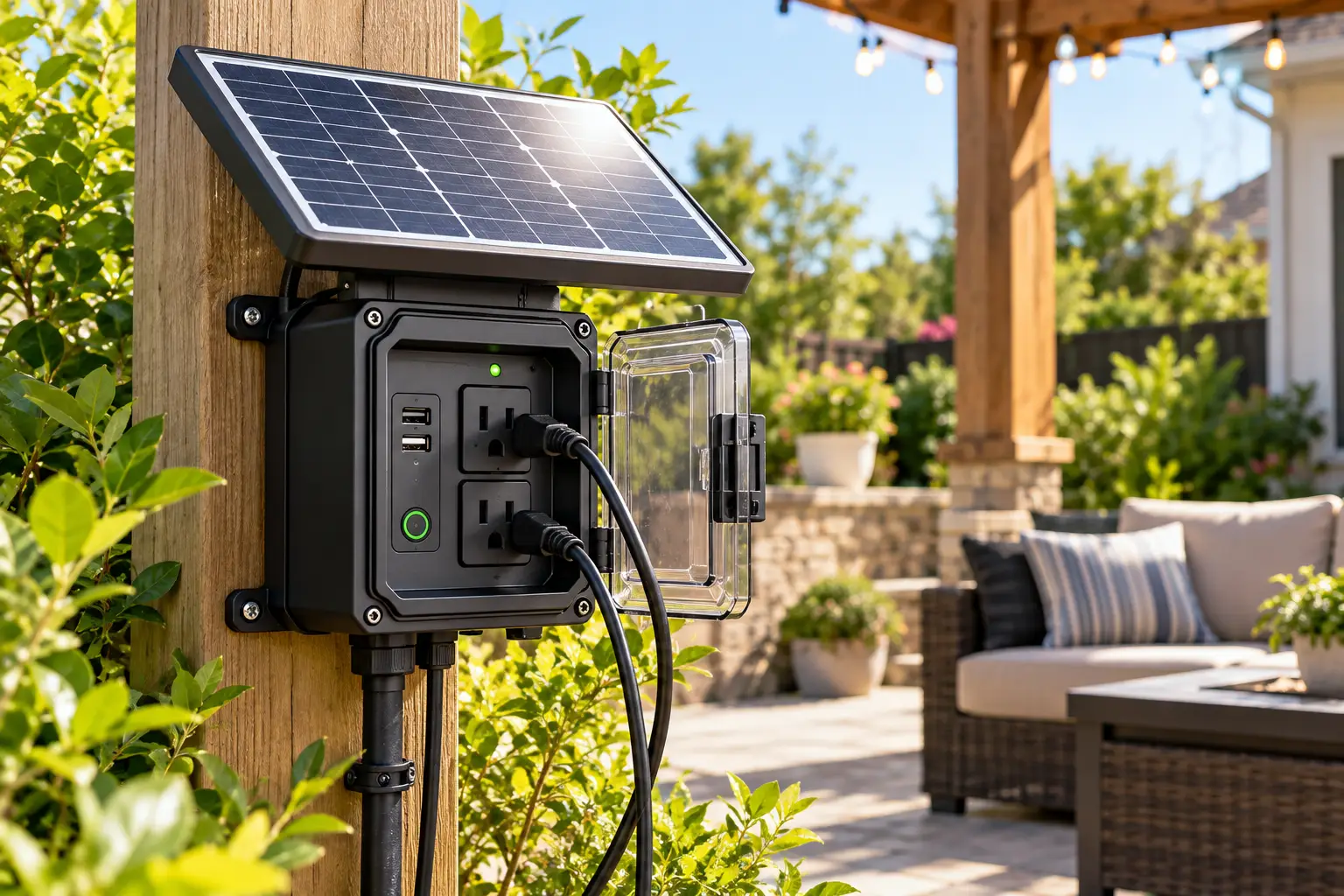
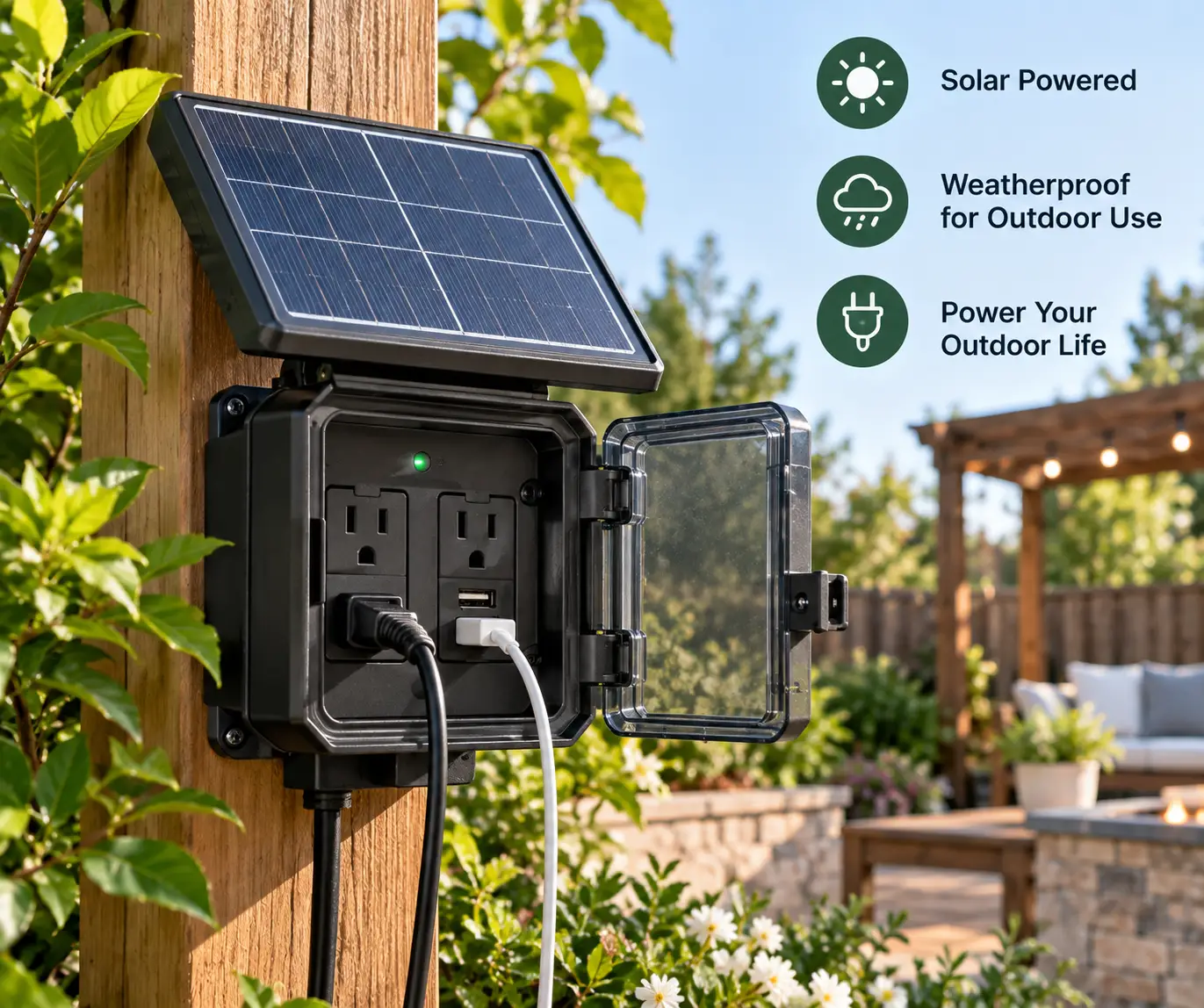
Picture it: the first warm Saturday of spring, string lights draped over the pergola, a speaker cued up, and the nearest outlet sitting 60 feet away behind the rosebushes. You can trench a new circuit, snake a heavy cord across the lawn, or skip both with a solar powered outdoor power outlet that sits exactly where you need it.
That’s the promise, anyway. The reality is a little more nuanced, and that’s what this guide is for. The market is crowded with gadgets labeled “solar outlet,” and they range from tiny panel-and-socket gizmos that die when a cloud drifts by to serious battery systems that can run a pressure washer, a mini fridge, or a backyard movie night well past midnight.
Here’s the core insight most buyers miss: the outlet is the easy part. What actually determines whether your outdoor power works at 9 p.m. is the battery behind it (measured in watt-hours), the inverter feeding it (measured in watts), and how quickly your solar panels can refill it the next day. Get those three numbers right, and the outlet simply works.
In this guide, you’ll find 7 real products available to US shoppers on Amazon, ranging from a backpack-sized starter unit to a 2 kWh powerhouse. Every pick is analyzed against its real spec sheet and the independent reviews we could verify. You’ll also get a first-30-days setup plan, user scenarios with budgets, a troubleshooting guide, a cost-of-ownership breakdown, and the US safety rules (GFCI, weather-resistant receptacles, in-use covers) that matter when power meets rain.
What Is a Solar Powered Outdoor Power Outlet?
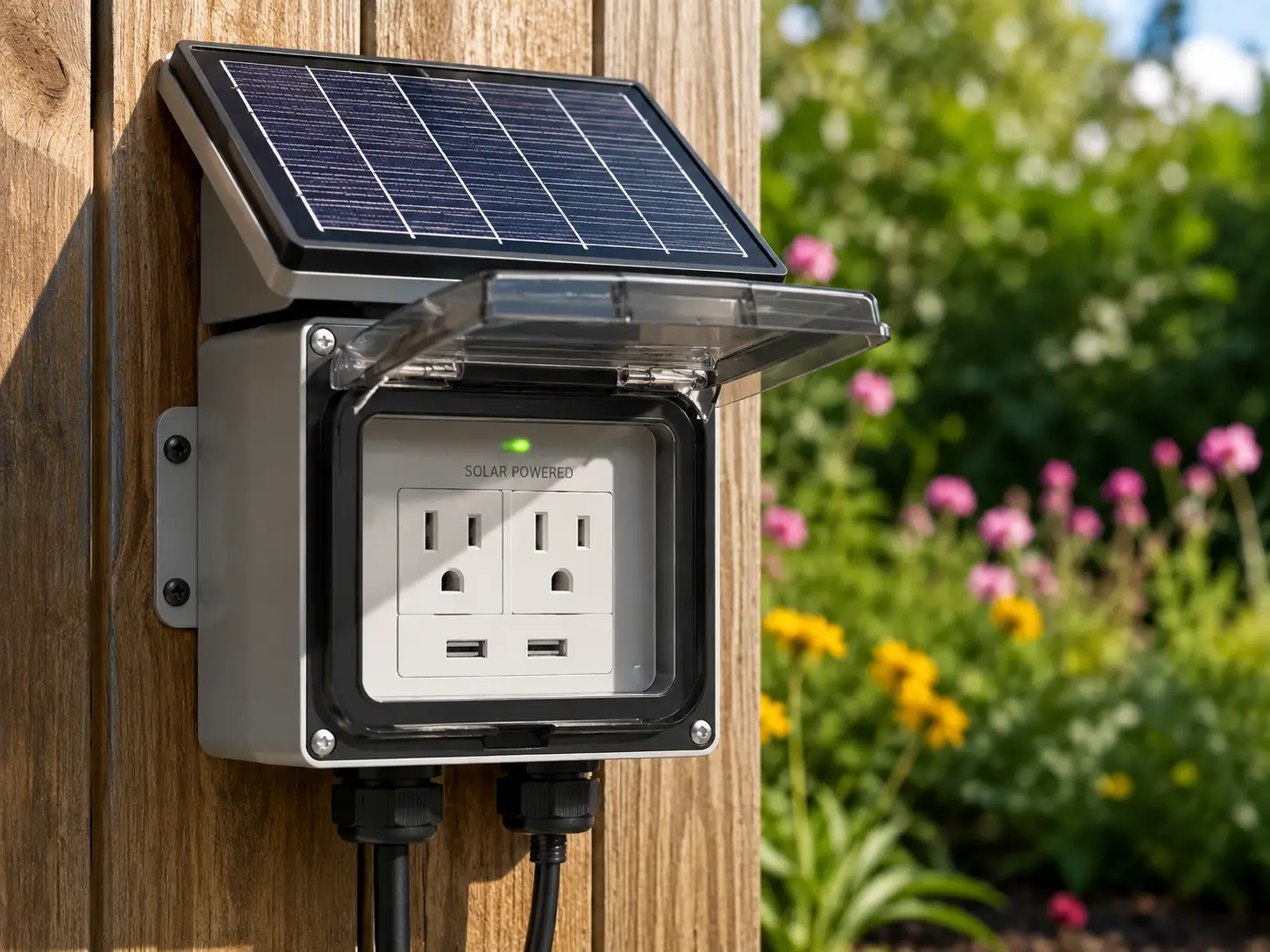
A solar powered outdoor power outlet is a self-contained power source that turns sunlight into usable household electricity outdoors. Solar panels charge a battery, an inverter converts stored DC power into 120V AC, and standard outlets let you plug in lights, tools, or appliances, with no trenching, wiring, or grid connection required.
In practice, that description covers two very different product types, and confusing them is the number one reason people end up disappointed.
Type 1: Panel-only solar outlets
These are small units where a panel feeds an inverter and a socket directly, with little or no battery. They only deliver power while the sun is shining. That makes them fine for charging a phone at the beach, but useless for evening string lights or a fountain pump that runs after sunset.
Type 2: Battery-backed solar outlets (portable power stations)
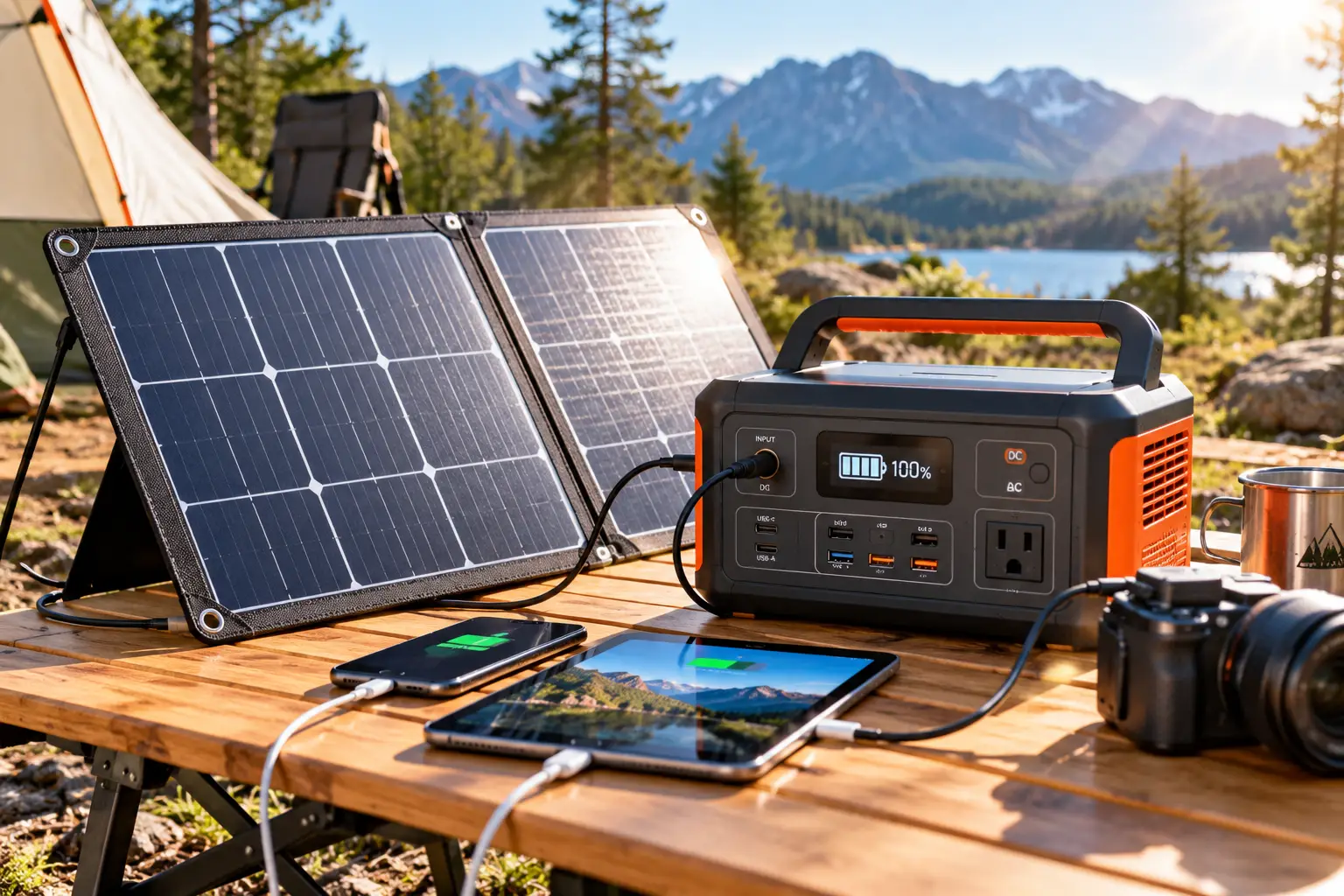
This is what most US shoppers actually need, and it’s what all 7 picks below are. A portable power station paired with a folding or fixed solar panel works as an outdoor solar power station: it stores daytime energy and releases it on demand, day or night. Most current models use lithium iron phosphate (LiFePO4) battery chemistry, which trades a bit of weight for far better cycle life and thermal stability than older lithium-ion packs. That’s the reason you’ll see claims of 3,000 to 6,000 charge cycles in the specs below.
Quick Comparison: 7 Solar Outlet Options at a Glance
Product
Battery Capacity
AC Output (Continuous)
Max Solar Input
Best For
Jackery Explorer 300 Plus
288Wh
300W
100W
Jackery Explorer 300 Plus: light loads, patios, travel
EcoFlow RIVER 3 Plus
286Wh (expandable to 858Wh)
600W
220W
EcoFlow RIVER 3 Plus: small yards that may grow
Jackery Explorer 1000 v2
1,070Wh
1,500W
Up to 400W (check listing)
Jackery Explorer 1000 v2: all-around backyard power
Anker SOLIX C1000
1,056Wh (expandable to 2,112Wh)
1,800W
600W
Anker SOLIX C1000: fast solar refills, many outlets
BLUETTI AC180
1,152Wh
1,800W
500W
BLUETTI AC180: most capacity per dollar in its class
EcoFlow DELTA 3 Plus
1,024Wh (expandable to ~5kWh)
1,800W
1,000W (2 × 500W)
EcoFlow DELTA 3 Plus: heavy solar setups, future expansion
BLUETTI Elite 200 V2
2,073.6Wh
2,600W
1,000W
BLUETTI Elite 200 V2: tools, events, long outages
Looking at the table, the real dividing line is capacity: the Jackery Explorer 300 Plus and EcoFlow RIVER 3 Plus are built for lights, fans, and electronics, while everything from the Jackery Explorer 1000 v2 upward can handle genuine appliances. Within the 1 kWh class, solar input is the hidden differentiator: the EcoFlow DELTA 3 Plus can accept far more panel wattage than the others, which matters if you want to refill a drained battery in a single afternoon. If budget per watt-hour is your priority, the BLUETTI AC180 usually delivers the most storage for the money in that tier.
Tap a highlighted product name to check today’s price and availability.
Top 7 Solar Powered Outdoor Power Outlet Picks
Each pick below was chosen from real, current spec sheets and the independent reviews we could verify, then ordered from entry-level to high-end. Runtime estimates assume roughly 85% usable energy after inverter losses, a conservative rule of thumb.
If you want a portable solar outlet you can carry one-handed to the patio, this is the smallest serious option here.
The Jackery Explorer 300 Plus packs a 288Wh LiFePO4 battery and a 300W pure sine wave inverter (600W surge) into an 8.27 lb body. In practice, 288Wh runs a 30W string of LED patio lights for about eight hours, which covers a full evening. Its solar input tops out at 100W, so even a perfectly aimed 100W panel needs roughly three to four hours of strong sun to refill it.
Based on comparing the specs, this is a lights-and-electronics machine, not an appliance runner. It suits renters, balcony gardeners, campers, and anyone who mostly charges phones, runs a fan, or powers a small speaker. A detail buyers overlook: the US version has a single AC outlet, so plan on an outdoor-rated power strip if you need several plugs. Note that it isn’t weatherproof, so it belongs under a table or eave, not in the rain.
We couldn’t verify a large pool of US customer reviews specific to this model, so weigh independent coverage instead: Pro Tool Reviews singled out its compact, roughly 11 lb solar-generator kit weight as a highlight.
Pros:
Truly portable at just over 8 pounds
LiFePO4 rated for 3,000 cycles to 80%
Two 100W USB-C ports charge laptops quickly
Cons:
Single AC outlet limits outdoor setups
Slow 100W solar input caps daily refills
Typically in the $200-$300 range for the station alone; solid value if your loads stay under 300W.
Jackery Explorer 300 PlusSee current price, sizes and reviews on Amazon.
The EcoFlow RIVER 3 Plus starts small but can triple its capacity later, which makes it a smart hedge for uncertain needs.
It pairs a 286Wh LiFePO4 battery with a 600W inverter, and EcoFlow’s X-Boost mode lets resistive devices up to 1,200W run at reduced power. What that means in practice: a small kettle or heat gun may work slowly, but motor loads beyond 600W won’t. The 220W solar input is more than double the Jackery above, so a drained unit can refill in about 1.5 hours under ideal sun. Add-on batteries push total capacity to 858Wh.
On paper, this is the best entry-level choice for a homeowner who wants a backyard plug now and longer runtime later. The sub-10 ms UPS switchover also makes it useful indoors, protecting a router or a security camera hub during outages. At 10.4 lb and under 30 dB, it disappears on a patio table.
Independent testing from StorageReview reported solid energy efficiency in its discharge and recharge tests, which supports EcoFlow’s claims. We couldn’t confirm a consistent theme from US buyer reviews, so treat that as the strongest verified signal.
Pros:
Expandable from 286Wh up to 858Wh
220W solar input refills quickly
Fast UPS switchover protects sensitive gear
Cons:
600W limit rules out most power tools
Expansion batteries add significant cost
Usually between $200 and $330 for the base unit; strong value thanks to its growth path.
EcoFlow RIVER 3 PlusSee current price, sizes and reviews on Amazon.
The Jackery Explorer 1000 v2 is the sweet spot where a solar outlet stops being a gadget and starts running real appliances.
Its 1,070Wh LiFePO4 battery and 1,500W inverter (3,000W surge) can handle a mini fridge, an electric grill, or a hedge trimmer. Rated at 4,000 cycles to 70% capacity, it could, in theory, cycle daily for a decade. Wall charging takes about 1.7 hours. Solar input is where you should read the fine print: current US listings advertise up to 400W across two inputs (about 3.8 hours with two 200W panels), but some earlier listings cited 200W.
Here’s what to weigh: Jackery’s ecosystem is simple and plug-and-play, ideal for buyers who don’t want to study connectors. Jackery notes that when you use both solar inputs, the panels must be the same model and count, which limits mix-and-match setups.
TechRadar’s review praised its silent operation and mains-like output, while flagging the 1,500W ceiling, the price, and the lack of weatherproofing. Deal-forum commenters have also criticized the solar input on listings that state 200W.
Pros:
4,000-cycle LiFePO4 rating is excellent
Runs most household essentials up to 1,500W
Simple, beginner-friendly Jackery ecosystem
Cons:
Lower 1,500W output than rivals
Not weatherproof; keep it sheltered
Often found in the $400-$600 range for the station alone; excellent value when bundled with panels.
Jackery Explorer 1000 v2See current price, sizes and reviews on Amazon.
If your outdoor setup involves many plugs at once, the Anker SOLIX C1000 removes the power-strip clutter.
It delivers 1,800W continuous (2,400W with Anker’s SurgePad mode) from a 1,056Wh LiFePO4 battery, with six AC outlets and 11 ports in total. Its 600W solar input can refill the battery in about 1.8 hours, and AC charging hits 100% in 58 minutes with UltraFast mode enabled. One practical catch: it won’t combine AC and solar charging; AC takes priority when both are connected.
Based on comparing the specs, this is the best pick for gatherings, workshops, and multi-device setups where plugs matter as much as watt-hours. The optional expansion battery doubles capacity to 2,112Wh, which turns it into a credible outage backup. At 28.44 lb, it’s portable but not something you’ll carry far.
Anker states the C1000 is certified by SGS to UL 1012, UL 1778, UL 1973, and UL 60730, a meaningful safety signal. We couldn’t verify a stable pattern in US buyer reviews for the current listing, and some retailers now carry renamed variants such as the C1000X, so confirm the exact model.
Pros:
Six AC outlets reduce extension clutter
600W solar input refills in 1.8 hours
Expandable to 2,112Wh with one battery
Cons:
Cannot charge from AC and solar together
3,000-cycle rating trails some rivals
Generally in the $400-$650 range; great value if you need many outlets.
Anker SOLIX C1000See current price, sizes and reviews on Amazon.
5. BLUETTI AC180 — most watt-hours per dollar in its class
The BLUETTI AC180 wins on raw capacity per dollar, packing 1,152Wh into a unit that often prices like a smaller one.
It offers 1,800W continuous output (2,700W in Power Lifting mode for resistive loads), four 120V outlets, a 15W wireless charging pad, and Bluetooth app control. Solar input is 500W (12-60V, 10A), which BLUETTI says refills it in roughly 2.8 to 3.5 hours. AC turbo charging reaches 80% in about 45 minutes. In practice, 1,152Wh runs a 60W fountain pump for well over 15 hours.
What the spec sheet doesn’t stress: the AC180 isn’t expandable, and at 35.3 lb it’s the heaviest of the 1 kWh group. That makes it a great fixed-location backyard power hub, but a less pleasant camping companion. The 3,500-cycle rating sits comfortably mid-pack.
Customer feedback hosted on BLUETTI’s own US store skews strongly positive, though vendor-hosted reviews deserve some skepticism. StorageReview’s field testing focused on its charging speeds and capacity and found them in line with its claims. Availability varies by region, so check that the listing is current.
Pros:
1,152Wh at a mid-tier price
Built-in wireless charging pad
Fast 1,440W turbo AC charging
Cons:
Not expandable with extra batteries
Heaviest unit in the 1 kWh class
Commonly in the $450-$650 range; the strongest capacity-for-money pick here.
BLUETTI AC180See current price, sizes and reviews on Amazon.
The EcoFlow DELTA 3 Plus is built for people who take solar seriously and want the battery full by mid-afternoon.
Its 1,024Wh LiFePO4 battery and 1,800W inverter (3,600W surge) are standard for the class, but the dual 500W solar inputs are not. With 1,000W of panels, EcoFlow rates a full charge in about 70 minutes; AC charging takes 56 minutes. It’s rated for 4,000 cycles to 80%, supports EcoFlow’s alternator charger for 800W car charging, and runs under 30 dB at 600W loads.
On paper, this is the most future-proof pick. Extra batteries expand it to roughly 4 to 5 kWh depending on the add-on you choose, and it can prioritize solar while plugged into AC to trim your utility bill. The tradeoff is cost: you’ll need a lot of panel wattage to exploit that input, and panels are rarely cheap.
StorageReview called it a thoughtful redesign of the DELTA series and noted a $649 price on EcoFlow’s site at the time of its review. We couldn’t verify a consistent theme in US buyer reviews beyond that.
Pros:
1,000W solar input across two ports
Expandable well beyond its base capacity
Quiet under moderate loads
Cons:
Needs costly panels to use full input
Higher price than similar-capacity rivals
Typically between $550 and $750; best value for solar-heavy, long-term setups.
EcoFlow DELTA 3 PlusSee current price, sizes and reviews on Amazon.
The BLUETTI Elite 200 V2 is the pick when your outdoor plans include power tools, big events, or multi-day outages.
It delivers 2,073.6Wh and 2,600W continuous output, plus a 3,900W Hercules mode for resistive loads like heaters. Solar input reaches 1,000W (12-60V, 20A), enough to refill in about 2.4 hours of ideal sun, and AC plus solar together can reach 2,400W. BLUETTI rates the cells for 6,000+ cycles to 80% and backs it with a 5-year warranty.
Here’s what to weigh: at about 53 lb, this is a wheel-it-out unit, not a carry-to-the-dock unit. It isn’t expandable, and some listings ship without a solar cable, so budget for a 20A MC4-to-XT60 cable. In exchange, you get enough capacity to run a 150W chest freezer for roughly 11 to 12 hours.
Independent reviews are notably positive. The Gadgeteer measured usable capacity above 93% of rated, and StorageReview praised its build and reliability. That’s the most verified review data of any pick here.
Pros:
2,073.6Wh and 2,600W output
6,000+ cycle rating and 5-year warranty
Verified high real-world efficiency
Cons:
Heavy at about 53 pounds
Solar cable may be sold separately
Usually in the $1,000-$1,600 range; the best long-run value for heavy users.
Don’t miss the right fit for your yard!
Take your outdoor power to the next level with this carefully curated lineup. Click a highlighted product name to check current pricing and availability. These picks will help you light, cook, and create outdoors the whole family will enjoy!
BLUETTI Elite 200 V2See current price, sizes and reviews on Amazon.
Head-to-Head: How the Top 7 Compare Beyond the Headline Specs
Product
Solar Refill (ideal sun, max input)
Rated Battery Cycles
Expandable?
Typical Price Range
Best For
Jackery Explorer 300 Plus
~3-4 hrs (est.)
3,000 to 80%
No
$200-$300
Jackery Explorer 300 Plus: balconies, camping
EcoFlow RIVER 3 Plus
~1.5 hrs
3,000 to 80%
Yes, to 858Wh
$200-$330
EcoFlow RIVER 3 Plus: starter that scales
Jackery Explorer 1000 v2
~3.8 hrs (2 × 200W)
4,000 to 70%
No
$400-$600
Jackery Explorer 1000 v2: simple all-rounder
Anker SOLIX C1000
~1.8 hrs
3,000 to 80%
Yes, to 2,112Wh
$400-$650
Anker SOLIX C1000: many plugs at once
BLUETTI AC180
~2.8-3.5 hrs
3,500+
No
$450-$650
BLUETTI AC180: capacity on a budget
EcoFlow DELTA 3 Plus
~70 min
4,000 to 80%
Yes, to ~4-5kWh
$550-$750
EcoFlow DELTA 3 Plus: solar-heavy systems
BLUETTI Elite 200 V2
~2.4 hrs
6,000+ to 80%
No
$1,000-$1,600
BLUETTI Elite 200 V2: tools and long outages
The refill column tells a story the capacity column hides: the EcoFlow DELTA 3 Plus can go from empty to full during a single lunch-hour window of strong sun, while the Jackery Explorer 1000 v2 needs most of a good day. Cycle ratings matter more than they look, too; the BLUETTI Elite 200 V2 is rated for roughly twice the cycles of the Anker SOLIX C1000, which shifts its long-term cost per kWh sharply downward. Note that refill times assume you actually own panels matching the maximum input, which most buyers don’t on day one.
Compare current prices on the highlighted picks before you decide.
Getting Started: Your First 30 Days With a Solar Outlet
A solar outlet rewards a little setup discipline. Here’s a practical plan for the first month, the part no Amazon listing walks you through.
Day 1: charge, update, and baseline. Fill the battery from a wall outlet before its first outdoor job. Install the manufacturer’s app if there is one, apply firmware updates, and note the input and output watt readings on the display. Those numbers are your best diagnostic tool from now on.
Days 2-7: find your panel’s sweet spot. In the continental US, aim panels toward the south and tilt them roughly to your latitude, then adjust while watching the input reading. A shadow from a single branch can cut output dramatically, so avoid partial shade even if it looks minor.
Days 8-14: run a real load test. Plug in exactly what you plan to use (lights, pump, speaker) and log how many percent the battery drops per hour. This turns marketing runtimes into your own numbers.
Days 15-30: build habits. Keep the station shaded and dry while the panel sits in full sun; a longer solar extension cable makes this easy. Keep plug connections off wet ground, and use only outdoor-rated cords.
Common first-month mistakes:
Leaving the station baking in direct sun or a hot car
Daisy-chaining indoor power strips outside
Mixing mismatched panels on dual-input units
Storing it at 0% for weeks between uses
For long storage, most manufacturers recommend parking the battery partway charged and topping it up every few months.
Real-World Scenarios: Matching the Right Unit to Your Yard
Numbers only matter when they meet a real routine. Here are three common US buyer profiles, each with a budget, a usage pattern, and the reasoning behind the match.
Profile 1: The weekend patio host (budget around $300-$450)
You run LED string lights (about 30W) and a Bluetooth speaker (about 10W) for five hours on Friday and Saturday nights. That’s roughly 200Wh per evening. The EcoFlow RIVER 3 Plus with a 100W-200W panel handles this comfortably, and its expansion option means a fountain pump next summer won’t force a full upgrade. If you’d rather carry it to the beach, the Jackery Explorer 300 Plus works too, with less headroom.
Profile 2: The DIY homeowner and outage-planner (budget around $700-$1,000)
You want to run a hedge trimmer, a shop vac, or an electric chainsaw away from the house, and keep a refrigerator going during a short outage. You need 1,500W+ output and about 1 kWh. The Anker SOLIX C1000 with a 200W-400W panel fits best because six outlets and the expansion battery cover both jobs. On a tighter budget, the BLUETTI AC180 gives you more watt-hours for the money.
Profile 3: The event planner, hobby farmer, or remote-shed owner (budget $1,500+)
You power tools for hours, run a chest freezer, or host outdoor events with catering gear. Choose the BLUETTI Elite 200 V2 with 400W-800W of panels. If you’d rather grow a system over years, the EcoFlow DELTA 3 Plus is the alternative, since it can accept 1,000W of solar and add batteries later.
Problem → Solution: Fixing Common Solar Outlet Headaches
Most frustrations with solar outlets trace back to a handful of predictable causes. Here’s how to diagnose them quickly.
Problem 1: “My 200W panel only shows 90W of input.” Solution: That’s often normal. Panels rarely deliver their rated wattage outside lab conditions, and heat, haze, angle, and even light shade reduce output. Re-angle the panel toward the sun every couple of hours, clean the surface, and check that cables are fully seated.
Problem 2: “The unit shuts off the moment my saw or compressor starts.” Solution: Motors draw a startup surge well above their running wattage. Check the tool’s rating against the station’s surge spec. The Jackery Explorer 300 Plus and EcoFlow RIVER 3 Plus are not tool runners; the 1,800W-plus models are.
Problem 3: “My lights die before midnight.” Solution: Do the math: add up watts × hours for everything plugged in, then compare it with about 85% of the battery’s rated watt-hours. Use a plug-in outdoor timer, switch to lower-wattage LED strings, or step up in capacity.
Problem 4: “It won’t charge on cold mornings.” Solution: LiFePO4 batteries typically won’t charge near or below freezing; Jackery, for example, lists a charging range starting at 32°F for the Jackery Explorer 300 Plus. Bring the unit into a garage overnight and let it warm before solar charging.
Problem 5: “My connected cords keep tripping or arcing in the rain.” Solution: Water is the problem, not the solar. Elevate connections, use outdoor-rated cords with covered connectors, and keep the station itself under shelter, since none of these units is designed for exposed, rain-soaked use.
How to Choose a Solar Powered Outdoor Power Outlet
Choosing a solar powered outdoor power outlet comes down to seven decisions, made in this order:
List your loads and add up watt-hours. Multiply each device’s watts by its hours of use per day. This single number decides your battery size more than any marketing claim.
Check continuous and surge output. Your inverter must exceed the sum of everything running at once, and motors need surge headroom. A 1,200W circular saw on a 600W unit simply won’t start.
Match solar input to your sun and patience. Higher input means faster refills, but only if you buy enough panels. Look for a high-efficiency maximum power point tracking (MPPT) charge controller, which squeezes the most power out of panels as light conditions shift.
Prefer LiFePO4 chemistry. It’s now standard in this market for a reason: thousands of cycles and better thermal stability.
Count outlets and their types. Six AC plugs beat one plug plus a power strip, especially outdoors where every extra connection is a moisture risk.
Weigh weight against wheels. Anything over about 30 lb becomes a stay-put unit for most people.
Think about expansion. If your needs may grow, an expandable unit avoids buying twice.
Solar Outlet vs. Hardwired GFCI Outlet vs. Gas Generator
A solar outlet isn’t the only way to get power into the yard, so it’s worth comparing it honestly with the two traditional alternatives.
Option
Upfront Cost
Works in an Outage
Noise and Emissions
Installation
Best For
Solar outlet (power station + panel)
Roughly $250 to $2,000+
✅ Yes, until the battery runs low
Silent, no fumes
None; set it and plug in
EcoFlow RIVER 3 Plus to BLUETTI Elite 200 V2, depending on loads
Hardwired outdoor GFCI outlet
Varies widely with distance and trenching
❌ No
Silent
Licensed electrician, often a permit
Permanent, heavy, everyday use near the house
Gas portable generator
Often lower per watt
✅ Yes, while fueled
Loud, produces carbon monoxide
Fuel storage and outdoor placement
Long outages with very high loads
The table shows the real tradeoff: a hardwired outlet is unbeatable for heavy daily use near the house, but it adds nothing during an outage and requires permitted work, including GFCI protection and weather-resistant gear the IAEI explains in its guide to outdoor receptacles. Gas generators win on raw power but bring noise, fuel, and serious carbon monoxide risk. For most backyards, a solar outlet covers the middle ground, and units such as the Anker SOLIX C1000 or BLUETTI AC180 can even double as indoor backup.
Features That Actually Matter (and Ones That Don’t)
Marketing pages list dozens of features. Only a few change your daily experience.
Features that matter
Pure sine wave output. Every pick here has it, and it protects sensitive electronics, motors, and LED drivers from buzzing or failure.
Rated cycle life. A 6,000-cycle rating like the BLUETTI Elite 200 V2‘s versus a 3,000-cycle rating changes long-term value dramatically.
UPS or fast switchover. The sub-10 ms switchover on the EcoFlow RIVER 3 Plus means a router or camera hub won’t reboot during a blip.
Safety certifications. Third-party UL testing, like the certifications Anker lists for the Anker SOLIX C1000, is a meaningful signal.
Features that matter less than you think
Peak “boost” wattage for resistive loads. X-Boost, Power Lifting, and Hercules modes are useful for heaters and kettles but won’t help motors start.
Wireless charging pads. Handy, but a USB-C cable does the same job.
Fancy app dashboards. Nice to have; a clear front display matters more outdoors.
Solar Outlet for Outdoor Lights: Holiday and Landscape Setups
Lighting is the most common reason people shop for a solar outlet for outdoor lights, and it’s also where small units shine.
Modern LED strings are remarkably efficient. A typical run of LED holiday or patio lights might draw anywhere from about 5W to 50W, depending on length and bulb count. That means even the Jackery Explorer 300 Plus can run a modest display all evening, and the EcoFlow RIVER 3 Plus can run several strands.
Here’s the planning trick most guides skip: winter is the hardest season for holiday lighting off solar. Days are shorter, the sun sits lower, and panels produce much less. If you’re powering a December display, oversize your panel relative to summer needs and angle it more steeply toward the low sun.
Three practical tips:
Use a plug-in outdoor timer so lights shut off at midnight automatically.
Keep the station under a covered porch or a weatherproof box with ventilation, never in standing snow.
Choose lights rated for outdoor use, and route connections so water drains away from plugs.
For landscape lighting, low-voltage systems usually run through a transformer that plugs into a standard outlet; check the transformer’s wattage against your station’s continuous output before committing.
Long-Term Cost and Maintenance
The sticker price is only half the story. A useful way to compare is the theoretical cost per kilowatt-hour over the battery’s rated life.
Product
Price Midpoint Used
Capacity
Rated Cycles
Theoretical Cost per Lifetime kWh
Best For
Jackery Explorer 300 Plus
$250
288Wh
3,000
~$0.29
Jackery Explorer 300 Plus: light, occasional use
EcoFlow RIVER 3 Plus
$265
286Wh
3,000
~$0.31
EcoFlow RIVER 3 Plus: entry with upgrade path
Jackery Explorer 1000 v2
$500
1,070Wh
4,000
~$0.12
Jackery Explorer 1000 v2: frequent mid use
Anker SOLIX C1000
$525
1,056Wh
3,000
~$0.17
Anker SOLIX C1000: multi-device users
BLUETTI AC180
$550
1,152Wh
3,500
~$0.14
BLUETTI AC180: budget capacity
EcoFlow DELTA 3 Plus
$650
1,024Wh
4,000
~$0.16
EcoFlow DELTA 3 Plus: solar-heavy setups
BLUETTI Elite 200 V2
$1,300
2,073.6Wh
6,000
~$0.10
BLUETTI Elite 200 V2: daily heavy use
This is rough math (price ÷ capacity ÷ cycles), and nobody actually cycles a battery fully every day for 16 years, so treat it as a ceiling on value rather than a promise. Still, the pattern is clear: the BLUETTI Elite 200 V2 and Jackery Explorer 1000 v2 become the cheapest storage over time, while small units cost more per kWh because their fixed electronics are spread across less capacity. Compare those figures with the per-kWh rate on your own utility bill for perspective.
Maintenance is refreshingly light: wipe panels clean, inspect cables and connectors seasonally, store the battery partly charged in a cool, dry place, and top it up every few months.
Safety, Regulations, and Standards
Solar outlets remove the combustion risk, but electricity outdoors still demands respect. Here’s what applies in the US.
The electrical code for fixed outlets. The National Electrical Code (NEC), adopted by most states, requires GFCI protection for outdoor dwelling receptacles and listed weather-resistant (“WR”) receptacles in damp and wet locations, plus extra-duty “in-use” covers where plugs stay connected in wet locations. These rules govern hardwired outlets, not your power station, but they show what safe outdoor power looks like.
What that means for a portable unit. Most power stations don’t have GFCI-protected outlets. In wet areas, consider a portable GFCI adapter or cord between the station and your devices, and keep the station itself sheltered.
Never backfeed your house. Plugging a power station into a home outlet to “power the house” is dangerous for you and utility workers. Use a manufacturer-approved transfer switch or home-backup kit installed by a licensed electrician.
Why solar beats gas for safety. The US Consumer Product Safety Commission estimates that about 85 consumers die each year from carbon monoxide poisoning linked to portable generators, and its report and safety campaign on generator CO fatalities is worth a read. A battery-based solar outlet produces no exhaust, so it can sit near a patio or even indoors.
Look for certifications. UL listings or third-party testing to UL standards, plus FCC compliance, indicate the unit was evaluated for safety and interference.
Common Mistakes to Avoid When Buying a Solar Outlet
Even well-informed buyers stumble on the same pitfalls. Avoid these and you’ll be happier long after unboxing.
Buying watts when you needed watt-hours. A 1,800W unit with 1 kWh runs a 1,500W heater for well under an hour. Capacity sets runtime; output sets what can start.
Ignoring panel costs. A station with 1,000W of solar input is only as fast as the panels you actually buy, and panels can approach the station’s own price.
Expecting rain resistance. None of these units is built to sit exposed in a downpour. Budget for shelter.
Skipping the connector check. Panels use different plugs (MC4, XT60, DC8020). The BLUETTI Elite 200 V2, for instance, may need a separate cable.
Overbuying. A 53 lb, 2 kWh unit is overkill for patio lights; the EcoFlow RIVER 3 Plus may serve better.
Trusting “on sale” urgency. Prices in this category swing constantly. Compare current listings and bundle contents carefully before you buy.
FAQ: Solar Powered Outdoor Power Outlet Questions Buyers Ask
Can a solar powered outdoor power outlet run a refrigerator?
Yes, if you choose a 1 kWh-class unit or larger. A typical fridge needs roughly 1,000W of surge headroom and steady capacity, so models like the Anker SOLIX C1000 or BLUETTI AC180 fit, while 300W units don't.
How many solar panels do I need for an outdoor solar power station?
Start with enough panel wattage to replace one day's energy use in about five good sun hours. For a 1 kWh unit, 200W-400W is a practical start, then add panels up to the station's maximum input.
Is a power station and solar panel bundle worth buying?
Often, yes. Bundles guarantee compatible connectors and are frequently priced below buying separately. Still, compare the bundled panel's wattage with the station's solar input, since a small panel can bottleneck a fast-charging unit.
Can I leave a solar outlet outside year-round?
The panel, usually; the station, no. None of the picks here is built for rain exposure, and LiFePO4 batteries dislike freezing charging conditions. Keep the station sheltered, ventilated, and dry, and bring it in during winter.
Do solar outlets work on cloudy days?
The battery keeps working regardless of weather, but recharging slows sharply under clouds. Panels may produce only a fraction of their rating, so size your battery to cover a cloudy day or two, or top up from the wall.
Conclusion: Bring Power to Every Corner of Your Yard
A solar powered outdoor power outlet is no longer a novelty gadget; in 2026, it’s a practical, silent alternative to trenching new circuits or wrestling a gas generator. The key is to shop by watt-hours, output, and solar input rather than by the word “solar” on the box.
If you mostly need lights and electronics, the Jackery Explorer 300 Plus is the most portable entry point, and the EcoFlow RIVER 3 Plus gives you a starter unit that can grow. For true backyard versatility, the Jackery Explorer 1000 v2 keeps things simple, the Anker SOLIX C1000 handles crowds of devices, and the BLUETTI AC180 stretches your budget furthest. Solar enthusiasts should look hard at the EcoFlow DELTA 3 Plus and its 1,000W input, while the BLUETTI Elite 200 V2 is the long-term workhorse for tools, events, and extended outages.
Whichever you choose, do the watt-hour math first, budget for panels and cables, keep the station dry, and treat outdoor electricity with the same respect the electrical code does. Get those basics right, and you’ll have quiet, clean power wherever the party, project, or storm takes you.
Ready to power your outdoor space?
Take your backyard to the next level with this carefully curated lineup. Click a highlighted product name to check current pricing and availability. These picks will help you light up evenings, run your tools, and stay powered through outages the whole family will appreciate!
Disclaimer: This post contains affiliate links. As an Amazon Associate, I earn from qualifying purchases made through these links, at no additional cost to you.
Found this article helpful? Share it with someone who needs it!