As an Amazon Associate I earn from qualifying purchases. Links in this article may be affiliate links. How we choose gear
Why a Mini Solar Module Belongs in Your Toolkit
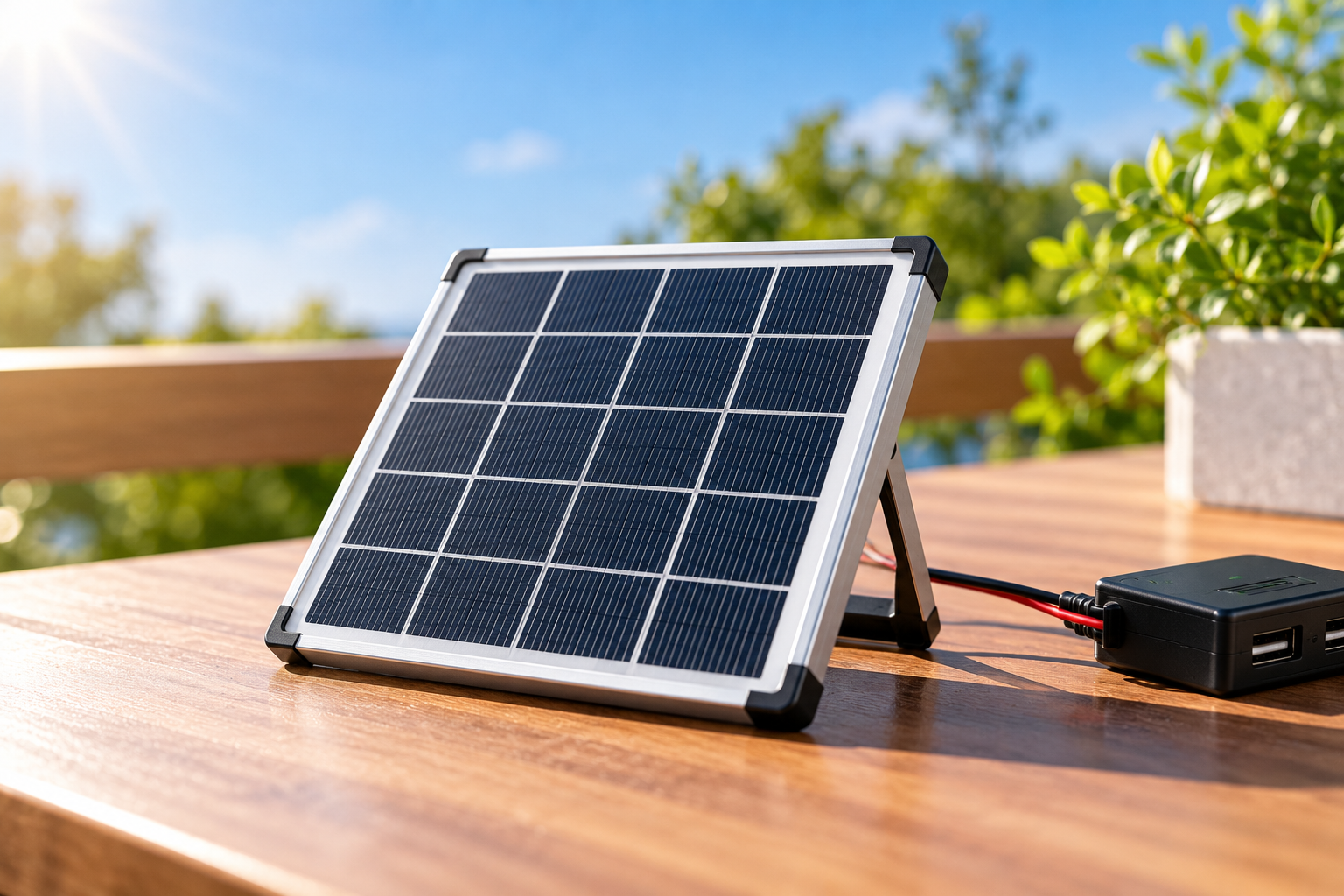
A mini solar module is one of those small purchases that quietly solves annoying problems. The dead battery in the lawn tractor every April. The trail camera that dies two weeks into hunting season. The science-fair project that needs “real” power instead of a wall adapter. A palm-sized panel, aimed at the sun, can handle all three — if you pick the right one.
And that “if” is where most buyers stumble. The mini solar module category on amazon.com is a jumble of very different products sharing the same search results: bare 6V epoxy cells meant for soldering, USB panels that plug straight into a phone, and 12V framed modules built to trickle-charge car and boat batteries. They look alike in thumbnails. They behave nothing alike in your driveway.
So this guide does the sorting for you. We compared spec sheets, manufacturer datasheets, and the recurring themes in real customer reviews for seven mini solar module options across three price tiers, from a sub-$15 DIY multipack to a 20W kit with its own charge controller. No product here gets a pass on marketing claims — where the spec sheet and user feedback disagree, you’ll hear about it.
You’ll also get the practical stuff Amazon listings skip: how to estimate real daily output, how to avoid frying a battery, which mistakes kill small panels in their first month, and when a mini solar panel is simply the wrong tool. By the end, you should know exactly which module fits your project — and which ones to scroll past.
What Is a Mini Solar Module?
A mini solar module is a small photovoltaic panel, usually rated somewhere between 0.3 and 20 watts, that converts sunlight into low-voltage DC electricity. It’s designed to power or charge small devices — sensors, USB gadgets, cameras, and 12V batteries — rather than a home or RV.
Under the hood, it works exactly like a rooftop array, just shrunk down. Individual silicon cells are wired together to reach a useful voltage (commonly 5V, 6V, or 12V nominal), sealed under glass, epoxy, PET, or ETFE, and given some kind of output: solder pads, a DC jack, a USB port, or battery clips. If you want a plain-English primer on the physics, the U.S. Department of Energy’s overview of how solar works is a solid, jargon-light starting point.
The important thing to understand is the wattage scale. A 1W small solar module produces roughly a fiftieth of what a single standard home panel does. That’s not a flaw — it’s the point. Small loads need small panels, and a correctly sized mini solar module can run indefinitely without anyone touching it.
Here’s the rough breakdown by class:
0.3–2W (DIY/micro): sensors, microcontrollers, solar garden lights, school projects.
5–10W (USB): phones, power banks, USB fans, security cameras.
Quick Comparison: Mini Solar Module Picks at a Glance
Product
Power / Voltage
Output Type
Approx. Price Range
Best for
Eujgoov 6V 1W Mini Solar Panel (3-pack)
1W / 6V each
Bare leads
Under $15
Eujgoov 6V 1W Mini Solar Panel — classroom and budget DIY
Voltaic Systems P124 6V 1.2W
1.22W / 6V
Solder pads
$15–$25
Voltaic Systems P124 6V 1.2W — long-life outdoor electronics
FlexSolar 6W USB Mini Solar Panel
6W / 5V
USB-A
$15–$25
FlexSolar 6W USB Mini Solar Panel — USB fans and cameras
FlexSolar E10 10W Foldable Charger
10W / 5V USB
USB-A
$20–$35
FlexSolar E10 10W Foldable Charger — hiking and phone top-ups
Renogy RNG-10D-SS 10W
10W / 12V nominal
Junction box leads
$30–$50
Renogy RNG-10D-SS 10W — custom 12V builds
SUNER POWER 12W Pro
12W / 12V
SAE + clips, built-in MPPT
$50–$80
SUNER POWER 12W Pro — set-and-forget battery maintenance
SOLPERK 20W Solar Panel Kit
20W / 12V
Controller + clips
$40–$60
SOLPERK 20W Solar Panel Kit — larger batteries, more margin
Looking at the table, the real dividing line isn’t price — it’s output type. The Eujgoov 6V 1W Mini Solar Panel and Voltaic Systems P124 6V 1.2W need a charging circuit you supply, the two FlexSolar panels plug straight into USB devices, and the Renogy RNG-10D-SS 10W, SUNER POWER 12W Pro, and SOLPERK 20W Solar Panel Kit are aimed at 12V batteries. Decide what you’re powering first, and your shortlist shrinks from seven to two or three in seconds.
If you just want to see a motor spin or an LED glow from sunlight, the Eujgoov 6V 1W Mini Solar Panel is about as low-risk as it gets. You get three polycrystalline epoxy panels in one pack, each pre-wired with a roughly 30cm (12-inch) cable.
That pre-attached cable matters more than it sounds: tiny epoxy panels with bare solder tabs are fiddly, and beginners often crack them with a too-hot iron. Three identical units also let you experiment with series wiring (two in series gives about 12V) and parallel wiring (more current at 6V) — the single most useful lesson in small-scale solar.
On paper, this is a teaching and tinkering tool, not a dependable charger. Polycrystalline cells under epoxy are less efficient than monocrystalline cells under ETFE, and epoxy can yellow after long sun exposure, slowly reducing output. Use it for prototypes, science projects, and solar toys.
Customer reviews consistently describe these as no-frills panels that are ready to wire into your own circuit, but several buyers note the output is too weak to meaningfully charge something like an 18650 lithium cell, and at least one reported a loose wire on a unit.
Pros:
Three panels per pack for series and parallel experiments
Pre-attached leads spare beginners from delicate soldering
Very low cost per panel
Cons:
Too little power for practical battery charging
Quality control varies from unit to unit
Usually priced under $15 for the pack — excellent value for learning, poor value if you expected a real charger.
Eujgoov 6V 1W Mini Solar PanelSee current price, sizes and reviews on Amazon.
The Voltaic Systems P124 6V 1.2W is what you pick when a tiny panel needs to survive on a fence post for years instead of months. It’s an engineering-grade module rather than a hobby toy.
Its monocrystalline cells are rated at 22%+ efficiency, mounted to a 1.5mm PCB and sealed under a matte ETFE coating. In practice, ETFE resists UV yellowing and scratches far better than epoxy, which is why Voltaic designs it for a 5–7 year outdoor life. The datasheet lists 7.09V open-circuit, 6.07V at peak power, and about 200mA peak current — numbers that line up neatly with charging a single-cell (1S) lithium-ion or LiFePO4 battery through a proper solar charger IC.
Based on comparing the specs, this is the right choice for remote sensors, weather stations, LoRa nodes, and Arduino or ESP32 projects. At just 66 x 113 x 2.6mm and 31.6 grams, it disappears onto an enclosure lid. The trade-off: you’ll solder to pads, so it assumes some electronics comfort.
Retailer listings and maker-community feedback consistently praise its build quality and accurate ratings; a verified, large pool of Amazon reviews specifically for the P124 was not available to us, so judge it on its well-documented specs.
Pros:
ETFE coating built for multi-year outdoor exposure
Published, realistic electrical specs
Thin and light enough for compact enclosures
Cons:
Requires soldering and a separate charge circuit
Amazon availability fluctuates; check before planning around it
Typically in the $15–$25 range where stocked — pricier per watt, but cheaper than replacing a yellowed epoxy panel twice.
Voltaic Systems P124 6V 1.2WSee current price, sizes and reviews on Amazon.
The FlexSolar 6W USB Mini Solar Panel skips the soldering entirely: plug a USB device in, point the panel at the sun, done. It’s the easiest bridge between “solar curious” and “solar useful.”
The panel (model FLS-6W) weighs about 230 grams, measures roughly 10.7 x 6.9 inches, and carries an IP67 rating, with a 5V USB output rated around 1A. In real terms, that’s enough to run a small USB fan directly, keep a USB-powered security camera topped up, or slowly charge a phone in strong sun. Listings advertise monocrystalline cells at around 20–24% efficiency depending on the variant.
Who’s it for? Campers, gardeners, and anyone with USB-powered outdoor cameras. Interestingly, review themes show a lot of buyers swap out the stock panels on their security cameras for this one — a sign it holds up well in continuous outdoor use.
Reviews consistently praise it for powering USB fans under canopies and running cameras reliably, while a common complaint is that output drops sharply without full, direct sunlight, and that it has no mount of its own.
Pros:
Direct USB output — no electronics knowledge needed
IP67 build handles rain and dust
Light enough to clip to a backpack or tent
Cons:
Output falls off quickly in shade or haze
No adjustable mount included for camera installs
Usually $15–$25 — strong value for a no-fuss USB panel.
FlexSolar 6W USB Mini Solar PanelSee current price, sizes and reviews on Amazon.
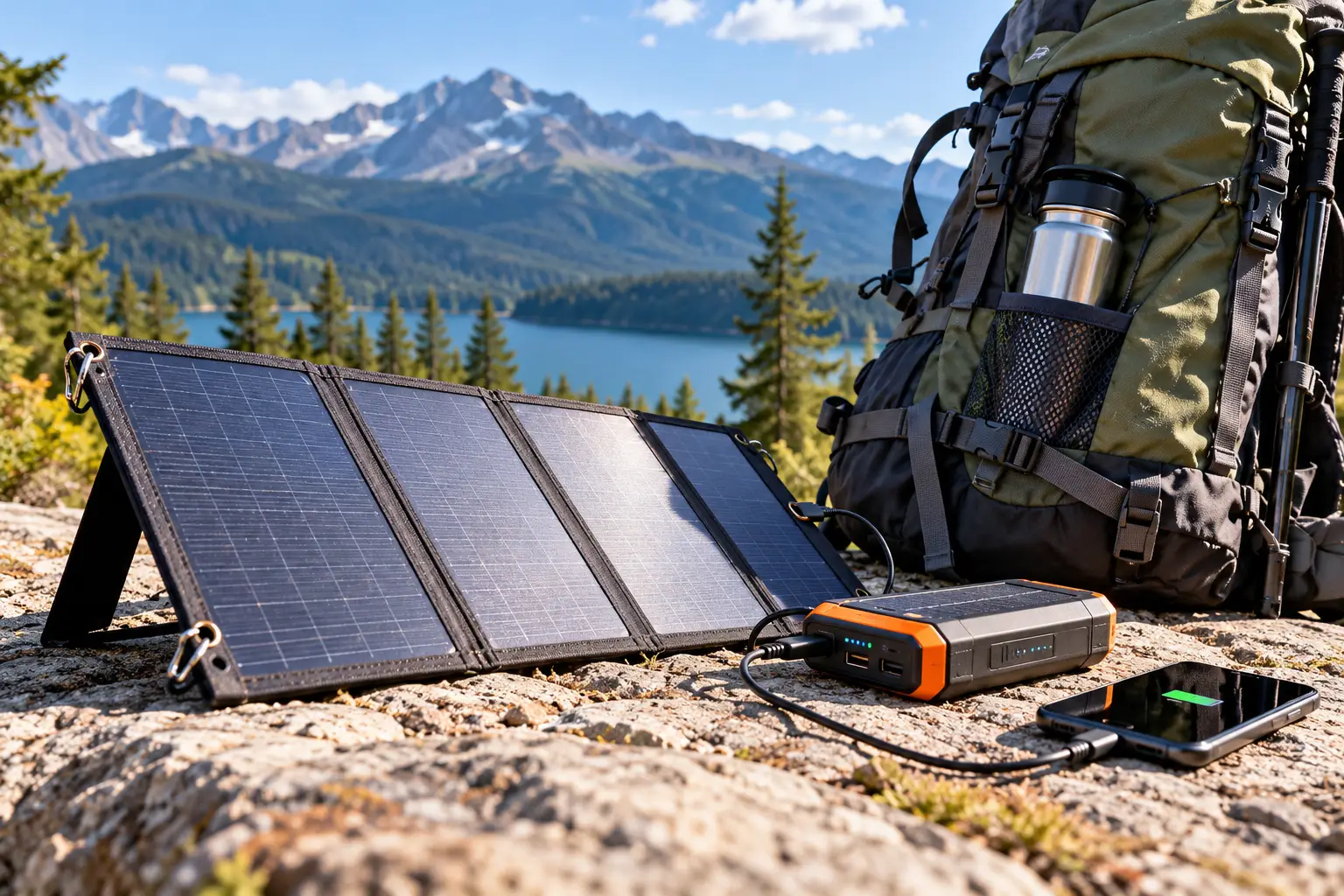
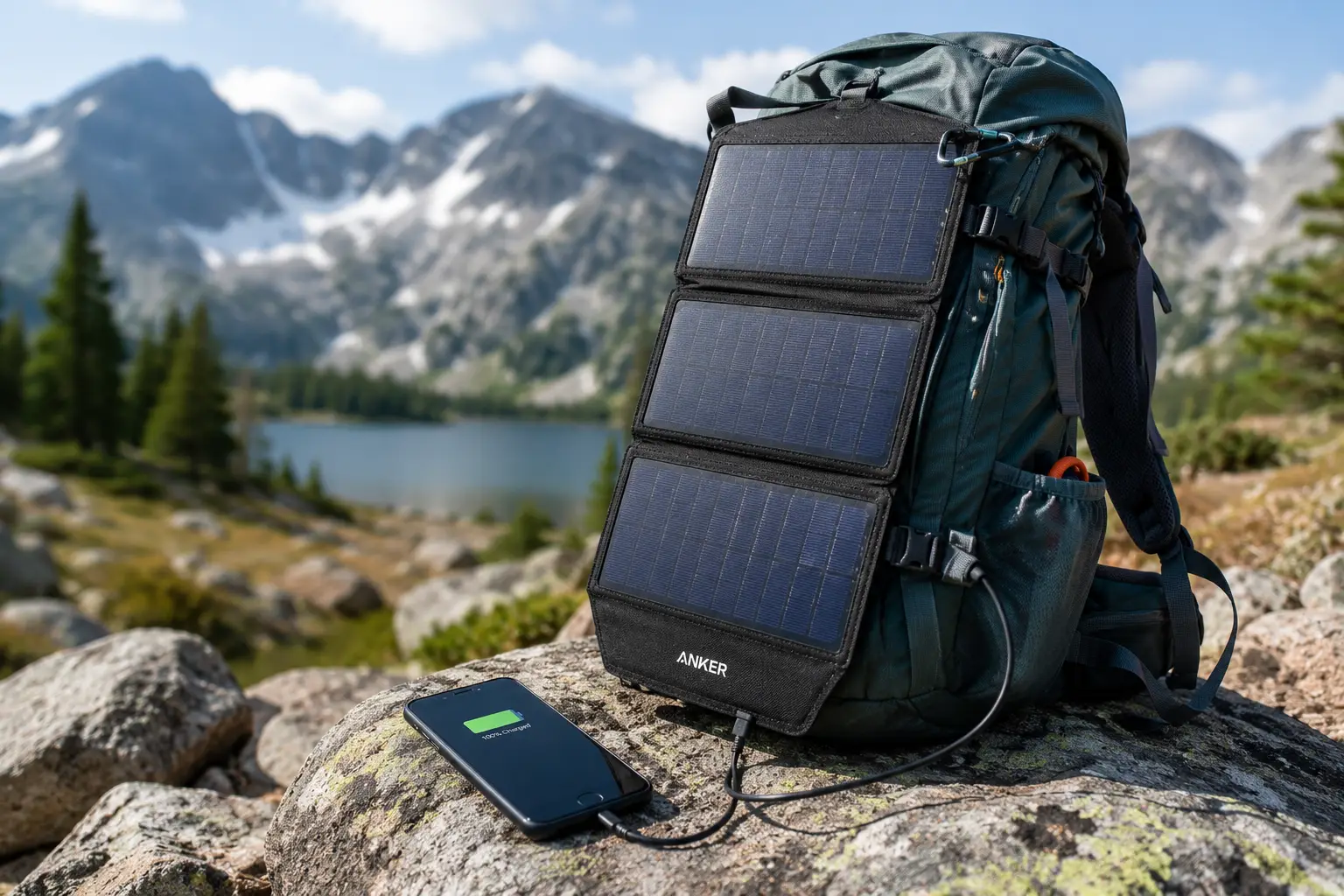
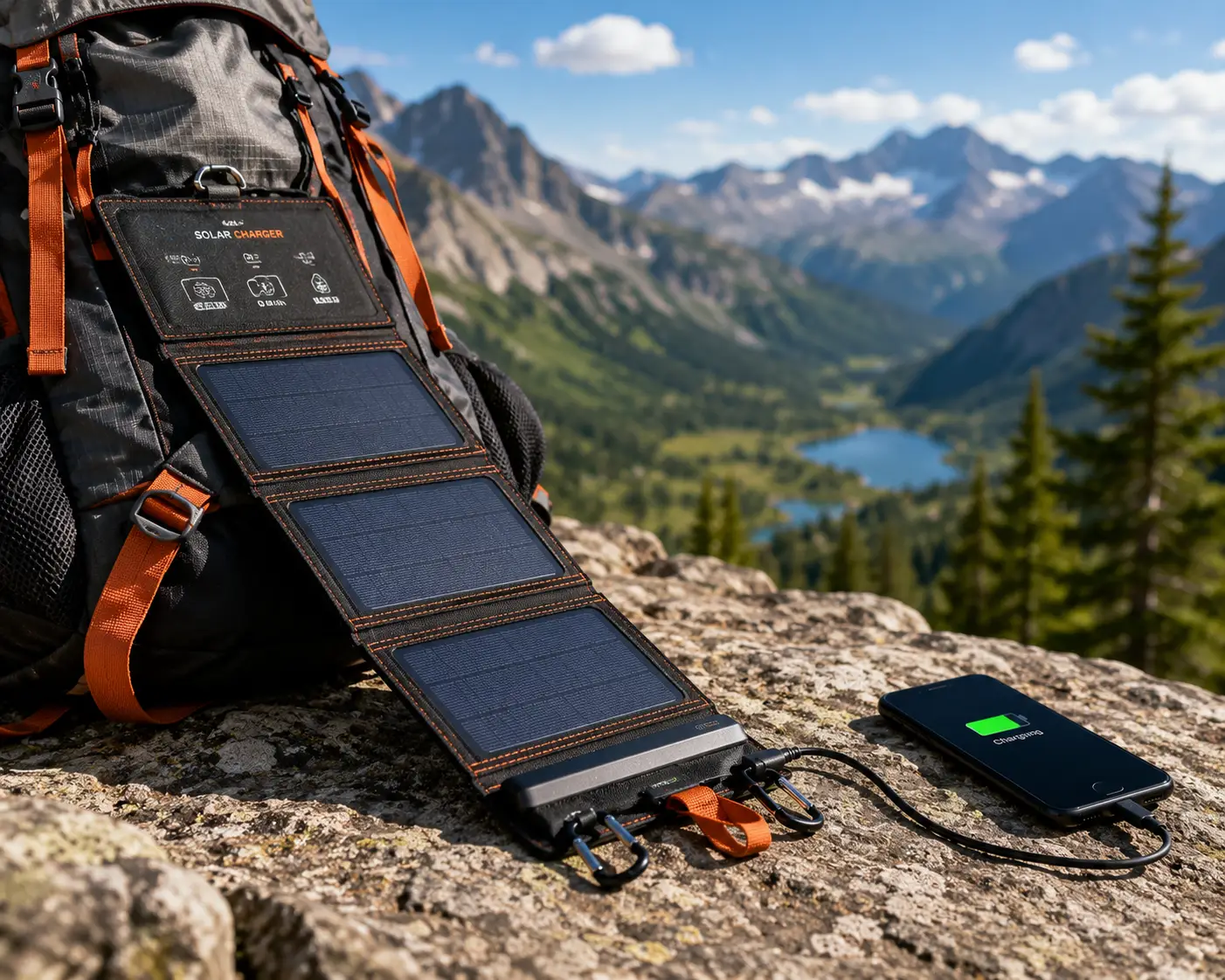
The FlexSolar E10 10W Foldable Charger doubles the USB panel’s surface area while folding down to roughly tablet size. It’s the trail-friendly pick.
Unfolded, it spans about 15.5 x 8.8 inches; folded, it’s roughly 7.6 x 8.8 x 0.7 inches and weighs about 10.6 ounces. The USB-A port is rated 5V/2A, and an auto-restart feature means charging resumes when a cloud passes — a genuinely useful detail, since cheaper panels often “forget” the connected device and stop until you replug it. FlexSolar’s own estimates put a phone at about 1.5 hours and a 10,000mAh power bank at about 5.5 hours in direct sun.
What the spec sheet doesn’t stress: the IP67 rating covers the panel laminate, but the USB port and junction box should stay out of water. Our honest read is that its best use is charging a power bank during the day, then charging your phone from the bank at night — that avoids the stop-start charging phones dislike.
Deal-community comments and reviews generally like the low weight and packability, while repeatedly reminding buyers that “only 10W” means patient charging, not wall-outlet speed.
Pros:
Folds compact with carabiners for pack mounting
Auto-restart handles passing clouds
Very light for a 10W panel
Cons:
Single USB-A port, no USB-C on this model
Port area isn’t waterproof
Typically $20–$35 at the time of writing — a fair price for its weight class.
FlexSolar E10 10W Foldable ChargerSee current price, sizes and reviews on Amazon.
The Renogy RNG-10D-SS 10W is a miniature version of a full-size rooftop panel: aluminum frame, tempered glass, junction box, and a real datasheet. It’s the builder’s choice.
Its 32 monocrystalline cells deliver 17.5V at peak power (0.57A) and 21.6V open-circuit. That voltage headroom is exactly what a 12V battery charger needs. The IP65 junction box, bypass diode, and pre-drilled frame holes make mounting straightforward, and Renogy rates its ideal output around 40Wh per day depending on sunlight. Translation: enough to offset parasitic drain on a vehicle battery or run a small 12V sensor setup.
Here’s what to weigh: this is a panel only. You must add a charge controller — connecting 21.6V straight to a battery for weeks invites overcharging. At 10.6 x 13.4 x 1.0 inches and about 2.65 lbs, it’s also no backpack item. The warranty is a standout: 25 years on power output and 5 years on materials and workmanship.
Reviews consistently describe it as well built and sturdy, with users powering things like wireless weather stations; several mention it measures “hot,” meaning voltage meets or exceeds expectations.
Pros:
Rigid glass-and-aluminum build with long warranty
Honest, detailed electrical datasheet
Pre-drilled holes simplify permanent mounting
Cons:
Controller and cabling sold separately
Heavier and bulkier than USB-style panels
Usually $30–$50 — very good value for anyone comfortable adding their own controller.
Renogy RNG-10D-SS 10WSee current price, sizes and reviews on Amazon.
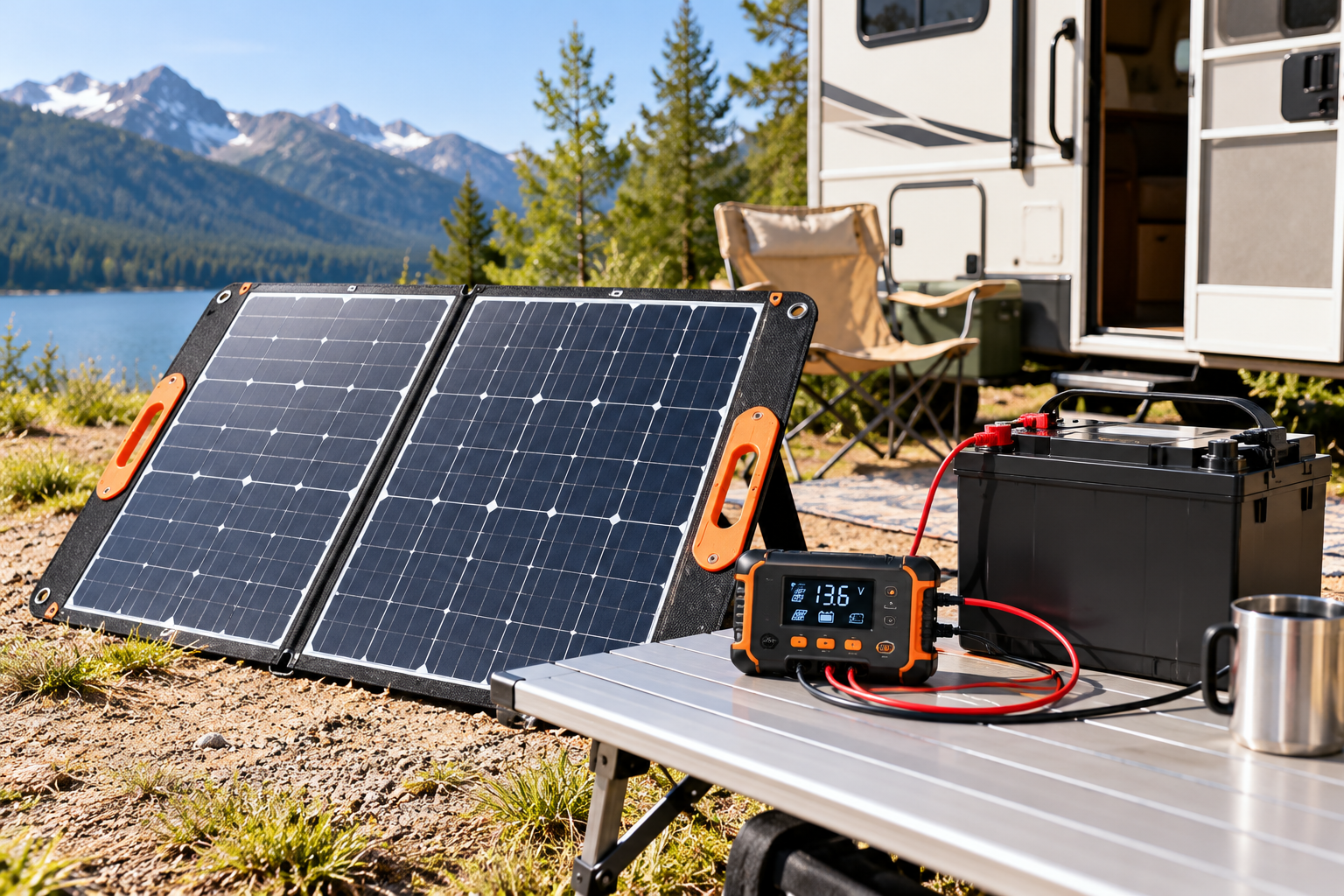
The SUNER POWER 12W Pro packages a panel and an MPPT charge controller into one sealed unit. You connect it to a 12V battery and, ideally, never think about it again.
The built-in “UltraSmart” MPPT controller runs a three-stage algorithm (bulk, absorption, float) and supports flooded, AGM, gel, and LiFePO4 batteries. Charge-level indicators show 25/50/75/100%, and the unit stops charging when the battery is full, then resumes as it drains. The 99% tracking-efficiency figure is a manufacturer claim; the practical benefit of MPPT on a panel this small is real but modest — call it a meaningful bump on cold, bright days rather than a miracle.
Based on comparing the specs, this is the best fit for seasonal vehicles: boats on trailers, motorcycles, RVs in storage, and dump trailers. The integrated design eliminates the classic beginner error of wiring a controller backward.
Reviews are generally positive about long-term battery maintenance, and a notable recurring theme is that the unit must be in sunlight even to detect the battery — something that confused at least one buyer until SUNER’s support team, praised as responsive, walked them through it.
Pros:
Built-in MPPT controller with three-stage charging
Supports lithium (LiFePO4) and lead-acid batteries
Clear state-of-charge indicators
Cons:
Pricier per watt than panel-only options
Battery detection requires sunlight, which confuses first-time users
Generally $50–$80 — worth it if you value integrated protection over DIY flexibility.
SUNER POWER 12W ProSee current price, sizes and reviews on Amazon.
The SOLPERK 20W Solar Panel Kit gives you twice the wattage of most mini options, plus a separate controller, adjustable bracket, and alligator clips — the “maintain a bigger battery” pick.
The panel uses monocrystalline cells under tempered glass, and the kit’s 8A controller provides overcharge and short-circuit protection with indicator lights. The 20W rating translates to roughly 1.1–1.2A of charging current in strong sun, which is a far more comfortable margin for larger deep-cycle batteries, lawn tractors that sit for weeks, or setups that also run a small load.
Our honest analysis: the panel is the strong half of this kit. The controller is rated far above what a 20W panel can deliver, which is fine, but review evidence suggests controller quality can vary. If you already own a decent PWM or MPPT controller, the panel alone is a good buy.
Reviews generally praise the panel’s build and its ability to keep tractors and boats charged, while one detailed review found the bundled controller delivered noticeably less current than a Renogy controller — the seller replaced the unit.
Pros:
Double the wattage of 10W competitors
Adjustable bracket for seasonal tilt changes
Complete kit with clips and controller
Cons:
Bundled controller quality is inconsistent in reviews
Larger footprint than true “mini” panels
Typically $40–$60 — the best watts-per-dollar here if you can tolerate a possible controller swap.
Don’t miss these smart solar picks!
Power your projects the clever way with this carefully curated lineup. Click a highlighted product to check current pricing and availability — and keep your batteries, gadgets, and gear charged by the sun all year long!
SOLPERK 20W Solar Panel KitSee current price, sizes and reviews on Amazon.
Mini Solar Module for DIY Projects: A Getting-Started Guide
Buying a mini solar module for DIY projects is the easy part; the first 30 days decide whether it becomes a working build or a drawer item. Here’s a practical sequence.
Step 1 — Measure before you build. Put your panel in full midday sun and check its open-circuit voltage and short-circuit current with a basic multimeter. Budget 6V 1W epoxy panels often measure below their label — one buyer of a generic 1W unit measured roughly 0.86W in ideal conditions. Knowing your real number prevents you from designing around a fantasy.
Step 2 — Never connect a panel straight to a lithium cell. A 6V panel can push well above a lithium cell’s safe 4.2V. Use a dedicated solar charger board (TP4056-style modules work for basic builds; MPPT boards are better) between the Voltaic Systems P124 6V 1.2W or Eujgoov 6V 1W Mini Solar Panel and the battery.
Step 3 — Add a blocking diode if your circuit lacks one. At night, some circuits let current leak back through the panel. A Schottky diode stops it with minimal voltage loss.
Step 4 — Wire for the job. Series raises voltage; parallel raises current. Two 6V panels in series give a 12V-class string; two in parallel give double the current at 6V.
Step 5 — Seal your connections. Most DIY failures in the first month are corrosion at solder joints, not the panel itself. Heat-shrink tubing plus a dab of silicone goes a long way.
Common first-month mistakes: mounting flat (rain pools, dust settles), shading one corner with a wire, and testing indoors under LED bulbs — which produce almost nothing a panel can use.
Real-World Scenarios: Matching a Small Solar Module to Your Life
Specs only make sense in context. Here are three realistic profiles and the small solar module that suits each.
Profile 1: The weekend boater (budget ~$50–$80)
A boat owner keeps a 12V AGM battery in a bass boat that sits on a trailer from Monday to Friday. Parasitic drain from the fish finder memory and bilge float switch slowly flattens the battery. They want zero tinkering.
Best match: the SUNER POWER 12W Pro. The integrated MPPT controller handles AGM charging stages, the indicators tell her the state of charge at a glance, and there’s no separate controller to wire wrong. Twelve watts comfortably outpaces typical small parasitic draws on sunny weeks.
Profile 2: The maker with a garden weather station (budget ~$20–$40)
Dev runs an ESP32 sensor node that wakes every 10 minutes, reads temperature and humidity, and transmits over Wi-Fi. Average consumption is tiny, but it must survive Midwest winters.
Best match: the Voltaic Systems P124 6V 1.2W paired with a single-cell LiFePO4 battery and a solar charge IC. ETFE durability matters more than raw wattage here — the panel will spend years outdoors.
Profile 3: The hiker and camper (budget ~$20–$35)
Jordan does three-day backpacking trips and needs to keep a phone and headlamp charged. Weight counts.
Best match: the FlexSolar E10 10W Foldable Charger, used to fill a 10,000mAh power bank during midday breaks. At around 10.6 ounces, it earns its spot in the pack. If Jordan also runs a USB fan at a car campsite, the FlexSolar 6W USB Mini Solar Panel is a cheap second panel.
Problem → Solution: Fixing Common Mini Solar Panel Headaches
Even a good mini solar panel can seem “broken” when the real culprit is setup. Here are the problems that show up most in reviews, with fixes.
Problem 1: “My phone keeps stopping and restarting.”Solution: Phones dislike fluctuating current. Charge a power bank from the panel instead, then charge the phone from the bank. The FlexSolar E10 10W Foldable Charger‘s auto-restart helps, but buffering through a bank is the reliable fix.
Problem 2: “The maintainer won’t detect my battery.”Solution: Units like the SUNER POWER 12W Pro need sunlight on the panel to power the controller’s detection circuit. Connect the battery in daylight, and check the battery isn’t so deeply discharged that it’s below the controller’s minimum voltage.
Problem 3: “Output is way below the rating.”Solution: Ratings are measured under lab conditions — 1,000 W/m² of light at 25°C. Real-world output is often 60–80% of the label. Tilt the panel toward the sun, keep it cool, and clean the surface.
Problem 4: “The bundled controller seems weak.”Solution: Measure charging current with a clamp meter or inline USB/DC meter. If it’s well under what the panel should produce — as one SOLPERK 20W Solar Panel Kit reviewer found — contact the seller or swap in a known-good controller.
Problem 5: “My DIY panel turned yellow.”Solution: That’s UV degradation of the epoxy, common in budget panels like the Eujgoov 6V 1W Mini Solar Panel. For permanent outdoor installs, step up to ETFE or tempered glass.
How to Choose a Mini Solar Module
Choosing a mini solar module comes down to seven decisions, in this order:
Identify the load. USB device, 12V battery, or a custom circuit? This single choice eliminates more than half the market.
Estimate daily energy. Multiply panel watts × local peak sun hours × about 0.7 for real-world losses. A 10W panel in a 4-sun-hour location yields roughly 28Wh per day.
Match the voltage. A 12V battery needs a panel with roughly 17–18V at peak power, like the Renogy RNG-10D-SS 10W; a 1S lithium cell needs a 5–6V panel.
Decide on charge control. Panel-only modules require a separate controller; integrated units like the SUNER POWER 12W Pro don’t.
Pick the surface material. ETFE and tempered glass last; PET and epoxy cost less but age faster.
Check the IP rating. IP67 handles temporary immersion; IP65 handles rain jets. Ports and junction boxes may carry lower protection.
Plan the mount. Tilt, orientation, and shade-free placement matter more than an extra two watts.
For step 2, NREL’s free PVWatts Calculator lets you look up solar resource for your ZIP code — it’s built for larger systems, but the location data is just as useful for sizing a small solar module.
Mini Solar Panel 12V vs USB Mini Solar Panel: Which Fits Your Job?
This is the most common fork in the road, so let’s take it slowly.
A mini solar panel 12V setup is built around a battery. Panels like the Renogy RNG-10D-SS 10W produce around 17–18V at peak power so they can push current into a 12V battery even when it’s warm or partially charged. That’s why they always need a controller (separate or built in) to keep the battery from overcharging. The payoff is storage: your battery holds the energy for night, cloudy days, and loads that run 24/7.
A USB mini solar panel, like the FlexSolar 6W USB Mini Solar Panel, has built-in regulation that delivers 5V directly to a device. There’s no battery management because the device’s own charging circuit handles that. It’s simpler and lighter, but it’s live-only: when the sun dips, power stops.
How do both compare to the traditional alternatives — disposable batteries or a plug-in trickle charger?
Option
Upfront Cost
Ongoing Cost
Works Off-Grid
Best for
USB mini solar panel (e.g., FlexSolar 6W USB Mini Solar Panel)
Low
None
Yes
FlexSolar 6W USB Mini Solar Panel — cameras, fans, phones
Mini solar panel 12V (e.g., SUNER POWER 12W Pro)
Moderate
None
Yes
SUNER POWER 12W Pro — stored vehicles and boats
Disposable batteries
Very low
Recurring
Yes
Rarely used gadgets
Plug-in trickle charger
Low–moderate
Small electric cost
No
Garages with an outlet
The table makes the trade-off clear: if an outlet is within reach, a plug-in maintainer is hard to beat, but the moment the vehicle or device lives off-grid, solar wins on ongoing cost. Disposable batteries look cheapest at checkout but become the most expensive option for anything that runs continuously.
Mini Solar Module Specs Compared Side by Side
Product
Cell / Surface
Peak Voltage
Weather Rating
Controller
Best for
Eujgoov 6V 1W Mini Solar Panel
Poly / epoxy
~6V
Weather-resistant (not rated)
None
Eujgoov 6V 1W Mini Solar Panel — prototypes
Voltaic Systems P124 6V 1.2W
Mono / ETFE
6.07V
IP67
None
Voltaic Systems P124 6V 1.2W — remote sensors
FlexSolar 6W USB Mini Solar Panel
Mono / PET
5V USB
IP67
Built-in regulator
FlexSolar 6W USB Mini Solar Panel — fixed USB loads
Reading across the rows, surface material and controller type predict long-term satisfaction better than wattage. The Voltaic Systems P124 6V 1.2W and Renogy RNG-10D-SS 10W stand out for durability-to-price, while the SUNER POWER 12W Pro is the only option here that combines a sealed panel with MPPT in one housing. If you plan to leave a panel outdoors for years, avoid epoxy-surfaced modules for anything mission-critical.
Features That Actually Matter (and Ones That Don’t)
Small solar is full of big claims. Here’s where to focus.
Features that matter
Peak-power voltage (Vmp), not just watts. A panel with the wrong voltage won’t charge your battery efficiently, no matter its wattage. Check Vmp against your battery or device.
Surface material. ETFE and tempered glass resist UV and scratches; PET and epoxy degrade faster. This decides whether your panel lasts two summers or seven.
Charge control. For any battery, a controller is non-negotiable. Integrated designs like the SUNER POWER 12W Pro reduce wiring errors.
Real datasheets. Brands that publish Voc, Isc, Vmp, and Imp — like Renogy and Voltaic — tend to rate their panels honestly.
Features that matter less than marketing suggests
“Up to 30% efficiency.” Commercial monocrystalline cells typically land in the low-to-mid 20s. Higher efficiency mostly means a smaller panel for the same watts, not more energy.
MPPT on tiny panels.Maximum power point tracking genuinely extracts more energy, but on a 1–10W panel the absolute gain is a watt or two at best. Worth having on a maintainer; not worth overpaying for on a micro panel.
“8A controller” ratings on a 20W kit. A 20W panel can’t produce anywhere near 8A at 12V. The rating describes controller headroom, not charging speed.
Common Mistakes to Avoid When Buying a Mini Solar Module
Most disappointment with a mini solar module comes from a handful of predictable errors.
Mistake 1: Buying by wattage alone. A 10W USB panel and a 10W 12V panel are not interchangeable. The FlexSolar E10 10W Foldable Charger cannot charge a car battery, and the Renogy RNG-10D-SS 10W cannot plug into a phone.
Mistake 2: Expecting a small panel to revive a dead battery. Maintainers maintain. A 12W panel delivers well under one amp; recharging a deeply drained 100Ah battery would take weeks. Charge it fully with a mains charger first, then let solar hold it there.
Mistake 3: Skipping the controller. Connecting a panel-only module directly to a battery works — until it overcharges. Budget for a controller up front if you choose the Renogy RNG-10D-SS 10W.
Mistake 4: Ignoring winter sun. Peak sun hours in northern states can drop by half or more in December. Size for your worst month, not July.
Mistake 5: Mounting behind glass. Windshields and windows, especially tinted or low-E glass, cut output substantially. Dash-mounted panels underperform almost every time.
Mistake 6: Trusting deal-site “sale” banners. Prices on small solar gear swing constantly through coupons and codes. Compare current prices across a couple of weeks before deciding.
Long-Term Cost and Value of a Mini Solar Module
A mini solar module has almost no running cost, so value comes down to lifespan and what it replaces.
Product
Approx. Price Range
Expected Outdoor Life
Value Verdict
Best for
Eujgoov 6V 1W Mini Solar Panel
Under $15
Short (epoxy)
Cheap to learn on
Eujgoov 6V 1W Mini Solar Panel — short-term projects
Voltaic Systems P124 6V 1.2W
$15–$25
5–7 years (rated)
High per year
Voltaic Systems P124 6V 1.2W — permanent installs
Renogy RNG-10D-SS 10W
$30–$50 + controller
Long (25-yr output warranty)
Highest long-term
Renogy RNG-10D-SS 10W — multi-year 12V use
SUNER POWER 12W Pro
$50–$80
Multi-year
Good if it saves a battery
SUNER POWER 12W Pro — seasonal vehicles
The math gets interesting when you factor in what a dead battery costs. A replacement marine or powersport battery typically runs well over $100, and repeated deep discharges shorten battery life. If a SUNER POWER 12W Pro or Renogy RNG-10D-SS 10W setup saves even one premature battery replacement, it has paid for itself. For DIY micro panels, the cheapest option isn’t always the most economical: replacing a yellowed Eujgoov 6V 1W Mini Solar Panel every year or two can cost more over time than buying a Voltaic Systems P124 6V 1.2W once.
Maintenance schedule that protects your investment:
Monthly: wipe dust, pollen, and bird droppings with a soft damp cloth.
Quarterly: inspect connectors for corrosion; reseal if needed.
Twice a year: adjust tilt — steeper in winter, flatter in summer.
Each season: check battery voltage with a multimeter to confirm the maintainer is keeping up.
Safety, Standards, and Weatherproofing
Small doesn’t mean risk-free — especially when lithium or lead-acid batteries are involved.
Weather ratings. The “IP” in IP65 and IP67 refers to the IP code (Ingress Protection rating). The first digit covers dust; the second covers water. IP65 resists water jets, while IP67 withstands temporary immersion. Note that the rating can differ by component: FlexSolar says the junction box and USB port on its foldable panels aren’t waterproof, even though the panel surface is IP67.
Certifications. Look for FCC compliance on panels with electronics (USB regulators and built-in controllers can emit radio interference), and RoHS for restricted hazardous materials. Full-size panels in the U.S. are typically UL-listed; on mini panels, UL listing is less common, so prioritize brands with published datasheets and warranties. The Renogy RNG-10D-SS 10W datasheet lists a 600 VDC UL maximum system voltage rating.
Battery safety.
Never charge lithium cells without a proper charge controller or IC.
Use fuses close to the battery on 12V installs.
Keep lead-acid batteries ventilated during charging; they can vent hydrogen.
Double-check polarity — integrated maintainers like the SUNER POWER 12W Pro include reverse-polarity protection, but panel-only setups may not.
Mounting safety. Secure panels against wind; even a 2-pound framed module like the Renogy RNG-10D-SS 10W can become a projectile on a moving trailer if poorly fastened.
Frequently Asked Questions About Mini Solar Modules
Can a mini solar module charge a car battery?
It can maintain one, not revive it. A 10–20W panel offsets parasitic drain and keeps a stored battery topped up, but recharging a fully dead battery takes a mains charger. Always use a charge controller between panel and battery.
How many watts do I need to maintain a 12V boat battery?
For most small boats and motorcycles, 10–20W is enough to offset typical parasitic loads in sunny conditions. Larger deep-cycle banks or shadier spots benefit from 20W or more, with an MPPT or quality PWM controller.
Do mini solar panels work on cloudy days?
Yes, but output drops sharply — often to a small fraction of the rating under heavy overcast. Batteries or power banks bridge the gap, which is why storage matters more than panel size in cloudy climates.
Can I connect a USB mini solar panel directly to my phone?
You can, but charging may stop and restart as clouds pass. Charging a power bank first, then the phone, is more reliable and gentler on the phone's charging circuit, especially with 6–10W panels.
How long do small solar modules last outdoors?
It depends on the surface. Glass-and-aluminum panels can last decades, ETFE-coated panels are often rated around 5–7 years, and budget epoxy panels may yellow and lose output within a couple of seasons of direct sun.
Conclusion: Picking the Right Mini Solar Module
The best mini solar module isn’t the one with the biggest wattage or the boldest efficiency claim — it’s the one matched to your load. Get that match right, and a small panel will quietly do its job for years.
For learning and quick prototypes, the Eujgoov 6V 1W Mini Solar Panel is the cheapest entry ticket. For durable outdoor electronics, the Voltaic Systems P124 6V 1.2W earns its higher price with ETFE construction and honest specs. If you just want USB power without touching a soldering iron, the FlexSolar 6W USB Mini Solar Panel handles fixed loads like cameras and fans, while the FlexSolar E10 10W Foldable Charger is the better travel companion.
On the 12V side, the Renogy RNG-10D-SS 10W is the builder’s pick with a long warranty and a real datasheet, the SUNER POWER 12W Pro is the easiest set-and-forget maintainer thanks to its built-in MPPT controller, and the SOLPERK 20W Solar Panel Kit offers the most watts for bigger batteries — just verify the bundled controller.
Before you buy, run through the seven-step checklist above: load, daily energy, voltage, charge control, surface, IP rating, and mounting. Five minutes of planning beats a month of troubleshooting. And whichever module you choose, aim it south (in the U.S.), keep it clean, and let the sun do the rest.
Ready to harness free sunshine?
Pick the mini solar module that fits your project and click a highlighted product to check current pricing and availability. Your batteries — and your weekend plans — will thank you!
Disclaimer: This post contains affiliate links. As an Amazon Associate, I earn from qualifying purchases made through these links, at no additional cost to you.
Found this article helpful? Share it with someone who needs it!