
In This Article
Introduction: Why Your RV AC Lives or Dies by the Generator
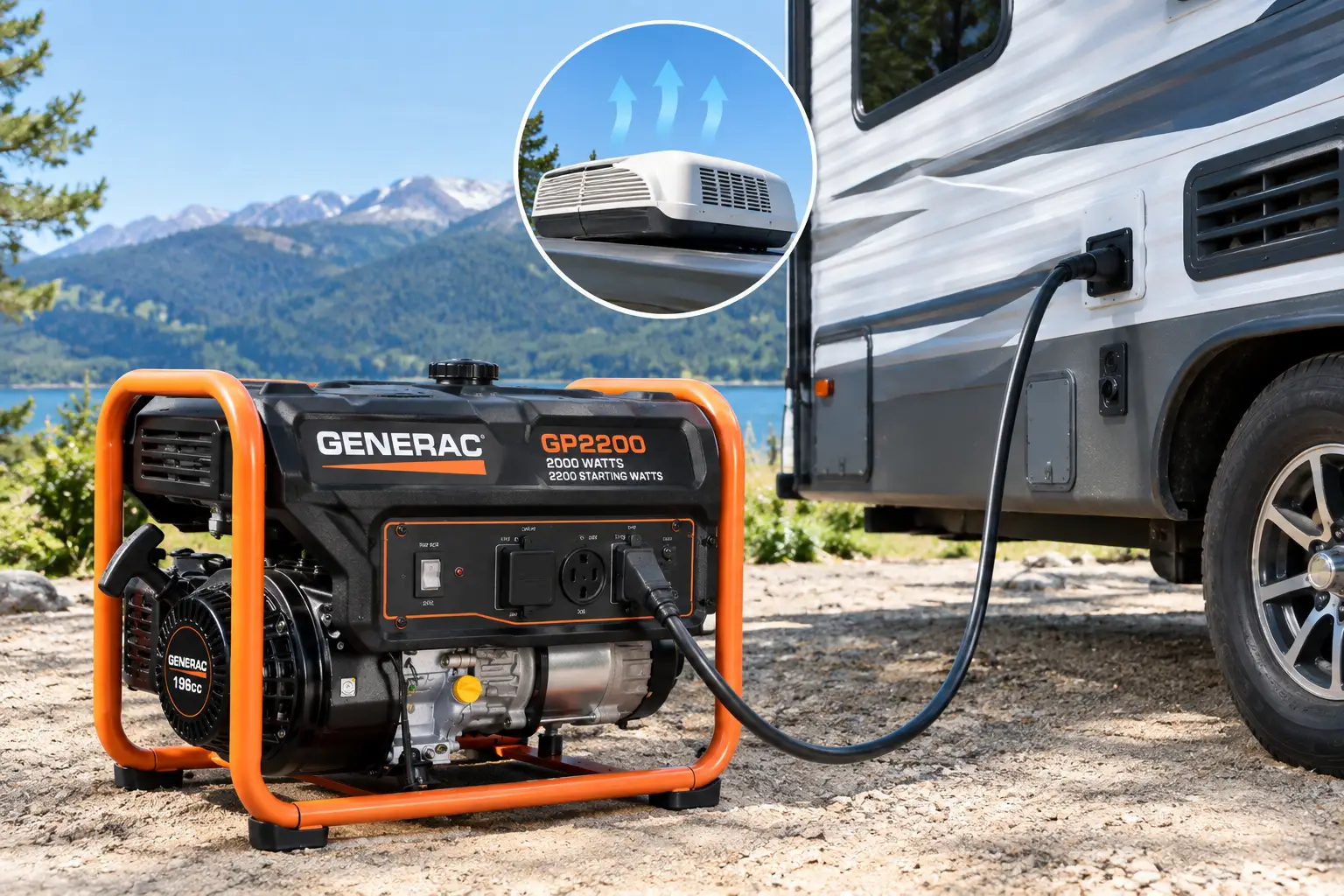
Picture this: it’s 3 p.m. in late July, you’re boondocking outside Moab, the thermometer inside the rig reads 94°F, and you flip the thermostat to “cool.” The rooftop unit clicks, the compressor groans… and your generator coughs, flashes an overload light, and quits. Sound familiar? That single moment is why choosing the right generator for RV air conditioner duty is the most important power decision most RV owners will ever make.
Here’s the thing most product listings won’t tell you: a rooftop AC doesn’t fail on a small generator because of the power it needs to run. It fails because of the brief, brutal spike it demands to start. A typical 13,500 BTU unit might cruise along at roughly 1,300–1,800 watts, then ask for nearly double that for a second or two when the compressor kicks on. Pick a generator for RV air conditioner use based only on the big number printed on the box, and you’ll learn this lesson the sweaty way.
In this guide, we compare seven real generators sold in the US—from a featherweight 2,200-watt inverter to a 7,000-watt powerhouse that can run two air conditioners at once. You’ll get honest analysis grounded in manufacturer spec sheets and real owner sentiment, sizing math you can actually use, a troubleshooting section for when the AC won’t kick on, and the safety rules that matter most.
No fluff, no invented “test drives”—just the information you need to buy once and stay cool. ✅
Heads up: this post contains affiliate links. If you buy through them, we may earn a small commission at no extra cost to you.
What Is a Generator for RV Air Conditioner?
A generator for RV air conditioner use is a portable or built-in engine-generator with enough starting (surge) watts to kick on a rooftop AC compressor and enough running watts to keep it cooling. Most are 3,000–4,500-watt inverter models with a 30-amp TT-30R RV outlet and clean, low-distortion power.
Why “BTU” Matters to Your Generator Choice
Air conditioners are rated in British thermal units (BTU), a measure of how much heat they can pull out of the air per hour. Most RVs carry a 13,500 or 15,000 BTU rooftop unit, and bigger BTU numbers mean bigger compressors—which means bigger startup surges. Translating BTU into watts is the first step in figuring out what size generator to run RV air conditioner loads reliably, and we walk through that math in detail further down.
Think of BTU as the “job size” and watts as the “muscle” your generator must bring to the job. A 13,500 BTU unit is a moderate job; a 15,000 BTU unit in 105°F desert heat at 5,000 feet of elevation is a heavy lift. Your generator choice should match the hardest day you expect, not the easiest.
Quick Comparison: 7 Best Generator for RV Air Conditioner Picks at a Glance
| Generator | Running / Starting Watts (gas) | Fuel | RV Outlet | Approx. Price Range | Best For |
|---|---|---|---|---|---|
| Champion 4500-Watt Dual Fuel Inverter | 3,500 / 4,500 W | Gas + propane | TT-30R | $1,000–$1,300 | Champion 4500-Watt Dual Fuel Inverter: best all-rounder for one 15K AC |
| Westinghouse iGen4500DFc | 3,700 / 4,500 W | Gas + propane | TT-30R | $1,000–$1,300 | Westinghouse iGen4500DFc: longest runtime + remote start |
| WEN 56380i | 3,400 / 3,800 W | Gas | TT-30R | $700–$950 | WEN 56380i: budget 13.5K AC power |
| Honda EU2200i | 1,800 / 2,200 W | Gas | None (adapter) | $1,100–$1,300 | Honda EU2200i: light-trailer owners with a soft start |
| Honda EU3200i | 2,600 / 3,200 W | Gas | L5-30R (adapter) | $2,000–$2,400 | Honda EU3200i: lightest true 13.5K AC solution |
| Champion 3400-Watt Dual Fuel Inverter | 3,100 / 3,400 W | Gas + propane | TT-30R | $800–$1,000 | Champion 3400-Watt Dual Fuel Inverter: entry-level dual fuel |
| Honda EU7000iS | 5,500 / 7,000 W | Gas | L5-30R / L14-30R | $4,500–$5,000 | Honda EU7000iS: two ACs / 50-amp rigs |
Prices are approximate ranges at the time of writing; check the current price on Amazon, as prices may vary.
Reading the table, the clear sweet spot for most 30-amp trailers is the 3,500–3,700 running-watt band, where the Champion 4500-Watt Dual Fuel Inverter and Westinghouse iGen4500DFc sit with comfortable surge headroom for a 15,000 BTU unit. The two Hondas trade raw wattage for weight and refinement, which makes a soft starter almost mandatory. Meanwhile, the WEN 56380i delivers the most AC-capable watts per dollar if you can live with gas only.
💬 One click helps other shoppers make an informed choice too! 😊
Top 7 Generator for RV Air Conditioner Picks: Expert Analysis
1. Champion 4500-Watt Dual Fuel Inverter — best all-rounder for one 15K AC
If you want one machine that starts a 15,000 BTU rooftop unit without drama, this is the safest bet in its price class. On gasoline, the Champion 4500-Watt Dual Fuel Inverter (model 201319) delivers 4,500 starting and 3,500 running watts; on propane, running output drops only to 3,150 watts while starting watts stay at 4,500. In practice, that unchanged surge figure on propane matters enormously—propane is where many dual-fuel units lose the headroom needed to start an AC compressor. Champion also rates it at 61 dBA from 23 feet and up to 14 hours on gas (21 hours on a 20-lb propane tank) at quarter load.
Based on comparing the specs, this is the right fit for owners of 25–32-foot travel trailers with a single 13,500 or 15,000 BTU AC who also want to run a microwave or coffee maker without juggling loads. The built-in CO Shield auto-shutoff is a genuine safety upgrade, not a marketing extra. Retailer summaries and owner feedback consistently praise its reliable starting, efficiency, and quietness for the wattage, while the most common complaint is the near-100-pound heft.
Pros:
- ✅ Full 4,500 starting watts even on propane
- ✅ TT-30R outlet plugs straight into a 30-amp RV
- ✅ CO Shield automatically shuts down if carbon monoxide builds
Cons:
- ❌ Roughly 99 pounds—a two-person lift into a truck bed
- ❌ Small 2.25-gallon gas tank limits full-load runtime
Typically priced between $1,000 and $1,300, it’s the best value for 15K AC owners who want propane flexibility.
2. Westinghouse iGen4500DFc — longest runtime with remote start
Westinghouse built this one for campers who hate refueling at midnight. The Westinghouse iGen4500DFc produces 3,700 running and 4,500 peak watts on gas, and 3,330 running / 4,050 peak watts on propane, with total harmonic distortion of 3% or less. The bigger news is its 3.4-gallon tank: Westinghouse quotes up to 18 hours at 25% load, which translates into a full night of AC cycling without a 2 a.m. fuel run.
The key-fob remote start sounds like a gimmick until you realize it lets you start the generator from inside your rig while it sits safely 20+ feet away. That’s genuinely useful. However, its propane surge rating (4,050 W) is lower than the Champion’s, so if you run propane-only in extreme heat with a 15K unit, a soft starter is cheap insurance.
We couldn’t verify a large pool of reviews specific to this exact DFc variant, so treat owner-sentiment claims cautiously. The broader iGen4500 family it’s built on is widely owned and generally reported as quiet and dependable. Westinghouse refreshes this lineup periodically, so confirm the Amazon listing shows the DFc (dual fuel + CO sensor) model.
Pros:
- ✅ Highest running watts among the 4,500-peak units here
- ✅ Up to 18 hours of runtime on one tank
- ✅ Wireless remote start plus CO sensor shutdown
Cons:
- ❌ Propane surge drops to 4,050 watts
- ❌ Variant availability changes; double-check the model number
Usually in the $1,000–$1,300 range, it earns its price through runtime and convenience.
3. WEN 56380i — budget power for a 13.5K AC
The WEN 56380i is the bargain-hunter’s way into reliable AC power. It’s rated at 3,800 surge and 3,400 rated watts from a 212cc engine, includes a TT-30R RV receptacle, electric start, and a fuel shutoff that burns off carburetor gas before shutdown—a small feature that prevents the gummed-up carb problems that plague seasonal generators.
What do those numbers mean in the real world? 3,400 running watts covers a 13,500 BTU AC plus a fridge and lights comfortably. The 3,800-watt surge is enough for most 13.5K units, but it’s tight for a 15K compressor on a hot day; pair it with a soft starter if that’s your setup. WEN quotes about 8.5 hours at half load from its roughly 2.2-gallon tank, so plan on a refill during a long, hot day.
Owner feedback is mixed on portability: some buyers find it easy to roll, while others say the 99.2-pound weight is a real challenge for solo handling. Buyers on a budget generally appreciate its price-to-power ratio.
Pros:
- ✅ Lowest price per running watt in this lineup
- ✅ Fuel shutoff protects the carburetor in storage
- ✅ RV-ready TT-30R outlet, no adapter needed
Cons:
- ❌ Gas only—no propane option
- ❌ Two-year warranty is shorter than Champion or Honda
Often found in the $700–$950 range, it’s the best value for 13.5K AC owners on a tight budget.
4. Honda EU2200i — the featherweight that needs a soft start
The Honda EU2200i is the most popular “small” generator among RVers, and it’s also the most misunderstood. Honda rates it at 2,200 maximum and 1,800 continuous watts, powered by a 121cc GXR120 engine. Here’s the honest truth: on its own, that’s marginal for a 13,500 BTU AC. RV forum owners report it sometimes starts a 13.5K unit and sometimes trips—and the consensus fix is a soft starter, after which many owners report reliable starts.
Why buy it, then? Because at under 50 pounds, it’s the only option here one adult can lift into a truck bed. Its quiet operation—roughly 48 dBA at quarter load—makes it the definitive quiet RV generator for tight campgrounds. And if you buy two, a parallel kit gives you about 4,400 starting and 3,600 running watts, which handles a 15K AC with ease.
It’s ideal for small travel trailers, pop-ups, and truck campers with an 11,000–13,500 BTU AC, as long as you budget for a soft starter. Owner sentiment for Honda reliability is overwhelmingly positive; the main complaint is price versus wattage.
Pros:
- ✅ Lightest generator in this guide by far
- ✅ Exceptionally quiet at low loads
- ✅ Parallel-capable to double output later
Cons:
- ❌ Cannot reliably start most 13.5K ACs without a soft starter
- ❌ No TT-30R outlet; you’ll need an adapter
At roughly $1,100–$1,300, you’re paying a premium for Honda refinement, not raw power.
5. Honda EU3200i — the lightest true 13.5K AC solution
Honda’s answer to “I want a Honda that runs my AC without tricks” is the Honda EU3200i. Honda rates it at 3,200 watts maximum (2,600 rated), runs it on a fuel-injected GX130 engine, and specifically markets it as capable of powering 13,500 BTU RV AC units. At 59.1 pounds, it’s less than half the weight of the older EU3000iS while operating at 54–58 dB(A).
Fuel injection is a bigger deal than it sounds. There’s no carburetor to gum up during winter storage, and EFI adjusts automatically for altitude, which matters if you camp in the Rockies where carbureted generators lose meaningful power. The CO-MINDER system and Bluetooth app add monitoring you’ll actually use.
The catch? Its 30-amp outlet is an L5-30R locking plug, not a TT-30R, so you need an adapter. And its 1.2-gallon tank yields roughly 3.3 hours at rated load, so plan around frequent refills during heavy AC use. Reviewers consistently praise the noise and weight but note that the price is steep for 3,200 watts.
Pros:
- ✅ Under 60 pounds for genuine 13.5K AC capability
- ✅ EFI engine starts easily and handles altitude
- ✅ CO-MINDER and Bluetooth monitoring built in
Cons:
- ❌ Small 1.2-gallon tank means frequent refueling
- ❌ Premium price per watt
Usually around $2,000–$2,400, it’s a worthwhile luxury if lifting weight is your top concern.
6. Champion 3400-Watt Dual Fuel Inverter — entry-level dual fuel for 13.5K units
The Champion 3400-Watt Dual Fuel Inverter is the most affordable way to get propane flexibility with an RV-ready outlet. It produces 3,400 starting and 3,100 running watts on gas, and 3,060 starting / 2,790 running watts on propane, from a 192cc engine at a rated 59 dBA. It includes a TT-30R outlet, two household outlets, and an economy mode.
What most buyers overlook is that the propane surge rating of 3,060 watts is right at the edge of a 13.5K AC’s startup demand. On gasoline it’s comfortable for most 13,500 BTU units; on propane in July heat, a soft starter becomes strongly recommended. Its small 1.6-gallon gas tank yields about 7.5 hours at 25% load, while a 20-pound propane tank roughly doubles that to 14.5 hours.
It’s a smart pick for weekend campers with a 13.5K AC who want to run off the RV’s propane supply. Owner reviews generally praise long-term reliability and the propane option, but many note it feels heavy at nearly 96 pounds.
Pros:
- ✅ Affordable entry into dual-fuel RV power
- ✅ Propane roughly doubles quarter-load runtime
- ✅ Parallel-capable with other Champion inverters
Cons:
- ❌ Propane surge is marginal for most AC startups
- ❌ Heavy for its wattage class
Typically between $800 and $1,000, it offers solid value if propane matters more than surge headroom.
7. Honda EU7000iS — two ACs and 50-amp rigs
When you own a fifth-wheel or Class A with two rooftop units, the 3,500-watt class simply won’t cut it—and that’s where the Honda EU7000iS comes in. Honda rates it at 7,000 maximum and 5,500 rated watts, selectable for 120 or 120/240 volts, on a fuel-injected GX390 engine. It runs 6.4 to 16 hours on a 5.1-gallon tank, depending on load, at 52–58 dB(A).
In practice, 5,500 running watts in 120-volt mode is enough to run two 13.5K ACs with careful staggering, or one 15K unit plus a microwave and fridge without thinking twice. The 30-amp 120/250-volt locking outlet can feed a 50-amp RV via an adapter.
The downside is obvious: at around 260 pounds, this is not portable in any casual sense. Most owners mount it on a hitch carrier or truck bed. Reviews widely describe it as quiet for its size and extremely dependable, with the price cited as the main drawback.
Pros:
- ✅ Starts and runs a 15K AC with lots of headroom
- ✅ EFI engine and CO-MINDER for reliability and safety
- ✅ 120/240V output works with 50-amp setups
Cons:
- ❌ Roughly 260 pounds—requires a mount or ramp
- ❌ Highest price in this guide
At around $4,500–$5,000, it’s an investment best suited to full-timers with big rigs.
Head-to-Head: Full Spec Comparison of the Top 7
| Generator | Propane Running W | Noise (rated) | Weight | Runtime (approx.) | Best For |
|---|---|---|---|---|---|
| Champion 4500-Watt Dual Fuel Inverter | 3,150 W | 61 dBA | ~99 lb | 14 h gas / 21 h LP @ 25% | Champion 4500-Watt Dual Fuel Inverter: 15K AC + propane |
| Westinghouse iGen4500DFc | 3,330 W | ~52 dBA (low load) | ~105 lb | up to 18 h @ 25% | Westinghouse iGen4500DFc: overnight cooling |
| WEN 56380i | — | 57 dBA (¼ load) | 99.2 lb | 8.5 h @ 50% | WEN 56380i: budget buyers |
| Honda EU2200i | — | ~48–57 dBA | <50 lb | up to ~8 h | Honda EU2200i: small trailers |
| Honda EU3200i | — | 54–58 dBA | 59.1 lb | 8.6 h @ 25% | Honda EU3200i: lightweight 13.5K |
| Champion 3400-Watt Dual Fuel Inverter | 2,790 W | 59 dBA | ~96 lb | 7.5 h gas / 14.5 h LP @ 25% | Champion 3400-Watt Dual Fuel Inverter: entry dual fuel |
| Honda EU7000iS | — | 52–58 dBA | ~260 lb | 6.4–16 h | Honda EU7000iS: two ACs |
This second table reveals a trade-off the first one hides: weight. The three ~100-pound units deliver the most AC-starting muscle per dollar, but the Honda EU3200i delivers 13.5K capability at nearly half the weight. Runtime also varies a lot—the Westinghouse iGen4500DFc‘s larger tank gives it a real advantage for overnight cooling compared to the Honda EU3200i‘s 1.2 gallons.
✨ Don’t sweat the next heat wave!
🔍 Ready to take your off-grid comfort to the next level? Click a highlighted model above to check current pricing and availability—each of these picks can keep your RV cool and your whole crew happy. ❄️🚐
What Size Generator to Run RV Air Conditioner Loads?
This is the question that decides everything, so let’s do the math properly. To figure out what size generator to run RV air conditioner units, you need two numbers: running watts (steady draw) and starting watts (the compressor’s brief surge).
Industry sizing guides commonly estimate these ranges:
- 13,500 BTU AC: about 1,300–1,800 running watts and 2,800–3,500 starting watts
- 15,000 BTU AC: about 1,500–2,000 running watts and 3,300–4,000 starting watts
The Simple Three-Step Formula
- Add all running watts you’ll use at the same time (AC + fridge + lights + converter).
- Add the single largest starting surge (almost always the AC compressor) on top of that total.
- Leave 10–20% headroom for heat, altitude, and aging equipment.
For example, a 13.5K AC running at 1,500 W, plus a fridge (~180 W), lights (~200 W) and a battery converter (~400 W) gives roughly 2,280 running watts. Add the AC’s ~1,500-watt surge above its running draw and you need roughly 3,800 starting watts. That’s why the WEN 56380i is borderline and the Champion 4500-Watt Dual Fuel Inverter is comfortable.
Altitude and Heat: The Hidden Derating
Westinghouse’s manual notes power drops about 3.5% for every 1,000 feet of elevation. At 7,000 feet, a 4,500-watt peak becomes roughly 3,400 watts—suddenly marginal for a 15K unit. Heat compounds the problem, because AC compressors work harder (and draw more) on the hottest days. Size for your worst-case campsite, not your driveway.
How to Choose a Generator for RV Air Conditioner Use
- Identify your AC’s BTU rating. Check the rooftop unit’s data plate; this tells you which surge range you need to cover.
- Match starting watts to the compressor surge. This is the number that makes or breaks AC startup—ignore it at your peril.
- Confirm the outlet type. A TT-30R outlet plugs straight into most 30-amp RVs; L5-30R units need an adapter.
- Choose inverter technology. An inverter generator for RV AC produces clean power (under 3% THD) that’s safe for your converter, TV, and laptops.
- Decide on fuel. A dual fuel RV generator lets you use the propane you already carry, at a small cost in output.
- Check noise and weight. Campgrounds enforce quiet hours, and you’ll be lifting this thing every trip.
- Plan for a soft starter. It can let a smaller, lighter generator handle the AC and reduces wear on everything.
Getting Started: Your First 30 Days with an RV AC Generator
Unboxing day is exciting, but the first few hours of a generator’s life affect its next thousand. Here’s a practical startup plan that most product listings skip.
Day 1: Break-In Matters
Add oil before the first start—most units ship dry. Westinghouse’s manual instructs owners not to exceed 50% of rated running watts during the first five hours. In practice, that means running lights, a fan, and the fridge, but not the AC. Resist the urge to “test” the AC on day one.
First Week: Learn Your Load Profile
Once broken in, start the generator, let it warm up for two to three minutes, then turn on the AC in fan-only mode before switching to cool. Owners on RV forums frequently report this simple sequence helps marginal generators start compressors more reliably, because the fan motor is already spinning when the compressor surges.
Watch the load indicator. If the generator bogs or the overload light flickers, turn off the water heater’s electric element and the microwave before starting the AC.
First Month: Maintenance Basics
- Change the oil after the first 20–25 hours (check your manual) to remove break-in metal particles.
- Use fresh, stabilized fuel, or run the carburetor dry before storage—the WEN 56380i‘s fuel shutoff does this automatically.
- Check the spark arrestor if you camp on public lands, where it’s often required.
- Exercise it monthly under a moderate load for 20–30 minutes if you’re not camping.
Common first-month mistakes: running out of oil because the low-oil sensor was ignored, running it inside a closed truck bed or garage (never do this), and buying a too-small extension cord that causes voltage drop.
Real-World Scenarios: Matching Campers to Generators
Specs only come alive when you match them to an actual camper. Here are three common profiles with our reasoning.
Profile 1: The Weekend Couple with a 19-Foot Trailer
Budget: under $1,300. Setup: 13,500 BTU AC, 30-amp service, camps 10–12 weekends a year, often in state parks with quiet hours.
Our pick: the Honda EU2200i plus a soft starter. The weight makes setup painless for two people, the low noise keeps neighbors happy, and the soft starter solves the startup problem. If they’d rather skip the soft-start install, the WEN 56380i is the budget alternative—louder and heavier, but plug-and-play.
Profile 2: The Family with a 28-Foot Bunkhouse
Budget: $1,000–$1,400. Setup: 15,000 BTU AC, kids who want the microwave and TV running, boondocking in the Southeast in summer.
Our pick: the Champion 4500-Watt Dual Fuel Inverter. The full 4,500-watt surge on both fuels handles the 15K AC with room for a microwave, and propane runtime from the trailer’s tanks avoids gas-can trips. If overnight runtime matters more, the Westinghouse iGen4500DFc is the alternative.
Profile 3: The Full-Timers in a 40-Foot Fifth-Wheel
Budget: flexible. Setup: two 15,000 BTU ACs, 50-amp service, months off-grid in the Southwest.
Our pick: the Honda EU7000iS on a hitch-mounted carrier, or two parallel-linked 4,500-watt-class inverters if they’d rather split the weight. Either way, soft starters on both ACs will make the system dramatically more forgiving.
Problem → Solution: When Your Generator Won’t Start the AC
Even a correctly sized generator can struggle. Here are the five most common problems and how to fix them.
Problem 1: The generator trips the moment the compressor kicks on. ✅ Solution: Install a soft starter. These devices ramp up motor voltage gradually, limiting the inrush current that can run several times higher than normal operating current. Soft-start manufacturers report cutting AC startup surge substantially—often by half or more—which can make the Honda EU2200i viable for a 13.5K AC.
Problem 2: It starts fine at home but fails in the mountains. ✅ Solution: Altitude derating. Turn off every other load before starting the AC, or choose an EFI model like the Honda EU3200i that compensates automatically.
Problem 3: The AC runs, then the generator overloads after a while. ✅ Solution: Your total running load is too high. The RV’s converter charging dead batteries can draw hundreds of watts. Charge batteries earlier in the day, or stagger the microwave and AC.
Problem 4: It works on gas but not on propane. ✅ Solution: Propane reduces output on most dual-fuel models. Either switch to gasoline for hot afternoons or choose a model like the Champion 4500-Watt Dual Fuel Inverter that holds full surge watts on propane.
Problem 5: The generator surges and hunts when the AC cycles. ✅ Solution: Turn off “eco” or economy mode during AC use. Economy mode idles the engine down and can be slow to respond to the compressor’s surge.
Inverter Generator for RV AC vs. Conventional Generator vs. Power Station
| Option | Power Quality | Noise | AC Startup Ability | Weight per Watt | Best For |
|---|---|---|---|---|---|
| Inverter generator | Clean (<3% THD) | Quiet (48–61 dBA) | Good–excellent | Moderate | Most RVers; see Champion 4500-Watt Dual Fuel Inverter |
| Conventional open-frame | Less clean | Loud (often 65+ dBA) | Excellent per dollar | Heavy | Construction-style budget use |
| Battery power station | Very clean | Silent | Limited runtime | Very heavy per hour of AC | Short AC bursts, quiet hours |
An inverter generator for RV AC duty wins for most campers because it combines clean power, campground-friendly noise, and good surge capability. Conventional open-frame generators deliver more watts per dollar, but their noise often breaks campground rules and their rougher power can stress sensitive RV electronics. Battery power stations are silent, but running a 1,500-watt AC for eight hours requires roughly 12 kWh of storage—far beyond most portable units.
Why Clean Power Matters in an RV
Modern RVs are full of microprocessors: the converter, inverter-chargers, smart thermostats, refrigerator control boards, and TVs. A conventional generator’s distorted waveform can cause these devices to overheat or misbehave. Inverter generators process power through electronics that produce a steadier sine wave, which is why all seven of our picks are inverter models.
Quiet RV Generator Picks: Decibels, Campgrounds, and Quiet Hours
Noise isn’t just about manners—many campgrounds and public lands enforce generator hours and noise limits. A quiet RV generator lets you run the AC during the afternoon heat without becoming the campground villain.
Understanding Decibel Ratings
Decibels are logarithmic, so a 10 dBA increase sounds roughly twice as loud. That means the Honda EU2200i at around 48 dBA (quarter load) sounds dramatically quieter than a conventional generator at 68 dBA. But be careful comparing listings: manufacturers measure at different distances (often 23 feet / 7 meters) and different loads. A generator rated “52 dBA” at quarter load may be closer to 60 dBA when your AC is running.
Our Quietest Picks for AC Use
- Honda EU3200i — 54–58 dB(A), the quietest option that runs a 13.5K AC on its own.
- Honda EU7000iS — 52–58 dB(A), remarkably quiet for its size when lightly loaded.
- Honda EU2200i — the quietest of all at low load, but needs a soft starter for AC use.
Practical Noise-Reduction Tips
Point the exhaust away from neighboring sites, place the generator on grass or dirt rather than pavement (hard surfaces reflect sound), and use a longer heavy-gauge cord to put more distance between the generator and your campsite. Never enclose a running generator in a box—it can overheat and trap carbon monoxide.
Dual Fuel RV Generator: Is Propane Worth It?
A dual fuel RV generator runs on gasoline or propane. Since most RVs already carry propane, this can be a huge convenience. But there are trade-offs worth weighing.
The Advantages of Propane
- Storage stability: propane doesn’t go stale or gum up carburetors like gasoline can over a long winter.
- Convenience: you can use the tanks already on your trailer’s tongue.
- Cleaner burn: propane tends to leave fewer carbon deposits on engine internals.
The Trade-Offs
Propane typically reduces output by roughly 10%. For example, the Westinghouse iGen4500DFc drops from 3,700 to 3,330 running watts, and the Champion 3400-Watt Dual Fuel Inverter drops from 3,100 to 2,790 running watts. For AC use, the starting-watt drop matters most, which is why the Champion 4500-Watt Dual Fuel Inverter‘s unchanged 4,500-watt propane surge is a standout spec.
Our Verdict
If you camp off-grid for extended periods, propane flexibility is worth it. Just size your generator so it still covers your AC’s startup surge on propane, not just on gasoline.
Long-Term Cost and Maintenance
The sticker price is only part of the story. Fuel, oil, parts, and lifespan determine the true cost of a generator for RV air conditioner use.
| Generator | Approx. Price Range | Warranty | Fuel Notes | Long-Term Value |
|---|---|---|---|---|
| WEN 56380i | $700–$950 | 2 years | Gas only | WEN 56380i: lowest upfront cost |
| Champion 4500-Watt Dual Fuel Inverter | $1,000–$1,300 | 3 years | Gas + propane | Champion 4500-Watt Dual Fuel Inverter: strong balance |
| Honda EU3200i | $2,000–$2,400 | 3 years | EFI gas | Honda EU3200i: long-life engine, high upfront cost |
| Honda EU7000iS | $4,500–$5,000 | 3 years | EFI gas | Honda EU7000iS: best for heavy daily use |
Warranty terms are summarized from manufacturer and retailer listings; confirm current terms before buying.
The WEN 56380i wins on upfront cost, but its shorter warranty shifts more long-term risk to you. The Honda models cost far more initially, yet their fuel injection and reputation for longevity make them attractive for full-timers who log hundreds of hours a year.
Annual Maintenance Budget
Expect to spend roughly $30–$80 per year on oil, spark plugs, and air filters for a typical weekend camper. Fuel is the larger expense: a 3,500-watt-class inverter running an AC can burn a gallon of gas every few hours, so a hot summer weekend can easily consume 5–10 gallons. Propane costs vary widely by region, so compare local prices before deciding which fuel to rely on.
Safety, Regulations, and Standards
Generators are deadly when misused. According to the U.S. Consumer Product Safety Commission’s carbon monoxide safety center, more than 100 US deaths each year from accidental non-fire CO poisoning are linked to portable generators, and the agency recommends running them outdoors at least 20 feet from homes with the exhaust directed away.
RV-Specific Safety Rules
- Never run a portable generator inside the RV, a basement, or a storage bay. Even with doors open, CO can build up quickly.
- Point the exhaust away from your rig and your neighbors’. Wind direction changes, so check it again during the day.
- Install and test working CO detectors inside the RV. Most modern RVs have them; replace them according to the manufacturer’s schedule.
- Choose models with CO shutoff technology. The Champion 4500-Watt Dual Fuel Inverter, Westinghouse iGen4500DFc, Honda EU3200i, and Honda EU7000iS all include CO detection systems.
Standards Worth Knowing
The CPSC encourages consumers to look for generators certified to the PGMA G300 and UL 2201 standards, which include carbon monoxide safety features. In California, look for CARB compliance, which affects which models can be sold there. Many national forests and parks also require a USDA-qualified spark arrestor—check the land manager’s rules before your trip.
Common Mistakes to Avoid When Buying an RV Generator
Even experienced RVers make these errors. Avoid them and you’ll avoid the most expensive regrets.
1. Buying by Peak Watts Alone
The biggest number on the box is usually starting watts, not running watts. A “4,500-watt” generator may provide 3,500 continuous watts. Always compare running watts for your steady load and starting watts for the AC surge.
2. Ignoring Propane Derating
Many buyers assume a dual-fuel generator performs identically on propane. It usually doesn’t. Check both gas and propane ratings before you buy.
3. Forgetting the Outlet Type
A TT-30R outlet plugs directly into a typical 30-amp RV cord. Otherwise, you’ll need an adapter—a small but annoying cost and an extra point of failure.
4. Choosing Weight You Can’t Handle
A 100-pound generator is easy on paper and miserable in a dark campsite. If you camp solo, consider the Honda EU3200i or a parallel pair of smaller units.
5. Skipping the Soft Starter
A soft starter is one of the most cost-effective upgrades for any RV AC. It reduces startup stress on the generator, the compressor, and campground pedestals, and may let you buy a smaller, quieter generator.
6. Overlooking Altitude
If you camp in the mountains, buy enough headroom or choose an EFI model. A generator that’s perfect in Florida can struggle in Colorado.
FAQ: Generator for RV Air Conditioner
❓ What is the best generator for RV air conditioner use under $1,000?
❓ Can I run my RV AC on a 3,000-watt generator?
❓ Is it worth buying two smaller generators instead of one large one?
❓ Do I need a 50-amp generator for a 50-amp RV?
❓ Will a soft starter void my RV AC warranty?
Conclusion: Stay Cool Without the Guesswork
Choosing a generator for RV air conditioner duty comes down to one truth: the AC’s startup surge, not its running draw, decides whether you stay cool. For most 30-amp trailers with a single 15,000 BTU unit, the Champion 4500-Watt Dual Fuel Inverter is our top all-around pick thanks to its full propane surge rating, TT-30R outlet, and CO Shield. If runtime and remote start matter more, the Westinghouse iGen4500DFc is a strong alternative.
Budget-focused owners with a 13.5K AC should look at the WEN 56380i, while those who want propane at a lower price can consider the Champion 3400-Watt Dual Fuel Inverter, ideally with a soft starter. If weight is your biggest concern, the Honda EU3200i delivers 13.5K AC capability in a remarkably light package, and the Honda EU2200i remains the featherweight favorite when paired with a soft starter. For big rigs with two ACs, the Honda EU7000iS is the premium choice.
Whatever you choose, size for your hottest day and highest campsite, keep the generator outside and away from your RV, and consider a soft starter as one of the smartest upgrades you can make. The best generator for RV air conditioner comfort is the one that starts every time—without leaving you sweating.
🚀 Ready to make your next summer trip a cool one?
🔍 Click any highlighted generator in this guide to check current pricing and availability. Pick the right power today, and enjoy quiet, comfortable adventures with the whole family all season long! ❄️🏕️
Recommended for You
- Franklin Battery Price 2026: 7 Smart Home Backup Picks Compared
- Solar Power Electric Bike: 7 Best Picks That Actually Work (2026)
- DIY Home Battery Backup: 7 Essential Products for a Reliable Power System
Disclaimer: This post contains affiliate links. As an Amazon Associate, I earn from qualifying purchases made through these links, at no additional cost to you.
✨ Found this article helpful? Share it with someone who needs it! 💬🤗
