In This Article
A solar charger for backpacking is a foldable, USB-output solar panel — usually 5 to 30 watts — that converts sunlight into power for phones, GPS units, and satellite communicators while you’re off the grid. It’s designed to be light enough to carry for days, not a home backup power system.
If you’ve ever watched your phone battery drop from 40% to 8% on day three of a trip, with your only “outlet” being a fire ring, you already understand the appeal. The best solar charger for backpacking isn’t the one with the biggest wattage number on the box — it’s the one you’ll actually strap to your pack and use every single day, rain or shine. That distinction matters more than most gear reviews let on, because a heavy 30-watt panel that stays zipped in your pack because it’s a pain to deploy is worse than a modest 10-watt panel you unfold at every lunch break.
This guide breaks down seven real, currently available portable solar chargers for backpacking, hiking, and thru-hiking, drawing on independent outdoor-gear testing alongside real spec sheets to cover entry-level budgets, dependable mid-range picks, and higher-output options for basecamp or bikepacking setups. You’ll also find a practical framework for choosing between wattage and weight, a look at how solar chargers compare to simply carrying a bigger power bank, and honest guidance on what these panels can — and can’t — do for you on trail. Every product mention below reflects real specs and aggregated review sentiment, not a rehashed spec sheet, so you can make a genuinely informed call before you buy.
Quick Comparison: Best Solar Chargers for Backpacking at a Glance
Before diving into the full reviews, here’s how the seven picks stack up on the numbers that actually matter for a multi-day trip: rated wattage, weight, and who each one is really built for.
| Solar Charger | Rated Output | Weight | Price Range | Best For |
|---|---|---|---|---|
| BigBlue SolarPowa 28 | 28W | ~1 lb 5 oz | $60–$75 | Fastest real-world charging |
| FlexSolar E10 Mini | 10W | ~7–9 oz | $40–$55 | Ultralight / thru-hiking |
| Goal Zero Nomad 10 | 10W | ~1.1–1.2 lb | $70–$100 | Trusted, no-frills reliability |
| BioLite SolarPanel 10+ 2.0 | 10W | ~1.2 lb | $140–$150 | Cloudy days (onboard battery) |
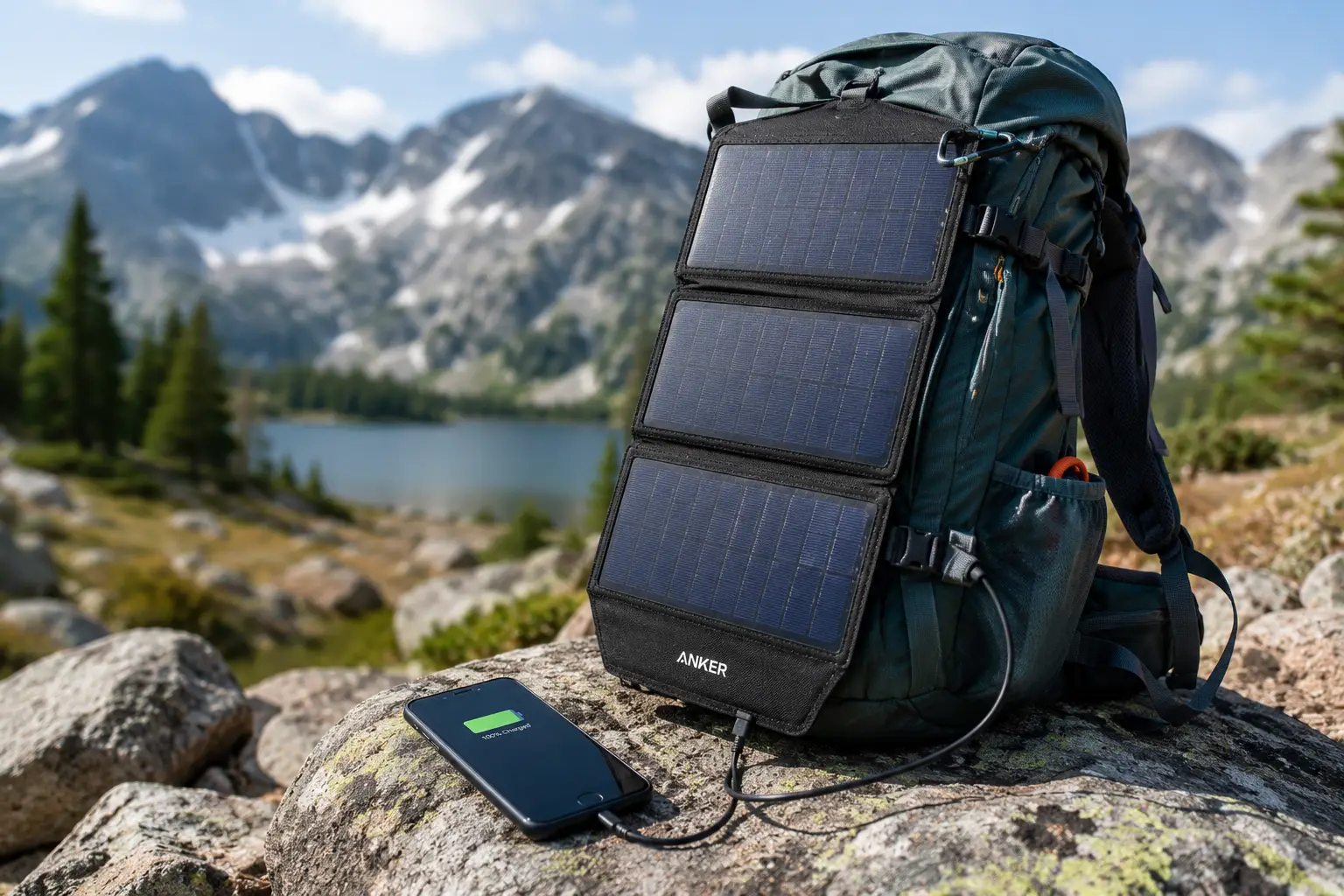
| Anker PowerPort Solar 21W | 21W | ~1 lb | $55–$65 | Charging two devices at once |
| Blavor 10W Solar Panel | 10W | ~10 oz | $25–$35 | Budget-conscious buyers |
| Jackery SolarSaga 100W | 100W | ~7–8 lb | $200–$260 | Basecamp / bikepacking with a power station |
A quick read of this table tells most of the story: wattage and weight move together, so there’s no single “best” pick — only the best pick for your trip length and how many devices you’re keeping alive. The BigBlue SolarPowa 28 and Anker PowerPort Solar 21W sit in the sweet spot most backpackers land on, balancing real-world charging speed against pack weight. If you’re counting every ounce on a thru-hike, the FlexSolar E10 Mini and Blavor 10W Solar Panel trade some charging speed for a barely-there footprint, while the Jackery SolarSaga 100W only makes sense once you’re carrying a power station rather than just a phone.
💬 One click helps other shoppers make an informed choice too! 😊
Top 7 Best Solar Chargers for Backpacking, Reviewed
Below are seven real, currently available solar chargers, covering entry-level, mid-range, and higher-output options. Each has been evaluated on real specs, aggregated review sentiment, and honest trade-off analysis — not marketing copy.
1. BigBlue SolarPowa 28 — best real-world output per ounce
The SolarPowa 28 has become something of a default recommendation in backpacking and camping communities, and the reason comes down to one thing: it actually delivers close to its rated output. Independent testing found it produces roughly 20 to 22 watts of usable power from its 28-watt rating on a clear day, which is a notably better ratio than many panels in this class manage. That gap between “rated” and “real” output is the single most important number a spec sheet won’t tell you, and it’s why this panel keeps landing at the top of camping-gear roundups.
Feature-wise, it packs both a USB-C and a USB-A port, so you’re not stuck charging only older devices, and an optional ammeter version lets you glance at real-time output instead of guessing. At roughly 1 lb 5 oz folded, it’s not the lightest thing on this list, but it folds down small enough to slide into a backpack side pocket. Reviewers consistently describe it as the panel that shows up most often in r/CampingGear and r/backpacking recommendation threads, generally praised for its reliability rather than any single standout feature — which, honestly, is what you want from gear that keeps your phone alive.
This is the pick for backpackers who want one panel that just works without babysitting the angle constantly, especially anyone charging a phone, GPS, and headlamp battery bank on the same trip.
Pros:
- ✅ Best real-world watts delivered per ounce carried
- ✅ USB-C and USB-A ports cover most devices
- ✅ Compact folded size fits a pack side pocket
Cons:
- ❌ Heavier than dedicated ultralight panels
- ❌ Ammeter display is a separate, pricier version
Priced around $60 to $75 at the time of writing, the BigBlue SolarPowa 28 delivers strong value for the charging speed you’re actually getting in the field, not just on the box.
2. FlexSolar E10 Mini — the lightest panel worth carrying
If you’re the type of backpacker who cuts toothbrush handles to save weight, the FlexSolar E10 Mini was built with you in mind. Independent outdoor-gear testing identified it as the lightest solar panel in its comparison set, coming in at roughly 7 ounces — a genuinely negligible addition to a pack. That weight savings is the entire pitch here, and it’s a legitimate one for anyone counting grams on a long-distance trail.
The trade-off, and it’s an honest one, is that a panel this light sacrifices some of the extra features — no oversized battery pocket, no elaborate kickstand — in favor of a bare-bones design that some testers noted a preference for slightly more feature-rich alternatives despite the weight cost. What you get in exchange is a panel that disappears into your pack until you need it, with a single USB-C output built for direct-to-device charging on a lunch break rather than powering a whole electronics kit.
This is the right call for thru-hikers and minimalist backpackers who mainly need to trickle-charge a phone and maybe a GPS watch, and who have already made peace with fewer bells and whistles in exchange for shaving ounces.
Pros:
- ✅ The lightest usable solar panel in independent testing
- ✅ Folds flat enough to disappear in a pack
- ✅ USB-C output matches most modern devices
Cons:
- ❌ No external battery pocket or extra storage
- ❌ Single port limits simultaneous charging
Expect to pay somewhere around $40 to $55, which puts the FlexSolar E10 Mini at a reasonable premium over bulkier 10W panels, justified almost entirely by the weight it saves.
3. Goal Zero Nomad 10 — the dependable, no-surprises pick
Goal Zero built its reputation on rugged, straightforward outdoor gear, and the Nomad 10 is a clean expression of that philosophy: a 10-watt monocrystalline panel, a USB-A port, and an adjustable kickstand, with nothing extraneous bolted on. At roughly 1.1 to 1.2 lb folded, it sits in the middle of the weight spectrum for 10W panels, and its 180-degree kickstand makes it genuinely easy to angle toward the sun on uneven ground rather than propping it against a rock.
What the spec sheet doesn’t fully convey is how consistently the brand’s build quality shows up in owner feedback — hunters and backpackers testing the panel in the field reported it reliably kept a phone, satellite communicator, and battery bank topped off over a multi-day trip. The catch is the single USB-A port and 10-watt ceiling, which puts it behind newer USB-C panels on raw charging speed; one detailed field comparison noted that a similarly priced USB-C competitor can deliver roughly three times the wattage. If USB-A compatibility and brand trust matter more to you than squeezing out maximum watts, that trade-off is easy to accept.
This is the pick for buyers who want a known, dependable brand backing their gear and don’t need cutting-edge charging speed, particularly hunters, day-tour backcountry skiers, and casual backpackers.
Pros:
- ✅ Trusted brand with strong field-reliability track record
- ✅ 180-degree kickstand simplifies sun alignment
- ✅ Compact folded size, easy to strap to a pack
Cons:
- ❌ USB-A only, no USB-C output
- ❌ 10W ceiling trails newer competitors on raw speed
You’ll typically find the Goal Zero Nomad 10 priced between $70 and $100, which is a fair ask for the brand reliability, though it’s worth comparing against higher-wattage USB-C options nearby in price.
4. BioLite SolarPanel 10+ 2.0 — best for unpredictable weather
The standout feature of the SolarPanel 10+ 2.0 isn’t the panel itself — it’s the 3,200 mAh battery built directly into it. That onboard battery means the panel can keep charging your device even when a cloud rolls over or you duck under tree cover, instead of losing the connection and needing to reset like a bare panel would. Independent testing specifically called out this “interruption recovery” as a genuine performance advantage over panels without a buffer battery.
BioLite also built in a small analog sundial and a 360-degree kickstand, letting you align the panel for maximum output without guesswork — a detail that matters more than it sounds, since misalignment can cost you up to 30% of a panel’s potential output. At roughly 19.4 oz (1.2 lb) with IPX4 weather resistance, it’s not the lightest 10W panel here, and it runs noticeably warmer during use than canvas-backed alternatives, though testers noted this didn’t measurably hurt performance. REI customer reviews for this exact model average 3.6 out of 5 stars across nearly 200 reviews, a solid but not universally glowing verdict that suggests it’s well liked without being a unanimous favorite.
This is the pick for backpackers heading into variable weather — forested trails, shoulder-season trips, or regions where a clear afternoon isn’t guaranteed — who’d rather trade a bit of weight for charging resilience.
Pros:
- ✅ Onboard 3,200 mAh battery survives cloud interruptions
- ✅ Sundial and kickstand simplify optimal alignment
- ✅ Rugged, IPX4 weather-resistant build
Cons:
- ❌ Heavier than bare panels with no onboard battery
- ❌ Runs warmer during extended charging sessions
At around $140 to $150, the BioLite SolarPanel 10+ 2.0 costs meaningfully more than a bare 10W panel — you’re paying for the built-in battery and the reliability that comes with it, which is a fair trade if unpredictable weather is a real factor on your routes.
5. Anker PowerPort Solar 21W — best for charging two devices at once
Anker’s PowerPort Solar 21W earns its spot here on a simple strength: it’s one of the higher power-to-size ratios in this list, packing 21 watts across three folding panels while staying close to a pound. Independent lab testing measured it producing roughly 1,560 mAh into an external battery over an hour in direct sun — a strong showing that came close to, though didn’t quite beat, the class-leading BigBlue panel in the same test.
The dual 2.4A USB-A ports are the practical selling point: you can charge a phone and a battery bank simultaneously instead of choosing one, which matters on a trip where you’re also keeping a GPS or camera topped off. Testing also found it recovered a lost charge connection within about five minutes after being shaded and re-exposed to sun, performing in line with most other panels in that scenario rather than standing out either way. A built-in velcro pouch handles small-item storage, a small but genuinely useful touch that some competitors skip entirely.
This is the pick for buyers who want to charge more than one device at a time without stepping up to a bulkier panel, and who are comfortable sticking with USB-A rather than USB-C.
Pros:
- ✅ 21W output across two ports for simultaneous charging
- ✅ Strong charging speed relative to size and weight
- ✅ Built-in velcro storage pouch for small items
Cons:
- ❌ USB-A only ports, no USB-C
- ❌ Average build durability compared to pricier rivals
Typically priced in the $55 to $65 range, the Anker PowerPort Solar 21W is one of the better dollar-per-watt values on this list, particularly for anyone charging multiple gadgets on the same trip.
6. Blavor 10W Solar Panel — best budget entry point
Not every backpacker needs — or wants to pay for — a premium panel, and that’s exactly the gap the Blavor 10W fills. Independent gear testers specifically flagged it as “such a good deal that we’re not too concerned with slightly more weight” compared to featherweight alternatives, which is a meaningful endorsement from reviewers who otherwise obsess over every ounce.
At roughly 10 ounces, it’s genuinely portable, and its core function — folding out to charge a phone or small device via USB in direct sun — does what it promises without extra frills. What most buyers overlook with budget panels like this one is that the fundamentals (a legitimate monocrystalline cell, a functional USB output, and a foldable design that survives being stuffed in a pack) matter more than marketing extras, and the Blavor covers those fundamentals solidly. It won’t out-charge a 21W or 28W panel, and you shouldn’t expect it to — but for weekend trips and casual use, it’s hard to beat on price.
This is the pick for backpackers testing out solar charging for the first time, or budget-conscious buyers who want a functional panel without committing $60-plus to the category.
Pros:
- ✅ Genuinely affordable entry point into solar charging
- ✅ Lightweight and packable at roughly 10 ounces
- ✅ Praised by testers as strong value for the price
Cons:
- ❌ Lower wattage means slower charging than pricier panels
- ❌ Fewer extra features (no kickstand, no onboard battery)
At an approachable $25 to $35, the Blavor 10W Solar Panel is the lowest-commitment way to find out whether solar charging fits your backpacking style before spending more.
7. Jackery SolarSaga 100W — best for basecamp and bikepacking with a power station
The SolarSaga 100W is in a different category from the rest of this list, and it’s here specifically for backpackers and bikepackers who travel with a power station rather than just a phone. At 100 watts of rated monocrystalline output, it’s built to recharge a power station in hours instead of days — reviewers testing a comparable Anker 100W panel found it could recharge a 300 Wh station in under five hours in good sun, a benchmark the SolarSaga is designed to compete with directly.
This isn’t a panel you clip to a pack strap; it’s meant to be set up at a basecamp, a bikepacking resupply stop, or a group campsite where you’re running a satellite communicator, a camera, headlamps, and phones for multiple people off one shared power source. The panel folds into a large but manageable case and connects to a compatible power station rather than plugging straight into a phone in most setups, so factor that pairing into your budget and pack weight. Reviewers of comparable high-wattage folding panels have noted they hold up well even in extreme heat without overheating cutouts kicking in, a meaningful reliability signal for desert or high-summer trips.
This is the pick for group trips, extended basecamp stays, or bike touring setups where the extra weight is worth it because you’re powering more than one person’s gear off a shared system.
Pros:
- ✅ 100W output recharges a power station in hours, not days
- ✅ Ideal for group trips sharing one power source
- ✅ Performs reliably even in high-heat conditions
Cons:
- ❌ Far too heavy and bulky for solo pack carrying
- ❌ Requires a compatible power station to be useful
Expect to pay in the $200 to $260 range, and remember that figure typically doesn’t include the power station itself — the Jackery SolarSaga 100W is an investment in a whole charging system, not a standalone gadget.
✨ Don’t miss these exclusive deals! 🔍 Take your backpacking power setup to the next level with this trail-tested lineup — click a highlighted pick above to check current pricing and availability. These panels will help you keep your phone, GPS, and satellite communicator charged for the whole trip.
How to Choose the Best Solar Charger for Backpacking
Picking a solar charger for backpacking comes down to weighing five factors against each other, since no single panel wins on all of them at once. Here’s the order most experienced backpackers actually prioritize:
- Weight versus wattage. Every extra watt of rated output generally costs a few extra ounces of pack weight — decide your ceiling before you start comparing panels, not after.
- Trip length. For trips under about five days between resupplies, a good power bank is often lighter and more reliable than a solar panel; solar starts paying off past roughly a week off-grid.
- Port type. USB-C charges most current phones and satellite communicators faster than USB-A — check what your actual devices use before assuming newer is automatically better for you.
- Onboard battery or not. A panel with a built-in battery, like the BioLite SolarPanel 10+ 2.0, keeps charging through cloud cover; a bare panel is lighter but stops the moment the sun does.
- Real-world output, not rated output. A panel rated at 28W producing 20-22W in the field, like the BigBlue SolarPowa 28, is more useful than one that only hits its rated number in a lab.
- Number of devices. If you’re keeping a phone, GPS watch, and satellite messenger alive simultaneously, a dual-port panel like the Anker PowerPort Solar 21W saves real time over single-port models.
- Durability and weather resistance. Look for an IPX4 rating or better if you’re hiking anywhere rain is a realistic possibility, since a panel that can’t handle a drizzle is dead weight on a wet trip.
Working through those seven questions in order will get most backpackers to the right panel faster than scrolling star ratings alone.
Setting Up and Getting the Most From Your Solar Charger on Trail
Buying the right panel is half the equation — using it correctly is the other half, and it’s the part most product listings skip entirely. A few habits make a measurable difference in how much charge you actually collect over a multi-day trip.
Start by charging during breaks, not while hiking. Clipping a panel to your pack and walking with it sounds efficient, but constant movement means the panel is rarely aligned with the sun, and independent testing has shown misalignment alone can cost up to 30% of potential output. You’ll collect more total power by unfolding the panel flat during a 20-minute lunch stop than by half-charging it all day while it bounces against your pack.
Angle matters more than most people expect. A panel with a built-in kickstand or sundial, like the Goal Zero Nomad 10 or BioLite SolarPanel 10+ 2.0, makes this easier, but even a bare panel benefits from propping it against a rock or log at roughly a 45-degree angle facing the sun rather than laying it flat on the ground. Reposition it every 30 to 60 minutes as the sun moves if you’re stationary at camp.
Pair your panel with a small battery bank whenever possible, rather than charging your phone directly. This buffers against clouds interrupting the connection and lets you store excess midday power for evening use — a workaround that gets you most of the benefit of a battery-equipped panel like the BioLite even if you bought a bare one. In the first 30 days of ownership, the most common mistake new solar-charger owners make is expecting cloudy-day performance to match a clear-sky test; budget for roughly half the rated output on overcast days, and you won’t be caught off guard.
Real-World Scenarios: Matching a Solar Charger to Your Trip
Different trips call for genuinely different gear, so here’s how three common backpacking profiles map to the picks above.
The weekend section-hiker. If you’re out for two or three nights with just a phone and maybe a headlamp, you likely don’t need solar at all — a fully charged phone and a small power bank will outlast the trip. If you want to try solar anyway, the Blavor 10W Solar Panel is a low-cost way to experiment without committing real money to the category.
The week-long thru-hiker on a budget resupply schedule. Once you’re seven or more days between towns, running a phone, a GPS watch, and possibly a satellite messenger, a panel earns its weight. The BigBlue SolarPowa 28 or Anker PowerPort Solar 21W both make sense here, trading a bit of weight for meaningfully faster real-world charging across multiple devices, especially if you’re hiking in variable weather where the BioLite’s onboard battery could also be worth the extra ounces.
The bikepacker or basecamp group traveler. If you’re touring by bike or running a group basecamp with cameras, drones, or multiple phones to keep alive, a bare USB panel won’t cut it. The Jackery SolarSaga 100W, paired with a compatible power station, is built for exactly this — recharging a shared power source in hours rather than trickle-charging one phone at a time.
Matching the panel to the actual trip — not the trip you imagine you might someday take — is the single biggest factor in whether a solar charger earns its place in your pack or becomes dead weight by day two.
Common Mistakes to Avoid When Buying a Backpacking Solar Charger
A few recurring mistakes show up across gear forums and reviews, and most of them are avoidable once you know to look for them.
The biggest one is buying based on rated wattage alone. As the comparison table above shows, a 28W-rated panel and a 21W-rated panel can end up producing similar real-world output depending on cell efficiency and conditions — the number on the box is a ceiling, not a promise. A second common mistake is assuming a panel will charge as fast in the field as it did in a five-star Amazon review written in ideal conditions; angle, shade, haze, and time of day all cut real output, typically to 60-80% of the rated number even on a clear day, and lower under tree cover.
Buyers also frequently skip checking port compatibility before purchase, then discover their satellite communicator or newer phone needs USB-C while their new panel only offers USB-A. And finally, a subtler mistake: choosing the heaviest, highest-wattage panel “just in case,” then leaving it in a drawer because it’s a hassle to pack — the panel that actually gets carried and used beats the theoretically more powerful one every time.
Portable Solar Charger vs Power Bank: Which Should You Carry?
This is genuinely the most important decision many backpackers skip, because it’s tempting to assume solar is automatically the better choice. It isn’t always.
A quality power bank is almost always lighter, cheaper, and more reliable per watt-hour than a solar panel for trips under about a week. It doesn’t care about clouds, tree cover, or the angle of the sun — it just delivers stored charge on demand. Solar chargers, by contrast, only make sense once you’re far enough from resupply that carrying enough stored battery capacity would itself become a weight problem, generally somewhere past the one-week mark, or on trips where you’re generating meaningfully more power demand than a battery alone can reasonably carry.
| Factor | Solar Charger | Power Bank |
|---|---|---|
| Weight for short trips (under 5 days) | Often heavier for the power delivered | Lighter and more predictable |
| Reliability | Weather-dependent | Consistent regardless of weather |
| Best trip length | 7+ days off-grid | Under 5–7 days |
| Ongoing capacity | Effectively unlimited in good sun | Fixed, drains with use |
| Upfront cost | $25–$260 depending on wattage | Generally lower per watt-hour |
The practical answer for most backpackers: carry a power bank as your primary charging source, and add a solar panel like the Blavor 10W Solar Panel or BigBlue SolarPowa 28 only once your trip length or device count genuinely outpaces what a battery alone can reasonably carry. For longer trips, the two work best together — the panel refills the battery, and the battery buffers against clouds — rather than as an either-or choice.
What to Expect: Everyday Performance on the Trail
Translating a spec sheet into what actually happens on trail is where most product listings fall short. Here’s a grounded, honest picture.
On a genuinely clear day with good sun exposure, expect a 10-watt panel to take roughly two to four hours to meaningfully charge a smartphone from a low battery, based on aggregated real-world testing across multiple 10W panels. Higher-wattage panels like the 21W Anker PowerPort Solar 21W or 28W BigBlue SolarPowa 28 cut that time noticeably, with lab testing showing the Anker charging a test phone roughly 1% every minute and a half in good conditions — fast enough to top off a phone during a longer lunch break.
Cloudy or hazy conditions are a different story: expect real output to drop to a fraction of the clear-day number, and winter sun angles compound the problem further, with one detailed regional comparison noting Northeast winter touring days receive roughly 3 to 4 peak sun hours versus 5 to 7 in the mountain West. This is exactly why a panel with an onboard buffer battery, like the BioLite SolarPanel 10+ 2.0, earns its extra weight for anyone hiking in variable-weather regions or shoulder seasons. Set your expectations around “supplemental trickle charge,” not “instant full battery,” and a solar charger will consistently deliver on what it’s actually built to do.
Watts, Weight, and Peak Sun Hours: What the Numbers Actually Mean
Solar charger spec sheets throw around a lot of numbers, and understanding what they actually measure makes comparison shopping far easier. According to NREL’s PVWatts documentation, solar output calculations account for the sun’s position throughout the day, which is exactly why a panel’s rated wattage — measured under laboratory-ideal “peak sun” conditions — rarely matches what you’ll see strapped to a pack in the field.
“Peak sun hours” is the concept that ties this together: it’s a standardized measure of how much usable solar energy a location receives in a day, and it varies by season, latitude, and weather far more than most buyers expect. A panel that performs beautifully in the Southwest in July may underperform noticeably in the Pacific Northwest in November, not because the panel is defective, but because the actual sunlight available is different. This is also why weight and wattage move together on spec sheets: cramming more solar cells into a panel to chase a higher rated wattage almost always means more surface area and more grams, which is the entire tension every product on this list is built around managing. Understanding this relationship — rather than just chasing the highest wattage number — is the single most useful thing a buyer can take from a spec sheet.
Lightweight Solar Panels for Thru-Hikers and Ultralight Backpackers
Ultralight backpacking culture treats every gram as a decision, and solar chargers are no exception — which is exactly why lightweight solar panels for thru-hikers deserve their own conversation separate from general backpacking use. On a five- or six-month thru-hike, even a 5-ounce difference between panels adds up over hundreds of miles of carrying it.
The FlexSolar E10 Mini, at roughly 7 to 9 ounces, currently sits at the featherweight end of what’s realistically usable, and it earns that distinction by stripping away the extras — no built-in battery, no oversized kickstand — that add both function and grams to competitors. The trade-off, which thru-hikers should walk in with eyes open, is reduced charging speed and fewer conveniences; some testers have explicitly noted they’d accept a bit more weight from the Blavor 10W Solar Panel in exchange for its slightly more full-featured design and lower price. A genuinely useful ultralight solar charger for backpacking also needs to survive being crushed at the bottom of a pack for weeks at a time, so durability claims are worth weighing alongside the ounce count on the label — a panel that saves two ounces but fails at week three of a thru-hike isn’t actually the lighter option in practice. For most ultralight backpackers, the sweet spot is a bare panel under 10 ounces paired with a small existing battery bank, rather than an all-in-one panel-plus-battery unit that adds weight in exchange for convenience they may not need.
Battery Safety, Certifications, and Long-Term Cost
Every solar charger on this list eventually connects to a lithium-ion device, whether that’s your phone, a satellite communicator, or a paired battery bank — and that means basic battery safety habits matter, even in the backcountry. The U.S. Consumer Product Safety Commission’s lithium-ion battery safety guidance recommends only using chargers and cables that came with a device, avoiding direct sunlight exposure for the batteries themselves (as opposed to the panel, which is designed for it), and stopping use immediately if a battery shows swelling, unusual heat, or physical damage. On a multi-day trip, that last point matters most: a battery bank that starts feeling unusually hot while charging from a solar panel should be disconnected and inspected, not pushed through to a full charge.
On the cost side, total cost of ownership varies more than the sticker price suggests. A $25 to $35 panel like the Blavor 10W Solar Panel carries the lowest upfront cost but may need replacing sooner if build quality proves inconsistent over repeated trips, while a $140 to $150 panel like the BioLite SolarPanel 10+ 2.0 costs more initially but includes a component — the onboard battery — that would otherwise be a separate $20 to $40 purchase. Reviewers evaluating higher-tier panels have generally found that ETFE-coated surfaces (used on premium options) resist UV degradation and stay cleaner over years of outdoor use better than PET-laminate coatings common on budget panels, which is worth factoring in if you expect to own the panel for many seasons rather than a single trip. None of this changes the core advice: buy the wattage and feature set that matches your actual trip length, not the biggest number you can afford, since an underused premium panel delivers worse value than a fully used budget one.
FAQ
❓ Do solar chargers actually work for backpacking?
❓ How many watts do I need for a backpacking solar charger?
❓ Can a solar charger charge my phone directly, or do I need a power bank too?
❓ Is USB-C or USB-A better for a backpacking solar panel?
❓ How long does it take to charge a phone with a 10W solar panel?
Conclusion
There’s no single best solar charger for backpacking — there’s only the best one for your specific trip length, device list, and how many ounces you’re willing to trade for charging speed. For most backpackers heading out for a week or more, the BigBlue SolarPowa 28 offers the strongest balance of real-world output and portability, while the FlexSolar E10 Mini and Blavor 10W Solar Panel serve ultralight and budget priorities respectively. If unpredictable weather is a real factor on your routes, the onboard battery in the BioLite SolarPanel 10+ 2.0 is worth its extra ounces, and anyone traveling with a power station for a group or a bike tour should look straight to the Jackery SolarSaga 100W.
Whichever you choose, remember that a solar charger is a supplement to good power habits on trail — charging during breaks, angling toward the sun, and pairing with a battery bank — not a replacement for them. Match the panel to the trip you’re actually taking, not the biggest number on the spec sheet, and you’ll end up with gear that earns its place in your pack trip after trip.
✨ Ready to keep your gear charged on your next trip? Compare the picks above and find the panel that matches your pack list. 🔋🥾
Recommended for You
- Backpacking Solar Charger: 7 Proven Picks for 2026
- Are Solar Batteries Worth It? 7 Reasons You Should Know
- Solar Panels 300 Watt: 7 Best Picks for 2026 (Ranked)
Disclaimer: This post contains affiliate links. As an Amazon Associate, I earn from qualifying purchases made through these links, at no additional cost to you.
✨ Found this article helpful? Share it with someone who needs it! 💬🤗