As an Amazon Associate I earn from qualifying purchases. Links in this article may be affiliate links. How we choose gear
Buying solar panels for semi trucks goes wrong in two places, and both are expensive to undo. One owner on The Truckers Report glued three 160-watt flexible panels to the roof of a Mack Anthem sleeper, then found they would not lie flat across its compound curve and that the side edges lifted. The inverter’s built-in PWM controller, rated for roughly 20 volts of input, was also the wrong match for an array that reaches about 70 volts in good sun.
The fix is to match the panel, the controller and the mounting spot to how the truck sits and charges, before choosing a wattage. This 2027 guide sorts five parts by situation, drawing on maker spec sheets, NACFE’s solar report as covered by Heavy Duty Trucking, carrier install reporting, and owner threads where drivers describe what held up and what peeled.
One point first. Solar will not move a Class 8 truck. It keeps batteries alive, trims idling, and, with a large enough battery bank, carries a sleeper’s comforts through the night.
Solar power for semi trucks: what a roof can run
NACFE’s report, as summarized by Heavy Duty Trucking, treats the main gain as battery health: fewer dead batteries, fewer roadside calls, longer replacement intervals. On sleeper cabs, the same power can feed electric heating and cooling overnight so the engine stays off. Fuel savings, by NACFE’s account, are generally small. Solar is a battery tool first and a fuel tool a distant second.
The output figures are modest. A 100-watt panel ideally produces 7 to 8 amps, and NACFE notes that real conditions can cut that by about 30 percent, so a panel might deliver around 1 amp at dawn and 5 to 6 amps at noon. Location matters too: output in the eastern United States runs about two-thirds of what Phoenix sees.
Sample calculation, with the assumptions stated: three 100-watt panels make 300 watts. Taking off NACFE’s roughly 30 percent real-world loss leaves about 210 watts at best. Assuming five hours of strong sun, that is around 1,050 watt-hours in a day. It refills a battery bank. It does not run a roof air conditioner on its own.
Owners who do run electric HVAC at night build for it. An Overdrive profile of a custom Peterbilt 379 powers roof HVAC and two refrigerators from about 1,100 watts of home-style panels feeding twelve 6-volt golf-cart batteries, and the owner calls the battery bank his most important investment. The same profile notes a cool, clear day can out-produce a hot one. On the carrier side, FreightWaves reported that GP Transco, an Illinois dry van fleet, cut its automatic engine starts from two two-hour runs per night to about one hour, sometimes less, after adding roof panels. That figure comes from the carrier’s own reporting, and the panel maker’s claim of tripled electric-APU battery life is a vendor claim. The maker’s founder also says solar likely tops out at golf-cart scale for large trucks.
Does Tesla truck have solar panels? What the Semi offers
Tesla’s Semi page describes a fully electric truck with active safety features, a spacious interior designed for visibility and two trims, Long Range and Standard Range. It does not list a roof solar array. The solar connection in Tesla’s Semi story has been about charging instead: in 2017 Musk described Megachargers backed by solar and batteries, and Notebookcheck’s report on a Sacramento Megacharger site noted that the factory-installed chargers appear to draw grid power, with no large solar array visible nearby.
Panels still matter for electric trucks. FreightWaves points out that solar can take auxiliary loads such as air conditioning and telematics off the propulsion battery, which helps range. A diesel tractor gains something different: a steadier 12-volt side.
Solar panel for truck roof: curve, voltage, and shade decide the pick
Three details separate the setups below, and a fourth, cost, follows from them.
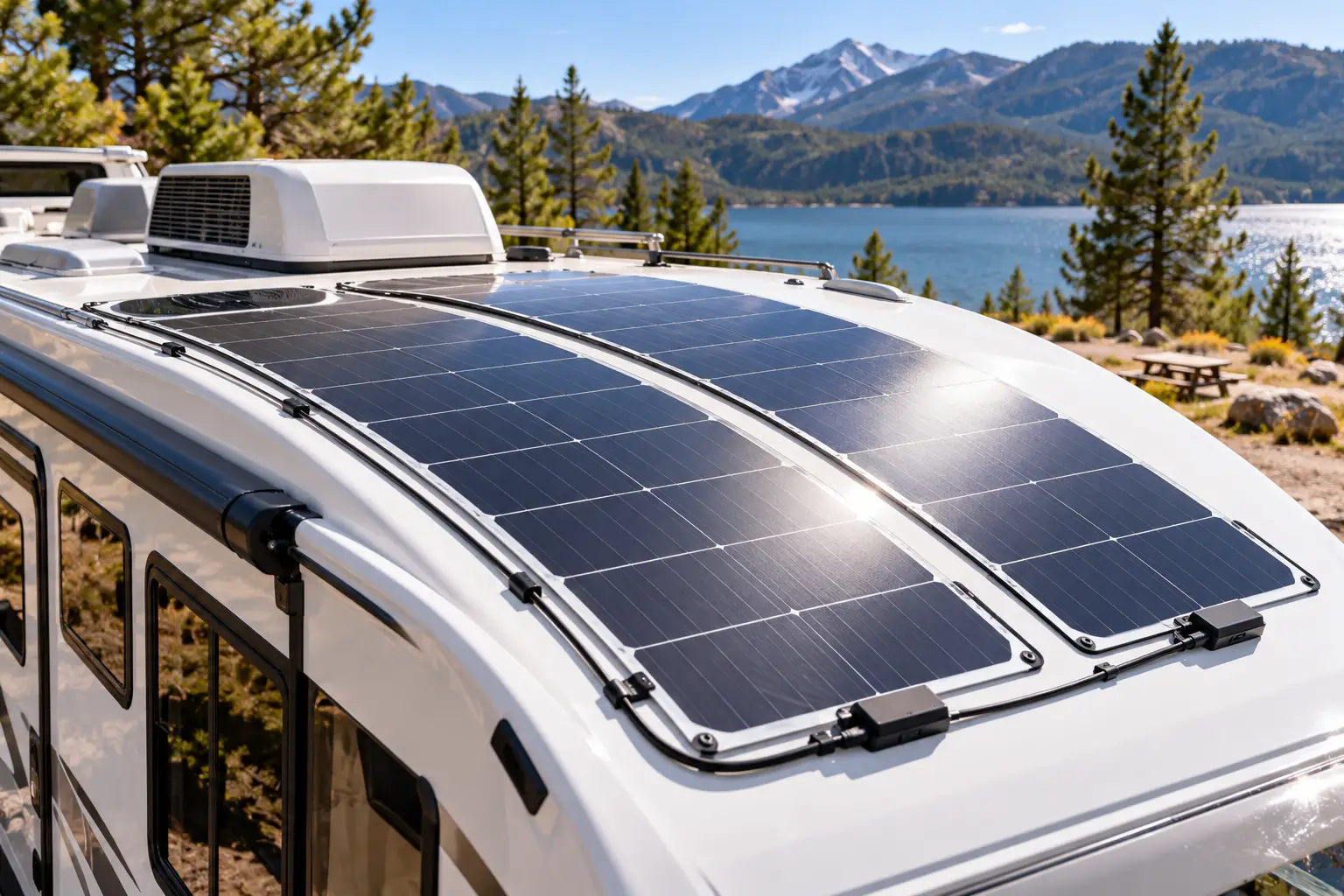
Roof shape. For a solar panel for truck roof use, NACFE’s report says panels commonly go on roof air deflectors, with at least one fleet using hoods, because thin flexible panels now follow curves. The Mack Anthem owner above reached a sharper conclusion after his install: large panels do not suit a compound-curved sleeper roof, and panels no bigger than about 2 by 3 feet, in greater number, work better even though they mean more wiring. Trailers are the easier surface for a roof-mounted array. They offer more flat area, and FreightWaves says panels there are often used to charge reefer batteries.
Voltage. A 12-volt truck system floats batteries near 14 volts, per the same owner, yet a panel’s working voltage is higher and climbs as panels are wired in series. The same owner replaced the inverter’s PWM controller with a 100-volt, 40-amp MPPT unit, which handled his roughly 70-volt, 35-amp array.
Where the truck sleeps. Shaded truck stops or tree-lined lots favor panels that can move. Fixed roof panels favor drivers who park in open lots.
Cost. NACFE put a 300-watt installation, panels and controls included, at about $2,000 in its 2018 report, with a payback of roughly three years depending on the application. On the carrier side, GP Transco estimates savings of about $1,700 per tractor per year at $4 diesel and 110,000 miles, roughly the cost of one unit bought in bulk. Both figures are estimates; NACFE found little fleet-reported data to confirm manufacturer claims.
Pick
Situation it fits
Size and weight (maker listing)
Watch for
Renogy 100W Lightweight Flexible Solar Panel
Curved sleeper roof or fairing
43.0 x 22.9 in, 5.3 lb
Several panels mean more wiring
Rich Solar MEGA 200 Watt 12V Solar Panel
Flat trailer roof or flat mounting surface
58.7 x 26.8 x 1.2 in, 24 lb
Weight and a gap above the roof
Renogy 100 Watt Eclipse Solar Suitcase
Leased or shaded truck, nothing mounted
20.5 lb, folding with kickstands
Output depends on the controller
Renogy Rover 40A MPPT Charge Controller
Any array above roughly 20 volts
40 A, up to 100 V input
520 W cap on a 12-volt system
Renogy 12V 50A DC-DC Charger with MPPT
Alternator plus a small solar array
50 A, 50 V solar input limit
Solar voltage ceiling
The table sorts panels by where they can physically live and controllers by what voltage they can safely accept. A series string running into a PWM unit rated near 20 volts is the mismatch the Mack Anthem owner ran into, and a 50-volt solar input rules out longer series strings. Measure the fairing against the listed dimensions before choosing a panel size.
Which setup fits which truck
Solar panels for semi trucks come in three physical formats: small flexible sheets for curves, rigid panels for flat areas, and folding units that never touch the roof. Each is paired below with the situation it suits.
A sleeper roof or air-deflector fairing that curves in two directions is the situation this panel is built around. The maker lists it at 43.0 by 22.9 inches and 5.3 pounds, flexing up to 240 degrees. That footprint sits close to the 2-by-3-foot ceiling the Mack Anthem owner recommended after his larger panels refused to lie flat.
On the electrical side, each panel lists 20.7 volts at maximum power and 24.4 volts open-circuit. Three wired in series add up to about 73 volts open-circuit, which is why the controller choice below matters as much as the panels. Wired in parallel, they stay near 24 volts.
Renogy’s own listing shows 77 reviews averaging about 4.8 stars, with buyers praising the weight and the easy install. Complaints include one buyer with five panels who reported overload errors and another who found grommet holes imprecisely placed. One buyer on a retailer listing says previous glued-down flexible panels lasted around six years on an RV roof, which is a single owner’s expectation, not a measured lifespan. The maker backs the panel with a 5-year output warranty and a 5-year material and workmanship warranty. The page lists efficiency at 15.7 percent in the spec table but 22 percent in the headline; the spec table is the safer number to plan around.
Pros:
Weighs 5.3 pounds, so a few panels barely add to roof load
Flexes to fit curved fairings and hoods
5-year output warranty
Cons:
The Mack Anthem owner found the adhesive allowed only one placement attempt
Several small panels mean more wiring and connectors
Renogy also lists a 200-watt flexible version at 63.2 by 29.4 inches and 10.8 pounds, closer to the size the forum owner warned about.
Renogy 100W Lightweight Flexible Solar PanelSee current price, sizes and reviews on Amazon.
Rigid panels trade easy mounting for more power per panel. This one is a tempered-glass, aluminum-frame monocrystalline panel rated 200 watts, and the maker lists it at 58.7 by 26.8 by 1.2 inches and 24 pounds. Dealer pages disagree slightly on weight, from about 15 pounds to 26.5 pounds, so the maker’s figure is the one to trust.
The fit is a flat surface. NACFE says trailers offer more room than tractors, and the Overdrive profile of a custom Peterbilt shows an array of home-style panels at about 1,100 watts feeding a large battery bank to run HVAC and refrigerators. A rigid panel on a curved sleeper roof would need standoffs. A Truckers Report thread raised the question of leaving an air gap to prevent heat from soaking into the cab roof, though the owner in that exchange had mounted on a fairing above the actual cab roof.
Weight is the main trade. FreightWaves describes flexible roof panels weighing under 20 pounds, which a single rigid panel here exceeds. The compensation is the warranty: Rich Solar lists a 25-year output warranty plus a 5-year limited material and craftsmanship warranty, and dealer pages list the panel at around $190 to $240.
Rich Solar MEGA 200 Watt 12V Solar PanelSee current price, sizes and reviews on Amazon.
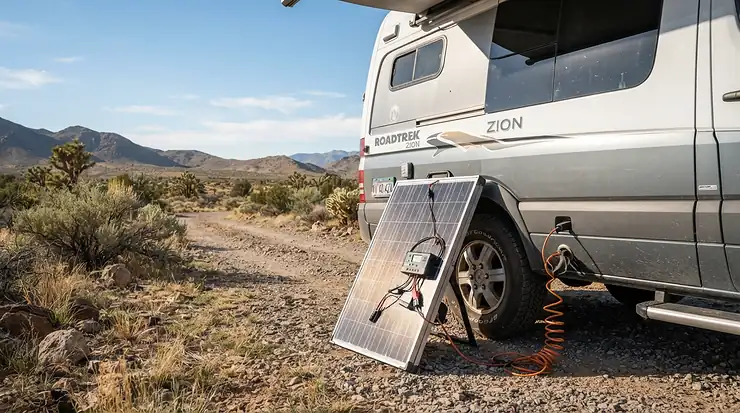
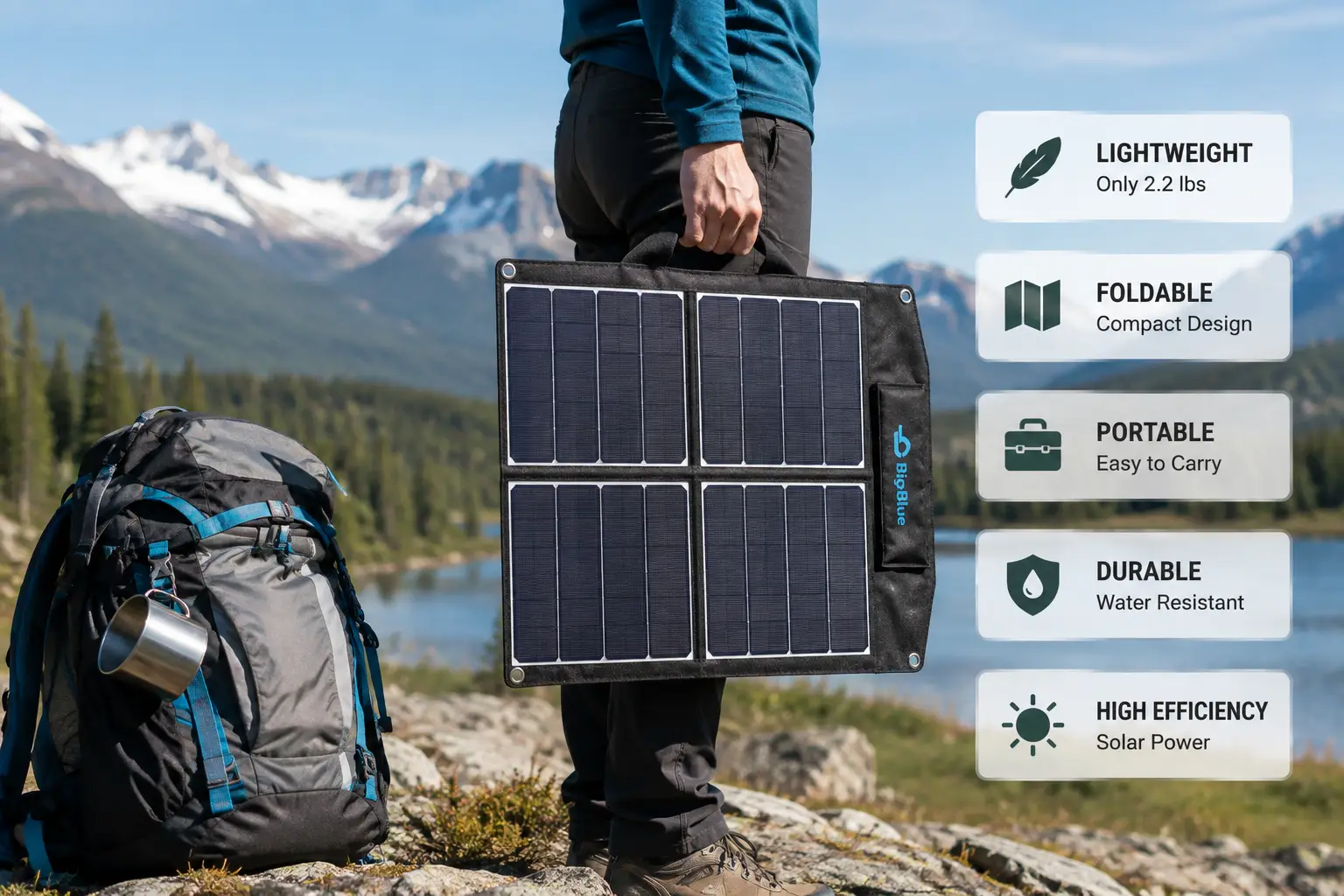
For a hypothetical leased tractor where the owner does not allow adhesive or drilling on the roof, a folding suitcase keeps the truck unmodified. A Truckers Report poster describes panels kept inside the cab and unfolded once the truck is parked. It also solves shade: set it in the sun while the truck sits in the shade.
The listing gives 20.5 pounds, 24.3 volts open-circuit, 20.3 volts at maximum power, 22 percent cell efficiency and adjustable aluminum kickstands. The maker’s warranty is 3 years on materials and workmanship, with output guaranteed at 95 percent at 5 years, 90 percent at 10 and 80 percent at 25. Among the reviews shown on the listing, most are five-star, but two reported low output: one saw about 60 watts until switching to a different charge controller, and another saw 30 to 45 watts on an overcast day. Those are individual reports, though they do show how much the controller and sky affect the number.
Pros:
No roof drag or adhesive, and it can follow the sun around a lot
3-year workmanship warranty with a 25-year output schedule
Cons:
20.5 pounds to carry, set up and stow every stop
Offers no charging while the truck is moving or unattended
The bundled version includes a 20A Voyager PWM controller, while the “w/o controller” listing leaves that choice to the buyer.
Compare the exact model number before you buy, because Renogy sells flexible, suitcase and controller-bundle variants that share names.
Renogy 100 Watt Eclipse Solar SuitcaseSee current price, sizes and reviews on Amazon.
A controller decides how much of a high-voltage array actually reaches the batteries, and the Mack Anthem owner learned this by replacing a PWM unit that tops out near 20 volts. The Rover listing shows a 15 to 100 volt open-circuit input range, a 40-amp rating, automatic 12-volt or 24-volt detection for non-lithium batteries, and the ability to charge over-discharged lithium batteries.
The numbers that matter are the caps. Maximum PV input power is 520 watts on a 12-volt system (1,040 watts on 24 volts), so the owner’s 480-watt array fits, while his full 640-watt kit would exceed the rating. The unit has an LCD showing PV voltage after connection and a 3-year workmanship warranty. Bluetooth is not built in; the maker sells an optional BT-2 module for the RS485 port.
Three flexible 100-watt panels wired in series, at about 73 volts open-circuit by the spec sheets above, stay under the 100-volt ceiling, though open-circuit voltage rises in cold weather and the margin should be checked against the panel’s temperature data. The controller’s model number is RNG-CTRL-RVR40.
Renogy Rover 40A MPPT Charge ControllerSee current price, sizes and reviews on Amazon.
The solar input on this charger tops out at 50 volts on the 50-amp model, so it suits one or two panels, not a 70-volt array. Two of the 100-watt flexible panels above wired in series reach about 48.8 volts open-circuit on their spec sheet, which leaves almost no cushion once cold weather lifts the voltage; wired in parallel, they sit near 24 volts and clear the limit easily. That is reasoning from the spec sheets, not a maker recommendation.
What the unit adds is alternator charging. The maker’s page lists 13.2 to 16-volt input for conventional alternators and 12 to 16 volts for smart alternators, which need an included ignition-signal wire. A built-in voltage-sensitive relay isolates the starter and house batteries, reverse-current protection stops the house bank draining into panels at night, and app monitoring is supported. It handles AGM, gel, flooded and lithium chemistries, with the type set by a push button because there is no display.
For a truck that already has a house bank on the alternator and only wants a modest solar top-up, this is the tidier route. Renogy gives the 50-amp model a 2-year warranty and lists a 7-day return window.
Renogy 12V 50A DC-DC Charger with MPPTSee current price, sizes and reviews on Amazon.
The failure modes in the sources trace back to a few decisions.
Adhesive that allows one try. The Mack Anthem owner reports a rubberized adhesive that left a visible gap and an overlap between panels, then planned to fix edge lift with 3-inch tape and primer.
Cab-roof drag. Royal Jones, quoted in a Heavy Duty Trucking fleet-solar feature, tried cab-mounted panels to extend electric-APU run time and abandoned them because the aerodynamic penalty was too great. He later moved to six roof-fairing and hood panels totaling 600 watts with four deep-cycle batteries.
Alternator wear. NACFE notes that alternator wear rises slightly when panels charge batteries on the road.
Harsh surroundings. FreightWaves lists road debris, vibration and temperature extremes as the difficult environment, and notes that earlier panel versions stopped working if any part was damaged, while newer ones isolate the damage to one section.
Skimping on the battery bank. The Overdrive owner’s advice is to treat batteries as the main investment and expect trial and error.
Idling rules add a second reason to go electric overnight. The American Transportation Research Institute keeps a free compendium of state and local idling regulations, and the limits it lists run as short as 3 minutes in Chicago and 5 minutes in Maricopa County, Arizona. Rules vary by place, so the compendium itself, not this guide, is the thing to check on a given route.
Tesla Semi solar, roof drag, and payback: short answers
Does the Tesla Semi have solar panels?
Tesla's Semi page describes a fully electric truck with Long Range and Standard Range trims and does not list a roof solar array. Musk's early plan was solar-backed Megachargers for charging, which is a different thing from panels on the truck.
Can solar panels run a sleeper air conditioner?
Not by themselves. An Overdrive profile of a truck that runs roof HVAC and two refrigerators pairs about 1,100 watts of panels with twelve golf-cart batteries. The panels refill the bank during the day; the batteries carry the night load.
Where do panels go on a tractor-trailer?
Roof air deflectors are the common spot, and at least one fleet has put panels on hoods, according to NACFE's report as covered by Heavy Duty Trucking. Trailers offer more area, mainly for reefer batteries, liftgates and pallet jacks.
Do roof panels hurt fuel economy?
NACFE says fuel savings from solar are generally small, so batteries and idle time are the real payoff. One carrier told Heavy Duty Trucking that panels on a cab roof carried too much aerodynamic penalty, and the effort was dropped.
How long does it take for solar panels to pay for themselves?
NACFE's report put a 300-watt installation near $2,000 in 2018 and described payback of roughly three years, depending on the application. GP Transco's own estimate is about $1,700 saved per tractor per year, a carrier figure rather than an independent one.
A fit-first way to buy solar panels for semi trucks
Start with the surface, then the voltage, then the budget. A curved sleeper roof points to small flexible panels such as the Renogy 100W Lightweight Flexible Solar Panel; a flat trailer roof points to a rigid panel like the Rich Solar MEGA 200 Watt 12V Solar Panel; a truck that cannot be modified points to the Renogy 100 Watt Eclipse Solar Suitcase. Whatever the panels, an array above about 20 volts needs an MPPT unit such as the Renogy Rover 40A MPPT Charge Controller, and a small solar top-up for a truck with an alternator-fed house bank suits the Renogy 12V 50A DC-DC Charger with MPPT.
Expect batteries to stay healthier and idling to drop. Do not expect panels to run an air conditioner without a large bank behind them. Buying solar panels for semi trucks is a fit decision first, a wattage decision second. Compare each listing’s dimensions and voltage figures against your own roof and batteries before ordering.