As an Amazon Associate I earn from qualifying purchases. Links in this article may be affiliate links. How we choose gear
Solar power for cabin use is really two jobs under one name. A weekend load list in Anker’s off-grid cabin guide adds up to 1,975 watt-hours a day, while TheGreenWatt builds its cabin example around 7 kWh a day, about 3.5 times as much (7,000 ÷ 1,975, a sample calculation). Everything that follows in 2027, from panel count to battery size, shifts with which of those two cabins is yours.
Maker spec sheets, sizing guides from Anker, Renogy and TheGreenWatt, forum threads relayed by The Cool Down and buyer reviews reproduced on retailer pages supply the figures below. Four setups cover the range: a plug-in power station, a panel-and-controller set for a DIY build, a boxed 12V bundle and a 24V system.
The short answer: a cabin used a few days at a time can run on a roughly 1 kWh power station, a seasonal cabin with a fridge and lights does better with 400 watts of panels and about 2.5 kWh of lithium storage, and a lived-in cabin needs a 24V system near 1,200 watts with 7 kWh of storage plus a generator for the dark weeks.
Sizing solar energy for cabin use: watt-hours first, panels second
Start with a list of every device, its wattage and the hours it runs. Anker’s weekend example, a two-bedroom cabin with four guests, totals 1,975 Wh a day: four LED fixtures at 200 Wh, phone charging at 40 Wh, a laptop at 195 Wh, two fans at 240 Wh, a coffee maker and flashlight charging at 100 Wh, and a small portable fridge at 1,200 Wh. The fridge alone is about 61% of the total (1,200 ÷ 1,975).
Idle draw gets forgotten. An Oukitel sizing guide notes that a pure sine wave inverter can pull 20 to 40 W by itself, which adds 480 to 960 Wh over 24 hours and can leave a battery 10 to 20% undersized.
How many solar panels for cabin loads
Anker’s formula divides daily watt-hours by peak sun hours (PSH), then by 0.85 as a planning allowance for losses. For the 1,975 Wh example at 5 PSH that gives about 465 W as a bare minimum, and Anker suggests two or three 400 W panels for margin. The 0.85 is an allowance, not a yield guarantee.
Sun hours change the answer fast. TheGreenWatt’s table holds the load at 7 kWh a day and swaps the location:
Peak sun hours
400 W panels needed
Array size
6 (Southwest, Mountain West)
4
1.6 kW
5 (US average)
5
2.0 kW
4 (Pacific Northwest, Great Lakes)
7
2.8 kW
3.5 (northern US winter)
8
3.2 kW
Moving from a sunny site to a gray one doubles the panel count for the same load. NREL’s PVWatts calculator estimates energy output for any address; it is built for grid-connected systems, but its monthly output estimates show how far winter falls below summer at your location.
For solar power for small cabin builds, the load list matters more than the array. A buyer of ECO-WORTHY’s 200 W starter kit, quoted on a retailer page, says three panels ran phones, a laptop, a fan and a light at an off-grid cabin but the battery took days to fill, and advises buying a larger kit. That is one report, yet it matches the arithmetic: 200 W at 4 PSH yields roughly 680 Wh a day (200 × 4 × 0.85).
Battery and inverter size
Anker’s battery formula multiplies daily watt-hours by the days you want covered, then divides by 0.8 for depth of discharge and 0.9 for efficiency. Two days of the 1,975 Wh example comes to about 5,486 Wh. TheGreenWatt recommends two days of autonomy for most locations, though its own table (365 Ah at 48V for two days) and its FAQ (456 Ah) disagree, a reminder to run the numbers for your own loads.
Inverters follow the biggest motor you plan to start. TheGreenWatt lists 2,000 W continuous with 4,000 W surge for a basic cabin, 3,000 W with 6,000 W surge for a standard one, and says a well pump needs a surge rating of at least 2,250 W.
Winter output: why a summer-sized cabin solar system still needs a generator
TheGreenWatt advises cutting peak sun hours by 40 to 50% when sizing for winter, and reports that a 2.4 kW system loses between 43% (Flagstaff) and 82% (Anchorage) of its summer output in the dark months.
Cabin owners say the same thing. A Reddit thread relayed by The Cool Down describes a cabin expected to use about 3,500 Wh a day, with roughly 5.5 PSH in summer and 2.5 to 3 in winter. One Pacific Northwest commenter reports 20+ kWh in summer but a maximum near 2 kWh a day in rainy winter spells, and calls a regularly run generator the only sensible fix. Another owner moved from 24V to 48V, more than doubled the array, and still burns a little diesel. Commenters advise modeling the system around winter, tilting panels more steeply and clearing snow, while agreeing those steps only go so far on dark, wet days.
A cabin that is empty from November to March can ignore all this. A lived-in one should budget for a generator, which TheGreenWatt prices at $500 to $800 for a 3,000 W dual-fuel unit.
Which cabin solar kit fits which stay
Each pick below maps to one kind of stay, and the table shows how they differ before the detail.
Product
Best-fit stay
Storage
Solar input
Main limit
EcoFlow DELTA 2
A few days at a time
1,024 Wh
Panels sold separately
About half a day of a 1,975 Wh load
Renogy 400W 12V Premium Kit
DIY seasonal build
None included
400 W, 40A MPPT
Battery and inverter extra
ECO-WORTHY 1.6KWH 400W Complete Kit
Seasonal cabin
2 × 12V 100Ah (2,560 Wh)
400 W, 40A MPPT
2,000 W inverter, setup friction
ECO-WORTHY 1200W 24V 5.52KWH Solar System
Lived-in cabin
2 × 12.8V 280Ah (7,168 Wh)
1,170 W, 60A MPPT
Needs about 58 sq ft of clear space
The Renogy set is only the generating half of a system, while both ECO-WORTHY bundles arrive with storage and an inverter. Storage grows much faster than solar across the four: 400 W of panels pairs with 2,560 Wh in the third row, but 1,170 W pairs with 7,168 Wh in the fourth, a ratio that favors multi-day stays over fast recharging.
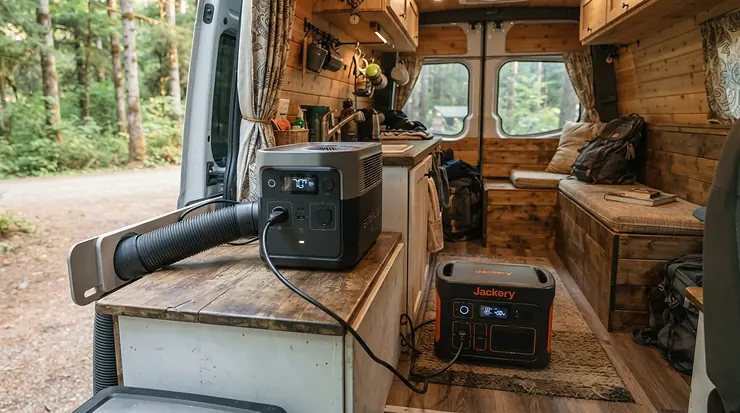
A cabin visited for two to five days at a stretch is the job PopSci’s review matches this unit to, and the reviewer adds that it falls short for extended outages or full-time living. The EcoFlow DELTA 2 holds 1,024 Wh in a lithium iron phosphate battery and weighs about 27 pounds. StorageReview and CameraJabber list 1,800 W of AC output (2,200 W with X-Boost), while PopSci lists the AC outlets at 1,200 W, so the product page is the figure to trust.
Solar input is another place sources differ: StorageReview gives up to 500 W, PopSci up to 400 W. Panels are sold separately, and PopSci reports that a full recharge from sun takes five or six hours in realistic conditions, against about three in perfect light. Its runtime estimates run from 7 to 14 hours for a full-size fridge to about a day and a half for a car fridge. Against Anker’s 1,975 Wh sample load, 1,024 Wh covers about half a day (1,024 ÷ 1,975 = 0.52).
Owners of cabins describe two different habits. One buyer with an island cabin, quoted on a retailer page, wishes the solar bundle had been skipped because the unit recharges quickly from a generator. Another, with a roughly 200-square-foot cabin in northern Michigan, describes two 100 W roof panels plus a small inverter generator feeding the unit. Both are single reports, and both show the station working as the hub of a mixed system.
EcoFlow’s page for the newer EcoFlow DELTA 3 lists the same 1,024 Wh and 1,800 W with a 500 W solar input, 4,000 cycles and a five-year warranty, so check which generation the listing shows. PopSci and Review Geek quoted the DELTA 2 at roughly $900 to $1,000; check the current price on Amazon.com. Because the battery and inverter sit in one 27-pound box, the whole system can leave with the owner when the stay ends.
EcoFlow DELTA 2See current price, sizes and reviews on Amazon.
This is only half a system, and Renogy’s own support page says so by omission: it lists panels, charge controllers, wiring, fuses and monitoring, and mentions no battery or inverter. Four 100 W monocrystalline panels feed a 40A MPPT controller, with Z-brackets, cables, an 8-foot 8 AWG tray cable, in-line and ANL fuses and a Bluetooth monitoring module listed on Renogy’s regional pages. Renogy claims the MPPT controller harvests up to 30% more than PWM designs and puts average output at 1.6 to 2.5 kWh a day depending on sun.
Run the same allowance Anker uses and 400 W gives 1,360 Wh at 4 PSH (400 × 4 × 0.85), about 69% of the 1,975 Wh weekend load, and 1,700 Wh at 5 PSH, about 86%. That makes it a solid base for lights, a laptop and a small fridge in a sunny location, and a partial supplement anywhere gray.
The kit suits someone who wants to pick battery chemistry and inverter separately, and who is comfortable following a fusing plan (see the wiring section below). A 12V lithium bank and an inverter chosen to match the controller are the first two purchases to line up.
Pros:
Fuses, cables and brackets included
40A MPPT controller with Bluetooth monitoring
Cons:
No battery or inverter
Four separate panels to mount and string
Check the current price on Amazon.com.
Renogy 400W 12V Premium KitSee current price, sizes and reviews on Amazon.
Two versions of this listing exist, so the details matter: the version with two 12V 100Ah lithium batteries and a 2,000 W pure sine inverter carries item model US-L02M100N-MCWMZIUS2000L200-4, while another lists one battery and a 1,100 W inverter. The two-battery version bundles four 100 W bifacial panels, a 40A MPPT controller, 2,560 Wh of nominal storage (12.8 V × 100 Ah × 2), a Bluetooth module and a listing figure of 3,000+ battery cycles. ECO-WORTHY claims up to 1.6 kWh a day.
Anker’s runtime formula (2,560 × 0.9 ÷ 1,975) gives about 1.2 days of the sample load, which fits a seasonal cabin where the family arrives, runs the fridge and leaves. A 400 W array at 4 PSH makes about 1,360 Wh a day, less than the sample load, so a long stay drains the bank slowly.
Buyer reviews on retailer pages show a setup learning curve more than a hardware verdict. One reports directions in the box contradicting the video instructions, another an error code on the inverter’s wired remote, and a third says the system would not leave standby and the battery kept charging from a generator even in strong sun. Other buyers on the same pages say support ended up resolving their problems. Retailer pages put the kit around 4 out of 5 stars.
A well pump is the load to check: TheGreenWatt says one needs a surge rating of at least 2,250 W, so confirm the inverter’s surge figure on the listing before pairing it with one. Check the current price on Amazon.com.
ECO-WORTHY 1.6KWH 400W Complete KitSee current price, sizes and reviews on Amazon.
A deal tracker showed this listing moving between about $2,000 and $2,900 depending on promo codes, which makes it the largest bundle here and the only one built around a lived-in cabin. It bundles six 195 W bifacial panels (1,170 W), two 12.8V 280Ah lithium batteries (7,168 Wh, calculated from 12.8 × 280 × 2), a 60A MPPT controller and a 3,000 W pure sine inverter, with Bluetooth monitoring listed at 82 feet.
The headline claim deserves a second look. The listing says 5.52 kWh a day under four hours of sun, yet 1,170 W × 4 h is 4.68 kWh before any losses, and with Anker’s 0.85 allowance it is about 3,978 Wh. That covers the Reddit cabin’s 3,500 Wh a day in summer; in winter at 2.75 PSH it falls to about 2,735 Wh (1,170 × 2.75 × 0.85), short of the load. Against TheGreenWatt’s 7 kWh example it covers about 57% at 4 PSH. Storage is generous: by Anker’s formula, 7,168 × 0.9 ÷ 1,975 is about 3.3 days of the weekend load, a figure Anker itself calls optimistic.
Space is the other number. ECO-WORTHY’s store lists its 195 W panel at 52.6 by 26.4 inches, so six cover about 58 square feet (calculated). One buyer of the 5.52 kWh kit says the panels were sitting in shade until a dual-axis tracker went on, which nearly doubled output. That is one report, but it shows why panel placement is worth more than a bigger array.
Pros:
7,168 Wh of storage in two batteries
60A MPPT controller and 3,000 W inverter in one bundle
Cons:
Listing daily output is higher than the simple math
About 58 square feet of unshaded space needed
Two 280Ah batteries and six panels to place, mount and wire
Pair it with a $500 to $800 generator for the dark weeks, per TheGreenWatt’s pricing. Check the current price on Amazon.com.
ECO-WORTHY 1200W 24V 5.52KWH Solar SystemSee current price, sizes and reviews on Amazon.
How to set up solar power for cabin use: the order that avoids rework
The sequence matters more than any single part, and the steps below run in the order mistakes are cheapest to fix.
Write the load list in watt-hours and mark the fridge, pump and any motor loads.
Pull monthly sun numbers for the address and size for the worst month the cabin is occupied.
Pick the system voltage. EDECOA’s off-grid guide says systems above roughly 3,000 W should strongly consider 48V, so 12V suits the small kits and 24V the mid-size one.
Choose where panels go. TheGreenWatt suggests buried conduit from a ground-mounted array to the cabin’s electrical panel, plus wire mesh to keep animals out from under the array.
Mount the battery and inverter in a dry, shaded, ventilated spot, per Anker’s guidance.
Wire, fuse and ground the system, then set the controller’s battery type to lithium. Renogy’s setup guide lists a wrong battery type as a cause of batteries that never fully charge.
Watch the first week of charge data in the monitoring app before adding loads.
How to wire a cabin for solar power: fuses, cable runs and the AC side
Power flows panels, controller, battery, inverter, then the cabin’s AC panel. Renogy’s wiring guide puts a fuse or breaker in three places: between panels and controller, between controller and battery, and between battery and inverter. Controller-to-battery fuses are sized at about 1.25 times the controller’s maximum output, so a 40A controller like the one in the ECO-WORTHY 1.6KWH 400W Complete Kit calls for a 50A fuse (40 × 1.25, a sample calculation from Renogy’s rule). The panel-side fuse is 1.25 to 1.56 times the array’s short-circuit current, and the battery-side one 1.25 to 1.5 times the inverter’s maximum draw. Renogy’s fusing guide adds that the controller-to-battery fuse belongs as close to the battery as possible.
When the fuse size exceeds a cable’s rating, Renogy’s DC fuse guide says to increase the wire gauge rather than lower the fuse. Voltage drop adds a second cable decision on long runs; one installer’s write-up reports a 30-foot panel run needing 8-gauge wire instead of 10-gauge to stay under 3% loss, which is one account, not a code requirement.
Grounding is the step most often skipped: Renogy’s setup guide lists an ungrounded inverter as a shock risk, with the fix being a 10 AWG ground wire to the chassis. The AC side is where a licensed electrician earns the fee. Anker’s guide points readers to the product manual and a licensed electrician for wire sizing, fusing and code, and permit rules differ by state and county.
What cabin solar costs, and where the money goes
TheGreenWatt’s budgets for solar power for cabin builds, which include wiring, breakers and conduit, run $3,000 to $4,500 for a basic 1.6 kW weekend cabin and $5,500 to $7,500 for a standard 2.4 kW year-round one, with a full DIY range of $3,000 to $8,000. Professional installation adds $2,000 to $5,000, and MPPT controllers alone run $200 to $600. The kits above land below those totals because they leave out conduit, a subpanel and often the generator.
The battery is the largest single line. TheGreenWatt’s 48V lithium estimates run from $2,500 to $3,500 for one day of a 7 kWh load up to $7,500 to $10,500 for three days.
Mistakes that send cabin solar kits back
The problems reported in the sources trace to a short list of mismatches:
Sizing from summer sun, then discovering a gray December.
Trusting a listing’s daily-output claim without multiplying watts by sun hours.
Missing always-on loads, such as an inverter’s idle draw or a fridge that runs all day.
Buying panels without checking the controller, battery and inverter match, since the Renogy 400W 12V Premium Kit leaves the battery and inverter to the buyer.
A fifth is skipping the fuses and ground wire because the kit “just worked” on the bench.
Panels, batteries and permits: quick answers for a cabin build
How many solar panels do I need for a small cabin?
Anker's cabin guide sizes a 1,975 watt-hour weekend load at about 465 watts of panels with five peak sun hours, then suggests two or three 400 watt panels for margin. Lighter loads need less, while shade and winter push the count up.
Can solar panels power a cabin without batteries?
Not for use after dark. South Carolina's solar program notes that off-grid systems store unused solar energy in batteries for night use, so a cabin that needs lights or a fridge in the evening needs storage as well as panels.
Does wiring a cabin for solar power need an electrician or a permit?
Rules vary by state and county. Anker's cabin guide sends readers to the product manual and a licensed electrician for wire sizing, fusing and code questions, and the local building department can say whether AC wiring to a cabin panel needs a permit.
How much battery storage does a weekend cabin need?
Anker's formula multiplies daily watt-hours by the days you want covered, then divides by 0.8 for depth of discharge and 0.9 for efficiency. For its 1,975 watt-hour example, one day works out to about 2,743 watt-hours and two days to about 5,486.
How much less power does cabin solar make in winter?
Output falls sharply. TheGreenWatt advises cutting peak sun hours by 40 to 50 percent when sizing for winter, and cabin owners relayed by The Cool Down describe running a generator through rainy winter weeks even with large arrays.
Matching a kit to your cabin
The load list decides everything else. A cabin visited for a few days a season fits a plug-in station such as the EcoFlow DELTA 2, a seasonal cabin with a fridge and lights suits the ECO-WORTHY 1.6KWH 400W Complete Kit or a self-assembled build around the Renogy 400W 12V Premium Kit, and a lived-in cabin points to the ECO-WORTHY 1200W 24V 5.52KWH Solar System plus a generator for December. Solar power for cabin use rewards sizing against winter sun rather than July, and it rewards fuses, a grounded inverter and a licensed electrician on the AC side. Spotted one you like? Take a closer look at its listing for battery voltage, inverter surge rating and what ships in the box.
Disclaimer: This post contains affiliate links. As an Amazon Associate, we earn from qualifying purchases made through these links, at no additional cost to you.
Match the battery voltage and inverter input on any listing to your own watt-hour list before you order.