As an Amazon Associate I earn from qualifying purchases. Links in this article may be affiliate links. How we choose gear
A GE backup bulb gives up to five hours of battery light, according to its maker, while a closed refrigerator stays safe for about four hours, according to FoodSafety.gov. Those two numbers show why light backup is rarely a single purchase: the lamp in your living room and the food in your kitchen run out of time on different clocks.
This 2027 guide splits the topic into the jobs people actually have: keeping a lamp lit, leaving a guide light in a hallway, getting through a long blackout, protecting the refrigerator, and adding a stronger reverse lamp to a truck. Maker spec sheets, specialist-press reviews, owner and buyer threads, and a federal food safety chart carry the findings, so each pick comes with a reason and a stated limit instead of a vague promise.
Where “light backup” splits: bulbs, plug-in lights, batteries, and reverse lamps
The same phrase covers products that have nothing in common. Four meanings show up in searches, and mixing them up is the fastest way to buy the wrong thing.
An LED light bulb with battery backup screws into an ordinary socket, charges while the lamp is on, and keeps glowing when the grid drops. An LED light with battery backup can also be a plug-in unit that sits in a wall outlet and switches on by itself when power fails. A larger LED battery backup is a power station that feeds appliances through AC outlets. And in a vehicle, a backup lamp is a completely different part, covered further down.
What is a backup light bulb?
Two answers, depending on where you are standing. In a house, a backup light bulb is a rechargeable LED bulb with a small built-in battery. In a car, it is the white bulb at the rear that lights when you shift into reverse. They share a name and nothing else, and the sections below treat them separately.
Switch behavior, runtime, and recharge: what separates these picks
Brightness on the box is the least useful number. Three other details decide whether a light backup setup works the night the power goes out.
Switch behavior. A bulb has no way to know whether you flipped the wall switch or the grid failed. TechHive’s review of a Feit battery bulb found that in a lamp the bulb switched off and on normally and kept running when the breaker was cut, but in a hardwired wall fixture the battery engaged every time the switch went off, so the bulb could not be turned off at all (TechHive). A Home Depot buyer of a Simply Conserve rechargeable bulb reports a similar mismatch: a lamp on a wall-switched outlet did not stay lit when the switch was shut off. Two separate reports pointing the same way is a pattern, not a fluke. Test any new bulb in the exact fixture before you rely on it.
Runtime against brightness. Battery mode is dimmer than mains mode, sometimes by a wide margin. GE’s own page describes up to 5 hours at 760 lumens, while retailer listings for the same bulb state about 95 lumens in battery mode (one lists 120). Sources disagree, so read the retailer’s spec line, not just the headline. Plug-in emergency lights run far lower brightness in return for longer runtime, and that trade is the whole point of them.
Recharge and age. Rechargeable bulbs only charge while the fixture has power, so a wall switch left off keeps them empty. GE says to charge its bulb for 10 consecutive hours before the first outage. Small lithium cells also age: one buyer review of a six-pack of budget bulbs, mirrored on Desertcart, says three of four backup batteries from an earlier purchase died within a couple of months. That is a single report, but it fits the general advice to buy a brand that carries a warranty. GE’s page lists 3 years.
Here is how the five picks compare at a glance.
Situation
Pick
Power source
Stated runtime
Lamp or fixture you use daily
GE LED+ Battery Backup A21 Bulb
Built-in battery, charges while lit
Up to 5 hours (maker)
Hallway or bathroom guide light
Amerelle LED Emergency Light
Plug-in with rechargeable battery
Up to 7 hours (retailer listing)
Multi-day outage, low light
Ideal Security Rechargeable LED Power Failure Light
Plug-in with rechargeable battery
Up to 48 hours (retailer listing)
Refrigerator and essentials
Anker SOLIX S2000
2,010Wh battery with AC outlets
Up to 35 hours of fridge backup (maker)
Reverse lighting on a truck
Morimoto XB Backup Light Boost Bar
The vehicle’s 12V reverse circuit
Runs only in reverse
The runtime column compares unlike things, so treat it as a rough guide, not a ranking. The bulb and the plug-in lights are about getting around a room; the power station is about keeping a compressor running; the bar has no battery at all. A buyer comparing the first three should weigh brightness against hours, and one who needs the fourth should skip straight to the sizing math below.
Matching a pick to the room, the outage, or the truck
For someone who wants the light they already use to survive a blackout, this is the plainest route. The GE LED+ Battery Backup A21 Bulb is an 8W, 60W-equivalent bulb with an E26 base. GE’s page states up to 5 hours of battery light and a Li-ion LiFePO4 battery, and the listing carries a built-in flashlight mode: switch off the lamp, unscrew the bulb, and carry it. It is not dimmable and it is rated for indoor or damp use, so a bathroom fan light works but a dimmer circuit does not. A single bulb has sold for around $15 on GE’s shop and at Target, and GE’s page estimates its electricity cost at roughly $1 a year. BestReviews adds that a bulb in this category is not made for dimmer switches, and some buyers found similar bulbs too bright for everyday use.
The weak spot is switching. A buyer review mirrored on Desertcart says the bulb does not turn off in a ceiling fan or when several bulbs share one switch, and that during an outage it has to be switched with the button on the bulb, not the wall. That makes it a poor choice for a fixture you cannot reach. One buyer called it the better option for a true cordless lamp, which is the situation where the button is easy to press. Different GE LED+ Battery Backup A21 Bulb versions list 650 or 760 lumens, so confirm the version on the page before ordering.
If you are shopping for an LED light bulb with battery backup for a table lamp or a bedside lamp, start here.
GE LED+ Battery Backup A21 BulbSee current price, sizes and reviews on Amazon.
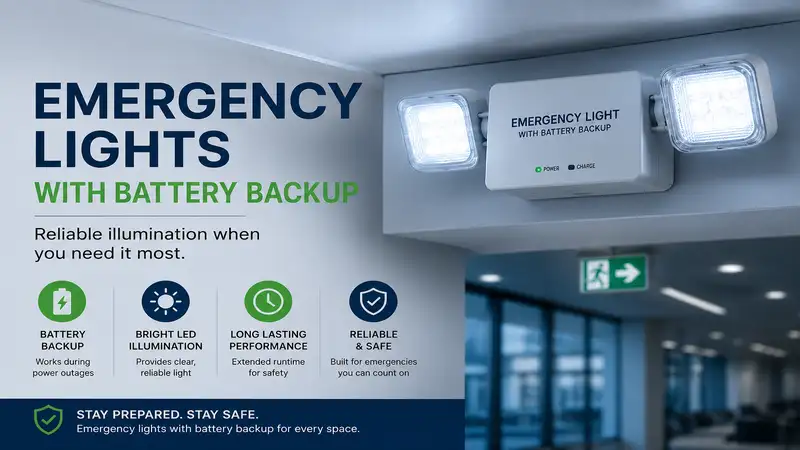
Some outages call for a light that finds you, not one you have to find. The Amerelle LED Emergency Light sits in a wall outlet, glows dimly as a guide light, and comes on at full strength when power fails. Retailer listings describe a 200-lumen LED panel, a rechargeable Ni-MH battery, and a flashlight function after you pull it out of the wall.
A buyer on a retailer’s review page reports that two units came on at power failure, tested through a power strip, and that one lasted over four hours at full brightness. That is one report, not a consensus, but it lines up with the stated seven hours on a lower setting. The trade-off is simple: the unit is single-purpose, and the red guide glow is a nightly presence in a bedroom. Check the current price on Amazon.com.
Hypothetically, a two-story house with the stairs and the bathroom as the places people fall in the dark is exactly where one or two of these earn their outlet.
Amerelle LED Emergency LightSee current price, sizes and reviews on Amazon.
Longer outages need a different design. The Ideal Security Rechargeable LED Power Failure Light (model 636V2) lists 140 lumens, three modes, dual adjustable heads, and up to 48 hours of light. The maker’s text also stresses an on-off switch so you can save battery when the light is not needed, and it warns that many similar-looking models cannot be turned off.
Runtime claims this large depend on the dimmest mode, and one buyer on a retailer listing says the lights stayed on low for six days without dimming. Read that as one owner’s outcome, not a guarantee. The heads detach from the plug, so the unit works as a small lantern on a table, which a fixed guide light cannot do. Buyers choosing between this and the Amerelle LED Emergency Light are really choosing between hours and simplicity.
Ideal Security Rechargeable LED Power Failure LightSee current price, sizes and reviews on Amazon.
Backup power for refrigerator: sizing the battery to the food
FoodSafety.gov says a refrigerator holds food safely for up to 4 hours without power if the door stays closed, and that perishables should be discarded after that. A full freezer holds for about 48 hours, a half-full one for about 24. Lights do not move those clocks. A compressor does.
Sources disagree on how much power a refrigerator draws. One buyer guide puts the long-run average at 50 to 150 watts, while Jackery says a home refrigerator typically consumes 300 to 800 watts, which describes the running draw while the compressor is on. The sticker inside the door gives the real figure for your unit. Anker adds that compressors can briefly need three to five times their running watts at startup, so surge output matters as much as capacity.
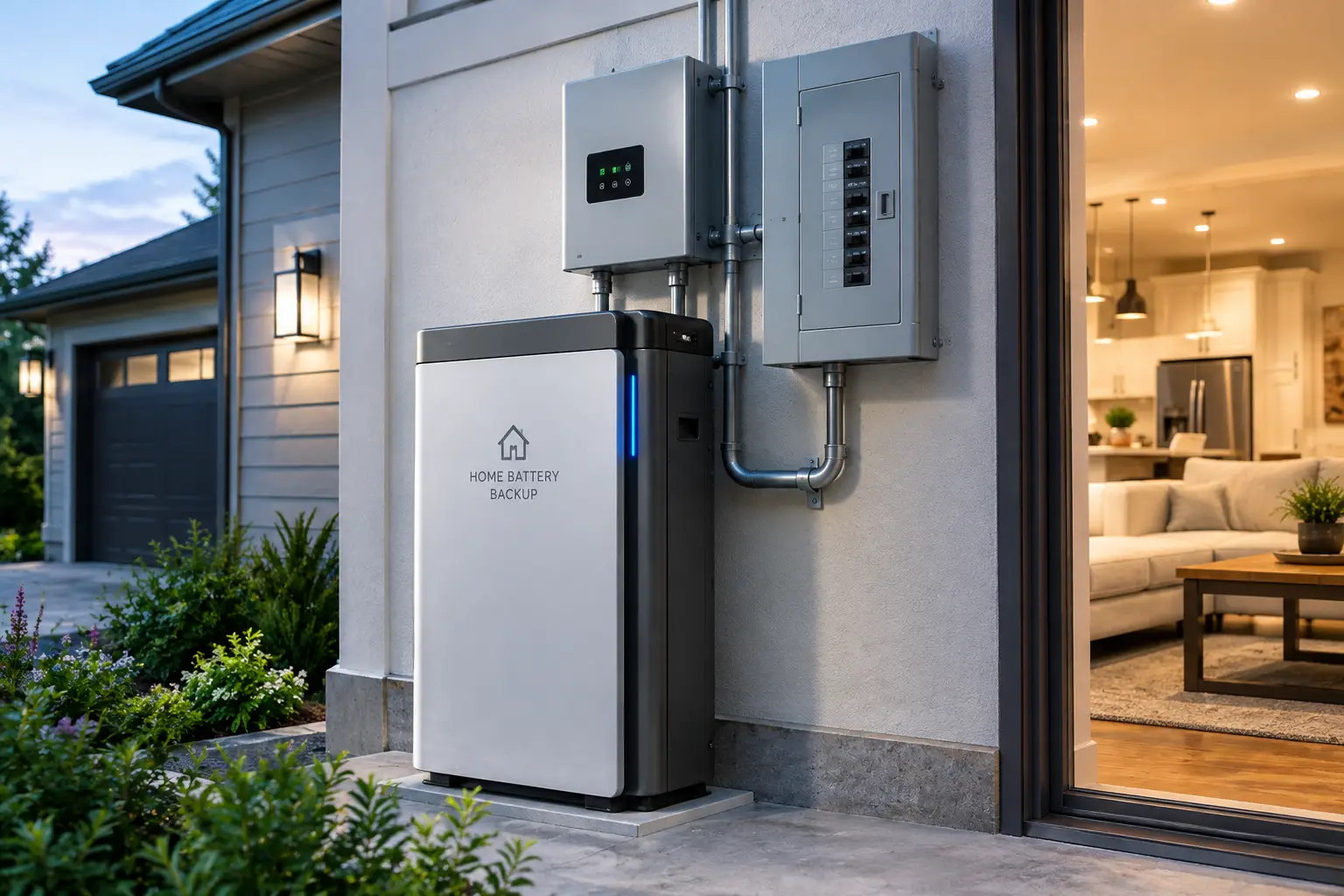
Anker’s runtime estimate is capacity in watt-hours times 0.8, divided by average watts. Sample calculation: a 2,010Wh battery at 0.8 gives 1,608Wh usable. At an assumed 100 watts average, that is about 16 hours; at 150 watts, about 11 hours; at 50 watts, about 32 hours. The same battery, three very different answers. That is why backup power for refrigerator use is sized on the appliance, not on the advertised hours.
4. Anker SOLIX S2000 — enough capacity for the fridge and the lights
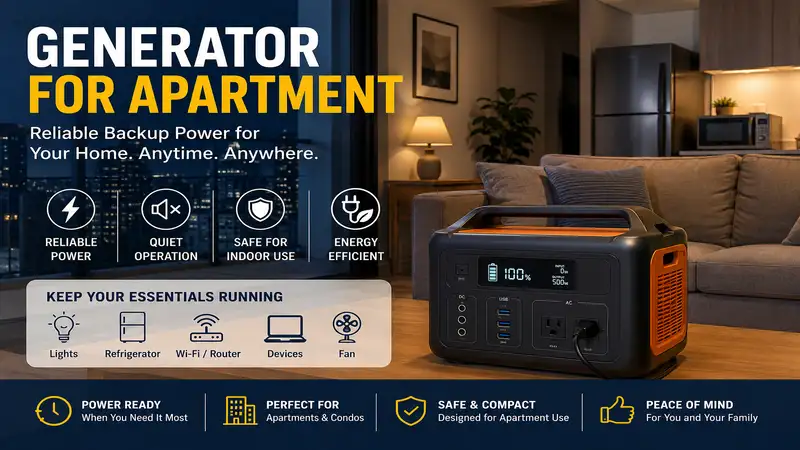
The Anker SOLIX S2000 is a 2,010Wh LiFePO4 power station with 1,500W of continuous AC output and a 3,000W peak, according to Anker and a dealer spec sheet. It weighs 35.7 pounds and has eight outlets. One review lists 2,400W continuous; the maker and two other sources say 1,500W, so trust the lower number when sizing a load.
Anker says its A+ runtime certification from TÜV SÜD translates to up to 35 hours of refrigerator backup. The Gadgeteer’s review notes the figure carries more weight if independent retests confirm it, which means the claim is still one maker’s number (The Gadgeteer). Gizmodo’s review adds a limit worth knowing: a 2kWh battery will not run an air conditioner at full blast for more than a few hours.
A power station also solves the lighting problem in one move. Plug in a low-power LED lamp, charge phones, and keep the compressor cycling. Anker’s store has shown it between roughly $600 and $700. For households that only want a glow in the hallway, it is far more than needed, and the plug-in lights above are the sensible spend.
For anyone weighing an LED battery backup that also feeds the kitchen, this is the one built for it, as long as the refrigerator’s startup surge sits comfortably under 3,000 watts.
Anker SOLIX S2000See current price, sizes and reviews on Amazon.
What is backup light in car terms: the reverse lamp, its switch, and the boost bar
Searchers who type “what is backup light in car” want a plain definition. CarAdvise describes a backup light as a safety feature mounted at the rear of a vehicle, also called a reverse light, that signals other drivers when the transmission is in reverse (CarAdvise). It switches on automatically through a switch tied to the transmission. When one stops working, the bulb is the usual culprit, followed by a fuse, wire, or the switch itself.
YourMechanic adds that the backup light switch sits under the hood, usually on the transmission, and can last the life of a vehicle, so wiring and bulbs fail more often. Replacement bulb types vary by vehicle, so the owner’s manual or the old bulb is the reliable reference. Auxito notes that US and UN rules require backup lamps to emit white light, which is why they stand out from the red tail lamps.
What is a backup light boost bar?
A backup light boost bar is an add-on LED bar that taps the reverse circuit and lights up when the vehicle is shifted into reverse, giving far more light than factory lamps. It is not a replacement bulb. It bolts to the license plate mount or sits on a bracket, and wires into the existing reverse wiring.
The Morimoto XB Backup Light Boost Bar (LED700) carries 45 to 54 CREE J-series LEDs depending on the dealer page, with 2,700 raw lumens, 1,950 effective, and a 29W draw. Dealer pages describe 4500K light, a die-cast aluminum housing with an IP69K rating, a five-year warranty, and compatibility with 9 to 16V reverse circuits through a power tap kit. It fits US-spec license plate mounts, and several dealers exclude 2019 and newer Ram models. Dealer pages show it between about $70 and $130.
The limits are real. Two dealer pages (The Retrofit Source and Alligator Performance) state that its output far exceeds the legal limit for a reverse light, and that rules vary, so a street-driven vehicle may be better served by a smaller upgrade. The bar suits trailer hookups, trail work and worksites, where the extra light matters more than the paperwork. Paired with Morimoto XB tail lights that have the Backup Light Boost connection, the install is plug and play; otherwise the supplied tap kit draws 12V from the factory reverse wiring.
If you were wondering what a backup light boost bar costs next to a bulb swap, this is the pricey end of the category, and the cheaper fix is usually the bulb itself.
Morimoto XB Backup Light Boost BarSee current price, sizes and reviews on Amazon.
Anker’s own guidance is to prepare and test a refrigerator setup in advance, and the same advice fits every pick here. Screw the bulb into the lamp it will live in and flip the breaker for a minute. Pull the plug-in light from the wall and confirm it lights without help. Run the refrigerator from the power station for an evening and watch the display for the actual draw, which beats any estimate on a box. Ten minutes of testing in daylight settles the questions that reviews can only guess at, and it shows whether a light backup plan survives your own wiring.
Mistakes that send these lights back
Testing only the wall switch. Bulbs can behave differently in a lamp, a ceiling fixture and a fan. Try the real setup before the first storm.
Reading peak lumens as battery lumens. The bulb’s mains brightness and its battery brightness are different numbers. GE’s own page and retailer pages disagree on the battery figure, so check the listing.
Skipping the first charge. GE’s page says to leave the bulb powered for 10 consecutive hours before counting on it.
Sizing a refrigerator battery on watt-hours alone. The startup surge matters as much as the capacity, and the compressor’s rated watts are on the door sticker.
Treating a boost bar as a stock replacement. Dealer pages themselves flag the output as above legal reverse-lamp limits.
Battery bulbs, fridge power, and reverse lamps: quick answers
Do LED light bulbs with battery backup turn off at the wall switch?
Often yes in a lamp that has its own switch, but results vary. Reviews report bulbs that stay lit in ceiling fans and multi-bulb circuits. Test the bulb in the exact fixture, and expect to use the button on the bulb during an outage.
How long does an LED light with battery backup last during an outage?
Makers state about 5 hours for a standard backup bulb and up to 7 hours for a plug-in unit. Long-runtime plug-in lights list up to 48 hours on a low mode. Battery mode is dimmer than mains mode.
How long can a power station run a refrigerator?
Multiply the station's watt-hours by 0.8, then divide by the refrigerator's average watts. A 2,010Wh unit at 100 watts averages about 16 hours. The maker claims up to 35 hours for its own model under favorable conditions.
How long is food safe in a refrigerator without power?
FoodSafety.gov says a refrigerator keeps food safe for up to 4 hours if the door stays closed. A full freezer holds about 48 hours and a half-full freezer about 24. Discard perishables after the 4-hour mark.
Is a backup light boost bar street legal?
Dealer pages state its output far exceeds the legal limit for a reverse light. Rules vary by state, so check local regulations before mounting one on a vehicle you drive on public roads. Many buyers use it for trailers and off-road work.
Which pick to buy, by situation
The right light backup depends on the job. For a lamp, the GE LED+ Battery Backup A21 Bulb is the plainest fix, provided you test it in the real fixture first. For hallways and stairs, the Amerelle LED Emergency Light costs the least effort, and the Ideal Security Rechargeable LED Power Failure Light is the one to pick when hours matter more than brightness. If the refrigerator is the real worry, size backup power for refrigerator use on its sticker watts, and consider the Anker SOLIX S2000 only if the surge and runtime math works for your unit. For the truck, the Morimoto XB Backup Light Boost Bar delivers a lot of light but belongs where its output is allowed. Spotted one you like? Take a closer look at the listing and compare the exact version.