As an Amazon Associate I earn from qualifying purchases. Links in this article may be affiliate links. How we choose gear
Introduction: Why Solar Panel Parts Matter More Than the Panel Itself
Here’s a slightly uncomfortable truth about DIY solar: the shiny panel on your roof is rarely the part that fails. It’s the $20 connector that wasn’t fully seated, the charge controller that can’t handle your array’s voltage on a frosty morning, or the undersized cable that quietly turns 15% of your harvest into heat. Solar panel parts — the controllers, wiring, mounts, combiners, and inverters that surround the module — decide whether your system hums along for a decade or becomes a weekend-ruining puzzle.
That’s why this guide focuses on solar panel parts rather than panels. Whether you’re wiring a 200-watt kit on a camper van, adding a few panels to a backyard shed, or building out an off-grid cabin, the same core components show up again and again. Get them right, and almost any decent panel will perform close to its rating. Get them wrong, and even premium modules underdeliver.
There’s also a money angle in 2026. The federal 30% residential solar tax credit is gone for homeowner-owned systems installed after 2025, so every dollar you spend now has to work harder. Smart component choices — sized correctly the first time, rated for your conditions, and expandable — are the cheapest “incentive” left.
Below, you’ll find seven real, Amazon-available solar components spanning budget to premium, analyzed from their published spec sheets and aggregated customer feedback. No invented test results, no recycled listing copy — just what each spec means in practice, who each part is really for, and where the hidden trade-offs live. You’ll also get a hands-on setup guide, troubleshooting fixes, a buyer’s checklist, and the safety rules that keep your system legal and your insurance agent calm.
What Are Solar Panel Parts?
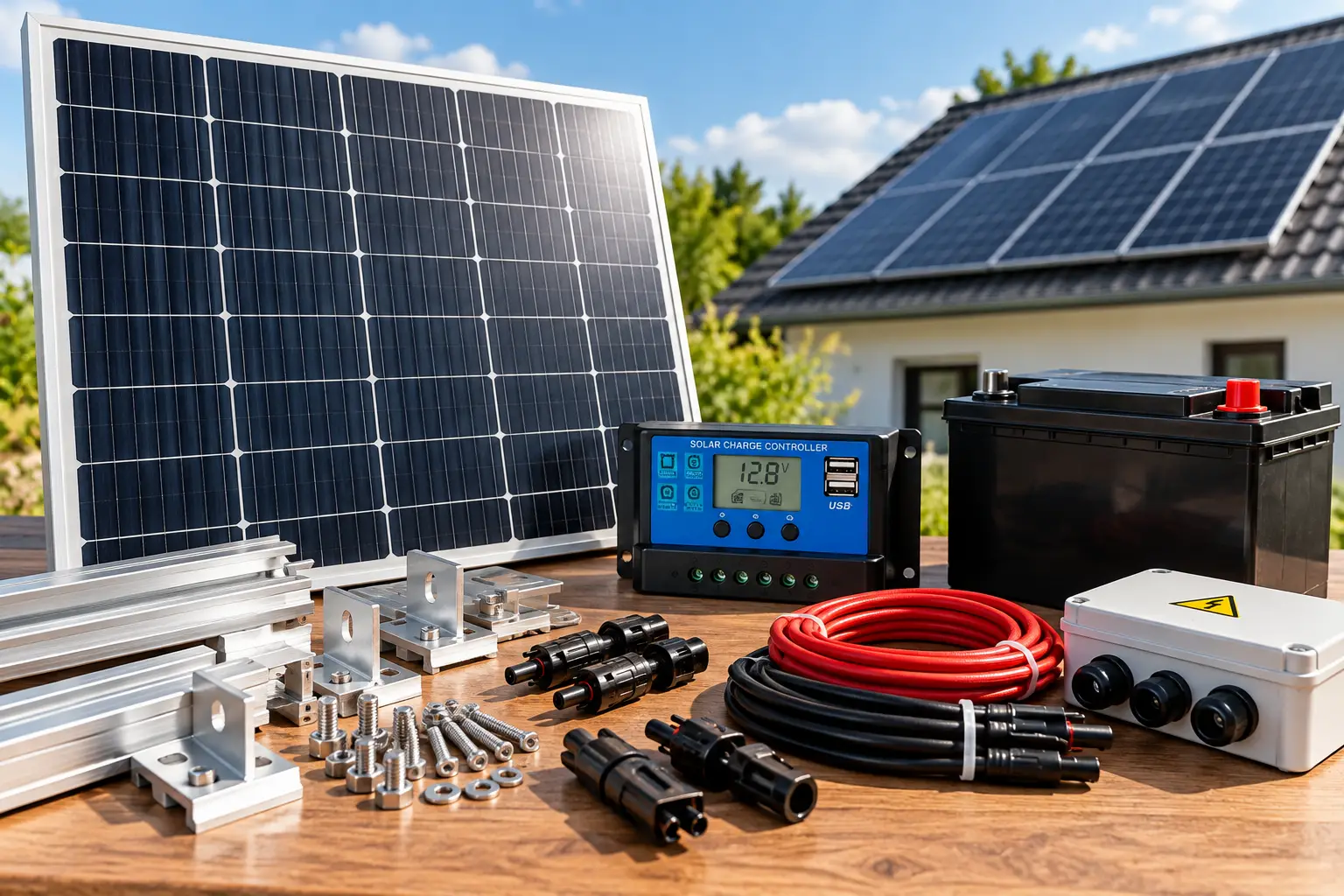
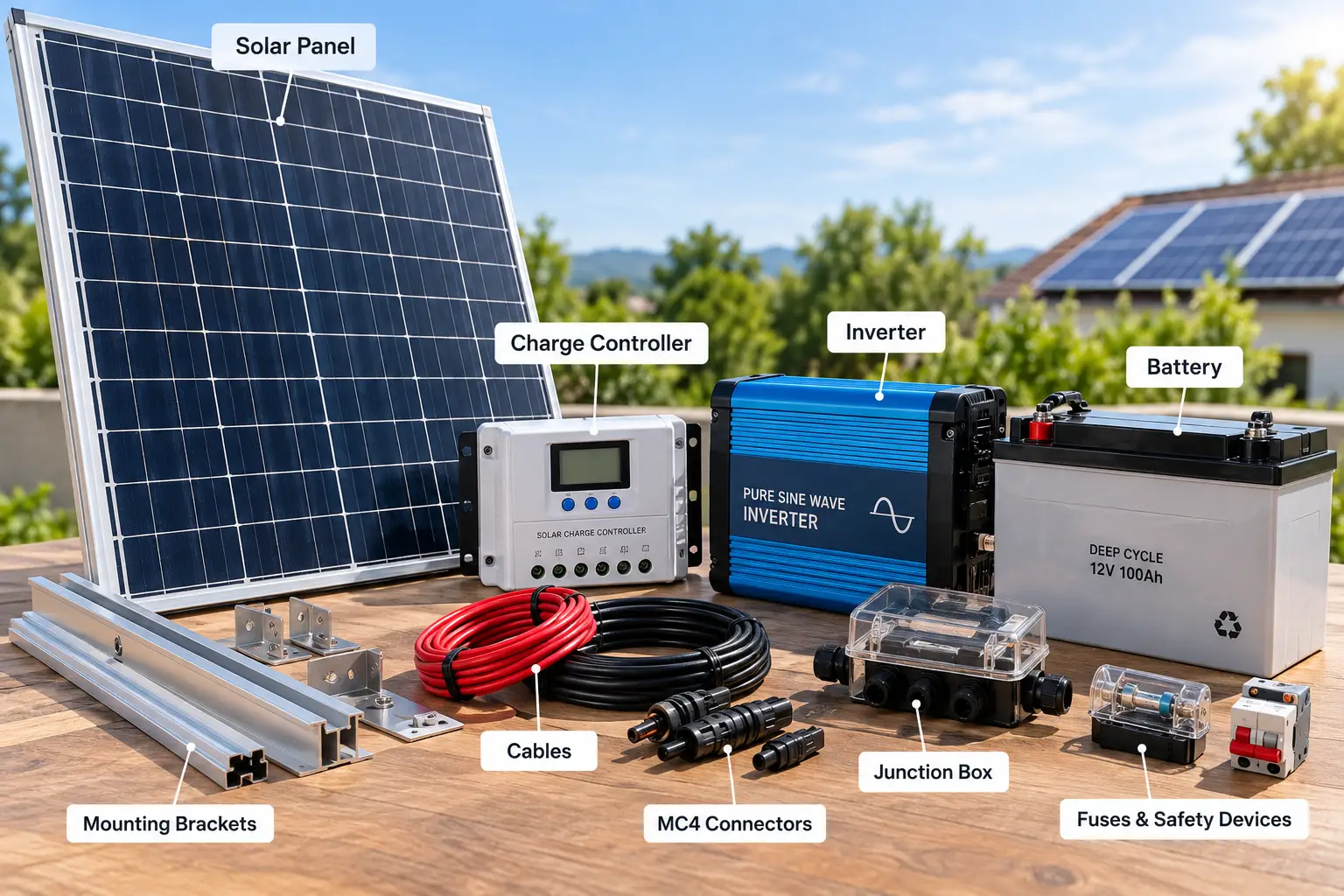
Solar panel parts are the components that turn sunlight into usable electricity: the module’s own cells, glass, frame, and junction box, plus the “balance of system” around it — charge controllers, PV cable and MC4 connectors, mounting hardware, combiner boxes, fuses, batteries, and inverters that store and convert power.
Think of the panel as an engine and everything else as the drivetrain. Inside the module, silicon cells sit sandwiched between tempered glass and a polymer backsheet, held by an aluminum frame. On the back, a small junction box houses bypass diodes that keep one shaded cell row from dragging down the whole panel. That’s the part you rarely touch.
Everything outside the module is where your buying decisions live. The U.S. Department of Energy’s overview of using solar electricity at home is a good primer on how these pieces connect in grid-tied and off-grid systems. In short: panels make DC power, cables carry it, a controller regulates it into a battery, and an inverter turns it into the 120V AC your appliances expect. Each handoff is a chance to gain — or lose — efficiency, safety, and money.
Quick Comparison: Top 7 Solar Panel Parts at a Glance
Product
Component Type
Key Spec
Price Range (approx.)
Best for
Renogy Wanderer Li 30A
PWM charge controller
12V, up to 400W PV
Under $50
Tight budgets, single-panel 12V kits
Renogy Z-Bracket Mounting Kit
Mounting hardware
Aluminum, set of 4
Under $30
RV roofs, sheds, small panels
Renogy 10AWG MC4 Extension Cable
PV cable + connectors
10AWG, IP67, 600/1000V
$20–$50 by length
Long runs with low voltage drop
Renogy Rover 40A MPPT
MPPT charge controller
12/24V, 100V max PV input
$150–$230
Growing 400–1,000W systems
Victron SmartSolar MPPT 100/30
MPPT charge controller
Built-in Bluetooth, 100V
$120–$170
Data lovers, premium vans and boats
Renogy 5-String Solar Combiner Box
Combiner enclosure
Up to 5 strings, IP55
$50–$120 (enclosure only)
Multi-string arrays
Renogy 2000W Pure Sine Wave Inverter
12V inverter
2000W continuous, 4000W surge
$300–$450
Running household AC appliances
Looking at the table, the pattern is clear: the cheapest solar panel parts (brackets, cable) are also the ones people skimp on most, even though they cost less than a tank of gas. The real fork in the road is the charge controller — the Renogy Wanderer Li 30A is fine for one or two 12V panels, but the moment you plan to expand, either the Renogy Rover 40A MPPT or the Victron SmartSolar MPPT 100/30 pays for itself in harvested watts. The Renogy 2000W Pure Sine Wave Inverter is the big-ticket item, and only worth it if you genuinely need household AC.
Top 7 Solar Panel Parts
Before diving in, a quick framing note: everything in a PV system except the modules is called the balance of system, and in small systems it can represent a surprisingly large share of total cost. The seven picks below cover that balance of system from entry-level to high-end, so you can build a complete, matched setup.
If you just need one or two 12V panels to keep a battery topped up, the Renogy Wanderer Li 30A does the job for pocket change. It’s a 12V-only PWM controller rated for 30 amps, a maximum of 400W of panels, and — critically — a maximum PV input of just 25V.
That 25V ceiling is the spec that matters most. It means you can only wire standard “12V” panels in parallel, never in series; two panels in series would blow past the limit. In practice, this makes the Renogy Wanderer Li 30A a fixed-ceiling choice: perfect for a trickle-charged trolling-motor battery or a shed light, frustrating if you later want 600W on a van roof. On the plus side, the “Li” version adds a lithium charging mode, four-stage charging with temperature compensation, and an RS232 port for Renogy’s optional BT-1 Bluetooth module (sold separately).
We weren’t able to verify a large, model-specific body of customer reviews for this exact Li revision, so check recent Amazon feedback before buying. On paper, it delivers what it promises — no more, no less.
Pros:
Very low cost of entry for small systems
Supports LiFePO4 as well as lead-acid batteries
Self-consumption under 10mA protects idle batteries
Cons:
25V input limit rules out series wiring
Bluetooth monitoring requires a separate purchase
Typically under $50 at the time of writing — excellent value as long as you accept its hard size limit.
Renogy Wanderer Li 30ASee current price, sizes and reviews on Amazon.
The Renogy Z-Bracket Mounting Kit is the humble aluminum hardware that holds your panel to a flat or slightly curved surface — RV roofs, sheds, trailers, or a homemade wooden frame. Each kit includes four brackets plus bolts, washers, nuts, and self-drilling screws.
The aluminum construction means no rust streaks down your roof after one wet season, and the low-profile shape keeps wind loading modest on a moving vehicle. Renogy’s U.S. guidance is specific: one set for a single panel up to 100W, two sets for 150–200W, and not recommended for single panels over 200W. Read that literally. Bigger panels act like sails, and four small brackets weren’t designed for that leverage.
Aggregated buyer feedback is consistently positive about ease of installation and the included hardware. The most common caveat is clearance: reviewers note there isn’t much air gap between panel and roof, which can trap heat and nudge output down on hot days. Several buyers also stress that sealing every roof penetration with a quality sealant is non-negotiable, and some advise against screwing directly into thin roof sheathing alone.
The Renogy 10AWG MC4 Extension Cable bridges the gap between your panels and your controller, available in lengths from 5 to 40 feet with male and female MC4 connectors pre-attached.
The headline number is 10AWG. Thicker wire means lower resistance, which means less voltage drop on long runs — the difference between a controller seeing 17V or 16V on a 12V array, which affects how much an MPPT controller can harvest. The cable is rated 600/1000V, IP67 waterproof, and specified from -40°F to 185°F, so it’s built for rooftop sun and winter cold alike. The TÜV marking printed along the jacket indicates certification to PV cable standards — useful when an inspector asks.
Customer sentiment is strongly positive: buyers repeatedly praise the robust insulation, quality connectors, and compatibility with other MC4-equipped panels. A practical tip that shows up in reviews: label your positive and negative runs, because black-on-black cables look identical once they’re coiled.
Pros:
10AWG gauge minimizes voltage drop on long runs
IP67 connectors resist rain and dust
Leaves headroom to expand your array later
Cons:
Both conductors are black, so labeling matters
Thicker cable is stiffer to route through tight spaces
Roughly $20–$50 depending on length — cheap insurance against invisible energy loss.
Renogy 10AWG MC4 Extension CableSee current price, sizes and reviews on Amazon.
The Renogy Rover 40A MPPT is where a hobby system becomes a real power system. It works with 12V or 24V batteries, accepts up to 100V of panel input, and handles up to 520W of panels at 12V or 1,040W at 24V.
That 100V input is the upgrade that matters. You can wire panels in series, which keeps current low and lets you use thinner, cheaper cable over long distances — exactly what you want when the array sits 30 feet from the battery. The MPPT circuitry continuously hunts for the panel’s maximum power point as sunlight and temperature shift, squeezing out energy a PWM controller would leave on the table, especially in cold weather and partial clouds. Renogy recommends a 40A ANL fuse between controller and battery — follow that advice.
We couldn’t verify a consistent body of recent aggregated reviews for the current Rover Li hardware specifically, so scan the latest Amazon feedback before ordering. Based on the specs alone, the Renogy Rover 40A MPPT suits RVers and cabin owners who expect to expand from 400W toward 1,000W.
The Victron SmartSolar MPPT 100/30 is the controller enthusiasts recommend to each other, and the reason is simple: deep insight with no extra hardware. Bluetooth is built in, and the free VictronConnect app shows real-time panel voltage, charge stage, and historical yield.
On paper, it’s rated for 30 amps, 100V maximum PV voltage, and roughly 440W of panels at 12V or 880W at 24V. Victron claims its fast MPPT tracking can harvest up to 30% more than PWM controllers and up to 10% more than slower MPPT units in changing light — a manufacturer figure, but consistent with how MPPT physics works. Its BatteryLife algorithm also helps lead-acid banks that rarely reach full charge, and it’ll even revive a deeply depleted battery.
Aggregated owner feedback is mostly enthusiastic, praising the app, build quality, and reliability over years of use. Several buyers note Victron prices have come down to roughly Renogy territory. A minority of reviews report unit failures and frustrating support experiences, so register your warranty.
Pros:
Built-in Bluetooth with a polished, free app
Fast MPPT tracking in changing light
Compact and easy to integrate with Victron monitors
Cons:
30A limits you to about 440W at 12V
IP43 rating means it must live indoors
Typically $120–$170 — the best value per feature in this list for monitoring-focused buyers.
Victron SmartSolar MPPT 100/30See current price, sizes and reviews on Amazon.
Once you have three or more panel strings, wiring them together with loose Y-connectors gets messy and unsafe. The Renogy 5-String Solar Combiner Box merges up to five strings into a single output inside a weatherproof steel enclosure.
The box accepts up to five single-pole miniature circuit breakers and one two-pole surge protective device on a standard 35mm DIN rail. In plain English: each string gets its own overcurrent protection, and you can add lightning-surge protection — something no Y-branch cable offers. The IP55 rating, rubber door seals, and rain cap let it live outside near the array, so you run one heavy cable to the controller instead of five. It’s listed for both on-grid and off-grid use.
The big caveat buyers should know: breakers, the disconnect, and the surge device are not included, so the real cost is higher than the sticker. We couldn’t verify a large pool of aggregated reviews for this enclosure, so treat this analysis as spec-based and confirm recent feedback on Amazon.
Pros:
Per-string breaker slots improve fault protection
Room for a surge protective device
Weather-sealed enclosure for outdoor mounting
Cons:
Breakers and surge device sold separately
Overkill for systems with one or two strings
Roughly $50–$120 for the empty enclosure — fair value once your array outgrows simple connectors.
Renogy 5-String Solar Combiner BoxSee current price, sizes and reviews on Amazon.
The Renogy 2000W Pure Sine Wave Inverter converts 12V battery power into 120V AC, delivering 2,000 watts continuous and up to 4,000 watts of peak surge, with efficiency stated at over 90%.
Each spec has a practical meaning. Pure sine wave output closely mimics utility power, so laptops, CPAP machines, induction cooktops, and motor-driven tools run cooler and quieter than on a modified sine inverter. The 4,000W surge lets you start things like a small refrigerator compressor or microwave, whose start-up spike briefly exceeds their running draw. That 90%-plus efficiency still means about 10% of your battery energy becomes heat, so don’t leave the inverter idling when you don’t need AC.
Here’s the part listings bury: at 12V, 2,000W means roughly 170–185 amps of battery current. That demands short, very heavy cables and a properly rated fuse exactly as specified in the manual. We couldn’t verify a consistent pool of aggregated reviews for this current model, so confirm recent buyer feedback before purchasing.
Pros:
Clean pure sine output for sensitive electronics
4,000W surge handles motor start-ups
Over 90% stated conversion efficiency
Cons:
Huge 12V current demands expensive heavy cabling
Idle draw wastes power if left on
Typically $300–$450 — solid value if you truly need household AC from a battery bank.
Renogy 2000W Pure Sine Wave InverterSee current price, sizes and reviews on Amazon.
Reading across, the two MPPT controllers share the same 100V input ceiling, so the choice between them comes down to amperage versus ecosystem: the Renogy Rover 40A MPPT gives you 10 more amps of headroom, while the Victron SmartSolar MPPT 100/30 gives you better built-in data. The Renogy Wanderer Li 30A‘s 25V ceiling is the single biggest limitation in the whole lineup — it decides how you’ll wire your array forever.
How to Install Solar Panel Parts: Your First-Week Setup Guide
Good parts can still be installed badly. Here’s a safe, logical order that avoids the most common first-month headaches.
Step 1: Mount and position first
Bolt the Renogy Z-Bracket Mounting Kit to the panel before lifting it onto the roof — buyers consistently say this is far easier. Aim panels south (in the U.S.) and avoid shade from vents, AC units, or trees; even a shaded corner can cut output dramatically.
Step 2: Connect the battery to the controller first
This is the golden rule for nearly every charge controller, including the Renogy Rover 40A MPPT and the Victron SmartSolar MPPT 100/30: connect the battery before the panels, so the controller can detect system voltage. Install the recommended fuse on the battery positive line.
Step 3: Run your PV cable, then connect panels last
Route the Renogy 10AWG MC4 Extension Cable with drip loops so water runs away from connectors. Cover panels with a blanket or connect at dusk — panels produce voltage the moment light hits them.
Step 4: Configure battery settings
Set the battery type (LiFePO4, AGM, flooded) in the app or controller menu. Wrong profiles are a leading cause of undercharged or overcharged batteries.
Your 30-day maintenance checklist
Week 1: Re-torque terminals; copper settles after initial heat cycles.
Week 2: Check controller logs for unexpected low-voltage disconnects.
Week 4: Inspect roof seals after the first heavy rain.
Monthly: Rinse dusty panels with plain water early in the day.
Real-World Scenarios: Matching Parts to Your Setup
Specs only matter in context. Here are three common profiles and the solar panel parts that fit each one best.
The weekend camper — budget under $150
You have a 100W panel and a single 100Ah battery for lights, a fan, and phone charging on weekend trips. Pair the Renogy Wanderer Li 30A with one set of the Renogy Z-Bracket Mounting Kit and a short Renogy 10AWG MC4 Extension Cable. MPPT would be wasted money here: with one 12V panel, PWM’s efficiency gap is small, and you’ll never hit the 400W ceiling. Total spend on parts stays comfortably low.
The full-time van lifer — budget $600–$900
You run 400W of panels, a 200Ah lithium bank, a fridge, a laptop, and occasional induction cooking. Here, the Victron SmartSolar MPPT 100/30 shines at 12V right up to its 440W limit — and its app makes it easy to see whether today’s harvest covers tonight’s fridge load. Add the Renogy 2000W Pure Sine Wave Inverter for the induction plate. If you think you’ll add panels, step up to the Renogy Rover 40A MPPT instead for headroom.
The off-grid cabin owner — budget $1,500+
You run five strings of panels on a ground mount 40 feet from a 24V battery bank. The Renogy 5-String Solar Combiner Box consolidates strings with per-string breakers and surge protection near the array. A 24V bank doubles what each controller can accept — the Renogy Rover 40A MPPT handles about 1,040W at 24V. Series-wired strings plus 10AWG cable keep voltage drop low across that 40-foot run.
Ready to build your own system?
Take your off-grid power to the next level with this carefully curated lineup. Click a highlighted product to check current pricing and availability. These picks will help you build a quieter, safer, more reliable setup the whole family will enjoy!
Troubleshooting: 5 Common Problems and How to Fix Them
Even well-chosen solar panel parts misbehave occasionally. These are the issues buyers report most often, with practical fixes.
1. Controller shows zero solar input. Check the battery connection first — most controllers won’t start charging without detecting a battery. Then confirm panel polarity at the MC4 connectors with a multimeter. A half-clicked MC4 connector is a classic culprit.
2. Output far below panel rating. A 100W panel rarely delivers 100W; real-world output is often 70–85W under good sun. If it’s much lower, look for shade, dirt, heat buildup (low-clearance mounts make panels hotter), or a PWM controller paired with a series-wired array.
3. Controller error after a cold night. Panel voltage rises as temperature drops. A string that measures 90V on a mild day can exceed 100V on a frigid morning. Recalculate using your panel’s temperature coefficient and remove one panel from the string if needed — this protects both the Renogy Rover 40A MPPT and the Victron SmartSolar MPPT 100/30.
4. Inverter shuts off when a fridge starts. Low battery voltage under surge is usually the cause, not the inverter. Undersized or overly long battery cables to the Renogy 2000W Pure Sine Wave Inverter cause voltage to sag. Use the manual’s cable gauge and keep runs as short as possible.
5. Roof leak near the mount. Remove the bracket, clean the surface, and reseal with a sealant compatible with your roof material. Many RV owners prefer adhesive mounting over drilling wherever possible.
How to Choose Solar Panel Parts
Picking solar panel parts is mostly about matching numbers. Follow these steps in order:
Estimate your daily energy need. Add up watt-hours for every device. This sets array size and battery capacity — everything else follows.
Model your sun. NREL’s free PVWatts calculator estimates production for your exact location and tilt, so you don’t oversize or undersize the array.
Choose battery voltage. 12V suits small systems; 24V or 48V halves or quarters current, which shrinks cable costs and lets controllers handle more watts.
Size the controller by amps and volts. Divide array watts by battery charging voltage for amps, then check that your cold-weather string voltage stays under the controller’s maximum input.
Size cables for voltage drop. Aim for under 3% drop on long runs; thicker cable like 10AWG is often the cheapest efficiency upgrade available.
Add protection at every junction. Fuses or breakers between controller and battery, battery and inverter, and on each string when combining three or more.
Plan for expansion. Buying a controller with spare capacity now costs less than replacing it in a year.
MPPT vs PWM Charge Controllers: Which Should You Buy?
This is the most important decision among all solar panel parts, so it deserves a closer look.
A PWM controller, like the Renogy Wanderer Li 30A, essentially connects the panel straight to the battery and rapidly switches it on and off. The panel is forced to operate near battery voltage — about 13–14V — even though a “12V” panel’s best operating point is often 17–18V. The difference is simply lost.
An MPPT controller, like the Renogy Rover 40A MPPT or Victron SmartSolar MPPT 100/30, acts as a DC-to-DC converter. It runs the panel at its optimal voltage, then converts excess voltage into extra charging current. That’s why MPPT gains are biggest in cold weather (when panel voltage climbs) and with series-wired arrays.
Factor
PWM Controller
MPPT Controller
Best for
Upfront cost
Low
Moderate to high
PWM: tiny budgets
Harvest efficiency
Lower; panel held at battery voltage
Higher; tracks optimal voltage
MPPT: 200W+ arrays
Series wiring
Usually not possible
Supported up to rated voltage
MPPT: long cable runs
Cold-weather gains
Minimal
Significant
MPPT: northern climates
The table makes the trade-off plain: PWM wins only on price and only for small, single-panel systems. Once your array crosses roughly 200W or the cable run gets long, MPPT’s extra harvest and series-wiring flexibility usually recover the price difference within a few seasons.
Features That Actually Matter (and Ones That Don’t)
Marketing pages love superlatives. Here’s how to cut through them when comparing solar panel parts.
Features that matter
Maximum PV input voltage. This decides how you can wire your array — and it’s the spec most beginners ignore until it’s too late.
Real amperage headroom. Size controllers so your array’s expected current sits around 80% of the rating, not 100%.
Weatherproof ratings that match placement. IP67 cables belong on the roof; IP43 controllers belong indoors.
Battery chemistry profiles. LiFePO4 support is essential if you’re running lithium.
Pure sine output for anything with a motor, compressor, or sensitive electronics.
Features that matter less than you’d think
Peak surge numbers on their own. They only matter if your battery and cables can actually deliver that current.
Flashy LCD screens. An app or simple indicator lights tell you just as much.
“Up to” efficiency claims. These are best-case lab figures; real-world gains depend on your climate and wiring.
Proprietary connector ecosystems. Convenient at first, but they can lock you into one brand for every future expansion.
Common Mistakes to Avoid When Buying Solar Panel Parts
These pitfalls account for a large share of disappointing DIY systems.
1. Ignoring cold-weather voltage. String voltage rises in cold temperatures. A string that’s safe in July can exceed your controller’s limit in January. Always calculate with your record-low temperature.
2. Mixing MC4 connector brands. Connectors from different manufacturers may look identical but have slightly different tolerances. Mismatched pairs can loosen, overheat, or void certification. Stick with matched pairs from one brand where possible.
3. Undersizing inverter cables. With the Renogy 2000W Pure Sine Wave Inverter drawing up to roughly 170–185 amps at full load, thin cables overheat quickly. Treat the manual’s gauge spec as a minimum.
4. Buying PWM for a growing system. The Renogy Wanderer Li 30A is excellent value — until you add a second string. Buying once is cheaper than buying twice.
5. Skipping fuses. Every battery connection needs overcurrent protection. Renogy specifies a 40A ANL fuse for the Renogy Rover 40A MPPT; similar logic applies across every manufacturer.
6. Overloading small mounts. Using one set of the Renogy Z-Bracket Mounting Kit on a large 300W panel ignores the manufacturer’s own limits — and highway wind.
Long-Term Cost and Maintenance
The purchase price is only part of the story. Here’s how total cost of ownership plays out for solar panel parts over a typical 10-year horizon.
Panels themselves often carry 25-year performance warranties, but balance-of-system components wear out sooner. Inverters are the most common replacement item; many industry guides assume at least one inverter replacement over a system’s life. Charge controllers, by contrast, are relatively cheap to swap and have few moving parts.
Component
Typical Maintenance
Replacement Risk
Long-Term Value Tip
Best for long-term value
Charge controller
Annual terminal check
Low to moderate
Buy headroom once
Renogy Rover 40A MPPT
PV cable & MC4s
Visual inspection yearly
Low
Choose thick gauge upfront
Renogy 10AWG MC4 Extension Cable
Mounts
Reseal every few years
Low
Seal properly on day one
Renogy Z-Bracket Mounting Kit
Inverter
Keep vents clear
Moderate
Avoid idle running
Renogy 2000W Pure Sine Wave Inverter
The takeaway: the cheapest parts to buy are also the cheapest to maintain — but only if you install them correctly the first time. Spending a little more on a controller with headroom, like the Renogy Rover 40A MPPT, avoids paying twice; spending a little more on thick cable recovers energy every sunny day for years.
Policy matters for ROI, too. Under 2025’s federal budget law, the homeowner-claimed 25D credit ended for systems installed after December 31, 2025 — the Solar Energy Industries Association’s breakdown of the bill’s clean energy provisions explains the details. For 2026 DIY buyers, that means no 30% federal rebate cushion, so efficient part choices carry more financial weight than before. State and utility incentives may still exist — check locally.
Safety, Regulations, and Standards
Solar electricity is DC electricity, and DC arcs don’t self-extinguish the way AC arcs often do. That’s why codes take solar panel parts seriously.
The National Electrical Code (NEC)
In the U.S., Article 690 of the NEC governs PV systems. It covers string voltage calculations (including cold-temperature correction), overcurrent protection, disconnects, grounding, and conductor sizing. Grid-tied, building-mounted systems must also meet rapid shutdown requirements, which allow firefighters to de-energize roof conductors quickly. Most U.S. jurisdictions adopt a version of the NEC, though the edition varies by state.
Certifications to look for
UL 1741 for grid-tied inverters, which governs how they interact with the utility grid.
UL or TÜV listings on PV wire and connectors, confirming the cable can handle UV, heat, and rated voltages.
Listed breakers rated for DC, not AC-only breakers, inside combiner boxes like the Renogy 5-String Solar Combiner Box.
Practical safety habits
Cover panels or work at dusk when connecting PV wiring.
Never connect a grid-tied system without utility interconnection approval.
Use an electrician for anything tied into your home’s main panel — local permits and inspections usually apply.
Off-grid RV and van systems have fewer permit requirements but follow the same physics; fuse everything.
Small off-grid systems using the Renogy Wanderer Li 30A or Victron SmartSolar MPPT 100/30 are generally DIY-friendly. Anything touching household wiring is where a licensed professional earns their fee.
FAQ: Solar Panel Parts
Where can I buy solar panel parts online in the US?
Amazon carries most major DIY brands, including Renogy and Victron, alongside specialty solar retailers. Compare listings by model number, confirm the seller is authorized for warranty coverage, and check recent reviews before ordering.
How much do solar panel parts cost for a small RV system?
A basic 100–200W RV setup typically needs a controller, cables, mounts, and fuses. Parts alone can run from under $150 with PWM to several hundred dollars with MPPT and an inverter, depending on brands chosen.
Is Victron worth the extra money over Renogy?
Not always. The Victron SmartSolar MPPT 100/30 offers built-in Bluetooth and excellent data, while the Renogy Rover 40A MPPT offers more amps for growth. Choose based on capacity needs versus monitoring preference, not brand alone.
Can I buy replacement solar panel parts like junction boxes?
Yes, replacement junction boxes, bypass diodes, and MC4 connectors are sold online. However, opening a panel's junction box often voids its warranty, so contact the panel manufacturer first if the module is still covered.
What size inverter should I buy for a camper?
Add the running wattage of devices you'll use simultaneously, then add a 20–25% margin. Many campers find 1,000–2,000W sufficient; a 2,000W model handles microwaves and induction cooktops but demands heavier cables and a bigger battery.
Conclusion: Build Smarter, Not Just Bigger
Here’s the big picture: panels get the attention, but solar panel parts determine whether your system actually delivers. A matched controller, correctly sized cable, secure mounts, and proper protection can make an ordinary panel perform like a great one — while a single weak link can undo all of it.
For quick decisions, here’s the recap. Starting tiny on a tight budget? The Renogy Wanderer Li 30A paired with the Renogy Z-Bracket Mounting Kit gets you running for very little. Want room to grow? The Renogy Rover 40A MPPT offers the most headroom. Love data and a polished app? The Victron SmartSolar MPPT 100/30 is hard to beat. Running long cable distances? The Renogy 10AWG MC4 Extension Cable recovers energy you’d otherwise lose. Merging three or more strings? The Renogy 5-String Solar Combiner Box keeps it tidy and protected. Need real household AC? The Renogy 2000W Pure Sine Wave Inverter delivers, provided you budget for heavy cabling.
With the federal homeowner credit gone in 2026, efficiency is your best incentive. Size once, protect every junction, and plan for the system you’ll want in two years — not just the one you need today.
Don’t miss these exclusive deals!
Take your solar setup to the next level with this carefully curated lineup. Click a highlighted product to check current pricing and availability. These picks will help you get reliable, worry-free power the whole family will enjoy!
Disclaimer: This post contains affiliate links. As an Amazon Associate, I earn from qualifying purchases made through these links, at no additional cost to you.
Found this article helpful? Share it with someone who needs it!