
In This Article
What Is a Generac 2000 Watt Generator?
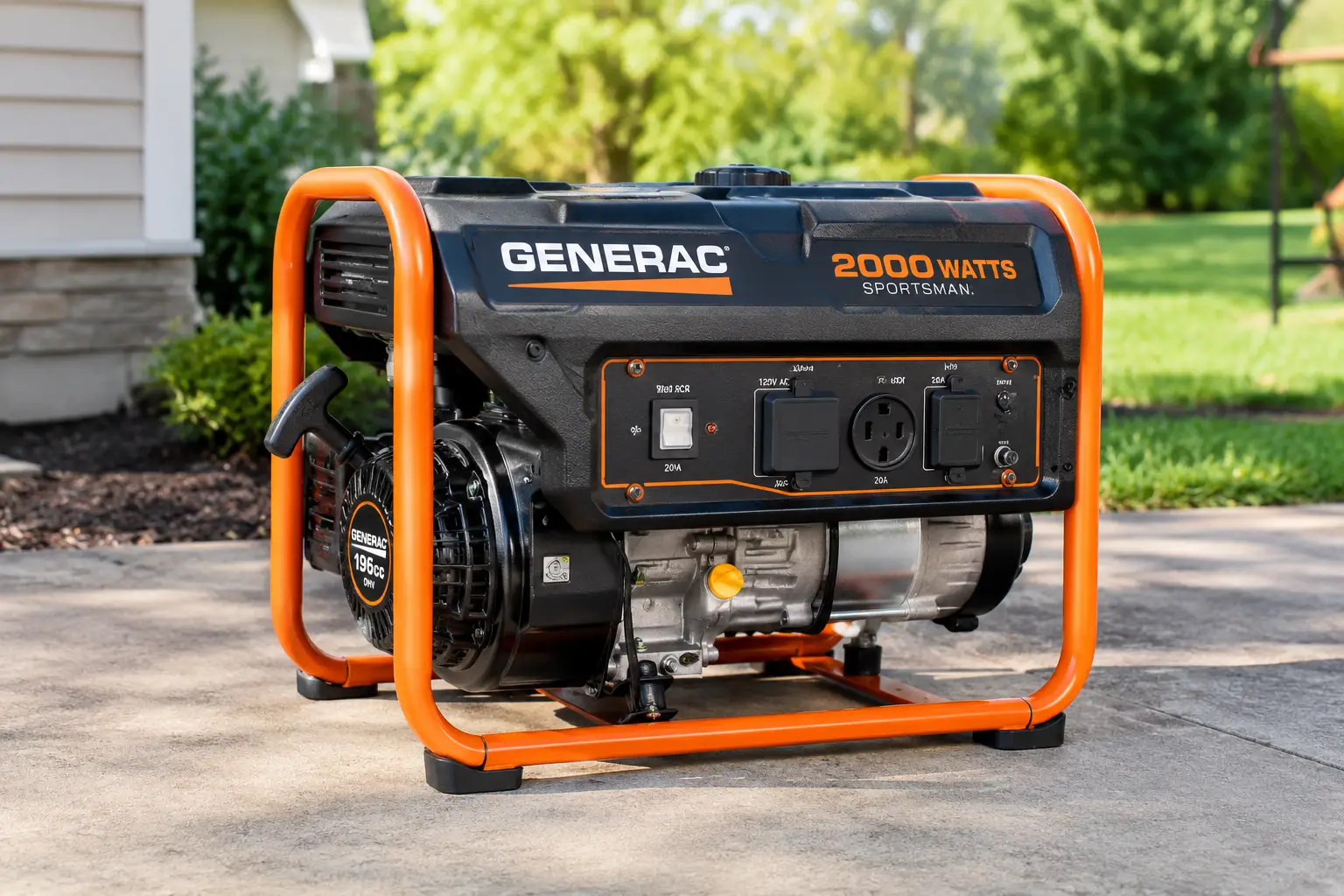
A generac 2000 watt generator is a compact, portable Generac power unit rated at roughly 2,000–2,200 starting watts and about 1,600–1,700 running watts. In 2026, the term covers two very different machines: gas inverter generators like the Generac GP2200i, and battery-based “generators” like the Generac GB2000 portable power station.
Here’s the part most product pages skip: those two machines solve different problems. One burns gasoline and keeps going as long as you keep feeding it. The other is silent, fume-free, and safe indoors — but it stops cold when the battery hits zero. 🔋⛽
Generac is best known for whole-house standby systems, yet its small portable lineup gets searched constantly. The original 2,000-watt model, the iQ2000 (1,600 running / 2,000 starting watts), has been discontinued, so most shoppers searching today end up choosing between the GP2200i and the GB-series power stations. That’s why this guide compares three current small Generac options, one Generac step-up model, and three strong rivals from Honda, Westinghouse, and Champion.
A quick word on method, because honesty matters here: we didn’t haul these units to a campsite. Every verdict below is built from published spec sheets, owner’s manuals, independent hands-on reviews, and the recurring themes in real customer feedback. If you want a refresher on how a portable engine-generator turns fuel into electricity, that primer is worth two minutes before you dive in.
By the end, you’ll know which generac 2000 watt generator — or which alternative — actually fits your outages, your campsite, and your budget. ⚡
Quick Comparison: Generac 2000 Watt Generator vs. Top Alternatives
Before the deep dives, here’s the at-a-glance view. Prices are approximate ranges at the time of writing — always check the current price on Amazon, since generator pricing moves with storm season.
| Model | Type | Running / Starting Watts | Weight | Rated Noise | Approx. Price | Best For |
|---|---|---|---|---|---|---|
| Generac GP2200i | Gas inverter | 1,700 / 2,200 | 46.6 lb | Not published | $550–$750 | Budget Generac camping and light backup |
| Generac GB2000 | Battery power station (2,106 Wh) | 1,600 / 3,200 | 43 lb | Silent | $1,000–$1,800 | Indoor, fume-free backup |
| Generac GB1000 | Battery power station (1,086 Wh) | 1,600 / 3,200 | 29 lb | Silent | $700–$1,200 | Apartments and short outages |
| Generac GP3000i | Gas inverter | 2,300 / 3,000 | 59.5 lb | Not published | $800–$1,100 | Bigger starting loads |
| Honda EU2200i | Gas inverter | 1,800 / 2,200 | 47.4 lb | 48–57 dBA | $1,100–$1,400 | Quietest, long-term reliability |
| Westinghouse iGen2200 | Gas inverter | 1,800 / 2,200 | 46.3 lb | From 52 dBA | $450–$650 | Long runtime on a budget |
| Champion 2500-Watt Dual Fuel | Gas/propane inverter | 1,850 / 2,500 (gas) | 39 lb | 53 dBA | $500–$750 | Propane flexibility, lightest gas pick |
Looking at the table, the gas inverters cluster tightly at 1,700–1,850 running watts, so the real differences are noise, runtime, and price rather than raw power. The Honda EU2200i is the quiet-and-proven benchmark but costs roughly double the Westinghouse iGen2200, while the Champion 2500-Watt Dual Fuel quietly wins on weight. Meanwhile, the Generac GB2000 and Generac GB1000 post the highest surge numbers of the group — but their real limit is stored energy, not wattage, which is why they belong in a different decision bucket.
If you’re choosing purely within the Generac family, the Generac GP2200i is the value play, and the Generac GP3000i is the move when your must-run list creeps past 1,700 watts.
💬 One click helps other shoppers make an informed choice too! 😊
Top 7 Picks: Generac 2000 Watt Generator Options and Rivals, Analyzed
Each pick below gets the same treatment: what the specs mean in practice, who it actually suits, what real owner feedback keeps saying, and whether the price makes sense.
1. Generac GP2200i — the classic Generac 2,000-watt pick
If you want the gas-powered generac 2000 watt generator most shoppers have in mind, this is it. It pairs an 80cc OHV engine with Generac’s TruePower inverter, rated at 2,200 starting watts and 1,700 running watts. Some retailer listings print 1,600 running watts, so plan around the lower figure. In practice, that covers a full-size fridge plus lights and phone chargers, or a microwave by itself — not both at once.
The 1.2-gallon tank is generous for the class, and Generac lists 7 hours at 50% load and 10.75 hours at 25%. Translation: run a fridge, a fan, and your Wi-Fi router overnight, and you’ll likely refuel once around breakfast. Economy Mode drops engine speed under light loads, saving fuel and trimming noise. A 20-amp duplex, a 12V DC outlet, and a USB port cover the basics, and it’s parallel-ready with Generac’s 7118 kit.
Who’s it for? Campers, tailgaters, and homeowners who want a light outage backup from a familiar brand. One thing to weigh: Generac doesn’t publish a dBA rating, which matters if you camp where quiet hours are enforced.
Owner feedback reads as mixed-to-positive. Reviews regularly praise the 46.6-pound weight and clean power, while recurring complaints involve hard starting after long storage and overload shutdowns near the top of the rated range.
Pros:
- ✅ Large 1.2-gallon tank stretches overnight runtime
- ✅ Clean inverter power suits laptops and TVs
- ✅ Parallel-ready to double available output
Cons:
- ❌ Generac publishes no official noise rating
- ❌ Some owners report hard starts after storage
At around $550–$750, it’s fair value — but stock comes and goes, so check current availability before you plan around it.
2. Generac GB2000 — fume-free power you can run indoors
The Generac GB2000 swaps the engine for a 2,106 Wh lithium-ion (NMC) battery, which means zero exhaust and zero pull cords. Its inverter delivers 1,600 running watts and 3,200 surge watts — more starting muscle than the gas Generac GP2200i — through three 120V outlets, two USB-A, two 65W USB-C, a 12V car port, and a 15W wireless charging pad.
What does 2,106 Wh mean in real life? A modern fridge averaging around 150 watts could run for roughly 10–12 hours, or a 40-watt CPAP for several nights, minus some inverter losses. It recharges from the wall (450W max), from solar through a built-in MPPT controller (up to 468W), from a car, or from a gas generator. Retail specs cite about 3.3 hours for a 0–80% wall charge. Generac rates the cells for 1,000 cycles to 80% capacity and recommends topping up every 3–6 months in storage.
Who’s it for? Apartment dwellers, CPAP users, and anyone who can’t safely run gas outdoors. A hands-on Bob Vila review of the GB2000 found it very simple to operate, while stressing that you must not overload it relative to its stored capacity.
Aggregated review themes center on ease of use and the big 4.7-inch color display; the most common caveat is weight for a battery unit.
Pros:
- ✅ Safe indoor use with no exhaust at all
- ✅ 3,200 surge watts handles motor startups
- ✅ Built-in MPPT allows direct solar charging
Cons:
- ❌ Heavy for a power station at 43 pounds
- ❌ Runtime ends when the battery does
Typically in the $1,000–$1,800 range depending on bundle; strong value if indoor safety tops your list.
3. Generac GB1000 — lightest Generac for light loads
Think of the Generac GB1000 as the GB2000’s smaller sibling: same 1,600 running and 3,200 surge watts, same port layout, but a 1,086 Wh battery and a much friendlier 29-pound body.
That combination creates an interesting split. The answer to “can it start this?” is identical to the bigger model, but the answer to “how long?” is roughly half. Generac quotes a 0–80% wall recharge in about 2.1 hours, which makes it easy to top off between short outages. The cells are rated for 800 cycles, slightly fewer than the GB2000’s 1,000.
On paper, it’s ideal for phones, laptops, LED lighting, a Wi-Fi router, and a CPAP for a night or two. A full-size fridge is possible, but only for a handful of hours — so it’s a bridge, not a solution, for multi-day outages.
Who’s it for? Renters, weekend car campers, and anyone building a go-bag for short blackouts. Honestly, we found far fewer owner reviews for this model than for the GB2000, so there’s less real-world feedback to lean on. Independent coverage, such as Pro Tool Reviews’ breakdown of the GB series, focuses mainly on its shared output specs and lighter build.
Pros:
- ✅ Light 29-pound body is easy to carry
- ✅ Same 3,200-watt surge as the bigger model
- ✅ Quick recharge between short outages
Cons:
- ❌ Half the stored energy of the GB2000
- ❌ Lower 800-cycle battery rating
Expect roughly $700–$1,200; good value for small loads, poor value if a fridge is your priority.
4. Generac GP3000i — step-up power for bigger starting loads
If your list lands just past 2,000 watts, the Generac GP3000i is the logical upgrade. A 149cc engine produces 3,000 starting and 2,300 running watts, and Generac’s PowerRush technology is marketed as providing up to 50% more starting capacity for motor loads.
Why does that matter? Refrigerators, sump pumps, and small window air conditioners pull a brief surge when their compressors or motors kick on. That surge is exactly where 2,000-watt units trip their overload lights. The extra 600 running watts also mean you can keep a fridge humming while the microwave runs — something the Generac GP2200i simply can’t do comfortably.
The trade-offs are real, though. Runtime drops to about 5.8 hours at 25% load and 4.5 hours at 50%, and the weight climbs to 59.5 pounds. That’s still one-person portable, but you’ll notice it on the walk to the truck.
Who’s it for? Homeowners whose outage plan includes a sump pump or a small AC unit, and RV owners who need a bit more headroom than a 2,000-watt class unit offers. Independent comparisons consistently frame it as the step-up from the GP2200i, praising starting headroom and citing weight and shorter runtime as the usual compromises.
Pros:
- ✅ 2,300 running watts adds real headroom
- ✅ PowerRush helps start motor-driven appliances
- ✅ Still compact enough for one-person carrying
Cons:
- ❌ Shorter runtime than the GP2200i
- ❌ About 13 pounds heavier to haul
At roughly $800–$1,100, it’s worth it only if you genuinely need the extra watts.
5. Honda EU2200i — quietest benchmark in the class
The Honda EU2200i is the generator other 2,200-watt models get measured against. Its 121cc GXR120 engine delivers 2,200 starting and 1,800 running watts, and Honda rates it at 48 dBA at quarter load and 57 dBA at rated load.
To put that in perspective, 48 dBA is close to a quiet library — your campsite neighbors may not even realize it’s running. Honda’s automatic decompressor reduces the force needed on the pull cord, which matters more than you’d think for older users or cold mornings. The built-in CO-MINDER system shuts the engine down if carbon monoxide builds up nearby.
The catch is the small 0.95-gallon tank. Honda lists 8.1 hours at quarter load, but only about 3.2 hours at rated load, so heavy use means frequent refueling. It’s also parallel-capable, letting two units deliver up to 4,400 watts.
Who’s it for? RV campers in strict campgrounds, and buyers who plan to keep one generator for a decade. Review sentiment is remarkably consistent: owners repeatedly praise reliability, easy starting, and low noise, and the most common complaint is simply the price.
Pros:
- ✅ Quietest rated output in this lineup
- ✅ CO-MINDER automatic carbon monoxide shutoff
- ✅ Long-standing reputation for engine reliability
Cons:
- ❌ Highest price among the gas picks
- ❌ Small 0.95-gallon tank limits heavy-load runtime
Around $1,100–$1,400; expensive up front, but strong long-term value for frequent users.
6. Westinghouse iGen2200 — longest gas runtime per dollar
The Westinghouse iGen2200 makes a simple pitch: Honda-like specs at roughly half the price. It produces 2,200 starting and 1,800 running watts from a 79cc engine, weighs 46.3 pounds, and runs as low as 52 dBA.
The standout number is runtime. Westinghouse rates it for up to 12 hours at 25% load on a 1.2-gallon tank — the longest of any gas pick here. In practical terms, a fridge plus a few lights could run from dinner through the next morning without a refill. Its power is rated under 3% total harmonic distortion (THD), meaning the output is clean enough for TVs, laptops, and phone chargers.
You get two 20-amp household outlets and two USB ports, plus parallel capability — though only with Westinghouse’s own parallel cord and compatible Westinghouse models.
Who’s it for? Budget-focused campers, tailgaters, and homeowners who want an outage backup without Honda pricing. Owner reviews frequently highlight runtime and value, and one independent load test reported reaching roughly 12 hours at 25% load on non-ethanol fuel. The common criticism is that it’s not quite as hushed as the Honda under load.
Pros:
- ✅ Up to 12 hours of runtime per tank
- ✅ Clean power under 3% THD
- ✅ Among the most affordable picks here
Cons:
- ❌ Slightly louder than the Honda at light loads
- ❌ Parallels only with Westinghouse-specific equipment
Around $450–$650; arguably the best runtime-per-dollar value in this lineup.
7. Champion 2500-Watt Dual Fuel — propane flexibility at 39 pounds
The Champion 2500-Watt Dual Fuel (model 200961, with a CO Shield version sold as 201183) is the lightest gas option here and the only one that runs on propane straight out of the box.
On gasoline, its 79cc engine delivers 2,500 starting and 1,850 running watts, with up to 11.5 hours at 25% load from a 1.05-gallon tank. Switch to a 20-pound propane tank and running output drops to 1,665 watts, but Champion rates runtime at up to 34 hours at 25% load. Here’s why that matters: propane doesn’t go stale in storage the way gasoline does, so a few spare tanks make a far more reliable emergency stockpile.
It’s rated at 53 dBA from 23 feet, delivers clean power under 3% THD, and includes Cold Start Technology for chilly mornings plus an Economy Mode. Champion backs it with a 3-year limited warranty and free lifetime technical support.
Who’s it for? Preppers, hurricane-zone homeowners, and campers who already carry propane for a grill. Review themes consistently praise the 39-pound weight and fuel flexibility; the main caveat owners raise is the reduced wattage on propane.
Pros:
- ✅ Lightest gas option at just 39 pounds
- ✅ Propane runtime up to 34 hours
- ✅ 3-year warranty with lifetime tech support
Cons:
- ❌ Running watts drop noticeably on propane
- ❌ No fuel gauge on most versions
Roughly $500–$750; excellent value if fuel flexibility matters to you.
Side-by-Side Specs That Decide Real-World Use
| Model | Fuel / Storage | Runtime @ 25% Load | Noise | CO Protection | Best For |
|---|---|---|---|---|---|
| Generac GP2200i | Gas, 1.2 gal | 10.75 h | Not published | Check the listing for CO-sensing versions | Overnight camping on one tank |
| Generac GB2000 | Battery, 2,106 Wh | ≈4–5 h at a 400W load | Silent | No emissions | Indoor backup |
| Generac GB1000 | Battery, 1,086 Wh | ≈2 h at a 400W load | Silent | No emissions | Phones, CPAP, laptops |
| Generac GP3000i | Gas | 5.8 h | Not published | Check the listing | Fridge + microwave together |
| Honda EU2200i | Gas, 0.95 gal | 8.1 h | 48–57 dBA | CO-MINDER | Quiet RV parks |
| Westinghouse iGen2200 | Gas, 1.2 gal | Up to 12 h | From 52 dBA | Check the listing | Budget long runs |
| Champion 2500-Watt Dual Fuel | Gas 1.05 gal / propane | 11.5 h gas, 34 h propane | 53 dBA | CO Shield (201183) | Storm prepping |
This table reveals the real trade-off triangle: noise, runtime, and price. The Westinghouse iGen2200 and Champion 2500-Watt Dual Fuel win on runtime per dollar, while the Honda EU2200i wins on quiet and built-in CO protection. The battery units sit outside that triangle entirely — their runtime figures are estimates that shrink fast as your load grows, so size them by watt-hours, not by watts.
✨ Don’t miss the right fit for your next outage!
🔍 Take your backup-power plan to the next level with this carefully curated lineup. Click a highlighted model to check current pricing and availability — these picks will help you keep the lights, the fridge, and the coffee maker running when the grid gives up.
Your First 30 Days With a Generac 2000 Watt Generator
Most generator disappointments happen in the first month — not because the machine is bad, but because the setup was rushed. Here’s a practical game plan.
Week 1: Unbox, Oil, and Do a Calm Test Run
- ✅ Add oil before anything else. Gas inverters like the Generac GP2200i ship dry; Generac’s listing recommends 10W-30 or SAE 30. Skipping this triggers the low-oil shutdown — or worse.
- ✅ Use fresh fuel with stabilizer. Fill with gasoline bought within the last month and add stabilizer from day one.
- ✅ Start it under light load. Run a lamp or fan for an hour so you learn the choke, the indicator lights, and how it sounds when healthy.
- ✅ Charge battery units to 100%. A Generac GB2000 or Generac GB1000 should be fully charged on arrival, then cycled once so the display’s runtime estimate calibrates.
Weeks 2–4: Build Your Outage Routine
Place the generator where you’d actually use it during a storm. The CPSC’s current guidance says to run portable generators outdoors, at least 20 feet from the house, with the exhaust pointed away from doors and windows. Measure that spot now, not in the dark during a blackout.
Next, buy outdoor-rated, heavy-gauge extension cords (12-gauge is a safe bet for 20-amp loads). Then write your “must-run” list with each item’s watts taped to the generator.
Common First-Month Mistakes
- ❌ Leaving untreated gas in the tank for weeks
- ❌ Testing only at idle, never under real load
- ❌ Storing a power station at 0% charge
After roughly the first month (check your manual for exact hours), change the break-in oil. That single habit adds more years to a small engine than any accessory.
Real-World Scenarios: Which Model Fits Your Life?
Specs are abstract until you map them to an actual household. Here are four common buyer profiles and the reasoning behind each match.
🏠 The Storm-Season Homeowner
Budget: around $700. Use: 2–3 outages a year, sometimes multi-day. Must-run: fridge, a few lights, phone chargers, maybe a sump pump.
The Champion 2500-Watt Dual Fuel is the strongest match. Propane stores for years without going stale, and up to 34 hours of runtime at light load covers a long weekend without a gas-station run. If the sump pump is non-negotiable, step up to the Generac GP3000i for its extra starting headroom.
🏢 The Apartment Renter With a CPAP
Budget: around $1,200–$1,500. Use: a few short outages a year. Must-run: CPAP, router, phones, a lamp.
Gas is off the table — there’s no safe outdoor spot 20 feet from a third-floor unit. The Generac GB2000 fits perfectly: silent, fume-free, and large enough to run a CPAP for several nights.
🏕️ The Weekend Camper
Budget: flexible. Use: 10–15 trips a year, often at campgrounds with quiet hours. Must-run: lights, a fan, phone and camera charging, a small coffee maker.
The Honda EU2200i earns its premium here with 48 dBA at light load. On a tighter budget, the Generac GP2200i or Westinghouse iGen2200 will do the job — just park it farther from your neighbors.
🏈 The Tailgater
Budget: under $600. Use: a dozen game days. Must-run: TV, speaker, small grill accessories.
The Westinghouse iGen2200 gives the best runtime per dollar, and its clean sub-3% THD output keeps the TV happy all afternoon.
Problem → Solution: Fixing Common 2,000-Watt Headaches
Every small generator owner eventually hits one of these. Here’s how to solve them fast.
1. “It won’t start after sitting all summer.”
This is almost always stale fuel varnishing the tiny carburetor jets. Drain the old gas, refill with fresh fuel, set the choke, and try again. To prevent it, add stabilizer every fill-up or run the carburetor dry before storage — a complaint that shows up repeatedly in Generac GP2200i owner reviews.
2. “The overload light trips when the fridge kicks on.”
Compressor startup surges can briefly exceed 2,000 watts when other loads are already running. Start the biggest motor first, let it settle, then add smaller items. If it still trips, you’ve outgrown the class — parallel a second unit or move up to the Generac GP3000i.
3. “Low-oil shutdown, but the oil is full.”
The oil sensor reads level, not quantity. Move the generator to flat ground and re-check the dipstick; a slight slope can fool the sensor.
4. “My power station was dead when I needed it.”
Lithium batteries self-discharge slowly. Generac recommends topping up the Generac GB2000 every 3–6 months and storing it ideally between 59°F and 77°F. Set a recurring calendar reminder.
5. “It’s too loud for the campground.”
Turn on Economy Mode, point the exhaust away from neighboring sites, and add distance — noise drops noticeably with every extra stretch of cord between you and the generator.
How to Choose a Generac 2000 Watt Generator
Use these seven steps in order — each one narrows the field fast.
- List your must-run devices and add up running watts. Keep the total under about 80% of rated output, so a 1,700-watt unit should carry roughly 1,350 watts comfortably.
- Find your biggest starting surge. Fridges and pumps can briefly demand two to three times their running watts; that number decides between a 2,000-watt class unit and something like the Generac GP3000i.
- Decide gas, propane, or battery. No safe outdoor spot 20 feet from your home? Battery is your only real answer.
- Match runtime to your outage history. Multi-day outages favor big tanks or propane; short blackouts suit a power station.
- Check noise if you camp. Many campgrounds enforce quiet hours, so published dBA ratings beat vague “quiet” claims.
- Prioritize CO safety features. Look for automatic CO shutoff, like Honda’s CO-MINDER or Champion’s CO Shield.
- Confirm the warranty and seller. Buy from an authorized seller and register the product to protect your coverage.
Follow those steps honestly and the “best” generator usually picks itself.
Common Mistakes to Avoid When Buying a 2,000-Watt Generator
Small generators look interchangeable on a product page, which is exactly why buyers trip over the same pitfalls.
Confusing Starting Watts With Running Watts
The big number on the box is usually starting (surge) watts. What you can actually run for hours is the smaller running-watt figure. A “2,200-watt” Generac GP2200i is really a 1,700-watt machine for sustained loads.
Expecting It to Run a Central AC
No 2,000-watt class unit will power central air conditioning or an electric water heater. Even a small window AC is borderline once anything else is plugged in.
Treating a Power Station Like a Gas Generator
The Generac GB2000 has impressive surge power, but its 2,106 Wh battery is a fixed fuel tank you can’t refill at a gas station. A space heater pulling 1,500 watts would drain it in about an hour.
Ignoring Fuel Storage
Gasoline degrades within months unless stabilized. If you won’t maintain it, propane (the Champion 2500-Watt Dual Fuel) or a battery unit is the more reliable emergency choice.
Buying Without a Plan to Connect It
Extension cords work for a fridge and a few lamps. Anything wired into your home requires a properly installed transfer switch or interlock — never a homemade “backfeed” cord.
Inverter Generator vs. Power Station vs. Conventional Generator
The 2,000-watt class is crowded with three fundamentally different technologies. Here’s how they compare in day-to-day reality.
| Factor | Inverter Generator | Portable Power Station | Conventional Open-Frame Generator |
|---|---|---|---|
| Example | Generac GP2200i, Honda EU2200i | Generac GB2000, Generac GB1000 | Budget open-frame models |
| Power quality | Clean, low THD | Clean, pure sine wave | Often higher distortion |
| Noise | Low (about 48–60 dBA) | Silent | Loud (often 65–75 dBA) |
| Indoor use | Never | Yes | Never |
| Runtime | Refuel and keep going | Limited by battery | Refuel and keep going |
| Maintenance | Oil, fuel, spark plug | Periodic recharging | Oil, fuel, spark plug |
| Best for | Camping, multi-day outages | Apartments, CPAP, quiet zones | Jobsites, cheap watts |
The table makes the decision clearer than any marketing copy. Inverter generators give you endurance, power stations give you indoor safety, and conventional open-frame units give you cheap watts at the cost of noise and power quality. For most people searching for a generac 2000 watt generator, the real choice is between the first two — and many households end up owning one of each.
What to Expect: Everyday Performance
Numbers on a spec sheet only matter when you know what they power. Here’s what a 1,600–1,800 running-watt unit realistically handles.
✅ Comfortably Runs
- Full-size refrigerator (about 100–200 watts running, with a startup spike)
- LED lights, phone and laptop chargers, Wi-Fi router
- CPAP machine, box fan, small TV
- Coffee maker or microwave, one at a time
⚠️ Runs With Care
- Sump pump (start it first, before other loads)
- Small 5,000 BTU window AC, mostly by itself
- Space heater on its low setting
❌ Won’t Run
- Central air conditioning
- Electric range, dryer, or water heater
- Well pumps on 240V circuits
In practice, a 2,000-watt class unit keeps food cold, phones charged, and a room lit — a comfort tier, not a whole-home solution. Battery units like the Generac GB2000 follow the same wattage rules, but the clock runs faster as loads grow. A 400-watt load gives you roughly four to five hours, while a 1,200-watt microwave session drains it in well under two.
Long-Term Cost and Maintenance
The sticker price is only the first check you write. Here’s how ownership costs stack up over time.
| Model | Approx. Price | Fuel Over Time | Routine Upkeep | Long-Term Value Verdict |
|---|---|---|---|---|
| Generac GP2200i | $550–$750 | Gasoline + stabilizer | Oil changes, spark plug | Good if maintained |
| Generac GB2000 | $1,000–$1,800 | Electricity or solar | Recharge every 3–6 months | Strong for low-maintenance users |
| Honda EU2200i | $1,100–$1,400 | Gasoline | Oil changes, spark plug | Best for frequent, long-term use |
| Westinghouse iGen2200 | $450–$650 | Gasoline, very efficient | Oil changes, spark plug | Best runtime per dollar |
| Champion 2500-Watt Dual Fuel | $500–$750 | Gasoline or propane | Oil changes, spark plug | Best for storage-heavy preppers |
Over five years, fuel and maintenance can rival the purchase price for a gas unit that’s used often, while a power station’s main “running cost” is battery wear — Generac rates the Generac GB2000 at 1,000 cycles to 80% capacity. That means occasional-use buyers often get better long-term value from a battery unit, whereas frequent campers recoup the Honda EU2200i’s premium through durability and fuel efficiency. If you only run a generator a few days a year, the cheapest machine you’ll actually maintain is the smartest buy.
A Simple Maintenance Schedule for Gas Units
- Every use: check oil level on flat ground
- Monthly: run 15–20 minutes under light load
- Every season: change oil, inspect the spark plug and air filter
- Before storage: stabilize the fuel or run the carburetor dry
Safety, Regulations, and Standards
A small generator is still an engine making carbon monoxide, so safety deserves more than a footnote.
Carbon Monoxide Is the Real Danger
CO is colorless and odorless, and the CPSC lists portable generators among the leading causes of post-storm CO deaths. The rule is simple: never run a gas generator inside a home, garage, basement, crawlspace, shed, or on a porch — even with doors and windows open.
Look for CO Shutoff Technology
Federal regulators have been moving toward stricter rules for years. The CPSC’s proposed Safety Standard for Portable Generators would require lower CO emissions and automatic shutoff when CO builds up. Meanwhile, the industry standards PGMA G300-2023 and UL 2201-2023 already include CO safety technology, so look for those certifications or an automatic shutoff feature like Honda’s CO-MINDER or Champion’s CO Shield.
Emissions and Certification
The Generac GP2200i and Champion 2500-Watt Dual Fuel are listed as CARB compliant, which means they can be sold in California and other states following California’s emissions rules. Always confirm CARB status on the specific listing if you live in one of those states.
Electrical Safety
- Never plug a generator into a wall outlet — backfeeding can electrocute utility workers.
- Use a licensed electrician to install a transfer switch or interlock.
- Keep the generator dry and use only outdoor-rated cords.
Features That Actually Matter (and Ones That Don’t)
Marketing pages love feature lists. Here’s what genuinely changes your experience.
Features Worth Paying For
- Automatic CO shutoff — the single most important safety upgrade available.
- Economy Mode — real fuel and noise savings at light loads.
- Parallel capability — a cheap path to more power later.
- Published dBA ratings — proof, not promises, on noise.
- Fuel flexibility — propane’s storage advantage is huge for emergency prep.
Features That Matter Less Than You Think
- Huge surge numbers on battery units — capacity in watt-hours matters far more.
- Wireless charging pads — handy, but your phone charges fine over USB.
- Color-matched camo editions — same machine, higher price.
The bottom line: buy for safety, runtime, and the watts you actually need — everything else is a tiebreaker.
FAQ: Generac 2000 Watt Generator
❓ Is the Generac iQ2000 still sold in 2026?
❓ Where is the best place to buy a Generac 2000 watt generator?
❓ Can I hook a Generac 2000 watt generator up to my house?
❓ How many years does a Generac 2000 watt generator last?
❓ Can I use a Generac 2000 watt generator in the rain?
Conclusion: Which Generac 2000 Watt Generator Should You Buy?
The smartest generac 2000 watt generator for you depends less on the brand on the case and more on one question: where will you run it?
If you have safe outdoor space and want a familiar name at a fair price, the Generac GP2200i delivers a big tank, clean power, and parallel capability. If indoor safety matters most — apartments, CPAP users, quiet neighborhoods — the Generac GB2000 is the honest answer, with the Generac GB1000 as its lighter, shorter-running sibling. And if your must-run list creeps past 1,700 watts, the Generac GP3000i buys you the headroom.
Outside the Generac family, the Honda EU2200i remains the quiet, durable benchmark for frequent campers. The Westinghouse iGen2200 wins on runtime per dollar, and the Champion 2500-Watt Dual Fuel is the prepper’s pick thanks to propane’s long shelf life.
Whatever you choose, the habits matter as much as the hardware: stabilize your fuel, top up your batteries, run it 20 feet from the house, and favor models with automatic CO shutoff. A $600 generator that’s maintained will beat a $1,400 one that won’t start when the storm hits. 🌩️
⚡ Ready to power through the next outage?
🔍 Pick the model that matches your space, your loads, and your budget — then click a highlighted product to check current pricing and availability. Your future self, sitting in a lit kitchen with a cold fridge during the next blackout, will thank you!
Recommended for You
- Franklin Battery Price 2026: 7 Smart Home Backup Picks Compared
- Solar Power Electric Bike: 7 Best Picks That Actually Work (2026)
- DIY Home Battery Backup: 7 Essential Products for a Reliable Power System
Disclaimer: This post contains affiliate links. As an Amazon Associate, I earn from qualifying purchases made through these links, at no additional cost to you.
✨ Found this article helpful? Share it with someone who needs it! 💬🤗
