
In This Article
A bad storm doesn’t care about your schedule, and neither does the grid when it finally gives out at 2 a.m. If you’ve been shopping for a 12 000 watt generator, you’ve probably already noticed how crowded this category is — every brand claims to be the “best,” every listing throws numbers at you, and almost none of them explain what those numbers actually mean once your fridge, well pump, and central air are all fighting for the same outlet. That’s the gap this guide is built to close.
A 12 000 watt generator sits in a genuinely useful middle ground: big enough to carry a well pump, a refrigerator, a window or central A/C unit, and household lighting all at once, but still small enough to wheel around, store in a garage, and start without a professional installation crew. It’s the size a lot of homeowners land on after realizing that a 5,000-watt unit runs out of headroom the moment the air conditioner kicks on, and that a 20,000-watt whole-house standby unit is more machine — and more money — than a typical outage actually demands.
Below, we’ve pulled together seven real, currently available models spanning entry-level to premium, broken down what each one is actually good at, and backed it up with genuine spec comparisons and aggregated owner feedback rather than recycled marketing copy. We’ll also walk through how to size, set up, and maintain one of these units so you’re not learning any of this the hard way during an actual outage.
What Is a 12 000 Watt Generator?
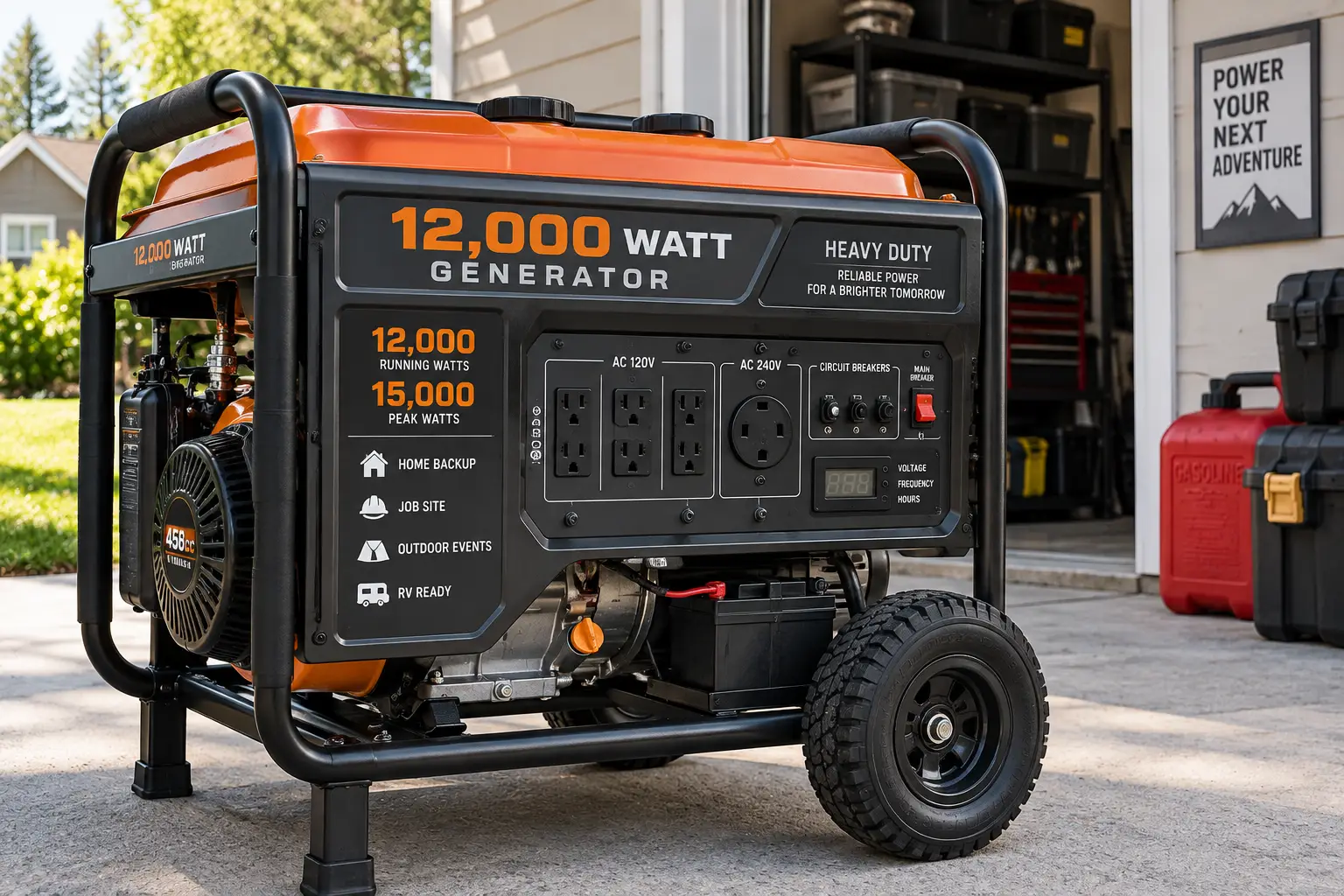
A 12 000 watt generator is a portable or semi-portable power unit rated to deliver roughly 12,000 running watts (with a higher peak/starting wattage, often 13,500–15,000W) — enough on a 120/240-volt circuit to simultaneously run a refrigerator, a well pump, lighting, and a central air conditioner, making it a popular choice for whole-home backup power during outages. Most current models are gasoline, dual-fuel (gas/propane), or tri-fuel (gas/propane/natural gas). For context on how CO exposure risk applies to any generator in this class, the U.S. Consumer Product Safety Commission’s generator safety guidance is worth reading before your first startup.
Quick Comparison: 12 000 Watt Generator at a Glance
| Model | Fuel Type | Running Watts (Gas) | Starting Watts (Gas) | Best For |
|---|---|---|---|---|
| Westinghouse WGen12000DFc | Dual fuel | 12,000W | 15,000W | Whole-home backup, low THD |
| DuroMax XP12000HX | Dual fuel | 9,500W | 12,000W | Best overall value |
| Firman T12071 | Tri-fuel | 12,000W | 15,000W | Natural gas households |
| Champion 100111 | Gasoline | 12,000W | 15,000W | Max running watts on gas only |
| Champion 12000W Dual Fuel (CO Shield) | Dual fuel | 9,500W | 12,000W | Balanced mid-range backup |
| Pulsar G12KBN | Dual fuel | 9,500W | 12,000W | Tightest budget |
| A-iPower SUA12000EDP | Dual fuel | 9,000W | 12,000W | Lightest, most compact |
Looking at the table, notice the split between models that hit 12,000 running watts (Westinghouse, Firman, Champion 100111) and those where 12,000 is really the starting/peak number, with running watts closer to 9,000–9,500 (DuroMax, the dual-fuel Champion, Pulsar, A-iPower). That distinction alone can decide whether your central A/C actually stays on during a heat-wave outage. Dual-fuel and tri-fuel flexibility also comes at a real cost premium — the Firman T12071 and Westinghouse WGen12000DFc sit at the top of the price range partly because of it, while gasoline-only options like the Champion 100111 deliver a full 12,000 running watts for meaningfully less.
💬 One click helps other shoppers make an informed choice too! 😊
Top 7 12 000 Watt Generators for 2026: Expert Analysis
We evaluated real spec sheets, manufacturer documentation, and aggregated owner feedback across entry-level, mid-range, and premium models to build this lineup. Every entry below covers what the numbers actually mean in daily use — not just what’s printed on the box.
1. Westinghouse WGen12000DFc — best overall for whole-home backup
The standout here is that the Westinghouse WGen12000DFc delivers a full 12,000 running watts (15,000 peak) on gasoline, and it doesn’t lose much ground on propane either, at 10,800 running/13,500 peak. That’s a genuinely rare spec: most dual-fuel units in this class see a much bigger drop when you switch to propane, but Westinghouse’s 713cc V-twin engine is tuned to keep the loss modest.
What sets it apart in practice is a rated total harmonic distortion under 5%, a built-in CO sensor that shuts the unit down if dangerous levels build up nearby, and a digital display that tracks voltage, frequency, and runtime hours in real time. Remote start via key fob means you can fire it up from inside the house during a storm instead of standing in the rain. Based on comparing the spec sheets across this whole category, this is the one built for buyers who want to run sensitive electronics — laptops, routers, a sump pump controller — without worrying about dirty power damaging them.
Reviews consistently report that the Westinghouse WGen12000DFc starts reliably even in cold weather and that the steel frame and lifting brackets make it easier to load into a truck bed than its weight would suggest. A recurring theme in owner feedback is that its price varies significantly by retailer, so it pays to shop around before buying.
Pros:
- ✅ Full 12,000 running watts on gasoline, not just peak
- ✅ Sub-5% THD safe for sensitive electronics
- ✅ Built-in CO sensor with automatic shutdown
Cons:
- ❌ Among the heaviest units in this roundup
- ❌ Premium price compared to single-fuel alternatives
Expect to pay between $2,400 and $3,100 depending on retailer and current promotions — check the current price before buying, since it shifts often. For the added safety features and true 12,000-running-watt output, this is strong value if whole-home reliability matters more to you than upfront cost.
2. DuroMax XP12000HX — best overall value for the money
The DuroMax XP12000HX produces 12,000 peak watts and 9,500 running watts on gasoline (a bit less on propane), powered by a 457–460cc OHV engine with all-copper windings — a detail that matters more than it sounds, since copper windings resist the heat buildup that eventually kills cheaper aluminum-wound alternators.
In practice, that 9,500-running-watt figure is still enough to carry a refrigerator, well pump, several rooms of lighting, and a central air unit without much drama, which is why DuroMax markets this as a home-backup and RV unit rather than strictly a jobsite generator. The CO Alert Technology automatically shuts the engine down if it detects unsafe carbon monoxide buildup nearby — a feature that’s becoming close to standard at this price point but is genuinely worth having.
What most buyers overlook with this model is how aggressively its price fluctuates; it’s been spotted well under $1,000 during promotional windows, which is unusually cheap for a copper-wound, transfer-switch-ready unit of this size. Reviews consistently report smooth performance and easy fuel switching, though a handful of owners note that documentation and parts availability can lag behind bigger brands like Westinghouse and Champion.
Pros:
- ✅ All-copper windings for long-term durability
- ✅ CO Alert automatic shutdown protection
- ✅ Frequently the best price-per-watt in this class
Cons:
- ❌ 9,500 running watts, not a true 12,000W workhorse
- ❌ Parts and support network smaller than major competitors
Price typically runs in the $1,000 to $1,600 range, though deal pricing has occasionally dropped it under $1,100 — always check the current price, as availability and promotions shift quickly. For most households, this is the sweet spot between capability and cost.
3. Firman T12071 — best for natural gas flexibility
Tri-fuel is the whole story with the Firman T12071. It runs on gasoline (15,000/12,000W peak/rated), propane (13,750/11,000W), or natural gas (12,500/10,000W) — meaning if your home already has an NG line, you can plug this generator directly into it and effectively never run out of fuel during an extended outage.
The 760cc V-twin engine is the largest displacement of any model in this roundup, and it shows in the numbers: even on its weakest fuel type (natural gas), the T12071 still outputs more running watts than most dual-fuel competitors manage on gasoline. Here’s what to weigh: that extra displacement and fuel flexibility come with a genuinely premium price tag, positioning this as the choice for buyers who see fuel security — not just raw wattage — as the priority during multi-day outages.
Aggregated owner feedback highlights the 13.3-gallon tank and roughly 12-hour runtime at half load as major advantages for extended power outages, along with a controlled 83dB noise level for a generator this size. The CO Alert protection and cETL/EPA certification round out a unit clearly engineered for serious home-backup duty rather than occasional camping trips.
Pros:
- ✅ True tri-fuel flexibility, including natural gas
- ✅ Largest engine displacement in this lineup
- ✅ Strong output retention across all three fuel types
Cons:
- ❌ The highest price point of any model here
- ❌ Overkill for buyers who only need occasional backup
Pricing sits between $2,700 and $4,000 depending on retailer and current promotions — at the time of writing, this places it firmly as the premium pick in the category. If natural gas access is a factor at your home, the ongoing fuel-cost savings can help offset that upfront price over several years.
4. Champion 100111 — best gasoline-only option for maximum running watts
Unlike most of the entries here, the Champion 100111 skips dual-fuel flexibility entirely and focuses on one thing: delivering a genuine 12,000 running watts (15,000 starting) on gasoline alone, using a 717cc V-twin engine. Because there’s no fuel-switching hardware to account for, this is one of the few models in the category that hits its full rated wattage without any propane-related power loss to plan around.
The Intelligauge display tracks volts, frequency, and hours, which makes it easier to notice engine wear before it becomes a breakdown — a small feature that translates into real maintenance savings over the unit’s life. Reviews consistently report that this Champion model starts easily and runs quieter than its V-twin size would suggest, though the tradeoff for skipping dual-fuel hardware is that you lose the fuel-security benefit that propane or natural gas options provide during a prolonged gasoline shortage.
What most buyers overlook here is that because it’s gasoline-only, its running-wattage-to-price ratio is genuinely strong compared to dual-fuel units claiming “12,000 watts” that only deliver 9,000-9,500 running watts in practice. If your outages tend to be short and gasoline access isn’t a concern, this is arguably the most literal interpretation of “12,000 watt generator” on this whole list.
Pros:
- ✅ Genuine 12,000 running watts, no dual-fuel derate
- ✅ Intelligauge monitoring for proactive maintenance
- ✅ EPA certified and CARB compliant in all 50 states
Cons:
- ❌ No propane or natural gas fuel-switching option
- ❌ 10.9-gallon tank means more frequent refueling on gas alone
Expect a price in the $1,800 to $2,200 range, positioning it between the budget dual-fuel units and the premium Westinghouse and Firman models. For buyers who prioritize raw running wattage over fuel flexibility, it’s a smart, focused value.
5. Champion 12000W Dual Fuel (CO Shield) — best balanced mid-range backup
The dual-fuel Champion 12000W (CO Shield) splits the difference between the brand’s gasoline-only 100111 and the budget dual-fuel competitors, delivering 12,000 starting/9,500 running watts on gasoline and 10,800/8,550 on propane. Champion’s Volt Guard system protects connected appliances from voltage spikes, while the CO Shield sensor automatically shuts the unit down if carbon monoxide accumulates nearby — both meaningful safety additions at this price tier.
Based on comparing the specs against the Pulsar and A-iPower entries below, this Champion model offers a noticeably more complete feature set (surge protection plus CO shutdown, both) for a modest price premium, backed by Champion’s 3-year warranty and free lifetime technical support — a combination smaller brands rarely match. What most buyers overlook is that lifetime technical support alone can be worth real money down the line, since troubleshooting a dead generator during a storm with no manufacturer support is a genuinely bad position to be in.
Aggregated review sentiment points to reliable startup performance and straightforward fuel switching, with a common complaint being that the 9,500 running watts (not the advertised 12,000) is the number to plan your actual appliance load around — a nuance that applies to most dual-fuel units in this roundup, not just this one.
Pros:
- ✅ Volt Guard surge protection plus CO Shield in one unit
- ✅ Backed by 3-year warranty and free lifetime support
- ✅ Reliable dual-fuel switching per aggregated owner feedback
Cons:
- ❌ 9,500 running watts, same dual-fuel wattage gap as rivals
- ❌ Bulkier dimensions than the Pulsar or A-iPower units
Price generally falls between $1,100 and $1,400, making it a reasonable middle-ground buy for households that want more safety features than the cheapest dual-fuel options without stepping up to Westinghouse or Firman pricing.
6. Pulsar G12KBN — best budget dual-fuel pick
If price is the deciding factor, the Pulsar G12KBN is consistently the least expensive genuinely dual-fuel 12,000-peak-watt unit in this category, delivering 9,500 running watts on gasoline and 8,550 on propane from a 457cc single-cylinder OHV engine. Pulsar’s “Switch & Go” system lets you change fuel sources without shutting the unit down first, which is a nicer touch than the feature list’s low price would suggest.
What most buyers overlook with this model is that its low published THD (some independent testing has found it under 1% at typical household loads, though Pulsar doesn’t officially publish a THD spec) makes it a surprisingly capable choice for households worried about sensitive electronics, despite its budget positioning. The 3-in-1 digital meter, low-oil shutoff, and 10-inch never-flat wheels round out a feature set that punches above its price point.
Reviews consistently report that the G12KBN comfortably runs a full 2,500-square-foot home including a well pump, with several owners specifically noting it’s quiet enough to barely notice from inside the house. A recurring complaint in aggregated feedback is that the included manual is thin and appears to be repurposed from a smaller model in Pulsar’s lineup, leaving some setup details to figure out independently.
Pros:
- ✅ Lowest price of any true dual-fuel model here
- ✅ Switch & Go fuel transition without shutdown
- ✅ Surprisingly low measured THD for the price tier
Cons:
- ❌ Thin manual/documentation compared to bigger brands
- ❌ 9,500 running watts caps larger appliance combinations
Typical pricing runs around $850 to $950, occasionally dipping lower during retailer promotions — check the current price, since Pulsar deals shift frequently. For value-focused shoppers, this is hard to beat dollar-for-dollar.
7. A-iPower SUA12000EDP — lightest and most compact option
The A-iPower SUA12000EDP produces 12,000 starting watts and 9,000 running watts from a 459cc OHV engine, with a CO sensor that automatically shuts the unit down if dangerous carbon monoxide levels are detected nearby. Its 6.6-gallon tank is the smallest in this roundup, but A-iPower rates it for roughly 14 hours of runtime at 25% load, which makes it more fuel-efficient in practice than the tank size alone suggests.
Here’s what to weigh: at 9,000 running watts, this is the lowest-output “12,000 watt” generator on this list, so it’s better suited to households running fewer simultaneous large appliances rather than a full central-A/C-plus-well-pump-plus-refrigerator combination. What the spec sheet doesn’t say, but owner feedback suggests, is that its comparatively compact frame and lighter overall footprint make it noticeably easier to load and unload solo, which matters more than most buyers initially expect.
Aggregated review sentiment is positive on ease of startup and fuel efficiency, with occasional notes that its running-watt ceiling means careful appliance planning is more important here than with the higher-output models above. If you cannot verify additional in-depth review data beyond what’s aggregated here, treat the 9,000-running-watt figure as your real planning number rather than the 12,000 headline.
Pros:
- ✅ Best-in-class fuel efficiency at 14 hours per tank
- ✅ Lighter, more compact frame than most rivals
- ✅ CO sensor shutdown included standard
Cons:
- ❌ Lowest running-watt output in this lineup (9,000W)
- ❌ Smallest fuel tank means more frequent refills on longer runs
Price generally lands in the $1,050 to $1,300 range. It’s a solid pick for smaller households or secondary/RV use where absolute maximum wattage matters less than portability.
How to Choose a 12 000 Watt Generator
Picking the right unit comes down to matching real appliance math to real spec-sheet numbers, not just chasing the biggest headline wattage. Here’s the process we’d recommend:
- Add up your running watts first. List every appliance you need during an outage (refrigerator, well pump, furnace fan, a few circuits of lighting) and add their running-wattage ratings together — most are printed on a nameplate or in the owner’s manual.
- Then account for starting watts separately. Motor-driven appliances like well pumps, refrigerators, and air conditioners draw 2-3x their running wattage for a second or two at startup; your generator’s peak/starting rating needs to cover the single largest of these spikes on top of everything else already running.
- Decide how much you value fuel flexibility. Gasoline-only units like the Champion 100111 hit their full rated wattage without any dual-fuel power loss, but propane and natural gas options protect you if gas stations are inaccessible during a widespread outage.
- Check the THD rating if you’ll power electronics. Anything under 5% total harmonic distortion is generally considered safe for laptops, routers, and similar sensitive gear; older or ultra-budget conventional generators can run much higher.
- Confirm transfer switch compatibility before you buy. A 30A or 50A outlet alone doesn’t power your home’s circuits — you’ll need a manual or automatic transfer switch installed by a licensed electrician to safely connect a generator this size to your panel.
- Factor in noise and placement realistically. Every model in this guide needs to sit at least 20 feet from doors, windows, and vents per CPSC guidance, so measure your actual yard or driveway space before assuming any unit will fit where you planned.
- Compare warranty and support, not just price. A 3-year warranty with live phone support (like Champion and Westinghouse offer) is worth real money if something goes wrong two winters from now.
Full Comparison: Top 7 Models Side by Side
| Model | Engine | Propane Running Watts | Noise Level | THD | Warranty |
|---|---|---|---|---|---|
| Westinghouse WGen12000DFc | 713cc V-twin | 10,800W | ~74 dB | <5% | 3-year |
| DuroMax XP12000HX | 457-460cc OHV | ~9,000W | Not published | Not published | 3-year |
| Firman T12071 | 760cc V-twin | 11,000W | 83 dB | Not published | Standard mfr. |
| Champion 100111 | 717cc V-twin | N/A (gas only) | Not published | Not published | 3-year + lifetime support |
| Champion 12000W Dual Fuel | Not published | 8,550W | Not published | Not published | 3-year + lifetime support |
| Pulsar G12KBN | 457cc single-cyl. | 8,550W | 74 dB | ~1-7% (unofficial) | 1-year |
| A-iPower SUA12000EDP | 459cc OHV | Not published | Not published | Not published | Standard mfr. |
This table makes the fuel-flexibility tradeoffs clearer: the Firman T12071 retains the most power across all three fuel types thanks to its larger V-twin engine, while the Pulsar G12KBN and Champion 12000W Dual Fuel both lose roughly 10% of their gasoline running-watt output when switched to propane. Warranty coverage is where the premium brands separate themselves — Champion‘s lifetime technical support and Westinghouse‘s 3-year coverage both add real peace of mind that budget models generally can’t match.
✨ Don’t miss these exclusive deals!
🔍 Take your home backup plan to the next level with this carefully curated lineup. Click a highlighted model above to check current pricing and availability. These picks will help you keep the essentials running the whole family depends on!
12000 Watt Dual Fuel Generator vs Tri-Fuel Generator
The core difference isn’t complicated: a dual fuel generator (like the DuroMax XP12000HX, Pulsar G12KBN, or Champion 12000W Dual Fuel) runs on either gasoline or propane, while a tri-fuel generator (like the Firman T12071) adds natural gas as a third option, typically by connecting to an existing NG line at the house.
In practice, dual fuel covers most homeowners’ needs — propane storage is straightforward, tanks don’t degrade like stored gasoline does, and switching between the two fuels is usually a simple valve or switch on the control panel. Tri-fuel only pulls ahead if you already have a natural gas line at your home, because it effectively gives you unlimited runtime without needing to store or transport any fuel at all during a multi-day outage — a meaningful advantage when gas stations are inaccessible or lines are hours long after a major storm.
| Factor | Dual Fuel | Tri-Fuel |
|---|---|---|
| Fuel storage needed | Propane tanks only | None, if NG-connected |
| Typical price premium | Lower | Higher |
| Best for | Most households | Homes with existing NG lines |
The tradeoff is cost: tri-fuel units like the Firman T12071 carry a meaningfully higher price than comparable dual-fuel models, and natural gas mode typically produces somewhat lower output than gasoline mode on the same unit. For most buyers without an NG hookup already in place, a dual-fuel model delivers nearly the same real-world flexibility for considerably less money.
Common Mistakes to Avoid When Buying a 12000 Watt Generator
The most common and costly mistake is buying based on the “12,000 watt” headline number alone without checking whether that’s the running or starting/peak rating — as this guide has shown, several models labeled 12,000 watts actually deliver 9,000-9,500 running watts, a difference that can mean your central A/C simply won’t start when everything else is already drawing power.
A second frequent misstep is skipping the transfer switch. Running extension cords through a cracked window or door to power individual appliances is both less safe and far less convenient than having a licensed electrician install a transfer switch that lets the generator power your home’s existing circuits directly — and per OSHA’s portable generator safety guidance, connecting a generator directly to household wiring without a proper transfer switch also creates a serious backfeed hazard for utility line workers.
Other recurring mistakes buyers report: purchasing a generator only after an outage has already started (when prices spike and inventory disappears), never running the unit before an emergency to confirm it actually starts, and forgetting to add fuel stabilizer to stored gasoline, which can gum up a carburetor after just a few months of sitting unused.
What to Expect: Everyday Performance of a 12000 Watt Portable Generator
On paper, a 12 000 watt generator sounds like it should silently and effortlessly run an entire house — the reality is a bit noisier and more hands-on than that. Expect a noise level somewhere between 68 and 83 decibels depending on the model (roughly the volume of a vacuum cleaner to a gas-powered lawn mower), which is loud enough that placement relative to bedroom windows matters for a good night’s sleep during an extended outage.
Startup is generally straightforward across every model in this guide — push-button or key-fob electric start has become close to standard even on budget units — but expect a genuine learning curve around load management. Turning on a central A/C unit and a well pump at the exact same moment, even on a 12,000-running-watt unit, can trip an overload protection breaker if you haven’t sequenced your appliance startups with a few seconds of spacing between them. Reviews consistently report that owners who take ten minutes to plan a startup order (largest motor loads first, one at a time, with lighting and electronics added last) have far fewer nuisance trips than those who flip everything on at once.
Setting Up and Maintaining Your Generator: The First 30 Days
Getting a new 12 000 watt generator ready for real use takes more than unboxing it and hoping for the best. Here’s what the first month should actually look like, based on manufacturer guidance across the models in this roundup.
First, add engine oil before the first start — most of these units ship without it, and running even briefly without oil can seize a brand-new engine within minutes. Check your model’s manual for the correct weight (typically 10W-30), and top off the fuel tank with fresh gasoline plus a stabilizer if you’re not using it immediately. Run the generator under a light load for 20-30 minutes to break in the engine before its first real test.
Next, schedule a full startup test on the actual fuel type and outlets you plan to use in an emergency — don’t wait for a storm to discover that your extension cords are the wrong gauge or that the transfer switch installation has an issue. Most manufacturers recommend running the unit for 20-30 minutes monthly under light load, which keeps the carburetor clean and the battery (on electric-start models) properly charged.
Common mistakes in the first 30 days include over-filling the oil (check the level cold, on a flat surface), forgetting to open the fuel valve before starting, and neglecting to register the warranty within the manufacturer’s specified window — a step that’s easy to skip but can affect coverage if you need support down the line.
Real-World Scenarios: Matching the Right 12000 Watt Generator to Your Situation
The suburban family managing a well pump and central A/C. A household running a 1/2-HP well pump, a refrigerator, central air, and normal household lighting needs the full 12,000 running watts that only gasoline-only or premium dual-fuel units genuinely deliver. The Westinghouse WGen12000DFc or Champion 100111 are the strongest fits here, since both hit their full rated output without a dual-fuel wattage penalty working against them.
The budget-conscious first-time buyer. For someone who mostly needs to keep a fridge, some lights, and a few electronics running through occasional shorter outages, the Pulsar G12KBN or A-iPower SUA12000EDP cover that load comfortably at a fraction of the premium models’ price, without paying for capability that would go unused.
The rural homeowner without reliable gas station access. If gasoline supply is unreliable after major storms in your area, the Firman T12071‘s tri-fuel flexibility — particularly natural gas, if your home already has a line — removes fuel logistics from the equation entirely, which is worth the price premium for households in genuinely storm-prone regions.
Long-Term Cost and Maintenance: Is a Whole House Generator 12000 Watts Worth It?
The sticker price is only part of the real cost of ownership. Factor in annual maintenance (oil changes roughly every 100 hours of use, air filter checks, spark plug replacement every couple of years), fuel costs during actual outages, and the eventual cost of a professional transfer switch installation if you don’t already have one — that last item alone commonly adds several hundred dollars beyond the generator’s purchase price.
Where the math tends to favor spending more upfront: models with better warranty coverage and support, like the Champion lineup’s lifetime technical support or Westinghouse‘s 3-year coverage, can save real money in avoided repair costs over a 5-10 year ownership window compared to budget units with only a 1-year warranty. Dual-fuel and tri-fuel flexibility also has long-term value that’s easy to underestimate — propane doesn’t degrade in storage the way gasoline does, meaning less wasted fuel and fewer carburetor issues from old gas sitting unused between outages.
For most households, a whole house generator 12000 watts represents a reasonable middle path: enough capacity to genuinely matter during a multi-day outage, without the five-figure investment and permanent installation that a true standby system requires.
Features That Actually Matter (and Ones That Don’t)
After comparing seven spec sheets side by side, a few features clearly separate the genuinely useful from the marketing filler. Total harmonic distortion is one that actually matters: a lower THD rating means cleaner, more stable power that’s safer for sensitive electronics, and it’s a real engineering distinction, not a gimmick — which is why the Westinghouse’s sub-5% rating is a genuine differentiator, not just a spec-sheet number.
CO sensors with automatic shutdown also matter enormously, given how quickly carbon monoxide can become lethal in enclosed or semi-enclosed spaces; every model in this roundup except the base gasoline-only unit includes one, and it’s a feature we’d consider close to non-negotiable at this point.
What matters less than it might seem: peak decibel ratings measured at unrealistic distances, and headline “starting watts” numbers in isolation, since — as this whole guide has emphasized — running watts are what actually determines whether your appliances stay powered. Flashy digital displays are nice for monitoring, but a simple analog gauge that accurately shows voltage and runtime hours does the same core job for less money.
Safety, Regulations, and Standards for 12000 Watt Generators
Every generator in this guide requires the same fundamental safety practices, and skipping them is genuinely dangerous, not just against the rules. Per CPSC guidance, a portable generator should run outdoors only, positioned at least 20 feet from doors, windows, and vents — closer distances recommended in some owner’s manuals don’t override this federal safety guidance. Never run a generator in a garage, basement, or shed, even with the door open; carbon monoxide can build to lethal levels within minutes in a partially enclosed space.
Electrically, connecting a generator to your home’s wiring requires a properly installed transfer switch — never a direct connection through a wall outlet — both to protect your appliances from backfeed damage and to protect utility line workers who could be electrocuted by power flowing backward into supposedly de-energized lines during a repair. All of the models here are EPA certified for emissions, and several (Champion, DuroMax) carry CARB compliance for sale in California and other states with stricter emissions standards. If you’ll be using extension cords rather than a transfer switch for partial-home backup, stick to heavy-duty, outdoor-rated cords with a wire gauge adequate for your appliance loads, and never use damaged cords.
Frequently Asked Questions
❓ What can a 12 000 watt generator run?
❓ How many hours will a 12000 watt generator run on a tank of gas?
❓ Is a 12000 watt generator enough to run a house?
❓ How much does a 12000 watt generator cost?
❓ Do I need a transfer switch for a 12000 watt generator?
Conclusion
Choosing among these seven models really comes down to one honest question: do you need the full 12,000 running watts, or will 9,000-9,500 comfortably cover your actual appliance list? Once you answer that, the rest of the decision narrows fast — the Westinghouse WGen12000DFc and Champion 100111 for buyers who need genuine 12,000-running-watt output, the Firman T12071 for households prioritizing fuel flexibility above all else, and the DuroMax XP12000HX, Pulsar G12KBN, or A-iPower SUA12000EDP for anyone balancing capability against a tighter budget.
Whichever you choose, don’t skip the fundamentals covered above: size the unit to your real running-watt needs (not just the headline number), install a proper transfer switch, and follow CO safety guidance every single time you use it. Do that, and any of the seven models here will genuinely earn its keep the next time the power goes out.
✨ Ready to stop worrying about the next outage? Compare the full lineup above and pick the 12 000 watt generator that matches your home’s real power needs before the next storm hits.
Recommended for You
- 100W Portable Solar Panel: 7 Best Picks for 2026 (Tested)
- Best 1000W Generator 2026: 7 Top Picks (Pros & Cons)
- Portable Solar Aircon: 7 Best Off-Grid Picks for 2026
Disclaimer: This post contains affiliate links. As an Amazon Associate, I earn from qualifying purchases made through these links, at no additional cost to you.
✨ Found this article helpful? Share it with someone who needs it! 💬🤗