
In This Article
If you’ve started shopping for a solar generator for rv 30 amp use, you’ve probably already hit the confusing part: almost every power station on the market claims to be “RV ready,” but very few of them can actually replace a 30-amp campground pedestal. A 30-amp RV service runs at 120 volts and pulls up to 3,600 watts at full load — and that single fact eliminates more than half of the popular portable power stations sold for camping. The rest split into two camps: units with a genuine TT-30R outlet that accepts your RV cord directly, and units that need a “dogbone” adapter down to a household plug and quietly cap your output well below what a real 30-amp pedestal delivers.
This guide cuts through that confusion. We researched seven real, currently available power stations — from a budget-friendly entry point to a modular, expedition-grade system — and looked past the marketing copy to the actual TT-30R rating, continuous wattage, and battery chemistry behind each one. You’ll get honest analysis of who each unit is really built for, what the aggregated owner reviews say, and where the trade-offs hide. Whether you’re chasing a 30 amp RV solar generator for weekend boondocking or a full off-grid setup for months on the road, the goal here is simple: help you match your actual power draw to a unit that won’t leave you guessing at the campsite.
What Is a Solar Generator for RV 30 Amp Use?
A solar generator for RV 30 amp use is a portable battery power station — built around a lithium iron phosphate (LiFePO4) battery pack and a pure sine wave inverter — that can be recharged by solar panels and that outputs 120V AC power through a dedicated TT-30R outlet rated to handle a 30-amp RV shore power cord. According to the U.S. Department of Energy, a complete solar (photovoltaic) system pairs panels with an inverter to convert the direct current the panels generate into the alternating current household and RV appliances actually use, which is exactly the process happening inside these units, just scaled down into a portable box (Department of Energy).
Not every “RV solar generator” on Amazon meets that bar. Some only offer standard 15- or 20-amp household outlets and rely on an adapter cord, which caps your usable output well under 3,600 watts. Understanding this distinction before you buy is the single most important step in this entire guide.
Quick Comparison: 7 Solar Generators for RV 30 Amp Use
| Product | Battery Capacity | Continuous Output | 30A RV Outlet | Best For |
|---|---|---|---|---|
| Anker SOLIX F3000 | 3,072Wh | 3,600W | Full TT-30R (30A/3,600W) | Full shore-power replacement |
| EcoFlow Delta Pro 3 | 4,096Wh | 4,000W | Full TT-30R (30A/3,600W) | AC-heavy rigs, boondocking |
| Bluetti AC200L | 2,048Wh | 2,400W | Native 30A RV outlet | Best value per watt-hour |
| Dabbsson DBS3500 | 3,430Wh | 3,600W | Native TT-30 port | Long-term durability |
| Point Zero Energy Titan | 2,000Wh per pack (modular) | 3,000W | Native 30A RV plug | Modular, expandable systems |
| Anker SOLIX C2000 Gen 2 | 2,048Wh | 2,400W | TT-30R capped at 20A/2,400W | Lightest true TT-30R option |
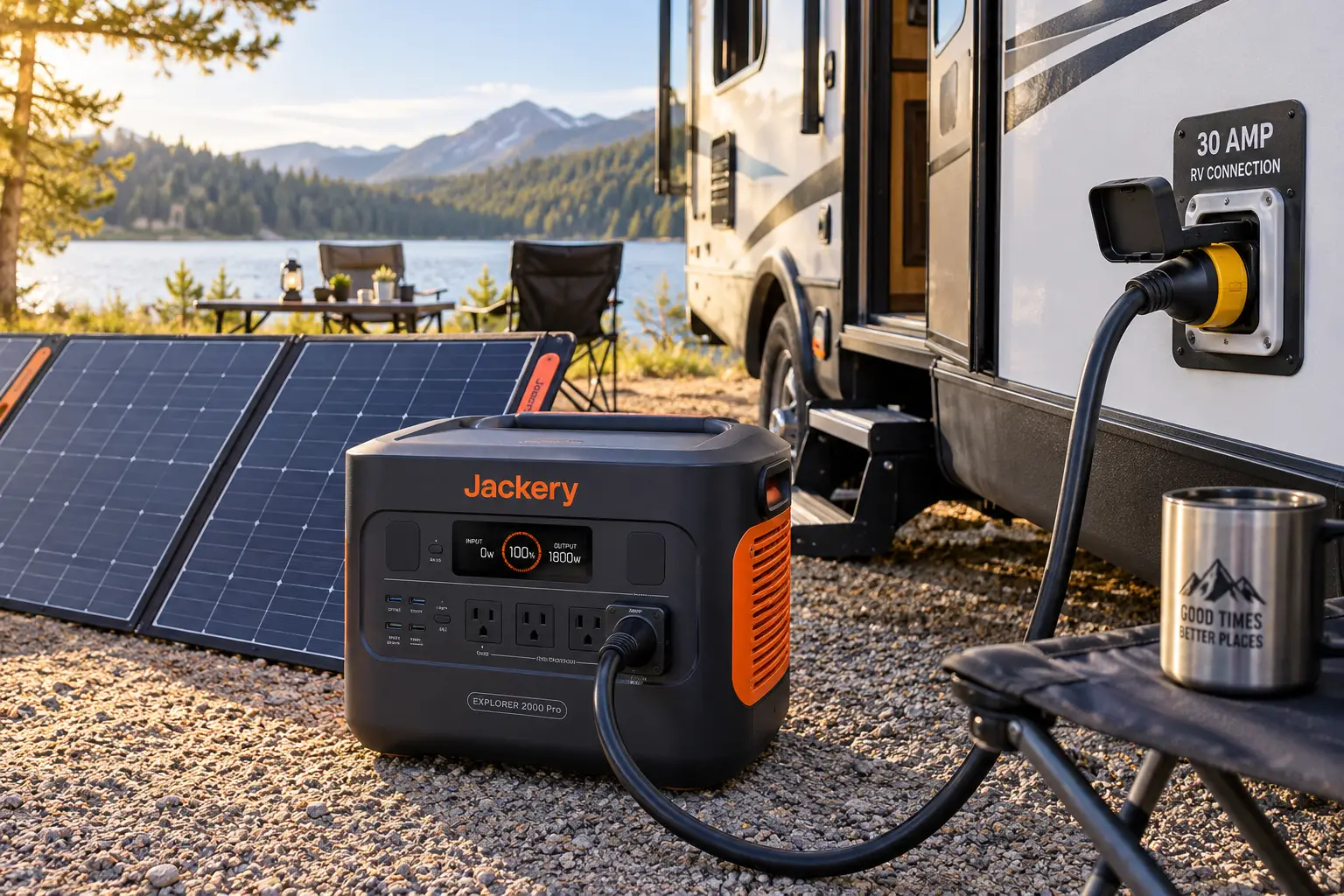
| Jackery Solar Generator 1000 v2 | 1,070Wh | 1,500W | None — adapter required | Budget first-time buyers |
Looking at the table, the split is immediately clear: the Anker SOLIX F3000, EcoFlow Delta Pro 3, Bluetti AC200L, Dabbsson DBS3500, and Point Zero Energy Titan all carry a TT-30R or equivalent outlet rated for the full 3,000–3,600 watts a 30-amp pedestal can deliver. The Anker SOLIX C2000 Gen 2 technically has the right socket shape but caps output at 20 amps, and the Jackery Solar Generator 1000 v2 has no native RV outlet at all — both are worth considering, but only once you understand what they can’t do.
💬 One click helps other shoppers make an informed choice too! 😊
Top 7 Solar Generators for RV 30 Amp Use: Expert Analysis
1. Anker SOLIX F3000 — full 30-amp shore-power replacement
The Anker SOLIX F3000 is built to act as a genuine substitute for a campground pedestal rather than a supplement to one. With 3,072Wh of LiFePO4 capacity and a 3,600W pure sine wave inverter, it’s one of the few portable units whose TT-30R outlet is actually rated for the complete 120V/30A/3,600W a 30-amp RV service is designed to carry — not a scaled-down approximation. In practice, that means you can run a microwave, a coffee maker, and your air conditioner’s startup surge without the unit tripping a soft-limit the way lower-output “RV compatible” stations often do.
What most buyers overlook with a unit in this tier is the charging ecosystem behind the number on the box. The F3000 accepts up to 2,400W of solar input across two MPPT-controlled ports, and its 3,600W AC pass-through means you can run loads and recharge from a generator simultaneously, which matters a lot during extended cloudy stretches while boondocking. Reviews consistently report that the unit runs quietly, holds its charge well in storage, and that the companion app’s time-of-use scheduling is a genuine convenience rather than a gimmick, though several owners note the unit’s roughly 66-pound weight means it’s a two-hand lift best suited to a fixed spot in a basement compartment rather than a grab-and-go battery.
This is the pick for full-time RVers or serious boondockers who want one box that behaves exactly like shore power, including running the air conditioner for a reasonable stretch. Casual weekend campers with lighter power needs will likely find the capacity — and price — more than they need.
Pros:
- ✅ TT-30R outlet rated for full 30A/3,600W, not a soft cap
- ✅ 2,400W solar input keeps up with real boondocking demand
- ✅ Simultaneous pass-through charging and discharging
Cons:
- ❌ At roughly 66 lbs, it’s not a grab-and-go unit
- ❌ Premium price puts it out of reach for casual campers
Price for the Anker SOLIX F3000 typically falls between around $2,500 and $3,200, with seasonal sales frequently pulling it toward the lower end — check the current price before buying, since Anker runs frequent promotions. For the buyer who genuinely needs a full 30-amp replacement, the value case is strong even near list price.
2. EcoFlow Delta Pro 3 — most muscle for AC-heavy rigs
The EcoFlow Delta Pro 3 leads this list on raw output. Its 4,096Wh battery and 4,000W continuous inverter (8,000W surge) give it more headroom than any other unit here, and its port selection reflects that ambition: alongside a native TT-30R 30-amp RV outlet, it also carries a 120/240V NEMA L14-30R transfer-switch outlet and a 240V NEMA 5-20R appliance outlet, plus a dedicated 12.6V/30A DC output on an Anderson connector for diesel heaters and 12V fuse panels.
In practice, that headroom is the whole point. What the spec sheet doesn’t say plainly is that most 30-amp power stations technically “support” an RV air conditioner but only for a matter of minutes before the battery drains or the inverter throttles; the Delta Pro 3’s larger capacity and 4,000W continuous rating give it meaningfully more runway for genuinely high-draw appliances running back-to-back, which is exactly the scenario that breaks smaller units. Reviewers highlight the EV-charger compatibility as a surprisingly practical feature for van-lifers who pass Level 2 chargers on the road, and the expansion batteries — which double capacity per unit, up to 12.2kWh — give this system real long-term scalability that a fixed-capacity unit can’t match.
The trade-off is size, weight, and cost. At this capacity tier, the Delta Pro 3 is a stationary or semi-stationary unit, not something you casually move between the RV and the campsite picnic table. It’s the right call for full-timers or families running a residential-style RV AC unit regularly and boondocking for multiple days between hookups.
Pros:
- ✅ 4,000W continuous output leads this entire class
- ✅ Three separate 30A-class outlets cover almost any use case
- ✅ Expandable to 12.2kWh for serious off-grid stretches
Cons:
- ❌ Large, heavy footprint isn’t practical for casual carry
- ❌ Full expansion setup gets expensive quickly
The EcoFlow Delta Pro 3 is commonly priced in the $2,000 to $3,700 range depending on bundle and current promotions, so it pays to compare listings before buying — prices on units like this shift often. For AC-heavy rigs, the extra headroom over the F3000 genuinely changes what a day of boondocking looks like.
3. Bluetti AC200L — best value per watt-hour
The Bluetti AC200L is the value play in this lineup, and it earns that reputation honestly rather than through a stripped-down feature set. For roughly the price of a mid-range unit, you get 2,048Wh of LiFePO4 capacity, a 2,400W continuous inverter (3,600W surge), a dedicated 30A RV outlet, and an expansion path all the way to 8,192Wh using Bluetti’s B300 battery modules — a genuine upgrade path most units at this price simply don’t offer.
The practical meaning of that expandability is flexibility: buy the base unit now for lighter camping needs, then add a battery module later if your power habits grow, instead of replacing the whole system. Aggregated reviews are notably consistent on two points: the fast-charge system, which reaches roughly 80% in about 45 minutes on AC power, gets praised repeatedly as a genuine convenience rather than a marketing number, and the 62-pound weight with no wheels is the recurring complaint, with multiple reviewers calling it a two-person lift for anything beyond sliding it into a fixed RV bay. The Bluetooth-only app (no native Wi-Fi on this model) is also mentioned as a minor inconvenience for remote monitoring compared to some competitors.
This unit fits RV owners who want serious 30-amp capability without paying flagship pricing, and who plan to more or less park the unit once it’s installed rather than moving it daily.
Pros:
- ✅ Dedicated 30A RV outlet at a genuinely competitive price
- ✅ Expandable to 8,192Wh as your needs grow
- ✅ Fast 45-minute charge to roughly 80% on AC power
Cons:
- ❌ 62 lbs with no wheels makes it awkward to relocate
- ❌ App relies on Bluetooth only, limiting remote monitoring
The Bluetti AC200L is usually found between about $900 and $1,600 depending on ongoing deals, making it one of the stronger value-for-money picks on this list once you weigh capacity and outlet type against price.
4. Dabbsson DBS3500 — longest-lasting battery chemistry
The Dabbsson DBS3500 is the lesser-known name here, but its spec sheet is anything but a budget compromise. It packs 3,430Wh of capacity using a semi-solid-state LiFePO4 battery, rated for around 4,500 cycles to 80% capacity — meaningfully higher than the 3,000-to-3,500-cycle figures typical of standard LiFePO4 packs in this category — alongside a 3,600W continuous inverter and a native TT-30-style RV port.
Here’s what that cycle-life number means in practice: at typical RV usage patterns, a 3,000-cycle battery still tends to outlast most owners’ patience for hauling a heavy power station around, but the longer-rated cell chemistry in the DBS3500 gives it a real edge for full-time RVers who cycle their battery daily rather than seasonally. Reviews and owner comments highlight the roughly two-hour full recharge on AC power as a standout, since most units in this capacity class take considerably longer, and the expandability up to 28.14kWh across multiple battery packs positions it as a legitimate whole-home or whole-RV backup option rather than a single-trip battery. The trade-off is brand recognition: Dabbsson doesn’t have the review volume or retail footprint of Anker, EcoFlow, or Jackery, so you’re trading some of that “everyone owns one” reassurance for genuinely newer battery technology.
This is a solid pick for buyers who prioritize long-term battery health over brand familiarity, and who are comfortable buying from a newer but legitimate US-market solar generator manufacturer.
Pros:
- ✅ Semi-solid-state cells rated for roughly 4,500 cycles
- ✅ Fast roughly two-hour full AC recharge
- ✅ Expandable up to 28.14kWh for whole-RV backup
Cons:
- ❌ Smaller brand footprint means fewer long-term owner reviews
- ❌ Heavier accessory ecosystem than the bigger three brands
The Dabbsson DBS3500 generally runs from around $1,400 to $2,300 depending on bundle and current promotions, which puts it squarely between the AC200L and the flagship units above it — a reasonable middle ground for buyers who want longevity without flagship pricing.
5. Point Zero Energy Titan — modular, field-swappable batteries
The Point Zero Energy Titan takes a fundamentally different design approach than everything else on this list. Instead of one sealed battery, the Titan splits into a power module and removable 2,000Wh lithium battery packs that stack together, so you can carry spare batteries separately rather than lifting one enormous unit as a single piece. The base configuration delivers a 3,000W continuous pure sine inverter (6,000W surge) and includes a native 30-amp RV outlet, which owner documentation and independent reviews describe as reliably handling roughly 25 amps of continuous draw in practice — plenty for a real RV setup, even if it’s a touch below the theoretical 30-amp ceiling.
What that modularity means in practice is meaningful flexibility for buyers who camp differently trip to trip: bring one battery pack for a short weekend, add a second or third for extended boondocking, and swap a depleted pack for a charged one instead of waiting hours for a single large battery to refill. Aggregated owner feedback is largely enthusiastic about build quality and the dual-MPPT solar charge controllers, which support up to 2,000W of combined solar input across two ports — genuinely fast for a unit in this class — though several reviewers note the modular design means a bit more setup complexity than a plug-and-play single-box unit, and the brand’s smaller manufacturing scale means parts and accessories can take longer to source than with the major three brands.
This unit is the right fit for buyers who want a genuinely expandable, field-serviceable power system — think long-term off-grid living or a cabin-plus-RV setup — rather than the simplest possible out-of-the-box experience.
Pros:
- ✅ Swappable 2,000Wh battery packs add real field flexibility
- ✅ Dual MPPT controllers support up to 2,000W of solar input
- ✅ Native 30A RV outlet handles real-world RV loads well
Cons:
- ❌ Modular setup adds a learning curve versus single-box units
- ❌ Smaller brand means longer waits on accessories and support
The Point Zero Energy Titan typically starts around $2,500 for a single-battery configuration and climbs past $4,000 as you stack additional battery packs, so pricing scales directly with how much runway you actually need.
6. Anker SOLIX C2000 Gen 2 — lightest true TT-30R option
The Anker SOLIX C2000 Gen 2 solves a problem the flagship units above don’t: portability. At 41.7 pounds, it’s roughly 25% lighter than the category average, and its 18.1 x 9.8 x 10.1-inch footprint is compact enough to fit under most RV beds — a real consideration if storage space in your rig is tight. It carries 2,048Wh of LiFePO4 capacity, a 2,400W continuous inverter with 4,000W surge, and — critically — a TT-30R outlet, so your standard 30-amp RV cord plugs in directly with no dogbone adapter.
Here’s the honest caveat that matters most for this keyword: despite having the correct TT-30R socket shape, the outlet on the C2000 Gen 2 is explicitly limited to 20 amps and 2,400 watts, not the full 30-amp/3,600-watt rating of a real pedestal. In practice, that means it comfortably runs lights, the fridge, a microwave, and charging gear, but it will not sustain a rooftop air conditioner running continuously — reviewers who tested it against a simulated 600W load and an induction cooktop burst confirmed it handles moderate RV draw well but drains in under an hour under full AC load. Owner reviews on retailer sites repeatedly praise the plug-and-play TT-30 connection for eliminating the need to hunt for adapters, and the sub-10-millisecond UPS switchover gets specific praise from CPAP users who don’t want a reboot mid-outage. The 800W alternator charging option is also a standout, letting you top up while driving instead of relying solely on campground hookups.
This is the pick for RVers who value portability and a direct RV-cord connection above maximum output — weekend boondockers running lights, a fridge, and electronics rather than a full house’s worth of load.
Pros:
- ✅ TT-30R outlet accepts your RV cord with zero adapters
- ✅ 41.7 lbs makes it genuinely portable for a 2kWh unit
- ✅ Sub-10ms UPS switchover protects sensitive electronics
Cons:
- ❌ TT-30R output capped at 20A/2,400W, not the full 30A rating
- ❌ Can’t sustain a rooftop AC unit running continuously
The Anker SOLIX C2000 Gen 2 is typically priced between about $1,100 and $1,500, which makes it a reasonable middle-tier pick specifically for buyers whose real-world loads stay under that 2,400W ceiling.
7. Jackery Solar Generator 1000 v2 — easiest budget entry point
The Jackery Solar Generator 1000 v2 rounds out this list as the entry point — both in price and in capability. It pairs Jackery’s Explorer 1000 v2 power station (1,070Wh LiFePO4 capacity, 1,500W continuous output, 3,000W surge) with a 200W SolarSaga solar panel, giving new RVers a complete, ready-to-use charging setup out of the box rather than a bare battery.
The honest trade-off, and the reason this pick sits at the bottom of this list rather than the middle, is that it has no native TT-30R outlet — you’ll need a separate 30-amp-to-household adapter cord (commonly sold alongside it) to connect it to your RV’s power inlet, and even then the unit’s 1,500W ceiling means you’re nowhere near a real 30-amp pedestal’s 3,600W capacity. What that means in practice: this unit is well suited to running a 12V fridge, lights, fans, laptops, and phone charging for a weekend, but it is not a stand-in for shore power on anything beyond light loads. Reviewers consistently praise the roughly one-hour full recharge on AC power and the switch to LiFePO4 chemistry (rated for over 4,000 cycles) as a genuine upgrade over the outdated NCM battery in the original v1 model, though several note that solar input maxes out at 400W and that Jackery’s proprietary MC3 solar connectors require an adapter to use third-party panels.
This is the right call for RVers just getting started with off-grid power who want a lower financial commitment while they learn their actual power habits before investing in a full 30-amp-rated system.
Pros:
- ✅ Genuine LiFePO4 chemistry rated for 4,000+ charge cycles
- ✅ Roughly one-hour full recharge on AC power
- ✅ Complete solar bundle included, ready out of the box
Cons:
- ❌ No native TT-30R outlet — a separate adapter is required
- ❌ 1,500W output is far below true 30-amp pedestal capacity
The power station alone for the Jackery Solar Generator 1000 v2 usually runs $400 to $800, with the full 200W solar panel bundle landing around $1,300 — genuinely the most accessible entry point on this list, provided your expectations match its lighter-duty role.
Getting Started: Your First 30 Days With a 30 Amp Solar Generator
The most common early mistake isn’t a hardware failure — it’s discharging the battery to zero before understanding your RV’s actual daily draw. In your first week, run the unit through a full charge-discharge cycle while logging what’s plugged in, so you have a real baseline instead of a guess based on the spec sheet. Most units, including the Bluetti AC200L and Anker SOLIX F3000, include an app that logs wattage in real time — use it obsessively during week one.
Next, confirm your RV’s shore power inlet actually matches the unit’s outlet before you’re at a campsite relying on it. Units with a genuine TT-30R, like the EcoFlow Delta Pro 3 and Point Zero Energy Titan, plug straight into a standard 30-amp RV cord, but if you bought the Jackery Solar Generator 1000 v2, you’ll need to test your adapter cord at home first, not on your first night off-grid. Set your solar panels up on a level, unshaded test run in your driveway to confirm actual wattage delivered versus the panel’s rated output — real-world solar input is almost always lower than the sticker number due to angle, temperature, and panel age.
Finally, resist the urge to run your air conditioner continuously to “test the limits” in week one. Most 30-amp solar generators, even flagship units, are built for AC support in short bursts or overnight cycling, not all-day continuous cooling — pushing past that in the first days of ownership is the single most common cause of early disappointment with these systems.
Real-World Scenarios: Which Solar Generator Fits Your RV Lifestyle
Consider three common buyer profiles. First, a retired couple in a 30-foot travel trailer who boondock two or three nights a month and mostly need to run a fridge, lights, and a CPAP overnight — for this profile, the Bluetti AC200L or Anker SOLIX C2000 Gen 2 covers real needs without paying for capacity they’ll rarely use, and both handle a budget in the $900–$1,500 range comfortably.
Second, a full-time working-from-the-road couple running laptops, a Starlink dish, a residential fridge, and occasional air conditioning for multi-day stretches without hookups — this is exactly the scenario the EcoFlow Delta Pro 3 or Anker SOLIX F3000 were built for, since their full 30A/3,600W outlets and expansion batteries absorb heavier, more constant daily loads without the anxiety of watching a percentage gauge drop.
Third, a family that splits time between a small cabin and a fifth-wheel and wants one power system that moves between both — here the modular Point Zero Energy Titan or expandable Dabbsson DBS3500 make the most sense, since both let you scale capacity by adding battery packs rather than buying an entirely new unit as needs grow.
Problem to Solution: Fixing the Most Common 30 Amp Solar Generator Headaches
Problem: The unit “supports” 30 amps but trips or shuts off under AC load. This almost always means the TT-30R outlet is soft-capped below 30 amps, as with the Anker SOLIX C2000 Gen 2‘s 20A limit — check the outlet’s actual amperage rating, not just the plug shape, before assuming a unit can carry your full RV load.
Problem: Solar recharging is far slower than expected. Real-world solar input is affected by panel angle, cloud cover, and panel age; pointing panels directly at the sun and cleaning them regularly can meaningfully close the gap between rated and actual watts. If your unit only accepts 400W of solar, as with the Jackery Solar Generator 1000 v2, consider that a fixed ceiling rather than a temporary limitation to troubleshoot around.
Problem: The battery drains faster than the runtime estimate suggested. Runtime estimates on spec sheets typically assume ideal, steady loads — a real RV draws power in spikes (compressor cycles, microwave bursts) that consume more energy than a flat average implies. Track your actual daily watt-hour usage for a week using the unit’s app rather than trusting the manufacturer’s generic estimate.
Problem: The unit won’t power the RV air conditioner at all. This usually comes down to surge wattage, not continuous wattage — an RV AC unit can spike to 1,800 watts or more on startup even if it only draws 650 watts running. Confirm your inverter’s surge rating comfortably clears your AC’s startup spike, not just its running wattage.
Problem: You bought an adapter but it doesn’t fit your unit’s outlet. Confirm the exact outlet type (TT-30R vs. NEMA 5-15R vs. 5-20R) printed on your unit’s spec sheet before ordering any adapter — outlet naming conventions are inconsistent across brands, and a mismatch is one of the most common return reasons cited in aggregated customer feedback.
How to Choose a Solar Generator for RV 30 Amp Use
- Confirm the outlet type, not just the wattage. A true TT-30R rated for 30A/3,600W behaves completely differently from a 20A-capped outlet wearing the same plug shape — this is the single most important spec on this entire list.
- Size the battery to your actual daily watt-hours, not your biggest single appliance. Add up your daily loads (fridge, lights, laptop, CPAP) across 24 hours rather than sizing around a one-time surge.
- Check the surge rating against your air conditioner’s startup draw. A unit can have plenty of continuous wattage and still trip on AC startup if the surge rating is too low.
- Match solar input to your realistic charging window. If you camp in shaded or forested sites often, prioritize AC charging speed over maximum solar wattage.
- Weigh expandability against your travel pattern. Full-timers benefit from expansion batteries; weekend campers rarely need them and pay a premium for capacity they won’t use.
- Factor in weight and portability honestly. A 60-plus-pound unit installed once in a permanent bay is a different proposition than one you’ll be lifting in and out regularly.
- Read aggregated battery-safety guidance before buying any lithium-based unit, since proper charging habits and storage conditions meaningfully affect battery lifespan and safety, according to consumer safety guidance from the Consumer Product Safety Commission.
Common Mistakes to Avoid When Buying a 30 Amp RV Solar Generator
The most expensive mistake buyers make is assuming any unit with a TT-30-shaped outlet delivers the full 3,600 watts a real 30-amp pedestal provides — as this guide’s comparison shows, that’s simply not always true, and the fine print on amperage limits matters more than the plug shape. A second common error is buying based on battery capacity (Wh) alone while ignoring continuous output (W); a large battery paired with an undersized inverter still can’t run high-draw appliances, even if it can technically store a lot of energy.
Buyers also frequently underestimate weight and portability needs, ordering a 60-plus-pound flagship unit for a rig with limited storage or for an owner who can’t comfortably lift it solo. On the flip side, some buyers underbuy capacity to save money upfront, then find themselves frustrated within a season once real usage patterns reveal the gap. Finally, skipping a real-world test of solar charging speed before a trip is a recurring theme in aggregated reviews — panel angle and shading can cut input well below the rated wattage, and finding that out for the first time mid-trip is avoidable with a simple driveway test beforehand.
Solar Generator vs Traditional Gas Generator for RVs
| Factor | Solar Generator (30A) | Traditional Gas Generator |
|---|---|---|
| Noise | Silent operation | 55–70+ dB running |
| Fuel/Recharging | Solar, AC, or car charging — no fuel cost | Requires ongoing gasoline or propane |
| Maintenance | Minimal — no oil changes or tune-ups | Regular oil changes, spark plugs, carb cleaning |
| Indoor/enclosed use | Safe for enclosed spaces | Carbon monoxide risk — outdoor use only |
| Upfront cost | Higher for comparable output | Often lower upfront |
| Campground restrictions | Generally allowed anytime | Often restricted to daytime “generator hours” |
The table makes the trade-off clear: a solar generator wins decisively on noise, maintenance, and campground flexibility, since many parks restrict gas generator hours while battery units face no such rule. Where a gas generator still has an edge is unlimited runtime as long as fuel is available, since even the largest solar generator here is ultimately capacity-limited between recharges. Independent testing from outlets like TechRadar’s portable power station coverage consistently finds that for weekend-to-week-long trips, the quiet operation and zero ongoing fuel cost make battery units the more practical choice for most RVers, while multi-week off-grid stays without reliable sun may still benefit from a hybrid approach using both.
What to Expect: Everyday Performance on 30 Amp RV Shore Power
On paper, a 3,600W-rated unit sounds like it should run everything a campground pedestal does. In real-world use, the difference shows up in how loads stack: running a microwave and a coffee maker simultaneously can briefly spike past 2,000 watts, and adding an air conditioner’s startup surge on top of that is exactly the scenario where a soft-capped outlet like the Anker SOLIX C2000 Gen 2‘s 2,400W limit trips, while a true 3,600W unit like the Anker SOLIX F3000 or Bluetti AC200L handles it without issue.
Day-to-day, expect noticeably quieter operation than a gas generator, near-instant startup with no choke or pull cord, and — on the higher-capacity units — enough headroom to run a residential-style fridge continuously while still having power left for lights, electronics, and short appliance bursts. The honest caveat reviewers repeat most often: running a rooftop AC unit continuously for hours, rather than in shorter overnight cycles, will still drain even a large battery faster than most owners initially expect, so treat continuous AC support as a feature for comfort stretches rather than an unlimited substitute for shore power or a generator during a heat wave.
Long-Term Cost and Maintenance of a 30 Amp Solar Generator
| Consideration | Entry-Level (e.g. Jackery 1000 v2) | Flagship (e.g. Anker F3000 / EcoFlow Delta Pro 3) |
|---|---|---|
| Upfront price range | Around $400–$1,300 | Around $2,000–$3,700 |
| Rated battery cycles | 4,000+ | 3,500–4,500+ |
| Realistic lifespan | 5–8 years of regular use | 8–12+ years of regular use |
| Expansion cost | Not expandable | Battery modules typically add proportional capacity cost |
| Maintenance | None — no fluids or filters | None — no fluids or filters |
Both tiers share the biggest long-term maintenance advantage over gas generators: there are no oil changes, spark plugs, or carburetor cleanings, and LiFePO4 chemistry across every unit on this list is rated for thousands of charge cycles, translating to years of regular use before capacity noticeably degrades. The real cost difference over time comes down to whether you buy once at a higher price point or buy an entry-level unit now and potentially replace or supplement it once your power needs outgrow it — for full-time RVers, the math often favors buying the higher capacity unit upfront rather than paying twice.
✨ Don’t miss the outlet-type detail before you buy!
🔍 Take your RV power setup to the next level by matching the actual outlet rating — not just the plug shape — to your rig’s real draw. Click a highlighted pick above to check current pricing and availability. The right choice keeps the fridge cold, the lights on, and the whole family comfortable on your next trip!
Solar Generator for RV 30 Amp for Beginners vs Experienced Boondockers
New RV owners are usually best served starting with a mid-capacity, simpler unit — something like the Bluetti AC200L or Anker SOLIX C2000 Gen 2 — because it’s easier to learn real power habits on a system that isn’t overwhelming to monitor, and the lower upfront cost reduces the sting if your needs change after a season of camping. Beginners also benefit from units with strong app-based monitoring, since seeing real-time watt draw is the fastest way to build an accurate mental model of what actually consumes power in an RV.
Experienced boondockers, by contrast, already know their daily watt-hour draw cold, and tend to prioritize expansion capability and charging speed over simplicity. This is where the modular Point Zero Energy Titan and expandable Dabbsson DBS3500 earn their keep — seasoned off-gridders can scale capacity precisely to a known usage pattern instead of guessing, and the faster AC recharge speeds on flagship units matter more once you’re regularly running batteries down to 20–30% during multi-day stretches without hookups.
Safety, Regulations, and Standards for RV Solar Generators
Every unit on this list uses LiFePO4 or semi-solid-state lithium battery chemistry, which is significantly more thermally stable than older lithium-ion formulations, but proper charging and storage habits still matter. The Consumer Product Safety Commission notes that lithium battery fires, while relatively rare per unit sold, are a growing concern as battery-powered devices proliferate, and recommends using only the charging cables and adapters designed for your specific unit, avoiding extreme temperature extremes during storage, and never charging a damaged battery pack (CPSC).
On the regulatory side, most portable power stations sold in the US carry UL certification (UL 1741 or UL 9540 for the larger flagship units), which indicates third-party testing against recognized electrical safety standards — it’s worth confirming this certification directly on the product listing before buying, since it isn’t universal across every brand at every price point. If you’re reading reviews or influencer content while shopping, it’s also worth knowing that the FTC requires clear disclosure whenever a reviewer has a financial relationship with a brand, exactly the kind of transparency this article aims to provide throughout (FTC).
Features That Actually Matter (and Ones That Don’t)
The outlet’s actual amperage rating matters far more than its shape — a TT-30R socket capped at 20 amps and a full 30A/3,600W TT-30R look identical from across the room but behave completely differently under load. Continuous wattage and surge wattage both matter, since one governs sustained loads and the other governs whether your AC or microwave can even start. Battery cycle life matters for long-term owners, since the difference between 3,000 and 4,500 rated cycles adds real years to a unit’s useful life under daily use.
What matters less than the marketing suggests: total number of USB ports, since most RVers charge phones and laptops the same way regardless of whether a unit has four USB-A ports or six, and app “smart features” like time-of-use scheduling, which are genuinely nice but irrelevant if you’re mostly running the unit off-grid without a utility rate schedule to optimize around. Color, styling, and brand name recognition also matter less than they seem to in marketing copy — several of the strongest values on this list, like the Dabbsson DBS3500, come from smaller, less brand-recognized manufacturers.
Frequently Asked Questions
❓ What size solar generator do I need for a 30 amp RV?
❓ Can a solar generator for rv 30 amp actually run my RV air conditioner?
❓ Do I need a special adapter to plug a solar generator into my RV?
❓ How long does a 30 amp RV solar generator last on a full charge?
❓ Is a solar generator with 30 amp RV outlet better than a gas generator for camping?
Conclusion
Choosing a solar generator for rv 30 amp use really comes down to one question: does the unit’s outlet actually deliver the full 30 amps a real pedestal provides, or does it just look like it does? Once you answer that honestly, the rest of the decision gets much easier. Full-timers and AC-heavy rigs are best served by the Anker SOLIX F3000 or EcoFlow Delta Pro 3, both of which carry a genuine 30A/3,600W TT-30R outlet and the battery capacity to back it up. Buyers balancing capability and price will find real value in the Bluetti AC200L or Dabbsson DBS3500, while portability-focused campers should look closely at the Anker SOLIX C2000 Gen 2‘s lighter build, with the clear understanding that its output caps below a full 30-amp pedestal. The Point Zero Energy Titan remains the strongest pick for buyers who want a modular, expandable system, and the Jackery Solar Generator 1000 v2 is a sensible, low-commitment way to start if you’re still learning your own power habits.
Whichever unit fits your rig and your travel style, the goal is the same: reliable, quiet power that matches how you actually camp, not just what a spec sheet promises.
✨ Ready to power your next trip?
🔍 Compare the picks above one more time, check the current price on the model that fits your rig, and get your off-grid power sorted before your next departure date!
Recommended for You
- Solar Panel Parts and Components: 7 Must-Have Essentials for a Powerful Solar System
- 100 Watt Solar Panel Kit: 7 Best Picks for 2026 (RV & Off-Grid)
- Shop RV Generators: 7 Best Quiet Picks for 2026
Disclaimer: This post contains affiliate links. As an Amazon Associate, I earn from qualifying purchases made through these links, at no additional cost to you.
✨ Found this article helpful? Share it with someone who needs it! 💬🤗