In This Article
What Powers the Generac Generator?
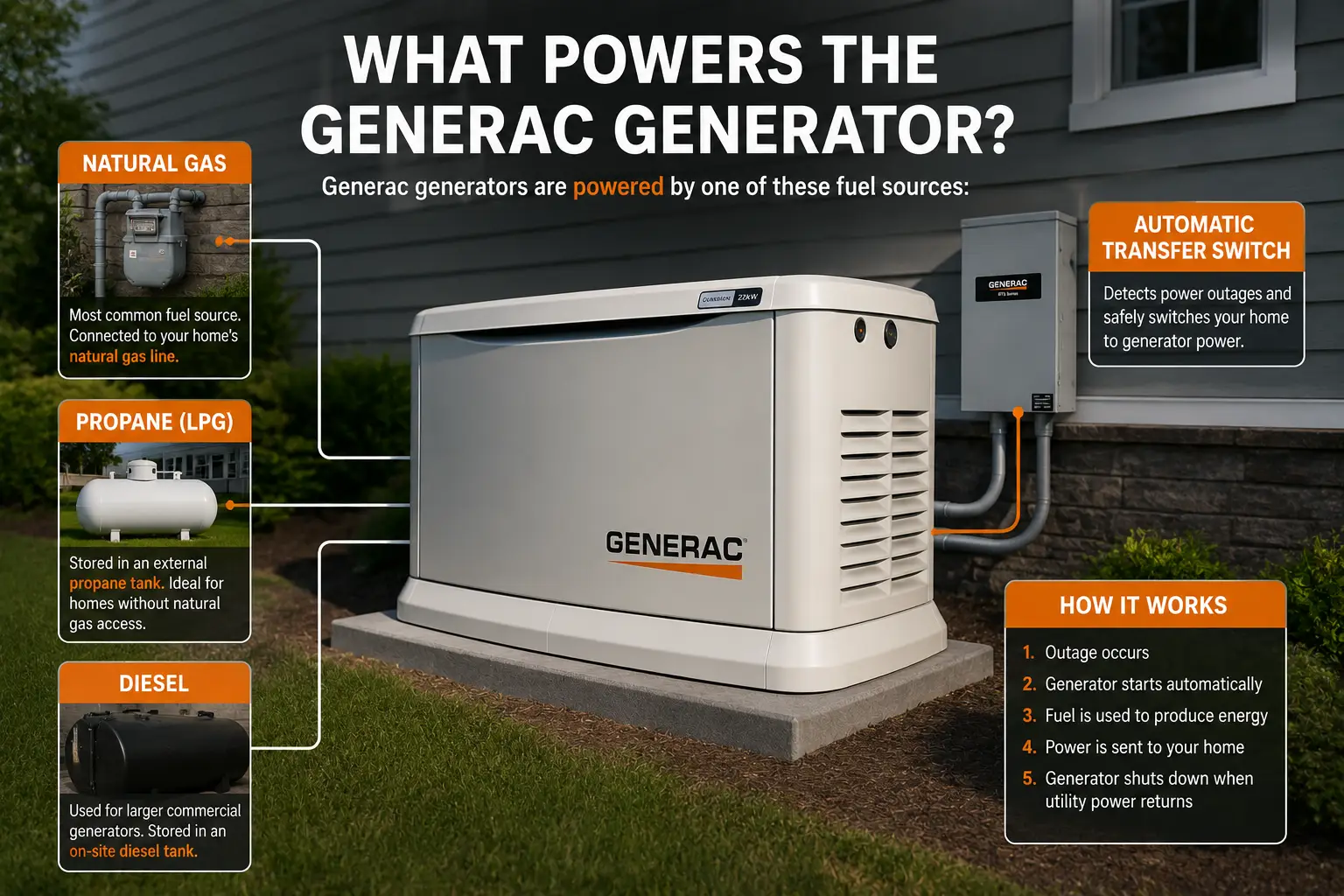
If you’re wondering what powers the Generac generator, the answer depends on which type of Generac system you have. For the typical permanently installed Generac home standby generator, the fuel source is either natural gas or liquid propane (LP). Generac confirms that its home standby generators are designed to operate on one of these two fuel sources and remain outside the home, similar to a central air-conditioning unit. (Generac)
That distinction matters because “Generac generator” doesn’t refer to just one product. Generac sells several categories of power equipment, including home standby generators, portable generators, inverter generators, and battery-powered portable power stations.
A home standby generator normally connects to an existing natural-gas line or an LP propane tank. When utility electricity fails, the automatic transfer switch detects the outage and the generator starts within seconds, then transfers the home’s electrical load to generator power. (Generac)
A portable Generac generator, on the other hand, may use gasoline. Generac’s portable generator guidance specifies fresh unleaded gasoline with a minimum 87-octane rating for its gasoline models. (Generac)
Generac also offers portable power stations, which use stored battery energy rather than an internal combustion engine. Its current portable-power lineup describes these units as 100% electric battery systems that can be recharged from wall outlets, 12V vehicle outlets, or compatible solar panels. (Generac)
Larger mobile and industrial Generac generators commonly use diesel, although some mobile units use gaseous fuels such as natural gas. (Generac)
So, if you have a Generac sitting permanently outside your house, natural gas or propane is most likely what powers it. If it’s a portable generator, gasoline is common. If it’s a portable power station, the source is a rechargeable battery.
Quick Comparison: What Powers Different Generac Generators?
| Generac Type | Power Source | Main Feature | Best For |
|---|---|---|---|
| Home Standby Generator | Natural gas or LP | Automatic backup | Whole-home backup |
| Guardian Series | Natural gas or LP | Automatic operation | Residential outages |
| PowerPact | Natural gas or LP | Compact standby system | Smaller homes |
| Portable Generator | Gasoline | Mobile backup | Camping & outages |
| Portable Inverter Generator | Gasoline | Quiet, efficient operation | Electronics & recreation |
| Mobile/Industrial Generator | Mostly diesel | High-output power | Job sites |
| Portable Power Station | Rechargeable battery | No emissions during use | Indoor/outdoor backup |
The key thing to remember is that Generac does not have one universal fuel source.
Generac’s current home standby models use natural gas or liquid propane. For example, the company’s current 22kW and 24kW residential standby models list Liquid Propane or Natural Gas as their fuel type. (Generac)
Portable generators are different. Generac’s portable inverter generators are gasoline-fueled, while its portable power stations rely on battery storage. (Generac)
💬 Bookmark this comparison — it’s the fastest way to identify what actually powers your Generac before you start thinking about fuel costs, runtime, or installation.
Top 7 Generac Power Sources and Systems: Expert Analysis
1. Natural Gas — best for permanently installed home generators
Natural gas is one of the most common power sources for a Generac home standby generator.
The biggest advantage is convenience. Instead of storing gasoline cans or manually refueling the generator during an outage, the standby unit can connect directly to the home’s natural-gas supply.
Generac describes natural gas as a preferred fuel when available because it can provide a continuous fuel supply through the utility line. (Generac)
This makes natural gas particularly attractive for long outages. As long as the gas utility continues supplying the property and the generator remains properly maintained, you don’t have to worry about the capacity of a household fuel tank.
There’s an important catch, though: natural gas availability isn’t guaranteed in every emergency. A severe disaster can potentially affect utility infrastructure.
Natural gas also requires the installation to have adequate fuel pressure. Generac’s installation documentation specifies that the fuel supply needs to meet the requirements of the particular generator model. (Generac)
Pros:
- ✅ Continuous supply from utility line
- ✅ No propane tank refilling
- ✅ Convenient for whole-home standby systems
- ✅ No gasoline cans to store
- Cons:
- ❌ Requires natural-gas service
- ❌ Gas infrastructure can be affected by disasters
- ❌ Professional installation is required
If you’re asking what powers the Generac generator at a typical house, natural gas is one of the most likely answers.
2. Liquid Propane — best when natural gas isn’t available
Liquid propane (LP) is the other major fuel option for Generac home standby generators.
Instead of connecting to a utility gas line, the generator connects to a propane storage tank installed on the property.
Generac specifically describes propane as a practical solution for homes without natural-gas service. The fuel is stored in a pressurized outdoor tank that requires periodic refilling. (Generac)
One major advantage is independence from a natural-gas utility line. You already have your fuel stored on-site, so the generator can continue operating as long as there is enough propane in the tank.
The downside is that the tank has a finite capacity.
How long the generator runs depends on tank size and electrical load. A generator working harder consumes more fuel than one powering only a few essential circuits.
For example, Generac’s current 24kW model lists different LP consumption rates at 50% and 100% load, illustrating why actual runtime varies substantially depending on how much electricity the home is using. (Generac)
Pros:
- ✅ Works without natural-gas service
- ✅ Fuel stored on-site
- ✅ Long runtime possible with a large tank
- ✅ Suitable for whole-home standby systems
- Cons:
- ❌ Tank requires refilling
- ❌ Fuel consumption increases with load
- ❌ Requires appropriate tank and installation
If your home doesn’t have natural gas, propane is often the most practical answer to what powers the Generac generator.
3. Gasoline — best for portable Generac generators
If you have a portable Generac rather than a permanently installed standby unit, gasoline is a common fuel source.
Gasoline-powered generators are designed for mobility. You can take them camping, use them during outages, or move them between locations as needed.
Generac’s current portable-generator guidance says gasoline models should use clean, fresh unleaded gasoline with a minimum 87-octane rating and no more than 10% ethanol. (Trung Tâm Hỗ Trợ Generac)
Gasoline is convenient because it is widely available, but it introduces an important maintenance issue: fuel degrades during storage.
Generac recommends draining fuel and running the carburetor dry when storing a portable generator for more than 30 days, while also recommending fuel stabilizer when appropriate. (Generac)
That’s one reason gasoline portable generators require more hands-on preparation than a permanently installed natural-gas standby system.
Pros:
- ✅ Widely available fuel
- ✅ Portable
- ✅ Easy to transport
- ✅ Useful for temporary backup
- Cons:
- ❌ Requires fuel storage
- ❌ Gasoline deteriorates over time
- ❌ Requires manual refueling
- ❌ Must be operated outdoors
If your Generac has a fuel tank that you fill manually, gasoline is likely the power source.
4. Diesel — best for large mobile and industrial generators
Diesel fuel is commonly used in Generac’s larger mobile and industrial generator equipment.
Generac’s industrial FAQ states that most mobile generators and light towers use diesel fuel, although some mobile products use gaseous fuels such as natural gas. (Generac)
Diesel makes sense for high-output applications because these systems are designed for demanding commercial, construction, industrial, and emergency applications.
A diesel generator is very different from the typical residential standby unit sitting beside a house.
These systems may be considerably larger, designed for long operating periods, and configured to provide substantial power to job sites or facilities.
The trade-off is size, complexity, fuel storage, and maintenance.
For an ordinary residential Generac Guardian or PowerPact system, diesel is generally not what you’re dealing with.
Pros:
- ✅ Well suited to high-output applications
- ✅ Common for mobile industrial generators
- ✅ Suitable for extended commercial use
- Cons:
- ❌ Not typical for residential standby systems
- ❌ Requires diesel fuel storage
- ❌ Larger systems require more maintenance
- ❌ Higher equipment complexity
If you’re looking at a commercial or mobile Generac, check the model specifications rather than assuming it uses natural gas or propane.
5. Battery Power — best for quiet, emission-free portable backup
Generac also sells portable power stations, which are fundamentally different from traditional fuel-burning generators.
These systems store electricity in a battery instead of producing electricity through an internal combustion engine.
Generac describes its portable power stations as 100% electric battery-powered products that can be recharged using wall outlets, 12V vehicle outlets, or compatible solar panels. (Generac)
This means there is no gasoline, propane, or diesel engine involved in the power-generation process.
The biggest advantage is that battery systems can be used indoors because they don’t produce combustion exhaust during operation.
They’re also quiet compared with fuel-powered generators.
The limitation is stored capacity. Once the battery is depleted, you need access to a charging source.
For short outages, electronics, small appliances, camping, or indoor emergency backup, this can be extremely convenient.
Pros:
- ✅ No combustion fuel
- ✅ Quiet
- ✅ No exhaust emissions during use
- ✅ Can be used indoors
- Cons:
- ❌ Limited by battery capacity
- ❌ Must be recharged
- ❌ Not equivalent to a large standby generator
If your Generac looks more like a large battery than an engine-powered generator, you’re probably dealing with a portable power station.
6. Solar Charging — best for extending battery backup
Solar power doesn’t directly fuel a traditional Generac engine, but compatible solar panels can recharge certain Generac portable power stations.
This creates a different kind of backup system:
Solar panel → battery power station → electrical devices
Generac’s current portable power-station information specifically identifies compatible solar panels as one of the available charging methods. (Generac)
The advantage is that sunlight can provide a renewable charging source when the electrical grid is unavailable.
However, solar charging speed depends on panel wattage, sunlight, weather, panel orientation, and the battery’s charging specifications.
This makes solar particularly useful for extending the runtime of a battery-based system rather than thinking of it as a replacement for the fuel supply of a conventional natural-gas or propane Generac standby generator.
Pros:
- ✅ Renewable charging source
- ✅ Useful during extended outages
- ✅ No fuel storage required
- ✅ Works with compatible battery systems
- Cons:
- ❌ Weather dependent
- ❌ Requires compatible equipment
- ❌ Solar panels need adequate space and sunlight
For a traditional Generac standby generator, solar panels are not what powers its combustion engine.
7. Engine + Fuel System — what actually creates the electricity
It’s easy to say that “gas powers the generator,” but there’s another step involved.
Fuel doesn’t directly become electricity.
In a traditional Generac generator, the fuel powers an internal combustion engine. The engine converts the chemical energy in the fuel into mechanical motion, which drives the generator’s electrical components and produces electricity.
Generac’s standby documentation identifies components such as the air induction system, fuel metering system, ignition system, and exhaust system as parts of the engine. (Generac)
So the basic process is:
Natural gas/propane → engine → mechanical rotation → electrical generation → transfer switch → home
The battery inside a standby generator serves a different purpose. It helps start the engine and supports the control system; it isn’t the primary source of the generator’s electricity.
Generac’s current standby specifications list a 12V battery for models such as the 22kW and 24kW units. (Generac)
That’s an important distinction when someone asks what powers a Generac.
How Does a Generac Generator Work During a Power Outage?
A home standby Generac system is designed to operate automatically.
Under normal conditions, your home receives electricity from the utility.
The automatic transfer switch continuously monitors the electrical supply.
When it detects a utility outage, the generator receives the signal to start.
The engine begins operating using its configured fuel source — typically natural gas or LP.
Once generator power is available, the automatic transfer switch moves the home’s electrical load from utility power to the generator.
Generac says this process can restore backup power within seconds. (Generac)
When utility power returns, the transfer switch moves the load back to the utility.
The generator then shuts down and returns to standby mode.
So you don’t normally have to walk outside and start a whole-home Generac during an outage.
That’s one of the biggest differences between a permanent standby generator and a portable generator.
Natural Gas vs. Propane: Which Powers a Generac Better?
| Feature | Natural Gas | Liquid Propane |
|---|---|---|
| Fuel stored on-site | No | Yes |
| Utility connection | Yes | No |
| Refilling required | Usually no | Yes |
| Long outage potential | Excellent if utility remains available | Excellent with adequate tank |
| Best for | Homes with gas service | Homes without natural gas |
| Installation | Gas-line connection | Propane tank + fuel connection |
There isn’t one universally better fuel.
If your home already has reliable natural-gas service, natural gas is extremely convenient because you don’t have to schedule propane deliveries or maintain a large storage tank.
If you don’t have natural gas, propane provides an independent on-site fuel supply.
Generac itself describes natural gas as the preferred fuel when available and propane as a common alternative when natural gas isn’t available. (Generac)
Your local fuel infrastructure, generator model, gas pressure, tank size, and expected outage duration should all be considered before choosing a fuel source.
How Long Can a Generac Generator Run?
A home standby Generac can run for as long as its fuel supply remains available and the generator is properly maintained.
Generac notes that natural-gas-powered standby generators can often operate continuously because they’re connected to a utility gas line. Propane-powered systems can also run for extended periods, but their runtime depends on tank size and electrical load. (Generac)
The amount of electricity you’re using matters enormously.
Running a refrigerator and several lights is very different from running:
- Central air conditioning
- Electric water heating
- Electric cooking appliances
- Multiple refrigerators
- Pool equipment
- EV charging
- Large heating systems
For example, Generac’s current 24kW model lists LP consumption at both 50% and 100% load, showing how dramatically fuel consumption can change as the electrical load increases. (Generac)
So there’s no single number of hours that applies to every Generac.
What Powers the Generac Battery?
This is where things can get confusing.
A traditional standby generator has a 12V starting battery, but the battery isn’t what powers the home.
The battery is primarily there to start the engine and support the generator’s control system.
Generac’s current standby specifications list a 12V battery on models such as the 22kW and 24kW systems. (Generac)
While utility power is available, the automatic transfer switch can provide power to the generator’s battery-charging circuit. Generac explains that its ATS can supply a constant 120V T1 circuit that powers the generator battery charger and keeps the battery charged. (Trung Tâm Hỗ Trợ Generac)
Once an outage occurs, the battery helps start the engine.
After the engine starts, the fuel-powered engine becomes the primary source of mechanical energy used to generate electricity.
So:
Battery = starts the generator
Natural gas/propane = powers the engine
Engine + alternator = produces electricity
That’s the simplest way to understand the system.
What Size Generac Generator Do You Need?
Fuel type isn’t the only important consideration.
You also need the generator to have enough electrical capacity for the loads you want to operate.
Generac’s current sizing guidance considers factors such as home size, heating system, EV charging, and whether you want whole-home or selected-circuit backup. (Generac)
A smaller home with basic electrical needs may require considerably less capacity than a large house with multiple air-conditioning units.
For whole-home systems, Generac currently offers residential standby models in a range of capacities, including 22kW and 24kW models. (Generac)
Don’t choose a generator simply because the number of kilowatts sounds impressive.
A proper load calculation can determine what equipment needs to operate simultaneously and what starting loads certain appliances create.
An authorized Generac dealer can perform a site and load assessment before installation. (Generac)
What Powers a Generac Portable Generator?
If you’re looking at a Generac portable generator rather than a standby system, the answer is usually gasoline.
Generac’s portable-generator documentation specifically instructs users of gasoline models to use clean, fresh unleaded gasoline with a minimum 87-octane rating. (Generac)
Portable inverter generators in Generac’s current lineup are also gasoline-powered.
The main difference is how they’re designed to operate. They’re compact, movable, and intended for applications such as recreation, temporary backup, and powering selected appliances.
Unlike a home standby generator, a portable unit doesn’t automatically become connected to your home’s electrical system simply because the power goes out.
It generally requires manual setup and appropriate connection equipment.
Most importantly, portable fuel-burning generators must be operated outdoors and away from doors, windows, and air intakes because of exhaust hazards. Generac explicitly warns never to run a portable generator indoors or in a garage. (Generac)
What Powers a Generac During a Long Power Outage?
For a typical home standby unit, the answer depends on the fuel connection.
Natural gas: the utility line continuously supplies fuel as long as service remains available.
Propane: the generator uses fuel stored in an on-site tank, so runtime depends on tank size and electrical load.
This makes propane particularly useful in areas without natural-gas service, but you’ll need to make sure the tank contains enough fuel before severe weather.
Generac states that standby generators can operate for as long as fuel is available and the unit is properly maintained. (Generac)
During an extended outage, you also need to consider maintenance.
Generac recommends periodic maintenance such as oil and filter changes and says it recommends service every six months through an authorized independent service dealer. (Generac)
The fuel may be available, but the generator still needs proper maintenance to operate reliably.
Long-Term Cost and Maintenance
Buying a Generac is only half the cost equation — the fuel and maintenance requirements matter just as much.
Natural gas can be particularly convenient because the generator is connected to an existing utility line rather than requiring a homeowner to repeatedly purchase and transport fuel.
Propane requires an appropriately sized tank and periodic refills.
Portable gasoline generators have a different maintenance profile because gasoline can deteriorate during storage. Generac recommends draining fuel for longer-term storage and using fuel stabilizer according to its instructions. (Generac)
Regardless of fuel type, engine-powered generators need regular maintenance.
Generac specifically identifies oil changes, oil-filter replacement, spark-plug replacement, and battery replacement among common service items for home standby systems. (Generac)
The good news is that a properly maintained standby generator can last for many years. Generac says a well-maintained home standby generator can last 20 years or more depending on usage and operating conditions. (Generac)
Safety, Installation, and Standards for Generac Generators
Fuel-powered generators require careful installation because you’re dealing with combustion, electricity, exhaust, and fuel.
A permanently installed Generac home standby generator should be installed outdoors in accordance with the manufacturer’s installation requirements and applicable local codes.
Generac says the generator is typically installed near the home’s fuel source, such as the propane tank or natural-gas meter. (Generac)
Portable generators require even more attention to placement.
Generac explicitly warns never to operate a portable generator indoors, in a garage, or directly in rain or snow. (Generac)
Never attempt to improvise a fuel connection or electrical connection.
For a standby system, the automatic transfer switch is what separates utility power from generator power and transfers the home’s load when the outage occurs.
Professional installation is therefore much more than simply placing a generator outside and connecting a gas line.
What to Expect: Everyday Performance
Specs only tell part of the story; the everyday experience depends heavily on which Generac system you actually own.
A permanently installed home standby generator is designed to sit quietly in standby mode until it detects an outage. When utility power disappears, the system starts automatically and transfers the home’s electrical load. (Generac)
A portable gasoline generator is much more hands-on. You need to store fuel, move the generator into an appropriate outdoor position, start it, and connect the loads correctly.
A portable battery power station is different again. There’s no combustion engine or exhaust, but the system’s runtime is limited by battery capacity and available recharge sources.
That’s why asking what powers the Generac generator is really only the first question.
The more useful question is: Which Generac product do you have?
Once you know the model, the fuel type, battery requirements, output capacity, runtime, and maintenance schedule become much easier to understand.
Frequently Asked Questions
❓ What powers a Generac home standby generator?
❓ Does a Generac generator run on gasoline?
❓ Can a Generac generator run on propane?
❓ Does the battery power a Generac generator?
❓ What powers a Generac portable power station?
Conclusion
So, what powers the Generac generator? For the typical permanently installed Generac home standby system, the answer is natural gas or liquid propane.
Natural gas is particularly convenient when your home already has a reliable gas connection because the generator can draw fuel continuously from the utility supply. Propane is a strong alternative when natural gas isn’t available because fuel can be stored in an outdoor tank. (Generac)
Portable Generac generators are different. Many use gasoline, while Generac’s portable power stations use rechargeable batteries and can be recharged from wall outlets, vehicle outlets, or compatible solar panels. (Trung Tâm Hỗ Trợ Generac)
Larger mobile and industrial Generac equipment commonly uses diesel, although some models use gaseous fuels. (Generac)
The most important distinction is that the fuel powers the engine, not the home’s electricity directly. In a traditional standby system, the fuel-powered engine creates the mechanical energy needed to generate electricity, while the 12V battery helps start the engine.
If you’re trying to identify the fuel source for your specific Generac, check the model number and owner’s manual before purchasing fuel or making any changes to the system.
✨ Don’t miss these exclusive deals! 🔍 Understand your backup power system before the next outage. Compare natural gas, propane, gasoline, diesel, and battery-powered Generac options so you can choose the right system for your home’s power needs!
Recommended for You
- USB Battery Charger: 7 Best Picks for AA/AAA in 2026
- UPS Generator: 7 Best Battery Backup Picks for 2026 Outages
- Brands of Generators: 7 Best Picks & Buying Guide for 2026
Disclaimer: This post contains affiliate links. As an Amazon Associate, I earn from qualifying purchases made through these links, at no additional cost to you.
✨ Found this article helpful? Share it with someone who needs it! 💬🤗