As an Amazon Associate I earn from qualifying purchases. Links in this article may be affiliate links. How we choose gear
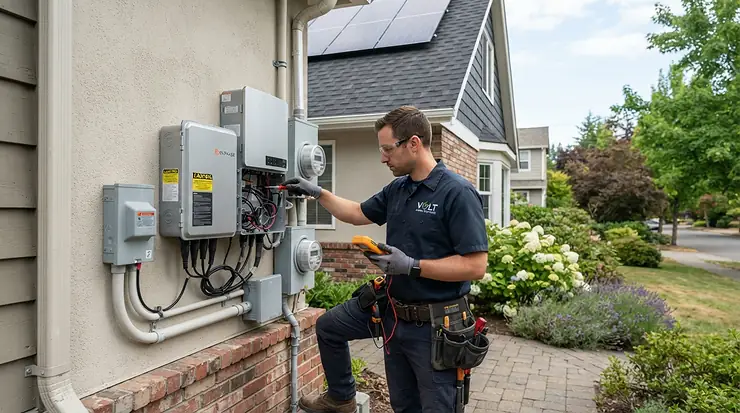
A 200 amp solar system does not make 200 amps, and there is no such thing as a “200 amp solar panel.” The number belongs to the electrical service on the side of the house, the one that feeds the breaker panel, and it decides how much solar you can attach to that panel. For a 200 amp service in 2027, the practical target lands near a 5 kilowatt solar system: a dozen or so panels, one inverter and a battery bank.
Maker spec sheets, electrical-trade guidance on the 120% busbar rule, installer cost surveys, retailer Q&A pages and the EG4 community forum supply the figures below, and the six picks cover panels, an inverter, two batteries, a bundled kit and a portable-station route.
The short answer: twelve 450-watt panels, a 6 kW split-phase inverter and two 5.12 kWh rack batteries make a workable 200 amp solar power system for backup or off-grid use, at hardware costs near $9,000 before wiring and labor.
A 200 amp panel sets a 40-amp ceiling for solar backfeed
A 200 amp service can deliver 48,000 volt-amperes to the house (200 A × 240 V), far more than any home array produces. The limit that matters sits inside the panel. IAEI Magazine’s explainer on the NEC 120% rule multiplies the busbar rating by 1.2 and subtracts the main breaker: 1.2 × 200 − 200 leaves 40 amps for a backfed solar breaker. The same article shows that swapping in a 150-amp main, where the panel maker allows it, lifts that allowance to 90 amps.
Forty amps at 240 volts is 9,600 watts. BGR’s walk-through of the rule also divides the 40 amps by 1.25 to account for continuous output, which leaves 32 amps, or 7,680 watts (sample calculation: 40 ÷ 1.25 × 240). A 5,000-watt inverter draws about 21 amps at 240 volts, so a 5 kW build fits under the cap with room to spare, and so does a 7 kW array.
Rules vary by state, utility and NEC edition. Anything tied into the main service panel needs a permit drawing and a licensed electrician, and the inspector’s reading of the busbar math is the one that counts.
How many solar panels for a 200 amp service? Twelve is a workable start
Panel count follows wattage, not amperage: divide the array size by the panel rating and round up. TheGreenWatt’s 2026 panel table builds a 5 kW array from twelve 410 W modules, and 450 W modules land at the same count (5,000 ÷ 450 = 11.1, so twelve panels and 5.4 kW).
Whole-house coverage is a larger job. EnergySage’s 2026 panel-count guide says most homes need 16 to 23 panels to erase their electric bill. Sixteen 450 W panels make 7.2 kW, which still sits under the 7,680-watt ceiling above, but 23 panels would not fit without a main-breaker derate or another interconnection method.
Space and weight come next. Renogy’s 450 W panel measures 75.2 by 44.8 inches and weighs 50.9 pounds, so twelve cover roughly 281 square feet and add about 611 pounds to the roof or rack (calculated from those listed dimensions).
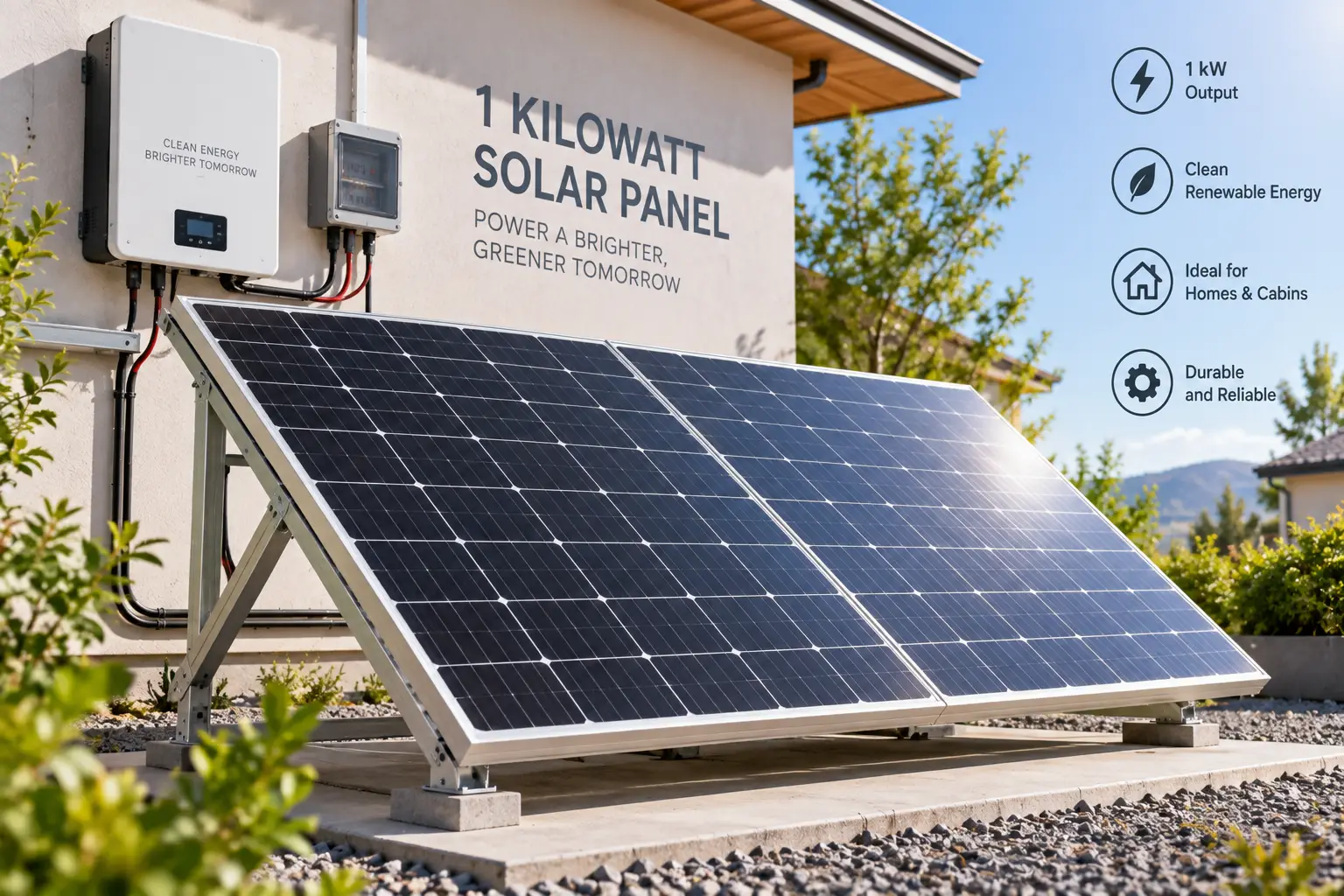
Listings muddy the word “watt” in a second way. A “5000 watt solar system” on a product page can describe the inverter, the array or the battery output, and the three numbers differ by a lot, as the kit in this list shows.
Grid-tied, backup or off-grid: which build you are really buying
Three different projects share the 200 amp label, and the parts differ.
A homeowner who wants lower utility bills through net metering needs a grid-interactive inverter that exports power, usually quoted and installed by a contractor. None of the inverters below exports; EnergySage’s installer-quote data is the better yardstick for that route.
A household that wants a fridge, lights, a well pump and a few outlets alive through outages needs a battery-backed inverter feeding a critical-loads subpanel. The EG4 6000XP Off-Grid Inverter with two rack batteries fits that case.
A cabin, workshop or shed with no utility connection can run on the same parts or on a smaller bundle such as the ECO-WORTHY 5KW Off Grid Solar System Complete Kit.
Each pick below was chosen against the electrical limits above and for a published spec sheet, and the table shows how the six fit together.
The parts worth buying for a 5 kilowatt solar system
Product
Job in the build
Key figure
Main limit
Renogy 450W Bifacial Solar Panel 2-Pack
Array
450 W each, 50.9 lb
Freight and glass damage reports
EG4 6000XP Off-Grid Inverter
Inverter-charger
6,000 W out, 8,000 W PV in
No grid export
EG4 LL-S 48V 100Ah Server Rack Battery
Storage
5.12 kWh
Two needed per inverter
ECO-WORTHY 5KW Off Grid Solar System Complete Kit
Starter bundle
2,340 W of panels
120 V output on this version
ECO-WORTHY CUBIX-100 48V 100Ah Server Rack Battery
Storage
5.12 kWh, UL 9540A
Open-loop with the 6000XP
Anker SOLIX F3800 Plus
Portable backup
3,840 Wh, 6,000 W
3,200 W solar input cap
The first three form the core build, and the ECO-WORTHY CUBIX-100 48V 100Ah Server Rack Battery is the alternative battery. The kit and the Anker SOLIX F3800 Plus serve smaller or simpler jobs. The table’s last column matters most: every pick has a boundary, and each boundary decides whether it suits a given house.
Six two-packs give twelve panels and 5.4 kW, the nearest even step above a 5 kilowatt solar system at this panel size. Renogy’s spec lines list 450 W at standard test conditions, 41.25 V open-circuit, 34.67 V at maximum power and 12.98 A at maximum power.
Those voltages decide whether the array suits the inverter. Two strings of six panels give about 247.5 V open-circuit and 208 V at maximum power per string (sample calculation from the listed figures). Both sit inside the 120–385 V working range of the EG4 6000XP Off-Grid Inverter, well under its 480 V ceiling, and 12.98 A stays below the 17 A of usable input per tracker in EG4’s spec sheet. Open-circuit voltage climbs in cold weather, so the coldest recorded temperature at your address belongs in the string math.
Renogy backs the panel with a 10-year material and workmanship warranty and a 25-year output guarantee that ends at 80%. The bifacial glass is sold as a gain of up to 30% from reflected light, a figure that depends on what sits under and behind the array. Renogy’s own store lists a two-pack between roughly $750 and $835. One buyer review reproduced on a retailer page reports that two sets ordered through Amazon during a sale arrived with a shattered panel in one of them, a single report but a good reason to inspect the glass before signing for a pallet.
Renogy 450W Bifacial Solar Panel 2-PackSee current price, sizes and reviews on Amazon.
Eight thousand watts of solar in, six thousand out: those two figures define this inverter. EG4’s spec sheet lists two MPPT trackers at 4,000 W each, a 100–480 V DC input range, a 125 A battery charge rate and 120/240 V split-phase output from a single unit, plus closed-loop communication with EG4’s own 48V batteries. Dealer pages from RES Supply and Signature Solar show prices around $1,500 to $1,550, and Signature Solar lists a five-year warranty.
It is not a grid-export inverter. The Solar Lab’s review describes it as strictly off-grid with no option to feed the grid, and a retailer page from A1 Solar Store says the same. Grid input exists for charging and passthrough. A SolarTech Online guide flags a second boundary: each 120 V leg tops out at 3,000 W with no automatic balancing between the legs, so heavy 120 V loads have to be split across both sides by hand.
Owner friction shows up in two places. One buyer’s question on Current Connected’s product page objects that reading local inverter data requires the system to report to EG4’s servers, and a 25-post thread on EG4’s community forum, viewed more than 7,600 times, covers the unit staying in bypass mode for hours. Both are individual reports and say nothing about failure rates.
Pros:
Two trackers accept up to 8,000 W of panels
120/240 V split-phase output from one unit
Five-year warranty listed by Signature Solar
Cons:
3,000 W cap per 120 V leg
No grid export, so no net metering
EG4 recommends at least 200Ah of battery per unit
EG4 6000XP Off-Grid InverterSee current price, sizes and reviews on Amazon.
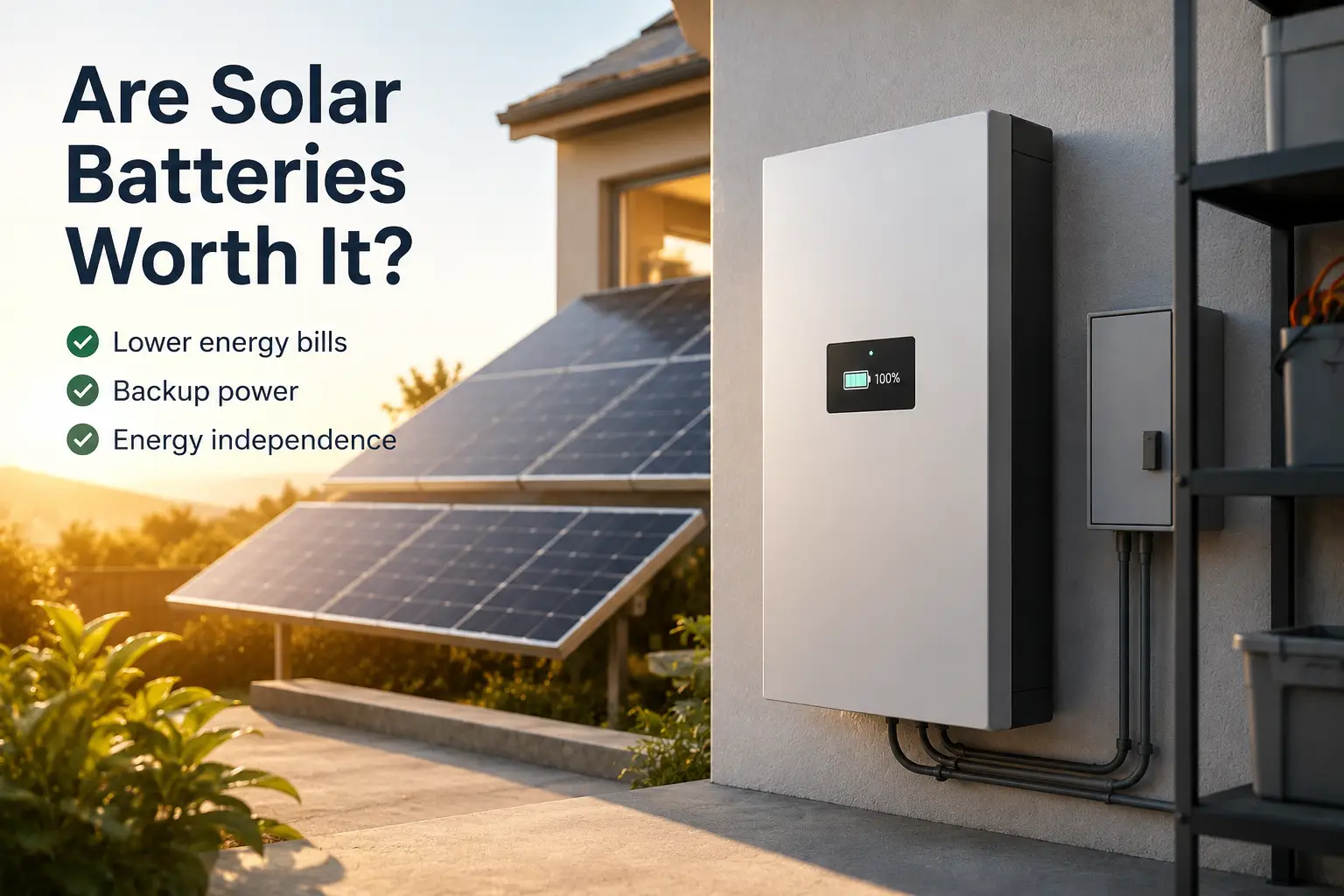
Two racks are the starting point, not one. Current Connected’s page for the inverter relays EG4’s recommendation of at least 200Ah of battery per 6000XP, which means two 100Ah racks and 10.24 kWh. Each EG4 LL-S 48V 100Ah Server Rack Battery stores 5.12 kWh at 51.2 V and carries UL 1973 and UL 9540A listings and a 10-year warranty, according to Signature Solar’s listing. Dealer pages show roughly $1,300 to $1,500 per unit, which makes the pair the biggest line in the budget.
For the best battery for solar power system use at this size, 48V racks are the format to compare. A Watts on the Roof buyer’s guide calls 48V the standard for whole-home off-grid because higher voltage means lower current and thinner wiring, and it names this model among the rack options. The Solar Lab, an independent review site, calls the LL series arguably the most popular rack-style battery on the market, and its follow-up review rates EG4’s and Signature Solar’s customer support highly. That is one site’s view, though a detailed one.
The energy math keeps expectations honest. The 5.4 kW array above would produce about 17 kWh on a day with four peak sun hours (5.4 × 4 × 0.8 derate, a stated assumption and not a measurement). Two racks store 10.24 kWh, so the batteries carry evening and overnight loads rather than a full day of output.
EG4 LL-S 48V 100Ah Server Rack BatterySee current price, sizes and reviews on Amazon.
This is the entry point for a cabin, a shop or one backup circuit, and the name oversells the array. The maker’s listing pairs twelve 195 W bifacial N-type panels (2,340 W in total) with a 48V 5 kW inverter and one 51.2V 100Ah rack battery, so the 5,000-watt label describes the inverter. The same kit appears on ECO-WORTHY’s store as a 120V single-phase package, and a retailer listing of the same kit notes that one inverter gives 120 V, so a dryer, well pump or central air conditioner needs a second inverter.
The listing says the inverter can accept up to 5,500 W of panels, which leaves room to add more later. A larger sibling on the maker’s own store, a 5,040 W set of twelve 420 W panels with four racks (20.48 kWh) and 120/240 V split-phase output, is the version that matches a true 5000 watt solar system. Check the current price on Amazon.com.
ECO-WORTHY 5KW Off Grid Solar System Complete KitSee current price, sizes and reviews on Amazon.
Current Connected describes this rack as 5.12 kWh, UL 1973 and UL 9540A listed, with CAN and RS485 communication for grid-tied, off-grid or backup installs. ECO-WORTHY’s FAQ gives its 51.2V rack battery a 10-year warranty that covers failures not caused by the user, and the maker’s kit pages say up to 32 units can run in parallel, or 163.84 kWh.
Compatibility is the question to settle first. Current Connected’s note for the 6000XP says any 48V battery outside EG4’s own runs through open-loop communication, without the closed-loop link EG4 describes for its batteries. The inverter listing carries a battery compatibility list worth reading before paying for a mixed bank.
Pros:
5.12 kWh at 51.2 V per rack
UL 1973 and UL 9540A listings
Maker lists up to 32 units in parallel
Cons:
Open-loop communication with the 6000XP
Price depends on the seller, so check the current price on Amazon.com
ECO-WORTHY CUBIX-100 48V 100Ah Server Rack BatterySee current price, sizes and reviews on Amazon.
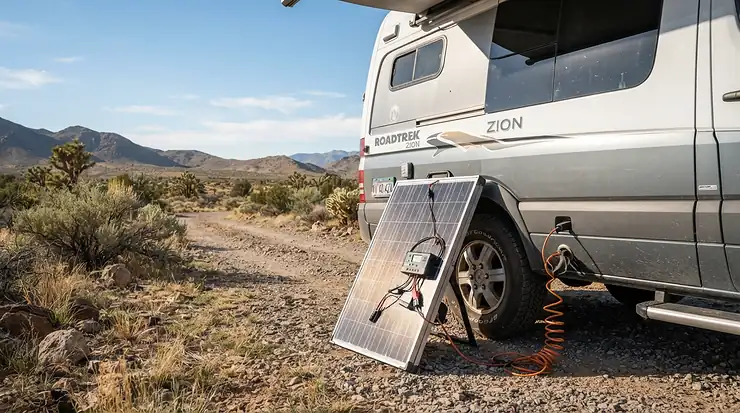
Solar input is where this one gives way: Anker lists up to 3,200 W through two MPPT inputs of 165 V each, well under the 5.4 kW array above. With 450 W panels, that means short strings (three in series is about 124 V open-circuit, calculated from the Renogy figures), and extra panels simply go unused.
What it adds is simplicity. The unit holds 3,840 Wh of LFP storage rated for 3,000+ cycles and delivers 6,000 W at 120/240 V, and Anker lists up to six BP3800 expansion batteries for 26.9 kWh in total. A 5-year warranty applies. Anker describes the portable setup as plug-and-play, and sells a manual 10-circuit transfer switch bundle for whole-home circuits, which is the point where an electrician and a permit enter the picture again. It also accepts 240 V gas-generator input through a bypass. Check the current price on Amazon.com.
Anker SOLIX F3800 PlusSee current price, sizes and reviews on Amazon.
How much does a 200 amp solar system cost? The hardware math
EnergySage puts a 5 kW rooftop system near $13,900 installed before incentives, using 2026 installation data. Other cost guides give $12,500 to $16,000 (TheGreenWatt, citing an NREL benchmark of $2.50 to $3.20 per watt) and $12,500 to $17,500 (ThePricer). Those figures include contractor labor and a grid-tied inverter.
A hardware tally for the core build looks different. Six Renogy two-packs run about $4,500 to $5,000 at the store prices above, the EG4 6000XP Off-Grid Inverter about $1,500 to $1,550, and two EG4 LL-S 48V 100Ah Server Rack Battery units about $2,600 to $3,000. That totals roughly $8,600 to $9,600 (sample calculation), before racking, wire, breakers, disconnects, shipping, permits and labor. The comparison is not like-for-like: the hardware list buys storage and no export, while the installed quotes buy a grid-tied system and no storage.
The federal credit no longer softens either number. Solar.com’s tax credit FAQ states that the homeowner credit, Section 25D, ended on December 31, 2025, while third-party-owned systems such as leases and power purchase agreements can still draw on a commercial credit through 2027. State and utility incentives vary by address.
Sizing and wiring slips that lead to returns
The problems reported in the sources trace back to a short list of mismatches:
Treating the kit’s inverter label as the array size, which leaves a “5000 watt” bundle with 2,340 W of panels.
Expecting net metering from an off-grid inverter, a point The Solar Lab’s review makes plainly.
Piling 120 V loads onto one leg of the 6000XP, past its 3,000 W per-leg cap.
Buying a single 100Ah rack for an inverter whose retailer guidance recommends 200Ah.
A fifth slip happens before purchase: skipping the cold-weather open-circuit voltage check on the strings. At 247.5 V the example strings have lots of headroom under 480 V, but longer strings erode that margin quickly.
200 amp solar power system sizing: short answers
How many solar panels does a 200 amp service need?
Panel count depends on panel wattage, not the 200 amp rating. A 5 kW array needs about twelve 410 to 450 watt panels, and the 120% rule limits the backfeed breaker to 40 amps, which comfortably allows arrays up to roughly 7 kW.
Can a 200 amp panel handle a 5000 watt solar system?
Yes. A 5,000 watt inverter draws about 21 amps at 240 volts, well under the 40-amp backfeed allowance on a 200 amp panel. Inspectors and utilities apply local rules, so a licensed electrician should confirm the connection method.
What is the best battery for a solar power system this size?
A 48V LiFePO4 rack battery fits the 6 kW inverters in this class. Two 5.12 kWh racks give 10.24 kWh and meet EG4's 200Ah recommendation for the 6000XP. Confirm the battery appears on the inverter's compatibility list first.
Does the federal tax credit still cover a home solar system?
Not for systems you own. Solar.com reports that the homeowner credit, Section 25D, ended on December 31, 2025. Leases and power purchase agreements can still use a commercial credit through 2027, and some states and utilities offer separate incentives.
Does a 200 amp solar power system need a permit?
Permit rules vary by city, county and utility, and any connection to the main service panel is electrical work. Confirm requirements with the local building department and a licensed electrician before buying equipment, since inspectors may require specific breaker sizes or disconnects.
Where to start with a 200 amp solar system
The sources point to one build for backup and off-grid use: twelve 450 W panels, the EG4 6000XP Off-Grid Inverter and two EG4 LL-S 48V 100Ah Server Rack Battery units, wired through a permitted critical-loads subpanel. Choose the ECO-WORTHY 5KW Off Grid Solar System Complete Kit for a 120 V cabin or shop, and the Anker SOLIX F3800 Plus for a plug-in setup with a 3.2 kW solar ceiling. A homeowner chasing a lower utility bill should skip these parts and gather grid-tied installer quotes, since the 40-amp backfeed math in a 200 amp solar system favors an array near 7 kW. Compare the inverter’s PV voltage window against your panel strings before buying.