
In This Article
Introduction: Why Choosing an Off Grid AC Unit Is Mostly a Power Problem
Picture this: it’s 94°F at your cabin, the solar panels are humming along, and the little 1,000-watt power station you trusted is blinking red after forty minutes of running a $150 big-box window unit. That’s the moment most people realize an off grid ac unit isn’t just an air conditioner with a long extension cord — it’s an energy-budget decision dressed up as a comfort purchase.
What Is an Off Grid AC Unit?
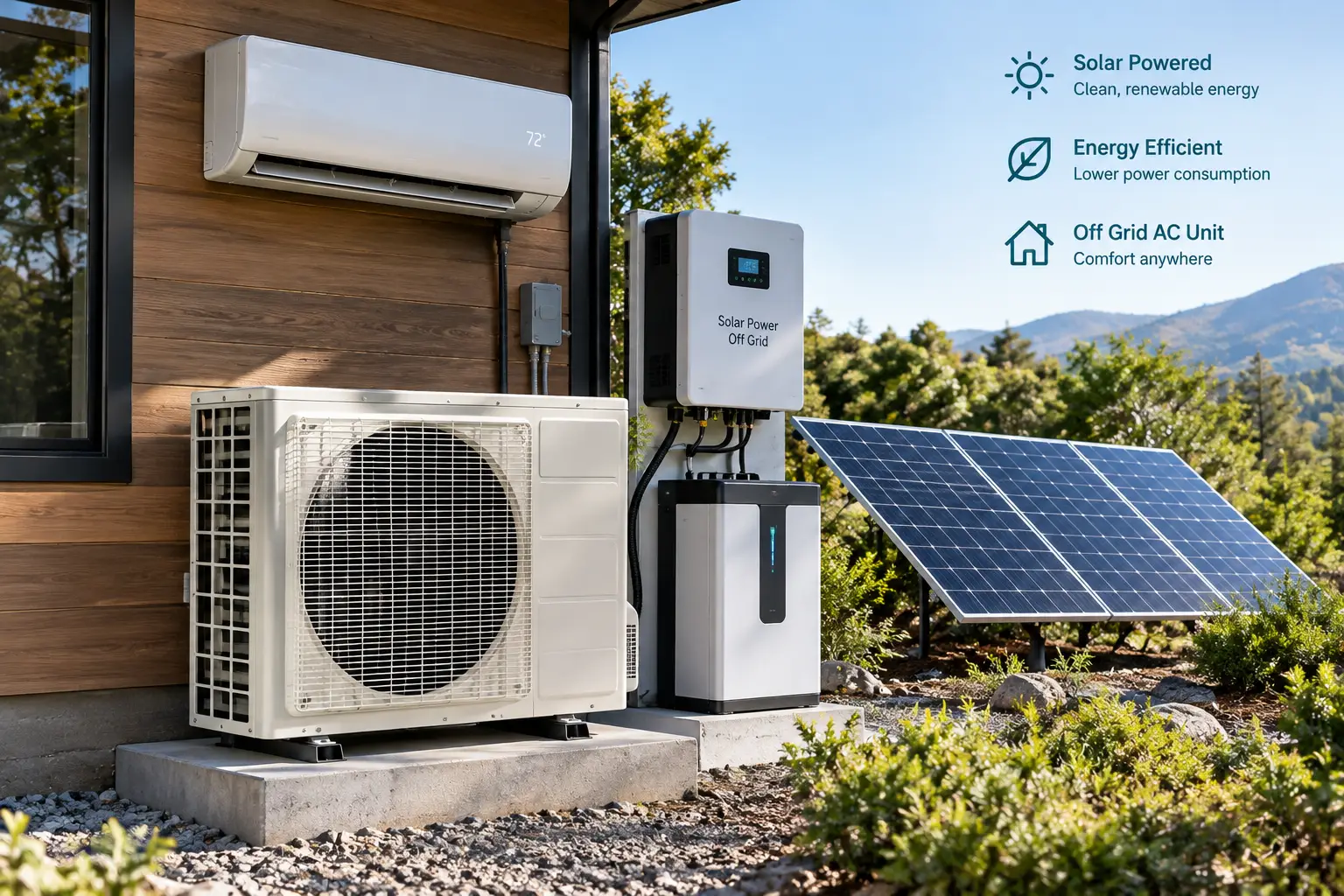
An off grid ac unit is an air conditioner designed (or well suited) to run without a utility connection — powered by batteries, solar panels, a vehicle alternator, or a portable power station. The best models use variable-speed inverter or DC compressors, which draw far fewer watts than conventional units and avoid huge startup surges.
That efficiency piece is everything. Air conditioners in the US are rated by metrics like the seasonal energy efficiency ratio (SEER), which compares cooling output in BTUs with the electricity consumed. Off the grid, every point of efficiency translates directly into extra hours of runtime or fewer solar panels on your roof.
In this guide, you’ll find seven real, currently sold units — from battery powered air conditioner designs like the EcoFlow Wave 3 and Zero Breeze Mark 3 to a solar powered air conditioner that wires straight into PV panels, the EG4 12K Hybrid Solar Mini-Split. You’ll also get runtime math, a first-30-days setup guide, a buyer decision framework, and honest notes on where each model falls short. No fake test stories, no invented star ratings — just spec-sheet analysis and real review sentiment, clearly labeled.
Heads-up: this guide contains affiliate links. As an Amazon Associate, I earn from qualifying purchases at no extra cost to you.
Quick Comparison: Off Grid AC Unit Picks at a Glance
| Product | Type | Cooling Capacity | Typical Power Draw | Best For |
|---|---|---|---|---|
| EcoFlow Wave 3 | Portable, battery-ready | 6,100 BTU | ~350W observed in cooling | EcoFlow Wave 3: tents, vans, small off-grid rooms |
| Zero Breeze Mark 3 | Portable, 48V DC | 5,280 BTU | 150–500W | Zero Breeze Mark 3: lightest serious portable |
| EG4 12K Hybrid Solar Mini-Split | Ductless mini-split | 12,000 BTU | 190–1,100W | EG4 12K Hybrid Solar Mini-Split: cabins up to ~650 sq ft |
| Midea U-Shaped 8,000 BTU | Inverter window unit | 8,000 BTU | up to ~710W | Midea U-Shaped 8,000 BTU: budget cabin on an inverter |
| Velit 2000R Mini | 12V/48V rooftop | 6,500–7,500 BTU | 250–650W | Velit 2000R Mini: camper vans and teardrops |
| EcoFlow Wave 2 | Portable, battery-ready | 5,100 BTU | varies by mode | EcoFlow Wave 2: value seekers in the EcoFlow ecosystem |
| Zero Breeze Mark 2 | Portable, 24V DC | 2,300 BTU | ~240W | Zero Breeze Mark 2: tents and sleeping spots |
Looking at the table, the split is clear: portables like the EcoFlow Wave 3 and Zero Breeze Mark 3 trade raw capacity for grab-and-go flexibility, while the EG4 12K Hybrid Solar Mini-Split delivers double the BTUs but stays bolted to one building. If you need to cool a whole small cabin rather than a single sleeping area, the jump to a mini-split or the Midea U-Shaped 8,000 BTU almost always makes more sense than stacking portables. Budget shoppers should notice that the cheapest unit to buy isn’t always the cheapest to power — battery capacity is where the real money goes.
💬 One click helps other shoppers make an informed choice too! 😊
Top 7 Off Grid AC Units for 2026: Expert Analysis
1. EcoFlow Wave 3 — best all-around portable heat and cool
The EcoFlow Wave 3 earns the top spot because it’s the most complete package for people who move between a van, a tent, and a backyard office. It pushes 6,100 BTU of cooling and 6,800 BTU of heating, a meaningful step up from the 5,100 BTU of its predecessor.
In practice, that extra headroom matters on humid afternoons when smaller portables simply can’t keep pace. The optional 1,024Wh LiFePO4 add-on battery clips onto the base and is rated for 4,000 cycles to 80% capacity — roughly a decade of nightly use before you’d notice serious fade. EcoFlow quotes 2–8 hours of runtime; StorageReview’s hands-on test logged roughly 356 watts while actively cooling, which works out to around three hours at full effort and longer in Eco mode.
Based on the specs, this unit is ideal for van-lifers and campers who want one machine for summer and shoulder seasons. Charging flexibility (700W AC, 400W solar, alternator, car outlet) means you can top it up almost anywhere.
Published reviews from RV.com, StorageReview, and The Gadgeteer consistently praise its build quality and versatility, while noting that the battery-plus-unit combo weighs about 55 pounds — portable, but not featherlight.
Pros:
- ✅ Strongest cooling output among true portables here
- ✅ Long-life LFP battery rated for 4,000 cycles
- ✅ Doubles as a 6,800 BTU heater
Cons:
- ❌ Battery sold separately on the base model
- ❌ Roughly 55 pounds with the battery attached
Expect around $1,100–$1,600 for the unit and roughly $2,000–$2,300 bundled with the battery (check the current price); it’s premium, but the LFP battery makes the long-term value strong.
2. Zero Breeze Mark 3 — lightest 5,000-BTU-class portable
The Zero Breeze Mark 3 squeezes 5,280 BTU of cooling into a 22-pound body, which is genuinely unusual for this capacity class.
That 48V DC architecture is the quiet hero here: higher voltage means lower current, thinner wiring, and less heat loss — the same reason the brand says it can sip as little as 150 watts at its lowest setting. The 1,022Wh battery has a built-in 500W MPPT solar controller accepting 12–60V panels, and you can chain multiple batteries to extend runtime. Heating mode delivers up to 5,800 BTU.
Who’s it for? Overlanders and boaters who carry their AC in and out every trip and care about every pound. The trade-off is “smart” features: reviewers at PickHVAC note it has no Wi-Fi or Bluetooth, so the remote is your only control.
Published review sentiment, including Dream Big Travel Far’s long-term comparison against the older Mark 2, frames the Mark 3 as a major upgrade in capacity, drainage, and dehumidifying. Independent Amazon review volume for this exact model couldn’t be verified at the time of writing, so weigh that accordingly.
Pros:
- ✅ Only 22 pounds for 5,280 BTU
- ✅ Built-in 500W MPPT accepts direct solar
- ✅ Chainable batteries for multi-night trips
Cons:
- ❌ No app control or Wi-Fi
- ❌ Proprietary 48V battery ecosystem
Bundles with one battery typically land around $1,800–$2,000 at the time of writing; strong value if portability is your top priority.
3. EG4 12K Hybrid Solar Mini-Split — runs straight from your solar panels
The EG4 12K Hybrid Solar Mini-Split is the only pick here that plugs PV panels directly into the outdoor unit — no battery, no separate inverter required for daytime cooling.
It accepts 90–380 VDC of solar input (up to about 1,100W), blends it automatically with 115V AC when clouds roll in, and carries a 22.5 SEER2 rating. What that means for you: on a sunny afternoon, the hottest part of the day is powered by the same sunshine causing the heat. EG4 sizes it for up to roughly 650 square feet, and its pre-charged quick-connect line sets let handy owners skip pulling a vacuum.
This is the logical choice for off-grid cabins, workshops, and tiny houses where you want whole-room cooling plus efficient heat-pump heating. It’s not portable, and nighttime operation still needs a battery bank or generator feeding the AC side.
Verified Amazon review data for this model is limited, and availability there varies — it’s widely sold through solar retailers. Discussion in DIY solar circles centers on its daytime solar offset rather than battery-free 24/7 operation, which matches the spec sheet.
Pros:
- ✅ Direct DC solar input up to 1,100W
- ✅ 22.5 SEER2 efficiency with heat-pump heating
- ✅ DIY quick-connect installation, no vacuum needed
Cons:
- ❌ Fixed install; zero portability
- ❌ Needs AC power or batteries after sunset
Typically priced around $1,400–$1,700 before panels; outstanding value per BTU for stationary off-grid buildings.
4. Midea U-Shaped 8,000 BTU — budget inverter window unit for cabins
The Midea U-Shaped 8,000 BTU (model MAW08U1QWT and its predecessors) is the budget-friendly way to cool a real room on an off-grid inverter system.
Its full DC inverter compressor ramps up and down instead of slamming on and off, which matters enormously when a battery bank is the power source — no giant startup surge to trip your inverter. Midea claims over 35% energy savings versus traditional units, and the earlier generation earned ENERGY STAR Most Efficient recognition. The U-shaped design straddles the sill so the noisy compressor sits outside, with Midea quoting as low as 32 dBA on the latest model.
Based on comparing the specs, this is the best fit for cabins and tiny homes with an existing 120V pure sine wave inverter and a few kilowatt-hours of storage. Rated maximum draw is about 710 watts.
Owner comments on deal forums like Slickdeals praise its efficiency — at least one owner reports running it from an isolated solar array — while the most common complaint is that the U-shaped body is awkward to clean.
Pros:
- ✅ Lowest purchase price in this lineup
- ✅ Inverter compressor avoids big startup surges
- ✅ Covers up to roughly 350 square feet
Cons:
- ❌ Needs a 120V inverter, not DC-native
- ❌ No heat mode on the U-shaped models
Usually found in the $300–$450 range; unbeatable cost per BTU if you already own a solid inverter setup.
5. Velit 2000R Mini — 12V rooftop cooling for vans and teardrops
The Velit 2000R Mini is a true 12V air conditioner for off grid vans, built to fit a standard 14×14 roof cutout with a slim 6.5-inch profile.
Running on 12V, it delivers 6,500 BTU; the 48V version reaches 7,500 BTU. Eco mode draws roughly 250–300 watts and turbo mode 400–650 watts. The practical upshot: no large inverter, no conversion losses, and the 48V version can pull as little as about 5 amps. Retailers note it can run from many vehicle alternators while driving.
Here’s what to weigh: at 61 pounds on the roof, you need a structurally sound mounting surface, and that 12V version will draw a hefty 20–50 amps, so wiring gauge and fusing really matter (the kit ships a 15-foot 6AWG harness).
Verified Amazon review volume is limited. Van-build retailers and RV parts specialists like etrailer position it specifically for boondocking teardrops and truck campers, and their Q&A focuses on installation details rather than performance complaints.
Pros:
- ✅ Native 12V or 48V DC, no inverter
- ✅ Low-profile roof unit fits 14×14 cutouts
- ✅ Can run from the alternator while driving
Cons:
- ❌ Permanent roof install required
- ❌ Only a one-year limited warranty
Expect around $1,500–$1,700 at the time of writing; good value for dedicated van builds.
6. EcoFlow Wave 2 — previous-gen value with heating
The EcoFlow Wave 2 is the smart-money pick if the EcoFlow Wave 3 stretches your budget.
It offers 5,100 BTU cooling and 6,100 BTU heating, plus a 1,159Wh add-on battery quoted for up to roughly 8 hours in Eco mode (launch coverage cited up to 9.6 hours). The unit weighs about 32 pounds without the battery, which adds roughly 16.5 pounds.
The key difference worth understanding is chemistry: the Wave 2’s add-on battery uses NCM lithium, while the Wave 3 moved to LiFePO4. NCM packs more energy per pound, but LFP generally tolerates far more charge cycles and has a gentler thermal-runaway profile. For occasional weekend camping, the Wave 2 is fine; for daily full-time use, the newer chemistry pays off.
Launch coverage, including Mighty Gadget’s, highlighted the roughly 27% capacity jump over the original Wave. Large verified review pools for current US listings are harder to pin down, so treat sentiment as limited.
Pros:
- ✅ Usually cheaper than the Wave 3
- ✅ Real heating mode for cool nights
- ✅ Same app-controlled EcoFlow ecosystem
Cons:
- ❌ NCM battery has shorter cycle life
- ❌ 1,000 BTU less cooling than Wave 3
Prices vary widely as stock clears — check current pricing, but it often sits below the Wave 3; good value for occasional campers.
7. Zero Breeze Mark 2 — smallest footprint for tents and sleeping
The Zero Breeze Mark 2 is the specialist: a 2,300 BTU unit for cooling a person, not a room.
Its 24V micro inverter compressor runs at roughly 240 watts, so the 840Wh battery delivers about 3–5 hours of cooling. The brand rates it for very small insulated areas — around 25–40 square feet. Translation: aim it into a sleeping bag zone, a rooftop tent, or a truck sleeper, and it shines.
It’s best for tent campers and solo overlanders sleeping in tight spaces who can’t justify a 5,000 BTU machine. In anything bigger than a two-person tent, it will feel underpowered.
The Gadgeteer’s review praised the streamlined design and cooling effect while noting the 28.5-pound unit-plus-battery combo feels heavy inside a cramped tent — a fair critique given its small output.
Pros:
- ✅ Very low 240W power draw
- ✅ Runs on any capable 24V battery
- ✅ Compact enough for rooftop tents
Cons:
- ❌ Only suited to tiny insulated spaces
- ❌ Heavy relative to its cooling output
Bundles have generally run between roughly $1,000 and $1,700 depending on battery inclusion; fair value only for tent-sized needs.
Head-to-Head: Specs, Power, and Price Ranges of All 7
| Product | Cooling / Heating | Power Source | Battery | Approx. Price Range | Best For |
|---|---|---|---|---|---|
| EcoFlow Wave 3 | 6,100 / 6,800 BTU | AC, solar, car, battery | 1,024Wh LFP (optional) | $1,100–$1,600 (unit) | EcoFlow Wave 3: mobile all-rounder |
| Zero Breeze Mark 3 | 5,280 / 5,800 BTU | 48V DC, solar via battery | ~1,022Wh, chainable | $1,800–$2,000 (bundle) | Zero Breeze Mark 3: ultralight carry |
| EG4 12K Hybrid Solar Mini-Split | 12,000 BTU heat pump | DC solar + 115V AC | none (external) | $1,400–$1,700 | EG4 12K Hybrid Solar Mini-Split: cabins |
| Midea U-Shaped 8,000 BTU | 8,000 BTU / no heat | 115V AC via inverter | none (external) | $300–$450 | Midea U-Shaped 8,000 BTU: budget rooms |
| Velit 2000R Mini | 6,500–7,500 BTU | 12V or 48V DC | none (house bank) | $1,500–$1,700 | Velit 2000R Mini: van rooftops |
| EcoFlow Wave 2 | 5,100 / 6,100 BTU | AC, solar, car, battery | 1,159Wh NCM (optional) | below Wave 3; varies | EcoFlow Wave 2: budget EcoFlow |
| Zero Breeze Mark 2 | 2,300 BTU / no heat | 24V DC | 840Wh (optional) | $1,000–$1,700 | Zero Breeze Mark 2: tents |
The table exposes the hidden cost of portables: the EcoFlow Wave 3 and Zero Breeze Mark 3 both land near $2,000 once you add a battery, while the Midea U-Shaped 8,000 BTU costs a fraction of that — but only because you’re supplying the battery and inverter yourself. Per BTU, the EG4 12K Hybrid Solar Mini-Split is the efficiency champion, yet it’s useless if you need to move it. Your decision really hinges on one question: does the cooling need to travel with you?
✨ Don’t miss these smart off-grid cooling picks!
🔍 Take your off-grid comfort to the next level with this carefully curated lineup. Click a highlighted product to check current pricing and availability. These picks will help you sleep cool, work comfortably, and stretch every watt your system makes!
Getting Started: Your First 30 Days With an Off Grid AC Unit
The first month decides whether your off grid ac unit becomes a trusted tool or an expensive dust collector. Here’s a practical plan.
Week 1: Baseline your power
Before relying on battery cooling overnight, run your unit on shore or grid power for a few hours with an inexpensive plug-in watt meter (or the app, on EcoFlow models). Note the draw in high, normal, and eco modes. Those numbers — not the brochure — become your planning figures.
Week 2: Seal the space
Portable units like the EcoFlow Wave 3 and Zero Breeze Mark 3 move hot air through ducts. Use the included window or tent adapters, and stuff gaps with foam. A leaky vent can quietly double how hard the compressor works.
Week 3: Pre-cool, don’t panic-cool
Start cooling while the sun is still on your panels, late morning to midafternoon. Pulling a hot van down 20°F at 9 p.m. on battery alone is the single fastest way to drain your bank.
Week 4: Build a maintenance rhythm
- ✅ Rinse or vacuum filters every two weeks in dusty conditions
- ✅ Check drain lines for kinks and clogs
- ✅ Inspect DC connections for heat discoloration monthly
Common first-month mistake: running everything on maximum fan and minimum temperature. Inverter compressors are most efficient at moderate, steady loads — set a realistic target (around 75–78°F) and let the unit coast.
Real-World Scenarios: Matching the Right Unit to Your Setup
Specs only matter in context, so here are three realistic profiles and how the reasoning plays out.
Profile 1: The weekend van camper
Budget: about $2,000. Use: two or three nights a month in summer, sleeping cool in a converted Sprinter. A full rooftop install like the Velit 2000R Mini is powerful, but cutting a roof hole for occasional trips is a big commitment. The EcoFlow Wave 3 with its battery fits better: it stays portable, doubles as a heater, and charges from the alternator while driving. If budget is tighter, the EcoFlow Wave 2 offers the same workflow at lower cost.
Profile 2: The full-time off-grid cabin owner
Budget: $2,500–$4,000 including panels. Use: daily cooling for a 500-square-foot cabin in a hot, sunny region. This is textbook EG4 12K Hybrid Solar Mini-Split territory. Roughly 1,000–1,100 watts of panels wired straight to the outdoor unit can carry most of the daytime load, and the heat-pump mode covers winter shoulder seasons. A battery bank feeding the 115V side handles evening cooling.
Profile 3: The tent camper and solo overlander
Budget: $1,000–$1,800. Use: sleeping in a rooftop tent during summer road trips. The Zero Breeze Mark 2 is purpose-built for exactly this, and its 240W draw makes a single battery last through the hottest part of the night. If you sometimes share a larger tent, step up to the Zero Breeze Mark 3 for more than double the BTUs at just 22 pounds.
The pattern across all three? Match the unit to how often and where you’ll use it, then size the power system — never the other way around.
Problem → Solution: Fixing Common Off-Grid Cooling Headaches
Problem 1: Battery dies hours before morning. Solution: Lower your target to a realistic setpoint, use eco or sleep mode, and pre-cool during solar hours. On the Zero Breeze Mark 3, chain a second battery rather than running at max.
Problem 2: The inverter trips when the AC starts. Solution: Fixed-speed compressors can surge several times their running watts. Choose inverter-driven units like the Midea U-Shaped 8,000 BTU, and size your pure sine wave inverter with comfortable headroom — at least double the rated running draw is a sensible target.
Problem 3: Room stays muggy even when cool. Solution: Oversized units cool too fast to pull humidity out. Use dry/dehumidify modes (both EcoFlow and the Zero Breeze Mark 3 offer one) and lower fan speed on humid days.
Problem 4: Water pooling around a portable unit. Solution: Level the unit, confirm drain hose routing slopes downward, and empty or connect continuous drainage before long humid runs.
Problem 5: Solar input drops and the mini-split switches to battery/AC. Solution: That’s the EG4 12K Hybrid Solar Mini-Split doing its job. Add panel capacity toward the recommended ~1,000–1,600W range, clean panels regularly, and check that shading hasn’t crept in.
How to Choose an Off Grid AC Unit
Follow these seven steps in order — each one narrows your list fast.
- Measure the space. ENERGY STAR’s room air conditioner sizing chart suggests about 5,000 BTU for 100–150 square feet and 8,000 BTU for 300–350 square feet. Oversizing wastes power and leaves rooms clammy.
- Decide portable vs. fixed. If it moves with you, choose a portable; if it stays in one building, a mini-split or inverter window unit wins on efficiency.
- Match your system voltage. A 12V van system pairs naturally with the Velit 2000R Mini; 48V setups favor the 48V variants and the Zero Breeze Mark 3.
- Calculate runtime. Divide usable battery watt-hours by realistic running watts. A 1,000Wh battery at 350W gives roughly three hours.
- Check compressor type. Inverter or DC variable-speed compressors avoid startup surges and run efficiently at partial loads.
- Look for heating. A heat-pump or heating mode turns a summer-only purchase into a three-season tool.
- Count the true cost. Add battery, panels, inverter, and wiring to the sticker price before comparing.
Sizing Solar and Batteries for a Solar Powered Air Conditioner
Here’s the math most product pages skip. Let’s say your off grid ac unit averages 400 watts while running eight hours a day. That’s 3,200 watt-hours (3.2 kWh) daily.
Panel sizing
Much of the US gets about 4–6 peak sun hours in summer. Using 5 hours and a realistic 80% system efficiency, you need roughly 3,200 ÷ (5 × 0.8) = 800 watts of panels just for the air conditioner. In cloudy regions, plan 25–50% more.
Battery sizing
If half that cooling happens after sunset, you need about 1,600Wh stored, plus margin. Lithium iron phosphate (LiFePO4) batteries are generally comfortable cycling to around 80–90% depth of discharge, so a 2,000Wh usable bank is a sensible floor for that scenario.
Why direct-DC changes the math
A solar powered air conditioner with direct DC input, like the EG4 12K Hybrid Solar Mini-Split, skips the battery for daytime cooling entirely and avoids inverter conversion losses (often 5–10%). That’s why it can be dramatically cheaper to operate during the day than an AC unit drawing from batteries through an inverter.
Quick rule of thumb
For every 100 watts of continuous AC load, budget roughly 200–250 watts of panels and 500–800Wh of battery if you want evening cooling. Treat this as a starting point and refine it with your measured draw from Week 1.
Battery Powered Air Conditioner vs. Gas Generator + Standard AC
Many cabin owners default to a generator and a cheap window unit. Here’s how that stacks up against a modern battery powered air conditioner setup.
| Factor | Battery/Solar Off Grid AC Unit | Gas Generator + Standard AC |
|---|---|---|
| Noise at night | Compressor only; often quiet | Generator noise all night |
| Fuel cost | Free sunshine after purchase | Ongoing gasoline cost |
| Startup surge | Low with inverter/DC compressors | High; needs oversized generator |
| Indoor air safety | No combustion exhaust | Carbon monoxide risk if misplaced |
| Upfront cost | Higher | Lower |
| Best for | EcoFlow Wave 3, EG4 12K Hybrid Solar Mini-Split users | Rare, short emergency use |
The table shows that generators win only on upfront cost. Once you factor in fuel, maintenance, noise restrictions at many campgrounds, and carbon monoxide risk, a battery-and-solar approach usually pays off within a few seasons for regular users. Generators still make sense as cloudy-week backup, not as the primary cooling source.
12V Air Conditioner for Off Grid Vans and Boats: What’s Different
A 12V air conditioner for off grid vehicles solves a specific problem: most van electrical systems store energy at 12V, and every inverter conversion wastes power.
Current is the challenge
At 12V, a 600-watt load pulls roughly 50 amps. That demands thick cables (the Velit 2000R Mini ships with 6AWG for 12V), proper fusing, and a lithium bank that can sustain high continuous discharge. At 48V, the same power needs only about 12.5 amps — which is why many builders now choose 48V house systems for air conditioning.
Alternator charging
DC rooftop units can often run from the vehicle’s alternator while driving, a big advantage for daytime travel. Check your alternator’s output and whether you need a DC-DC charger to protect it.
Marine considerations
Boats add salt air and moisture. Portable units like the Zero Breeze Mark 3 have been used in boat installs by reviewers, but always secure the unit against movement and keep condensate draining overboard or into a container — never into the bilge unchecked.
Mini-Split vs. Portable vs. Window: Which Off Grid AC Unit Type Wins?
Each type earns its place; the “winner” depends on mobility and space.
Ductless mini-splits
According to the US Department of Energy’s guide to ductless mini-split heat pumps, ductless mini-splits can reach roughly 15.2 to 35 SEER2, and they avoid duct losses entirely. For a stationary off-grid cabin, that efficiency is unmatched — and the EG4 12K Hybrid Solar Mini-Split adds direct solar input on top.
Portable units
Portables like the EcoFlow Wave 3, EcoFlow Wave 2, Zero Breeze Mark 3, and Zero Breeze Mark 2 sacrifice some efficiency because the whole refrigeration system sits inside your space and relies on ducts. In exchange, you get zero installation and true mobility.
Inverter window units
The Midea U-Shaped 8,000 BTU sits in between: excellent efficiency for the price, easy seasonal install, but it needs a 120V inverter and a suitable window.
Bottom line: fixed building → mini-split; moving between places → portable; tight budget with an existing inverter → inverter window unit.
Features That Actually Matter (and Ones That Don’t)
Features worth paying for
- ✅ Inverter or DC variable-speed compressor: the single biggest factor in off-grid runtime.
- ✅ Battery chemistry (LiFePO4): longer cycle life and better thermal stability than NCM.
- ✅ Built-in MPPT solar input: lets the Zero Breeze Mark 3 and EcoFlow Wave 3 charge from panels without extra controllers.
- ✅ Eco and sleep modes: these can extend runtime substantially overnight.
- ✅ Heating capability: turns a seasonal purchase into a year-round one.
Features that are mostly marketing
- ❌ “Rapid cool” headline claims: a 20°F drop in five minutes is measured near the vent, not across your room.
- ❌ Maximum runtime figures: “up to 8 hours” usually assumes eco mode in mild conditions. Plan with the low end of the range.
- ❌ App features you’ll never open: handy, but app control shouldn’t outweigh compressor quality or battery chemistry.
The bottom line: buy the compressor and the battery, not the feature list.
Common Mistakes to Avoid When Buying an Off Grid AC Unit
1. Buying the AC before sizing the power system. A great unit on an undersized battery is a frustrating unit. Do the runtime math first.
2. Trusting maximum runtime claims. Brochure runtimes assume ideal conditions. On a 100°F day in a poorly insulated van, expect the bottom of the quoted range.
3. Ignoring insulation. Reflective window covers and a few sheets of foam board can cut cooling load more cheaply than any battery upgrade.
4. Choosing a non-inverter unit for battery power. Cheap fixed-speed units can trip inverters with startup surges and waste energy cycling on and off.
5. Forgetting about heat output from portables. Single-hose portables can pull hot outside air in through gaps; seal the space well.
6. Overlooking warranty and support. Compare warranty terms — some van-specific units, like the Velit 2000R Mini, carry only a one-year limited warranty, which matters for a roof-mounted purchase.
7. Skipping the weight check. A 55-pound portable or a 61-pound rooftop unit affects payload, roof structure, and your back.
Long-Term Cost and Maintenance
The sticker price is only the beginning; the power system and battery lifespan decide the total cost of ownership.
| Option | Upfront (unit + typical power add-ons) | Battery Lifespan Outlook | Best For |
|---|---|---|---|
| EcoFlow Wave 3 + battery | ~$2,000–$2,300 | LFP: ~4,000 cycles to 80% | EcoFlow Wave 3: daily mobile use |
| Zero Breeze Mark 3 bundle | ~$1,800–$2,000 | Lithium-ion; chainable packs | Zero Breeze Mark 3: lightweight trips |
| EG4 12K Hybrid Solar Mini-Split + ~1,100W panels | ~$2,200–$3,000 | No onboard battery to wear out | EG4 12K Hybrid Solar Mini-Split: lowest daytime running cost |
| Midea U-Shaped 8,000 BTU + inverter/battery | ~$1,500–$3,000 if buying power gear | Depends on your bank | Midea U-Shaped 8,000 BTU: owners with existing solar |
Notice how the Midea U-Shaped 8,000 BTU is only the bargain if you already own the inverter and batteries — buy them new and its cost advantage shrinks. The EG4 12K Hybrid Solar Mini-Split has no onboard battery to replace, so its long-term costs mostly come down to panels, which commonly carry 25-year performance warranties. For mobile users, the EcoFlow Wave 3‘s LFP battery should outlast the NCM pack on the EcoFlow Wave 2 by a wide margin.
Maintenance schedule
- Every 2 weeks: clean filters; check drain lines.
- Monthly: inspect DC connections, fuses, and cable heat.
- Seasonally: clean outdoor coils on mini-splits and rooftop units; store batteries at 50–60% charge in mild temperatures.
Safety, Regulations, and Standards
Off-grid systems combine high-current electricity, refrigerants, and lithium batteries, so a little regulatory awareness goes a long way.
Electrical safety
Room air conditioners sold in the US are typically evaluated to UL 484, and the EG4 12K Hybrid Solar Mini-Split lists UL 1741 among its certifications. For permanent solar installations, the National Electrical Code (Article 690 covers PV systems) applies, and many counties require permits even for off-grid cabins — check locally before wiring panels to a building.
Refrigerants
Newer units increasingly use R-32, which carries an A2L “mildly flammable” classification, while several compact DC units, including the Velit 2000R Mini and Zero Breeze Mark 2, use R-134a. Pre-charged quick-connect line sets keep homeowners from opening the refrigerant circuit; anything beyond that, like recharging or repairs, belongs with an EPA Section 608-certified technician.
Batteries
Lithium iron phosphate chemistry is generally considered more thermally stable than NCM. Whatever you buy, avoid charging below freezing unless the battery has low-temperature protection, and check the CPSC’s recall database before buying used equipment.
Incentives in 2026
The federal tax credits that once covered heat pumps and residential solar were cut off for systems placed in service after December 31, 2025, so verify current rules before counting on them. State and utility rebates may still apply; ENERGY STAR’s ductless heating and cooling page is a good starting point for certified models and local savings tools.
FAQs
❓ Can a 100Ah lithium battery run an off grid ac unit overnight?
❓ Can an off grid ac unit run directly from solar panels without a battery?
❓ Is a 12V air conditioner worth it for a camper van?
❓ Can I run a window air conditioner on a portable power station?
❓ Do off grid AC units need to be vented outside?
Conclusion: Pick the Power System, Then the Off Grid AC Unit
The smartest way to buy an off grid ac unit is to start with where it will live and how you’ll power it. Moving between campsites and vans? The EcoFlow Wave 3 is the most complete portable, with heating and a long-life LFP battery, while the Zero Breeze Mark 3 wins when every pound counts. Staying put in a cabin with good sun? The EG4 12K Hybrid Solar Mini-Split turns panels directly into cool air at outstanding efficiency.
Budget-focused cabin owners with an existing inverter should look hard at the Midea U-Shaped 8,000 BTU, the cheapest route to real room cooling. Dedicated van builders get a clean, inverter-free solution from the Velit 2000R Mini. The EcoFlow Wave 2 remains a sensible value pick for occasional campers, and the Zero Breeze Mark 2 is the niche specialist for tents and sleeping spaces.
Whatever you choose, measure your real power draw, seal your space, pre-cool while the sun is shining, and size batteries for realistic — not brochure — runtimes. Do that, and off-grid summers become genuinely comfortable instead of a nightly battle with a blinking battery gauge.
🌞 Ready to stay cool without the grid?
🔍 Pick the unit that matches your space and power setup, then click a highlighted product to check current pricing and availability. Your coolest off-grid summer starts with one smart choice!
Recommended for You
- Hybrid Solar Power System: 7 Best Picks That Actually Deliver (2026)
- How to Use Solar Panels: 7 Best Picks & Proven Setup Guide (2026)
- Cost of a Generac Whole House Generator: 7 Proven Picks (2026)
Disclaimer: This post contains affiliate links. As an Amazon Associate, I earn from qualifying purchases made through these links, at no additional cost to you.
✨ Found this article helpful? Share it with someone who needs it! 💬🤗
