
In This Article
What Is a 2kw solar system? (And Why It’s Having a Moment in 2026)
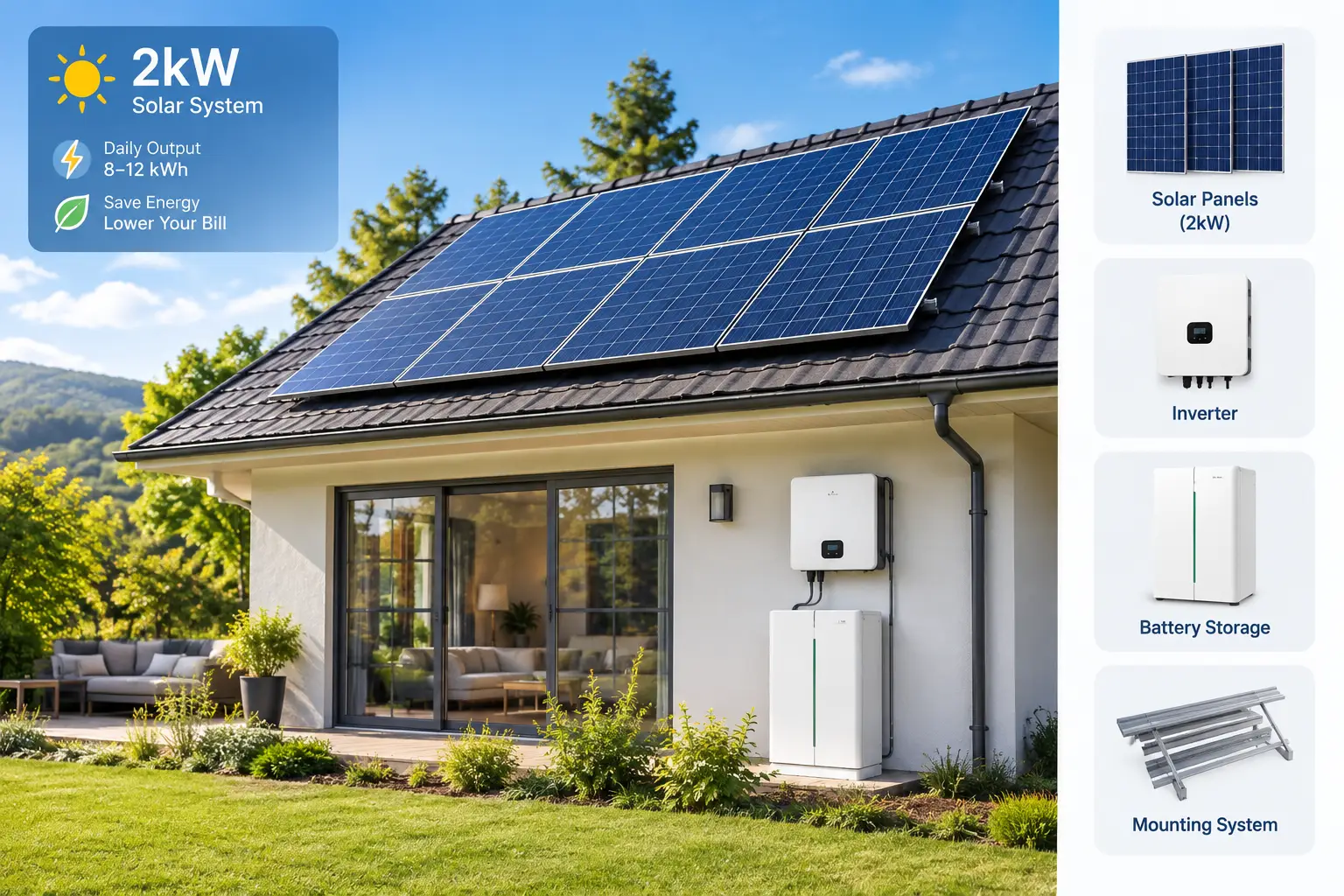
A 2kw solar system is a solar setup whose panels produce about 2,000 watts at peak under standard test conditions. Depending on your sunshine, that translates to roughly 6-9 kWh of usable energy per day — enough for a cabin, RV, workshop, or a meaningful backup circuit in a house.
That definition sounds tidy. The shopping reality is messier. ⚡ On Amazon, “2kW” can describe the solar array, the inverter, the battery, or all three at once, and those are wildly different things. A kit with 400W of panels and a 2,000W inverter will happily run your microwave — but it will harvest only a fifth of the energy a true 2kw solar system collects each day. Confusing the two is the single most expensive mistake buyers make in this category, and we’ll untangle it product by product.
Timing matters too. The federal 30% Residential Clean Energy Credit ended for expenditures after December 31, 2025, so in 2026 the math depends on your equipment price, not a tax break. That shifts the spotlight toward smaller, self-installed systems where every dollar has to earn its keep. Meanwhile, lithium iron phosphate (LiFePO4) batteries, 48V all-in-one inverters, and bifacial panels have become normal at mid-range prices, which makes a 2kW build far more capable than it was a few years ago.
Before you pick a kit, it helps to understand the big-picture steps — load analysis, siting, permits, and whether you’ll stay tied to the grid. The Department of Energy’s guide to planning a home solar electric system is a solid, vendor-neutral starting point. Then come back here: below you’ll find seven real options, honest analysis of what each “2kW” label actually means, and practical guides for sizing batteries, avoiding first-month mistakes, and keeping the system healthy for a decade or more.
Quick Comparison: 2kw solar system Picks at a Glance
| Product | What “2kW” Means Here | Included Storage | Price Range (approx.) | Best For |
|---|---|---|---|---|
| ECO-WORTHY 2340W 48V Off-Grid Kit | 2,340W solar array + 5kW inverter | ~5.1 kWh LiFePO4 | $2,800–$3,800 | ECO-WORTHY 2340W 48V Off-Grid Kit: cabins and serious home backup |
| ECO-WORTHY 1560W 48V Off-Grid Kit | 1,560W array, room to grow | ~5.1 kWh LiFePO4 | $2,200–$3,000 | ECO-WORTHY 1560W 48V Off-Grid Kit: workshops, trailers |
| ExpertPower 2.5KWH 12V Solar Power Kit | 2kW inverter charger, 400W array | ~2.56 kWh LiFePO4 | $1,500–$2,100 | ExpertPower 2.5KWH 12V Solar Power Kit: RVs with shore power |
| Anker SOLIX F2600 | 2.4kW output, 1kW max solar | 2.56 kWh LFP | $1,300–$2,400 | Anker SOLIX F2600: plug-and-play backup |
| ECO-WORTHY 1.6KWH 400W 12V Kit | 2kW inverter, 400W array | ~2.56 kWh (2 × 100Ah) | $900–$1,300 | ECO-WORTHY 1.6KWH 400W 12V Kit: first-time vanlifers |
| Renogy 2000W Inverter + 200W Starter Bundle | 2kW inverter, 200W array | None (add your own) | $700–$1,100 | Renogy 2000W Inverter + 200W Starter Bundle: DIY builders |
| GOWE 2KW Off-Grid Solar System | 2,000W array, 2kW inverter | None | Check current price | GOWE 2KW Off-Grid Solar System: panel-heavy budget builds |
Prices are approximate ranges at the time of writing and change often — check the current price before buying.
Looking at the table, only two options — the ECO-WORTHY 2340W 48V Off-Grid Kit and the GOWE 2KW Off-Grid Solar System — actually ship with around 2,000 watts of panels; the rest earn the “2kW” label through their inverters or output. That’s not a flaw if you mainly need to run appliances for short bursts, but it’s a big deal if you need daily energy. As a rule, compare the solar watts first, battery kWh second, and inverter watts third.
💬 One click helps other shoppers make an informed choice too! 😊
Top 7 2kW Solar Kits: Expert Analysis
1. ECO-WORTHY 2340W 48V Off-Grid Kit — the truest 2kW array here
If you want a 2kw solar system where “2kW” really describes the panels, this is the cleanest match on the list. The kit pairs twelve 195W N-type bifacial panels (2,340W total, backed by a 25-year linear power warranty) with a 5,000W 48V all-in-one inverter charger and a 51.2V 100Ah LiFePO4 server-rack battery, roughly 5.1 kWh. The 48V backbone is the quiet hero: moving 2kW at 48V takes about a quarter of the current a 12V system needs, so cables run cooler and losses shrink. The integrated MPPT charger and fast transfer (10 ms or less, per ECO-WORTHY’s listings) also let the kit double as a UPS-style backup.
Who is it for? Cabin owners, off-grid workshops, and homeowners building a dedicated backup panel who’d rather buy matched components than piece everything together. The Cubix 100 battery is listed to UL 1973 and UL 9540A, which helps when an inspector or insurer asks questions. However, ECO-WORTHY itself recommends professional installation, and a single inverter outputs 120V — 120/240V split-phase requires pairing inverters.
Aggregated Amazon review data for this exact bundle couldn’t be independently verified at the time of writing. On ECO-WORTHY’s own store, one owner reported a panel arriving broken and being replaced promptly — a reminder to inspect all twelve glass panels on delivery.
Pros:
- ✅ Genuine 2.3kW array, not just a 2kW inverter
- ✅ Efficient 48V architecture keeps current and heat low
- ✅ UL-listed battery simplifies permitting conversations
Cons:
- ❌ Professional installation recommended by the manufacturer
- ❌ Single inverter delivers 120V only, not 240V
Expect roughly $2,800–$3,800 (check the current price); strong value if you’ll use most of that daily harvest.
2. ECO-WORTHY 1560W 48V Off-Grid Kit — best room to grow into 2kW
Think of this as the little sibling that’s built to grow up. It uses eight 195W bifacial panels (1,560W), a 3,500W 48V all-in-one inverter, and the same style of 48V 100Ah rack battery. Because it shares the 48V platform, adding a few more panels later can push you toward a full 2kw solar system — as long as you stay within the inverter’s PV voltage and wattage limits listed in the manual. That upgrade path is the key feature: you buy the expensive “brain” once and expand the cheap part (panels) over time.
On paper, this suits trailer workshops, sheds, and off-grid weekend cabins where the budget is tight today but the ambitions aren’t. The 3,500W inverter comfortably handles window AC units, power tools, and a microwave, just not all at once. If your roof or ground mount space is limited, the smaller footprint is also a genuine advantage.
Verified aggregated Amazon sentiment for this bundle wasn’t available at the time of writing. One owner on ECO-WORTHY’s store described running a trailer air conditioner, fan, lights, chargers, and a compressor for about nine hours with 44% battery left — useful, but it’s a single report, so treat it as a data point, not a guarantee.
Pros:
- ✅ Same 48V platform as larger kits for easy upgrades
- ✅ 3,500W inverter handles most small-home appliances
- ✅ Smaller footprint fits tighter mounting spaces
Cons:
- ❌ Array falls short of a true 2kW out of the box
- ❌ Adding panels requires checking inverter input limits carefully
Typically $2,200–$3,000 (prices may vary); smart value for staged, budget-friendly expansion.
3. ExpertPower 2.5KWH 12V Solar Power Kit — best 2kW output for RVs on shore power
This kit’s “2kW” lives in its inverter, and it’s a very useful one. You get four 100W monocrystalline panels, a 30A MPPT controller with Bluetooth that auto-detects 12V/24V, a 12V 200Ah LiFePO4 battery (about 2.56 kWh) with its own Bluetooth monitoring, and a 2,000W pure sine wave inverter with a 35A charger. That charger is the underrated piece: plug into campground power or a generator and the battery refills without solar. In practical terms, the 2kW inverter runs a coffee maker or microwave, while the 400W array refills roughly 1.5-2 kWh on a sunny day.
It’s best for RVers and boaters who split time between hookups and boondocking. The battery can expand to four units, which is handy, but remember that the inverter is 12V — so you’d grow in parallel, not to 48V. At full 2,000W load, a 12V system pulls around 170-185 amps, so cable gauge and fusing need real attention.
Aggregated review sentiment specific to this complete bundle couldn’t be verified at the time of writing. What’s verifiable is the component list and expansion design, so focus on those and read recent reviews on the listing before buying.
Pros:
- ✅ Built-in 35A charger refills from shore power or generators
- ✅ App monitoring for both battery and charge controller
- ✅ Battery bank expands up to four units
Cons:
- ❌ 400W array limits daily solar harvest significantly
- ❌ 12V system demands heavy, expensive cabling at full load
Around $1,500–$2,100 at the time of writing; good value for mobile users who rarely rely on solar alone.
4. Anker SOLIX F2600 — easiest plug-and-play option
If “wiring a system” makes you nervous, this is the escape hatch. The Anker SOLIX F2600 is a portable power station with a 2,560Wh LFP battery, 2,400W continuous AC output (2,800W surge), up to 1,000W of solar input, and fast AC recharging up to 1,440W. It’s UL 1778 certified and switches to battery in under 20 ms, so it can act as a UPS for a home office or fridge. There’s also a NEMA TT-30 outlet, which means it plugs straight into many RVs.
The honest trade-off: it’s a 2.4kW output device capped at 1kW of solar, so it will never harvest what a true 2kW array does. It outputs 120V only, which rules out 240V appliances like well pumps or dryers. And at roughly 70 pounds, “portable” means wheels and a handle, not a carry-on.
Buyer feedback on retail sites such as Sam’s Club is strongly positive about build quality and thoughtful design, with several owners saying it runs most of their home besides central air during outages. Independent reviewers consistently mention the weight, and one review site noted early ratings were more mixed.
Pros:
- ✅ Zero wiring — unbox, plug in, and go
- ✅ Fast UPS switchover protects sensitive electronics
- ✅ TT-30 outlet makes RV hookup simple
Cons:
- ❌ 1,000W solar cap limits daily recharge from sun
- ❌ Heavy at roughly 70 pounds with no 240V output
Roughly $1,300–$2,400 for the station alone, depending on retailer and bundle; excellent value for renters and backup-first buyers.
5. ECO-WORTHY 1.6KWH 400W 12V Kit — most affordable complete starter
This is the budget-friendly way to get a working system with batteries in one box. It includes four 100W panels, a 40A MPPT controller with a Bluetooth module, two 12V 100Ah lithium batteries (about 2.56 kWh total), and an upgraded 2,000W inverter. The “1.6KWH” in the name matches what 400W of panels produce over about four good sun hours — a helpful, realistic figure rather than a storage number.
What most buyers overlook: this setup is sized for vans, small RVs, tiny cabins, and sheds, not household backup. The 2,000W inverter lets you run a microwave or induction burner briefly, but the array will take a full day to replace what those appliances burn in an hour or two. Consequently, it’s ideal for lights, a 12V fridge, laptops, fans, and phone charging — the loads that quietly add up in off-grid life.
Aggregated review sentiment for this exact bundle couldn’t be confirmed at the time of writing. ECO-WORTHY’s components appear widely across Amazon’s solar category, so check recent reviews on the specific listing for shipping and support experiences.
Pros:
- ✅ Complete kit with batteries at an entry-level price
- ✅ MPPT controller squeezes more from limited panel space
- ✅ Bluetooth monitoring helps beginners learn their usage
Cons:
- ❌ Array too small for daily heavy-appliance use
- ❌ 12V design limits future expansion toward 2kW
Usually $900–$1,300 (check the current price); the best value per dollar for first-time off-grid users.
6. Renogy 2000W Inverter + 200W Starter Bundle — best foundation for DIY builders
This bundle is a starting point, not a finished system — and for the right buyer, that’s the appeal. It pairs a Renogy 2,000W pure sine wave inverter (with a built-in transfer switch and Bluetooth) with two 100W monocrystalline panels and a 40A Rover MPPT controller. The Rover auto-detects 12V or 24V and advertises tracking efficiency up to 99%, while the panels are rated for 2,400Pa wind and 5,400Pa snow loads — meaningful if you live somewhere with real winters.
Based on comparing the specs, the smartest use here is as the inverter-and-controller core of a system you’ll expand. There’s no battery included, so budget for one, and note that a single 40A controller on 12V tops out around 500W of panels. Reaching a full 2kw solar system would mean adding controllers or moving to 24V. That’s more work, but you’ll understand every wire in your system, which pays off when troubleshooting.
Verified aggregated reviews for this particular bundle weren’t available at the time of writing. Renogy has sold solar gear since 2010, and its standalone inverters and Rover controllers are among the most commonly discussed in RV and van-build communities.
Pros:
- ✅ Quality inverter and MPPT controller from an established brand
- ✅ Panels rated for heavy wind and snow loads
- ✅ Built-in transfer switch eases shore-power integration
Cons:
- ❌ No battery included, so real cost runs higher
- ❌ Scaling toward 2kW requires extra controllers or rewiring
Around $700–$1,100 at the time of writing; good value if you’re building a system in stages.
7. GOWE 2KW Off-Grid Solar System — the most panels for the money
This is the “raw materials” option: ten 200W monocrystalline panels (2,000W total), a 60A 12/24V PWM charge controller, a 2,000W pure sine wave inverter with 4,000W surge, and 20 meters of solar cable. No battery is included. On paper, it’s a complete 2kW array, and if what you want most is lots of glass for the money, it delivers.
Here’s what the spec sheet doesn’t say out loud. The panels have a 36.26V operating voltage, but a PWM controller charging a 24V battery drags them down to battery voltage — throwing away roughly a quarter of their potential. Additionally, a 60A controller at 24V can only pass around 1,500-1,700W. The listing’s claim of 11,000Wh maximum daily consumption is optimistic; realistic harvest is lower. The fix is straightforward: swap in an MPPT controller and a 48V battery bank, and those ten panels become a genuinely strong array. Each panel weighs about 15.3 kg (roughly 34 lb), so plan your mounting accordingly.
Verified aggregated customer review sentiment for this listing couldn’t be confirmed at the time of writing, so weigh recent reviews carefully.
Pros:
- ✅ True 2,000W array at a panel-heavy price point
- ✅ Pure sine inverter handles sensitive electronics safely
- ✅ Great panel source for a custom MPPT build
Cons:
- ❌ PWM controller wastes a large share of panel output
- ❌ No battery, and optimistic daily-output claims
Pricing on this listing varies widely, so check the current price; best value only if you plan to upgrade the controller.
✨ Don’t miss the right fit for your roof or rig!
🔍 Take your off-grid power to the next level with this carefully curated lineup. Click a highlighted kit to check current pricing and availability — these picks will help you keep the lights on, the fridge cold, and the generator quiet.
Head-to-Head: How the 7 Kits Stack Up
| Product | Solar Array | Inverter (continuous) | System Voltage | Charge Controller | Best For |
|---|---|---|---|---|---|
| ECO-WORTHY 2340W 48V Off-Grid Kit | 2,340W bifacial | 5,000W | 48V | Built-in MPPT | ECO-WORTHY 2340W 48V Off-Grid Kit: max daily energy |
| ECO-WORTHY 1560W 48V Off-Grid Kit | 1,560W bifacial | 3,500W | 48V | Built-in MPPT | ECO-WORTHY 1560W 48V Off-Grid Kit: staged growth |
| ExpertPower 2.5KWH 12V Solar Power Kit | 400W | 2,000W + 35A charger | 12V | 30A MPPT | ExpertPower 2.5KWH 12V Solar Power Kit: hookup-heavy RVers |
| Anker SOLIX F2600 | Up to 1,000W input | 2,400W | Integrated | Built-in MPPT | Anker SOLIX F2600: no-wiring backup |
| ECO-WORTHY 1.6KWH 400W 12V Kit | 400W | 2,000W | 12V | 40A MPPT | ECO-WORTHY 1.6KWH 400W 12V Kit: vans and sheds |
| Renogy 2000W Inverter + 200W Starter Bundle | 200W | 2,000W | 12V/24V | 40A MPPT | Renogy 2000W Inverter + 200W Starter Bundle: DIY foundations |
| GOWE 2KW Off-Grid Solar System | 2,000W | 2,000W | 12V/24V | 60A PWM | GOWE 2KW Off-Grid Solar System: panel bargain hunters |
Reading down the “System Voltage” column tells you almost as much as the wattage. The two 48V ECO-WORTHY kits are the only ones engineered to move 2kW efficiently, while the 12V kits trade efficiency for simplicity and RV compatibility. If you want a 2kW array but end up with a 12V or PWM setup, budget for upgrades — especially with the GOWE 2KW Off-Grid Solar System.
Getting Started: Your First 30 Days With a 2kw solar panel kit
A 2kw solar panel kit rewards a little patience in the first month. Here’s a practical roadmap that most product listings skip. 🛠️
Week 1: Unbox, inspect, and dry-fit
- ✅ Inspect every panel’s glass and frame before signing off on freight; photograph any damage immediately.
- ✅ Lay the components out and dry-fit cable runs before drilling anything. Keep battery-to-inverter cables as short as the manual allows.
- ✅ Update firmware and pair the Bluetooth or Wi-Fi apps while everything is still on the bench.
Week 2: Install and set charging profiles
Most early “my battery won’t charge” complaints trace back to one setting: the battery type. Set the controller or all-in-one inverter to the LiFePO4 profile (or the exact voltages in your battery manual). Lead-acid defaults can undercharge lithium or push it into protection mode. Also, torque every lug to spec — loose DC connections are the leading cause of heat and melted terminals.
Week 3: Learn your real load
Run your normal routine and watch the app. Note your overnight draw, your fridge’s duty cycle, and your peak loads. This is when most owners discover a “phantom” load — an old router, a chest freezer in the garage, or the inverter’s own idle consumption.
Week 4: Tune and maintain
Adjust panel tilt if you can (steeper in winter, flatter in summer), set a low-battery cutoff that leaves 10-20% in reserve, and schedule a monthly check: clean panels if dusty, check connections for warmth, and confirm the battery’s state-of-charge readings match reality. That 15-minute habit prevents most long-term headaches.
Real-World Scenarios: Which Setup Fits Your Life?
Specs mean more when they’re attached to a real life. Here are three common buyer profiles and the reasoning behind each match.
🏕️ The weekend cabin owner (budget: $2,500–$4,000)
You visit two or three weekends a month, run a fridge, lights, a water pump, and a coffee maker, and you have plenty of open ground. The ECO-WORTHY 2340W 48V Off-Grid Kit fits best: its array can refill the 5.1 kWh battery on a decent day, and between visits the system sits topped up. If money is tight, start with the ECO-WORTHY 1560W 48V Off-Grid Kit and add panels next season.
🚐 The full-time RVer (budget: $1,000–$2,000)
You move every few days, sometimes on hookups, sometimes boondocking. Roof space limits you to around 400W, so a true 2kW array isn’t realistic. The ExpertPower 2.5KWH 12V Solar Power Kit makes sense because its built-in charger tops up from shore power or a generator, while the solar handles daily trickle loads. If you prefer zero wiring, the Anker SOLIX F2600 with its TT-30 outlet is the plug-in alternative.
🏡 The suburban homeowner who wants outage insurance (budget: $1,300–$2,500)
You’re grid-tied and just want the fridge, internet, and a few lights to survive a storm. You may not want roof permits at all. The Anker SOLIX F2600 plus a couple of portable panels gives you a quick UPS-style backup that recharges from sun during multi-day outages. It won’t cut your electric bill much, but it will keep dinner cold — and that’s the actual goal here.
How to Choose a 2kw solar system
Choosing well comes down to matching three numbers — daily energy, peak power, and storage — to how you actually live. Follow these steps in order:
- Add up your daily watt-hours. List each appliance’s watts multiplied by hours of use. This number drives array size, and nothing else matters until you know it.
- Check your sun. A 2kW array produces far more in Arizona than in Washington State. Look up your peak sun hours before trusting any “kWh per day” claim.
- Size the inverter for your biggest simultaneous load. Add the wattage of everything that might run at once, then leave about 20-25% headroom for motor startup surges.
- Pick your system voltage. For a true 2kW array, 24V is workable and 48V is ideal. 12V makes sense mainly for vehicles.
- Insist on MPPT charging. Maximum power point tracking can harvest meaningfully more energy than PWM, especially in cold weather or with higher-voltage panels.
- Choose LiFePO4 storage. It tolerates deep discharge, lasts thousands of cycles, and is far lighter than lead-acid.
- Confirm certifications and permits. Look for UL listings and check whether your jurisdiction requires an electrical permit or utility approval.
For context on step 1, the U.S. Energy Information Administration reports how much electricity an average American home uses — typically several hundred kilowatt-hours per month. A 2kw solar system usually covers a slice of that, not all of it, which is exactly why load analysis comes first.
How Much Power Does a 2kW Solar System Actually Produce?
Here’s where marketing meets physics. A 2kW array produces 2,000 watts only under ideal lab conditions: 1,000 watts of sunlight per square meter at 25°C. On your roof, heat, dust, wiring, inverter conversion, and panel angle all shave off output. Industry modeling tools commonly assume around 14% total system losses as a starting point.
So what does that mean day to day? ☀️ Multiply your array size by your peak sun hours, then apply losses. With 4.5 peak sun hours, a 2kW array yields roughly 7.5-8 kWh per day. In a sunny Southwest location with 6 hours, you might see 10 kWh; in a cloudy Northern winter with 2 hours, closer to 3.5 kWh. Over a year, a typical U.S. location lands somewhere around 2,500-3,200 kWh.
The easiest way to get a real estimate for your address is NREL’s free PVWatts calculator. Enter your location, 2 kW system size, and tilt, and it models hour-by-hour production using local weather data. It’s the same kind of math professional installers rely on.
What that energy runs in practice
- ✅ A modern refrigerator: roughly 1-2 kWh per day
- ✅ LED lighting for a small cabin: under 0.5 kWh per day
- ✅ A laptop, router, and phone charging: about 0.5-1 kWh per day
- ❌ Central air conditioning: often 20-30+ kWh on hot days — well beyond a 2kw solar system
In short, a 2kW array comfortably runs “essentials plus comfort” loads, while heavy heating and cooling loads call for a larger system.
2kw solar system with battery: Sizing Storage the Right Way
A 2kw solar system with battery storage is really two decisions: how much energy you harvest by day and how much you need at night. Get the ratio wrong and you’ll either waste sunshine or drain the bank before dawn. 🔋
The simple sizing rule
Start with your overnight and cloudy-day consumption, not your total daily use. If your evening and overnight loads are 3 kWh, you want at least 3.5-4 kWh of usable storage to preserve a reserve. For a cabin that needs to ride through one cloudy day, double that. As a result, most 2kW off-grid builds land in the 5-10 kWh range.
Why chemistry matters
LiFePO4 batteries can routinely use 80-100% of rated capacity, while lead-acid batteries last far longer when you use only about 50%. That means a 5 kWh LiFePO4 bank can deliver nearly as much usable energy as a 10 kWh lead-acid bank — at a fraction of the weight and with far more cycles.
Matching battery to array
A useful balance point: your array should be able to refill the battery in one good sun day while also powering daytime loads. For example, the ECO-WORTHY 2340W 48V Off-Grid Kit pairs about 7-8 kWh of typical daily harvest with 5.1 kWh of storage — a healthy ratio. By contrast, the ExpertPower 2.5KWH 12V Solar Power Kit pairs 2.56 kWh of storage with a 400W array, which is why its shore-power charger matters so much.
Growing later
Choose a battery system that supports parallel expansion and communicates with your inverter (CAN or RS485 on 48V rack batteries). Adding identical batteries within the first year or two keeps cells well matched.
2kw off grid solar system vs. a Grid-Tied Setup
Should your 2kw off grid solar system stand alone, or should you connect it to the utility? The answer shapes almost every other purchase.
Off-grid: independence with responsibility
A 2kw off grid solar system needs batteries, a charge controller (or all-in-one inverter), and usually a backup generator for long cloudy stretches. You’re your own utility. The upside is total independence — no bills, no outages from the grid, and no interconnection paperwork in most cases. The downside is that you must size storage conservatively and manage your loads, especially in winter.
Grid-tied: savings without batteries
A grid-tied system uses a UL 1741-listed inverter that feeds power back to the utility, often under net metering or net billing rules that vary widely by state. It’s usually cheaper per watt because batteries are optional, but it shuts down during outages for lineworker safety unless it’s a hybrid system with battery backup. It also requires a permit, inspection, and utility interconnection approval.
The hybrid middle ground
All-in-one inverters like those in the ECO-WORTHY 2340W 48V Off-Grid Kit can use grid or generator power as backup, but that doesn’t make them grid-tie inverters for exporting power. If you want to sell energy back, confirm the inverter is certified for interconnection in your area. For most 2kW buyers, off-grid or backup-focused setups offer the clearest value, because a system this small saves relatively little through net metering alone.
2000 watt solar kit vs. a Gas Generator
Many shoppers comparing a 2000 watt solar kit are really asking: “Should I just buy a generator?” It’s a fair question, so here’s a side-by-side look.
| Factor | 2000 watt solar kit (with battery) | Portable gas generator (~2,000–3,500W) |
|---|---|---|
| Upfront cost | Higher | Lower |
| Fuel cost | None after purchase | Ongoing gasoline or propane |
| Noise | Near silent (inverter fans only) | Loud; often restricted at campgrounds |
| Indoor safety | Can operate indoors (battery/inverter) | Never indoors — carbon monoxide risk |
| Best for | Daily off-grid use, quiet backup | Rare emergencies, very high short loads |
The table highlights the core trade-off: a solar kit costs more upfront but nothing to run, while a generator is cheap to buy but expensive, noisy, and hazardous to operate. The Consumer Product Safety Commission repeatedly warns that portable generators must never run indoors or in garages because of carbon monoxide. For most buyers, the smartest answer is both — solar for daily and quiet needs, a small generator for long winter storms.
Where the solar kit clearly wins
If you use power daily, a 2000 watt solar kit pays back its premium over time with no fuel runs, no oil changes, and no stored gasoline going stale. It also works during fuel shortages, which is exactly when many outages happen. Meanwhile, a generator still makes sense for rare, high-power needs like running a well pump during a multi-day storm.
Long-Term Cost and Maintenance
Sticker price is only the opening chapter. Here’s how the total cost of ownership plays out over ten years. 💰
The 2026 incentive picture
The federal 30% Residential Clean Energy Credit (Section 25D) ended for expenditures after December 31, 2025. Systems placed in service in 2026 generally don’t qualify, so the equipment price is the real price. Some states, utilities, and cities still run rebates, so check local programs before buying.
Where the money goes
- Panels: the longest-lived component. Many carry 25-year power warranties, like the bifacial panels in the ECO-WORTHY 2340W 48V Off-Grid Kit. Expect slow, gradual output decline.
- Batteries: the biggest long-term cost variable. LiFePO4 banks typically last thousands of cycles and often a decade or more, while lead-acid may need replacement in 3-5 years.
- Inverters and controllers: usually 10-15 years of service; budget for one replacement over the system’s life.
- Hidden extras: mounting racks, breakers, fuses, conduit, grounding, and possibly permits or an electrician — often 15-30% on top of kit price.
Maintenance that actually matters
Clean panels a few times a year (more in dusty or pollen-heavy areas), check DC connections for warmth and corrosion every few months, and keep batteries within their rated temperature range. Lithium batteries generally shouldn’t be charged below freezing unless they include built-in heating, which matters for unheated cabins.
Value math
A simple way to compare kits: divide the price by the expected kWh the system will deliver over ten years. A true 2kW array producing roughly 2,500-3,200 kWh a year will almost always beat a 400W kit on cost per kWh — even if its sticker price is several times higher.
Safety, Regulations, and Standards
A 2kW system carries enough energy to demand respect. Here’s what U.S. buyers should know. ⚠️
Electrical codes and permits
In most of the U.S., solar installations fall under the National Electrical Code (NEC), particularly Article 690 for photovoltaic systems and Article 705 for systems interconnected with other power sources. Rooftop systems on buildings typically require rapid shutdown capability. Local jurisdictions adopt different NEC editions and add amendments, so call your building department before starting — even a ground-mounted cabin system may require a permit.
Certifications to look for
- ✅ UL 1741 for inverters that interconnect with the grid
- ✅ UL 1973 and UL 9540A for stationary battery systems (as listed for the Cubix battery in the ECO-WORTHY 2340W 48V Off-Grid Kit)
- ✅ UL 1778 for UPS equipment, which the Anker SOLIX F2600 carries
- ✅ UL 458 for mobile and RV inverters
Practical safety rules
Never connect an inverter to your home’s panel without a proper transfer switch or interlock — backfeeding can electrocute utility workers. Fuse every battery positive close to the terminal, use cable sized for your worst-case current, and mount batteries where they’re protected from physical damage and extreme temperatures. Finally, if you’re unsure about any grid connection, hire a licensed electrician — the cost is small compared to the risk.
Common Mistakes to Avoid When Buying a 2kW Solar Kit
Most regrets in this category are predictable, which means they’re avoidable.
Mistake 1: Confusing inverter watts with solar watts
A “2kW kit” with 400W of panels won’t produce 2kW of daily energy. Always look at the solar array size first.
Mistake 2: Choosing 12V for a stationary 2kW build
For cabins and sheds, 12V creates huge currents and expensive cables. Choose 24V or 48V unless the system lives in a vehicle.
Mistake 3: Accepting PWM controllers on large arrays
PWM can waste a large share of energy with higher-voltage panels. The GOWE 2KW Off-Grid Solar System illustrates this well: great panels, limited controller.
Mistake 4: Ignoring surge loads
Fridges, pumps, and compressors can briefly draw several times their running watts. Undersized inverters trip right when you need them.
Mistake 5: Forgetting the “hidden” parts budget
Racks, breakers, disconnects, and wire add up. A realistic budget adds 15-30% to the kit price.
Mistake 6: Skipping the permit conversation
A quick call to your local building department can prevent fines, insurance complications, or forced removal later.
FAQ: Buying a 2kw solar system
❓ How many panels do I need for a 2kw solar system?
❓ Can a 2kw solar system run an air conditioner?
❓ How much does a 2kw solar system with battery cost in 2026?
❓ Can I install a 2000 watt solar kit myself?
❓ Is a 2kw off grid solar system enough for a tiny house?
Conclusion: Finding the 2kw solar system That Actually Fits
The biggest takeaway? “2kW” is a label, not a promise. A true 2kw solar system with a 2,000W-plus array — like the ECO-WORTHY 2340W 48V Off-Grid Kit — harvests several times more daily energy than a kit that only has a 2,000W inverter. Once you separate array watts, inverter watts, and battery kWh, the right choice usually becomes obvious.
If you’re building a cabin or a serious backup system, the 48V ECO-WORTHY kits deliver the best efficiency, with the ECO-WORTHY 1560W 48V Off-Grid Kit offering a lower-cost path to grow into. RVers who mix hookups and boondocking will appreciate the ExpertPower 2.5KWH 12V Solar Power Kit, while anyone who wants zero wiring should look at the Anker SOLIX F2600. Budget-minded beginners get a lot from the ECO-WORTHY 1.6KWH 400W 12V Kit, hands-on builders will like the Renogy 2000W Inverter + 200W Starter Bundle as a foundation, and the GOWE 2KW Off-Grid Solar System makes sense mainly as a panel source for an MPPT upgrade.
Whatever you choose, start with a load list, check your local sun and permit rules, and leave room to expand. Solar rewards the planners — and a well-sized 2kW system can quietly pay you back for a decade or more. 🌞
⚡ Ready to power up your independence?
🔍 Compare the highlighted kits above, check current pricing and availability, and choose the setup that fits your roof, your rig, and your budget. The right system today means quieter nights and fewer worries when the grid goes dark!
Recommended for You
- 1 Kilowatt Solar Panel: 7 Best Picks That Actually Deliver in 2026
- 15k Generator 2026: 7 Best Proven Picks for Whole-Home Backup
- Solar Power Inverter for RV: 7 Best Picks That Won’t Fail (2026)
Disclaimer: This post contains affiliate links. As an Amazon Associate, I earn from qualifying purchases made through these links, at no additional cost to you.
✨ Found this article helpful? Share it with someone who needs it! 💬🤗
