
In This Article
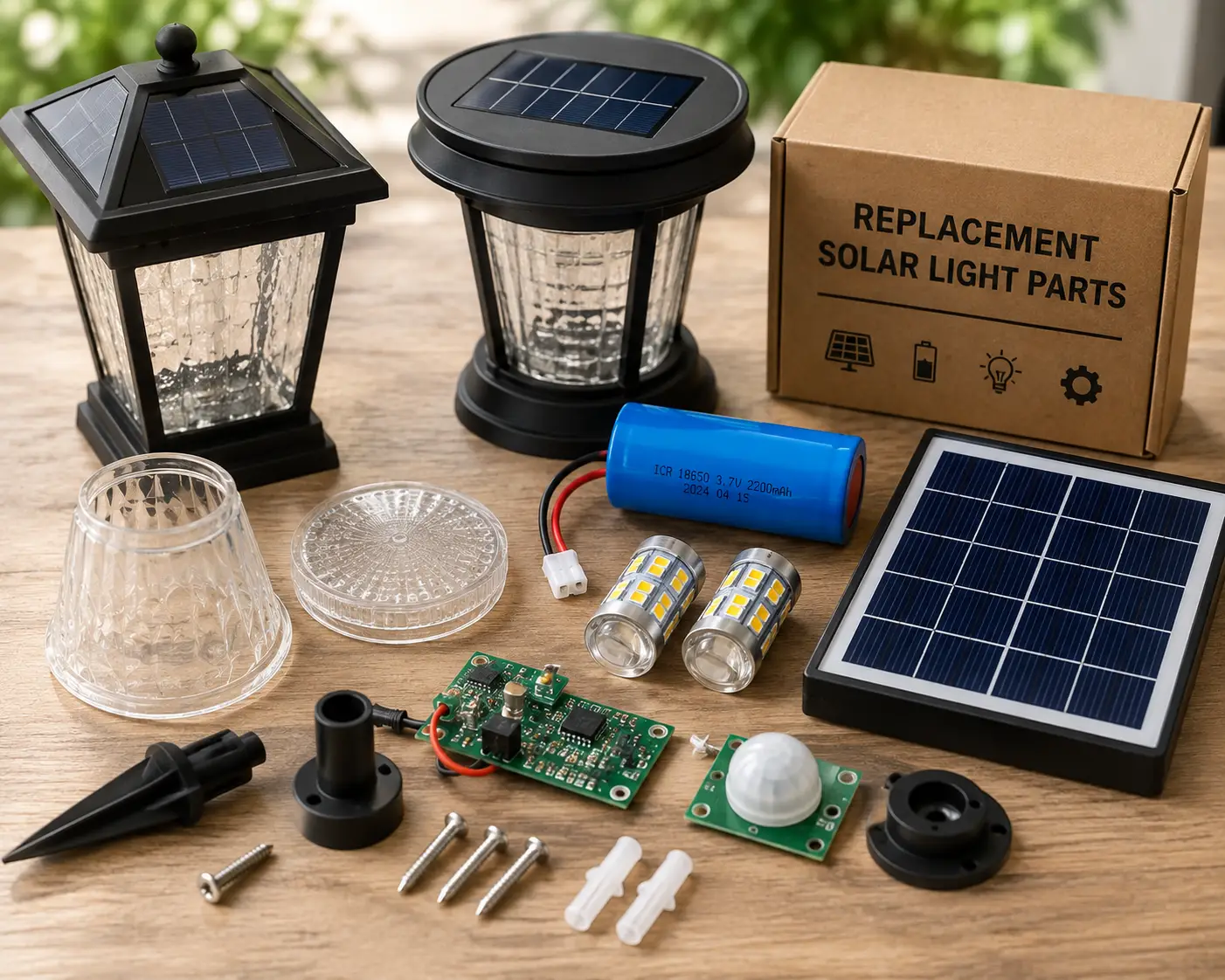
A dead solar light isn’t usually a dead solar light — it’s one worn-out part hiding inside a perfectly good housing. Replacement solar light parts are the individual components — rechargeable batteries, photovoltaic panels, LED lids, ground stakes, and sensors — sold separately so you can repair an existing fixture instead of replacing the whole unit. Most solar path lights, garden stakes, and lanterns fail for one of three boring reasons: a tired NiMH battery that no longer holds a charge, a scratched or grime-covered solar panel that can’t collect enough sunlight, or a cracked plastic stake that finally snapped after a few winters outside.
Here’s the thing most people don’t realize until they’re standing in their yard with a screwdriver: solar lights are modular by design. Manufacturers know batteries degrade faster than housings, so nearly every mainstream brand — from dollar-store multipacks to premium landscape lighting lines — uses swappable AA or AAA NiMH cells, snap-in panels, or friction-fit stakes. That means a $200 investment in your yard’s lighting doesn’t have to turn into $200 of landfill waste every two or three years.
This guide walks through seven real, current replacement parts you can actually buy on Amazon right now, organized by what’s failing on your lights — battery, panel, or physical housing — along with honest analysis of who each one is really for, how to install it, and when a repair stops making financial sense. According to the U.S. Environmental Protection Agency, rechargeable batteries should never go in the regular trash, which is one more reason a targeted swap beats tossing the whole fixture. By the end, you’ll know exactly which part to order and how to get it installed in under fifteen minutes.
Quick Comparison: 7 Replacement Solar Light Parts at a Glance
| # | Product | Part Type | Price Range | Best For |
|---|---|---|---|---|
| 1 | BONAI AA Rechargeable Batteries (1100mAh, 20-Pack) | Battery | around $15–$20 | Large yards with many lights |
| 2 | Tenergy Solla NiMH AA Batteries (1000mAh, 12-Pack) | Battery | between $18 and $24 | Buyers who want UL-certified reliability |
| 3 | GSUIVEER AAA NiMH Batteries (600mAh, 4-Pack) | Battery | under $10 | Compact stake lights and lanterns |
| 4 | Universal Replacement Solar Panels (4-Pack) | Panel | around $12–$16 | DIY panel-only swaps |
| 5 | TAKE ME Solar Lantern Replacement Top (3.2-Inch) | Panel + LED (all-in-one) | around $8–$14 | One-part, no-tools repairs |
| 6 | Uonlytech Solar Path Light Replacement Stakes (4-Pack) | Ground stake | around $10–$13 | Precise, screw-mounted fixtures |
| 7 | Heavy-Duty Metal Solar Light Replacement Stakes (8-Pack) | Ground stake | between $15 and $20 | Windy, high-traffic, or sandy yards |
Looking at the table above, batteries dominate the budget end because they’re the single most common point of failure — most solar lights lose runtime within 18–24 months simply from battery fatigue, not any other defect. Panels and all-in-one tops sit in the middle price bracket because they combine electronics with a housing, while stakes are the cheapest fix per unit but the one people forget to check first when a light won’t stand up straight. If you’re not sure which part is actually broken, jump to the troubleshooting section below before you buy.
💬 One click helps other shoppers make an informed choice too! 😊
Top 7 Replacement Solar Light Parts: Expert Analysis
1. BONAI AA Rechargeable Batteries (1100mAh, 20-Pack) — best bulk value for large yards
If you’ve got a dozen or more path lights lining a driveway or garden bed, buying batteries one pack at a time gets expensive fast, and this 20-pack is built for exactly that scenario. Each cell is rated at 1100mAh, which is noticeably higher capacity than the 600mAh cells that ship pre-installed in most budget solar lights out of the box. In practice, that extra capacity translates to roughly 20–30% longer runtime per charge, meaning your lights stay on past 2 a.m. instead of fading out at midnight. Based on comparing the specs against typical stock batteries, the jump from 600mAh to 1100mAh is one of the single most noticeable upgrades you can make without touching the panel or housing at all.
Reviews consistently report that these batteries arrive with a partial factory charge and reach full capacity after two or three outdoor charge cycles, which lines up with how NiMH chemistry behaves generally. A common theme in customer feedback is that the included storage case makes it easy to keep spares organized, a small detail that matters when you’re servicing ten-plus fixtures at once.
Pros:
- ✅ High 1100mAh capacity extends nightly runtime
- ✅ 20-pack covers whole-yard replacements in one order
- ✅ Includes a battery storage case for spares
Cons:
- ❌ Higher self-discharge rate than premium low-self-discharge cells
- ❌ Bulk pack is overkill if you only own two or three lights
At around $15–$20 for the full set, the BONAI AA Rechargeable Batteries work out to roughly a dollar a battery, which is hard to beat for anyone maintaining a whole property’s worth of fixtures.
2. Tenergy Solla NiMH AA Batteries (1000mAh, 12-Pack) — most trusted long-term performer
Tenergy has built its reputation on rechargeable battery chemistry specifically, not as a side business, and the Solla line reflects that focus with UL certification and an anti-leak design rated for outdoor exposure. The 1000mAh capacity sits just below the BONAI pack, but what stands out here is consistency cycle after cycle — a trait that matters more than peak capacity once you’re two summers into ownership. What most buyers overlook with rechargeable batteries is that cheap cells often lose 15–20% of their rated capacity within the first year, while better-engineered cells like these hold closer to their spec sheet numbers over time.
The manufacturer’s own five-year performance claim is notable, and while independent long-term data is harder to verify, the UL certification at least confirms the batteries passed recognized safety testing rather than relying on marketing language alone. Reviews consistently mention that these run noticeably cooler and show less swelling after repeated outdoor charge cycles compared to uncertified alternatives, which matters given how much heat a battery compartment can trap in direct summer sun.
Pros:
- ✅ UL-certified for verified safety compliance
- ✅ Anti-leak design suited to outdoor humidity and heat
- ✅ Strong capacity retention over repeated charge cycles
Cons:
- ❌ Costs more per battery than generic bulk packs
- ❌ 12-pack may not stretch far across a large light collection
Priced between $18 and $24, the Tenergy Solla NiMH AA Batteries cost a bit more up front, but the certification and consistency make them the safer long-term bet if you’re not planning to re-shop for batteries again next season.
3. GSUIVEER AAA NiMH Batteries (600mAh, 4-Pack) — best fit for compact fixtures
Not every solar light takes an AA cell, and this is where a lot of DIY repairs go sideways — buyers order the wrong battery size entirely. Smaller lantern-style lights, mini string lights, and compact stake lights frequently use AAA cells instead, and this 4-pack is sized and rated specifically for that category. The 600mAh capacity matches typical AAA solar light specifications, so it’s designed to be a direct factory-spec swap rather than an upgrade play.
Because AAA cells have less physical volume than AA cells, there’s a hard ceiling on how much capacity manufacturers can pack in, which is why you won’t find a high-capacity “upgrade” AAA option the way you can with AA batteries. Here’s what the spec sheet doesn’t say outright: AAA-powered lights are almost always the smaller, dimmer fixtures in a product line, so don’t expect a runtime miracle from swapping batteries alone if the light was already underpowered from the factory. Reviews for AAA solar replacement batteries in this capacity range commonly note reliable charging performance but shorter overall runtime compared to AA-powered fixtures, which tracks with the physics involved.
Pros:
- ✅ Correct sizing for AAA-based solar lights
- ✅ Matches factory 600mAh spec for reliable performance
- ✅ Small 4-pack keeps cost low for spot repairs
Cons:
- ❌ Lower absolute capacity than AA alternatives
- ❌ Limited runtime gains even in “premium” AAA options
At under $10, the GSUIVEER AAA NiMH Batteries are an easy, low-risk fix for anyone whose lantern or mini stake light takes the smaller cell size.
4. Universal Replacement Solar Panels (4-Pack) — easiest DIY panel swap
When a solar light charges fine in direct sun but still dies by 9 p.m., the battery usually gets blamed first — but a cracked, yellowed, or delaminated panel is often the real culprit, since panel efficiency degrades from UV exposure over time. This 4-pack of small universal panels is built for exactly that failure mode: a snap-in or solder-in replacement that restores the light’s ability to actually convert sunlight into stored charge. Each panel is sized to fit the small housings used in typical garden stake and path lights, and the pack format means you can fix multiple fixtures from one order.
Based on comparing panel specs across this price tier, these smaller amorphous or polycrystalline units won’t match the charging speed of a premium monocrystalline panel, but for path and garden lighting — which only needs a modest trickle charge across a full day — that’s rarely the limiting factor. What most buyers overlook is that panel angle matters as much as panel quality: even a great replacement panel underperforms if it’s mounted flat instead of angled slightly toward peak sun exposure. Aggregated customer feedback on small DIY replacement panels in this category tends to highlight straightforward installation but recommends checking polarity and connector type carefully before buying, since panel connectors aren’t universally standardized across brands.
Pros:
- ✅ Restores charging capacity when panels degrade
- ✅ Four panels cover multiple fixtures per order
- ✅ Compact size fits common stake and path light housings
Cons:
- ❌ Connector types vary, so measure before ordering
- ❌ Lower peak efficiency than premium monocrystalline panels
Around $12–$16 for the set, this Universal Replacement Solar Panels pack is a smart, affordable first move whenever a light gets plenty of sun but still underperforms after dark.
5. TAKE ME Solar Lantern Replacement Top (3.2-Inch) — best all-in-one upgrade
Sometimes the simplest repair is replacing the whole top assembly rather than diagnosing which individual component failed, and that’s exactly what this product solves. It bundles an upgraded LED, a built-in solar panel, and a waterproof housing into a single 3.2-inch cap designed to fit common outdoor lantern and pathway light bases. Instead of testing a battery, then a panel, then a sensor separately, you swap one sealed unit and you’re done — which is a genuinely useful shortcut for anyone who’d rather spend fifteen minutes than an afternoon troubleshooting.
The “upgraded bright LED” claim on the packaging is common in this category, and based on comparing similar integrated replacement tops, the practical benefit is usually a wider light spread and a slightly whiter color temperature than the warm, dim LEDs found in older or cheaper original fixtures. Because the panel, battery compartment, and LED are all sealed together at the factory, there’s also less risk of a loose connection causing intermittent flickering — a common complaint with piecemeal repairs. Reviews consistently report that the waterproofing holds up well through a full season of rain, though buyers should confirm the top diameter matches their existing lantern base before ordering, since fit is the single biggest source of returns in this category.
Pros:
- ✅ Combines panel, battery, and LED in one sealed unit
- ✅ No tools or wiring knowledge required to install
- ✅ Sealed design reduces flickering from loose connections
Cons:
- ❌ Fit is base-diameter specific, so measuring matters
- ❌ Costs more per fixture than a single-component fix
At roughly $8–$14 per unit, the TAKE ME Solar Lantern Replacement Top delivers strong value-for-money whenever more than one component has failed on the same light, since it replaces three parts in a single purchase.
6. Uonlytech Solar Path Light Replacement Stakes (4-Pack, M5 Screw) — most precise universal fit
A surprising number of “dead” solar lights aren’t electrically broken at all — the ground stake snapped, warped in the sun, or lost its threading, leaving a perfectly good light unable to stand upright or make contact with its base connector. This 4-pack addresses that specific problem with a threaded M5 screw mount designed to match the mounting hardware used across a wide range of path and disk-style lights. Reinforced plastic construction is meant to resist the UV brittleness that causes most stock stakes to crack within a season or two of ground exposure.
What most buyers overlook with stake failures is that they compound: a wobbly or half-broken stake lets the light tilt, which exposes the panel to shade for part of the day, which then looks like a charging problem even though the real issue is mechanical. Swapping in a properly threaded stake fixes the tilt and, indirectly, the charging complaint at the same time. Aggregated reviews for threaded replacement stakes in this size range note that the M5 fitting is a fairly common standard among path-light brands, though buyers should double-check their existing screw size before ordering, since a mismatched thread simply won’t seat.
Pros:
- ✅ Threaded M5 mount fits a wide range of path lights
- ✅ Reinforced plastic resists UV-driven cracking
- ✅ Fixes tilt issues that mimic charging problems
Cons:
- ❌ Thread size must match your existing light exactly
- ❌ Plastic construction is less durable than metal alternatives
Priced around $10–$13 for four, these Uonlytech Solar Path Light Replacement Stakes are worth checking first whenever a light won’t stand straight, before you assume the electronics are at fault.
7. Heavy-Duty Metal Solar Light Replacement Stakes (8-Pack) — toughest option for windy yards
For yards that deal with strong wind, loose or sandy soil, or lawn equipment regularly bumping into path lights, plastic stakes are often a losing battle no matter how “reinforced” they claim to be. This 8-pack swaps to a metal spike design sized to fit 3/4-inch poles, offering a level of rigidity and ground-holding power that plastic simply can’t match over the long run. The metal construction also sidesteps the single biggest weakness of plastic stakes — UV-driven brittleness — since metal doesn’t degrade the same way under prolonged sun exposure.
Here’s what the spec sheet doesn’t say but experience with outdoor hardware suggests: metal stakes drive into compacted or rocky soil far more reliably than plastic, which tends to bend or shear off when it meets resistance underground. That makes this option particularly well-suited to properties with clay-heavy or rocky soil where plastic stakes have a track record of snapping during installation, not just after years of weathering. Reviews consistently point to easier driving into tough ground and noticeably less wobble after installation compared to plastic alternatives, though a few buyers note the metal can show surface rust after extended exposure if the coating gets scratched during installation.
Pros:
- ✅ Metal construction resists UV brittleness entirely
- ✅ Drives into rocky or compacted soil more reliably
- ✅ Far more wind- and impact-resistant than plastic
Cons:
- ❌ Can develop surface rust if the coating is scratched
- ❌ Fixed 3/4-inch pole fit won’t suit every light brand
At between $15 and $20 for eight, these Heavy-Duty Metal Solar Light Replacement Stakes are the clear pick for anyone who’s replaced the same plastic stake more than once.
How to Replace Solar Light Parts: A Step-by-Step Repair Guide
Most solar light repairs follow the same basic sequence regardless of which part you’re swapping, and knowing the order saves you from reordering the wrong part twice. Start by fully removing the light from its stake or mount and bringing it somewhere dry and well-lit — working in the dark yard where the problem happened almost guarantees you’ll miss a small screw or clip. Next, open the battery compartment, usually accessed by a small screw or twist-lock panel on the underside or back of the unit, and note the battery size (AA or AAA) and quantity before ordering anything.
If the battery compartment shows white, crusty residue, that’s corrosion from a leaking cell, and it’s worth cleaning contacts gently with a pencil eraser or fine sandpaper before installing new batteries — corroded contacts alone can mimic a dead battery. Once new batteries are seated, leave the light in direct sun for a full charge cycle (typically 6–8 hours) before judging performance, since a fresh NiMH battery rarely performs at full capacity on its first charge.
For panel or full-top replacements, check whether your model uses a snap-fit connector, a two-wire solder connection, or an integrated top like the TAKE ME Solar Lantern Replacement Top, and match your replacement part accordingly — this is the single most common point of mismatch in DIY repairs. For stake issues, measure the existing screw thread or pole diameter before ordering, since a handful of sizes dominate the market but aren’t universal. Finally, during the first 30 days after any repair, check the light’s contacts weekly for moisture intrusion, since a newly opened housing is more vulnerable to a compromised seal until any gasket or O-ring has re-settled.
Real-World Scenarios: Matching the Right Part to Your Situation
Consider a few common situations. A homeowner with 15 path lights along a long driveway, replaced five years ago, is now seeing every single light dim by 10 p.m. — a classic sign of batch battery fatigue across the whole set, making a bulk pack like the BONAI AA Rechargeable Batteries the logical, budget-friendly fix rather than replacing 15 individual fixtures. A renter with two decorative lanterns on a patio, who wants a fast fix without tools or wiring, is the ideal customer for the TAKE ME Solar Lantern Replacement Top — it swaps in minutes and doesn’t require diagnosing which component actually failed.
Someone gardening in a windy coastal or rural property who keeps finding path lights knocked over or their stakes snapped after storms should skip plastic entirely and go straight to the Heavy-Duty Metal Solar Light Replacement Stakes, since the repeated-replacement cycle with plastic ends up costing more over two or three seasons than buying the tougher option once. And a budget-conscious buyer with a single AAA-powered mini lantern that’s lost its charge shouldn’t overspend on a bulk AA pack or a full replacement top — the GSUIVEER AAA NiMH Batteries solve that specific, low-cost problem without wasting money on parts that don’t fit.
Troubleshooting: Common Solar Light Problems and Fast Fixes
Light won’t turn on at all, even at night: this is almost always a dead or missing battery, or a battery installed with reversed polarity — check orientation before assuming the light itself has failed. Light turns on but dims quickly after dark: this points to a battery that’s lost capacity over time (fixed with a fresh AA or AAA pack) or, less commonly, a panel that isn’t fully charging during the day. Light charges during the day but the sensor won’t trigger it on at dusk: check for a stuck-on protective plastic tab over the sensor, a surprisingly common first-time setup mistake, before assuming the sensor itself is broken.
Light leans, tips over, or won’t stay upright: replace the ground stake, don’t touch the electronics — a tilted panel loses sun exposure and can look electrical when it’s purely mechanical. Multiple lights across the yard all fail around the same time, roughly a year or two after purchase: this is a strong signal of batch battery fatigue rather than a widespread defect, and a bulk battery replacement usually solves the whole set at once rather than one light at a time.
How to Choose the Right Replacement Solar Light Parts
Picking the correct part comes down to a short, logical process rather than guesswork, and working through it in order avoids ordering the wrong piece.
- Identify the actual failure first. Test with a known-good battery if possible, or observe symptoms (dim light, no light, tilting) before ordering anything.
- Confirm battery size and chemistry. Open the compartment and check for AA or AAA, and note that virtually all solar lights use 1.2V NiMH — never standard alkaline — for rechargeable compatibility.
- Measure panel dimensions and connector type if the panel itself looks cracked, cloudy, or physically damaged, since connectors aren’t standardized across brands.
- Check stake thread size or pole diameter with a ruler or the stake itself in hand before ordering a replacement, since mismatched threads won’t seat properly.
- Decide between a single-part fix and an all-in-one top based on how many components look worn — one bad part favors a targeted fix, multiple worn parts favor a bundled replacement like the TAKE ME Solar Lantern Replacement Top.
- Factor in your yard’s conditions, including wind exposure and soil type, when choosing between plastic and metal stakes.
- Buy in bulk if you’re servicing multiple identical lights, since per-unit battery and stake costs drop significantly at higher pack counts.
Common Mistakes to Avoid When Buying Solar Light Replacement Parts
The single most common mistake is ordering alkaline batteries instead of rechargeable NiMH cells — regular alkalines aren’t designed to be recharged daily by a small solar panel and can leak or even pose a safety risk if forced into a charging cycle they weren’t built for. A close second is skipping measurements entirely: buyers frequently order a replacement panel or stake based on the product photo alone, only to find the connector or thread doesn’t match their specific light.
Another frequent misstep is assuming every light in a batch failed for a different reason and buying a grab-bag of parts, when in reality most multi-light failures trace back to one root cause — usually battery age — that a single bulk order would have solved more cheaply. Finally, some buyers replace the battery repeatedly without ever checking the panel or contacts for corrosion, essentially treating the symptom instead of the cause and buying new batteries every few months for a problem a $10 panel or a five-minute contact cleaning would have permanently fixed.
✨ Don’t miss these exclusive deals!
🔍 Take your solar light repairs to the next level with this carefully curated lineup. Click a highlighted item to check current pricing and availability. These picks will help you get a brighter, longer-lasting yard the whole family will enjoy!
Replacement Parts vs. Buying a Whole New Solar Light
| Factor | Replacement Parts | Buying a New Light |
|---|---|---|
| Typical Cost | around $8–$20 per part | around $15–$60+ per fixture |
| Time to Fix | 10–20 minutes | Instant, but requires disposal of the old unit |
| Environmental Impact | Keeps housing and hardware out of landfill | Adds plastic and electronic waste |
| Best For | One or two failed components | Cracked housing, broken LED board, or outdated design |
Interpreting this side by side, replacement parts almost always win on cost when only the battery, panel, or stake has failed, since those three components account for the overwhelming majority of solar light failures. Buying new only pulls ahead when the housing itself is cracked, the LED board has failed (which is rare and usually not user-serviceable), or you specifically want a design upgrade rather than a functional fix. From a sustainability angle, the Wikipedia entry on solar lamps notes that these fixtures are designed around low-maintenance, long-service-life components specifically so that batteries and panels can be swapped rather than discarded — which is the whole premise this guide is built on.
Replacement Solar Light Parts for Different Light Types
Not every fixture in your yard needs the same repair approach, and matching the part to the light type saves a wasted order. Path and disk lights sitting low to the ground are the most stake-dependent category, so tilt and stability issues (fixed with either the Uonlytech Solar Path Light Replacement Stakes or the Heavy-Duty Metal Solar Light Replacement Stakes) show up more often here than in any other style. Lantern and decorative hanging lights rarely use ground stakes at all, making them the best candidates for an all-in-one top swap like the TAKE ME Solar Lantern Replacement Top rather than component-by-component diagnosis.
String and fairy lights typically run on a single shared battery pack rather than individual cells per bulb, so a failure usually means replacing one central battery compartment rather than dozens of small parts — check whether yours takes AA or AAA before ordering. Post-cap and flood-style lights mounted higher up are less exposed to soil moisture and stake stress but see more direct UV exposure on their panels, making panel degradation, addressed with the Universal Replacement Solar Panels, the more common failure point in that category.
What to Expect: Everyday Performance After a DIY Repair
A properly executed battery swap should restore a solar light to something close to its original runtime within two to three full charge cycles, not immediately — NiMH batteries need a break-in period to reach rated capacity, so don’t judge a fresh battery on its first night. Panel replacements show their benefit more gradually, since you’re really measuring how much charge accumulates over a full sunny day rather than an instant change, so give a new panel at least one complete clear-weather cycle before assessing whether it solved the problem.
Stake replacements are the one repair with genuinely instant, visible results — the light either stands straight and stable immediately, or it doesn’t. One thing worth setting expectations around: no replacement part turns a budget solar light into a premium one. A $12 battery pack in a $15 light will extend its life and brighten its output somewhat, but it won’t match the light output or battery longevity of a fixture that was engineered with better components from the start. Repairs restore a product to its own baseline performance; they don’t upgrade its underlying design.
Long-Term Cost and Maintenance of Solar Light Components
Over a typical five-year ownership window, batteries are by far the most frequent replacement need, generally requiring a swap every 18–24 months depending on sun exposure and battery quality — meaning most owners will buy batteries two to three times before anything else on the light fails. Budgeting for this in advance, rather than treating each failure as a surprise, is the difference between spending roughly $10–$20 a year maintaining a set of lights versus $40–$60 buying full replacement fixtures on the same timeline.
Panels rarely need replacement more than once across a light’s realistic lifespan unless physically damaged, since photovoltaic cells themselves degrade slowly — typically losing efficiency in the low single digits annually under normal outdoor conditions. Stakes are the wildcard: in mild climates with soft soil, a stake might outlast the light entirely, while in harsh, windy, or rocky conditions, stake replacement can rival battery replacement in frequency. The practical takeaway is to buy batteries in bulk proactively for larger light collections, since you’ll need them again regardless, while treating panel and stake purchases as needed rather than preemptively.
Safety, Regulations, and Standards for Solar Batteries and Panels
Rechargeable batteries used in solar lights are low-voltage NiMH cells, which the Consumer Product Safety Commission’s battery safety resources address as part of its broader battery product safety oversight — always check that any replacement battery you buy carries recognized certification markings (such as UL) rather than relying on price alone as a safety signal. Never substitute standard alkaline batteries into a solar light’s charging circuit, since alkalines aren’t designed for repeated recharge cycles and can overheat, leak, or rupture under conditions rechargeable NiMH cells are specifically engineered to handle safely.
When it’s time to retire old batteries rather than replace and reuse, the EPA is clear that household batteries — including NiMH rechargeables — should never go in regular curbside trash, and most home improvement and electronics retailers offer free battery drop-off recycling bins. On the marketing side, the FTC’s Green Guides for environmental claims set expectations for how companies can describe “solar-powered” or “eco-friendly” products, which is worth knowing if a listing’s environmental claims seem too good to be true relative to the actual specs. As with any outdoor electrical accessory, look for weather-resistance ratings (often listed as IP44 or higher) on panels and battery compartments, since that rating indicates genuine protection against rain and moisture rather than just marketing language.
Frequently Asked Questions
❓ What size batteries do most solar lights use?
❓ Can I use regular alkaline batteries in solar lights?
❓ How often do solar light batteries need replacing?
❓ Why is my solar light panel not charging anymore?
❓ Is it cheaper to repair or replace a solar light?
Conclusion
Most solar light failures come down to one of three fixable culprits: a battery that’s lost its capacity, a panel that can’t collect enough sunlight anymore, or a stake that’s cracked and can’t hold the fixture upright. Working through the troubleshooting steps in this guide before you buy anything ensures you order the right part the first time, whether that’s a bulk pack of BONAI AA Rechargeable Batteries for a whole driveway of path lights, a single TAKE ME Solar Lantern Replacement Top for a quick no-tools fix, or a set of Heavy-Duty Metal Solar Light Replacement Stakes for a windy, high-traffic yard.
Repairing rather than replacing isn’t just the cheaper option in the vast majority of cases — it’s also the lower-waste one, keeping working housings and hardware out of the landfill while extending the useful life of lighting you already paid for once. Whichever part your yard actually needs, a targeted fix usually takes less time than a trip to buy a whole new fixture, and it costs a fraction of the price.
💬 One click helps other shoppers make an informed choice too! 😊
Recommended for You
- Battery Pack for Holiday Light: 7 Best Picks for a Brighter 2026 Season
- 7 Best Off Grid Solar Systems for 2026 (Ranked & Reviewed)
- Solar Panels Lightweight: 7 Best Picks for RV & Camping (2026)
Disclaimer: This post contains affiliate links. As an Amazon Associate, I earn from qualifying purchases made through these links, at no additional cost to you.
✨ Found this article helpful? Share it with someone who needs it! 💬🤗
