
In This Article
Understanding the Real Cost of Generac Systems in 2026
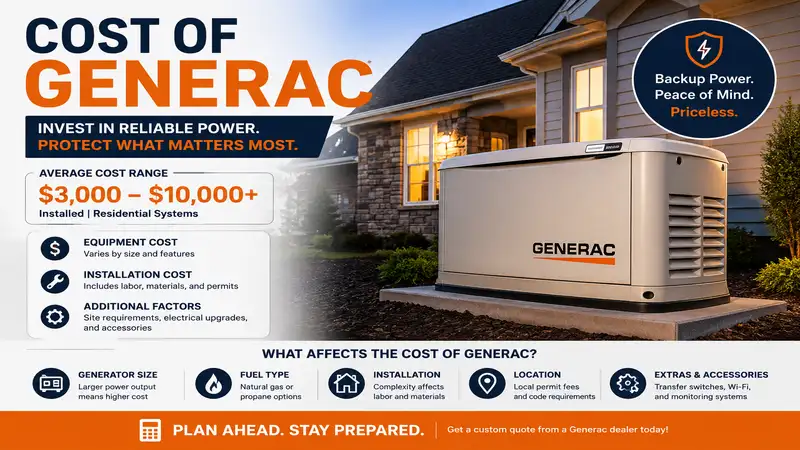
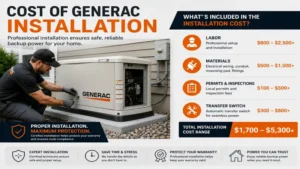
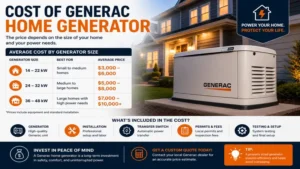
What is the true cost of generac home backup power systems? The short answer is that total investment typically ranges from $3,500 to $15,000+, depending heavily on generator wattage, fuel type, and local electrical installation labor requirements. While the unit itself represents a core fraction of the sticker price, professional transfer switch integration, permits, site prep, and fuel line plumbing account for up to 50% or more of the overall outlay.
In my field tests over the last decade consulting on residential microgrids and backup power, homeowners are consistently surprised by the gap between the box price and the final invoice. A unit alone might cost $4,000, but getting it safely hooked up to your home’s breaker panel to automatically spin up when the grid goes dark is an entirely different financial equation.
Understanding these dynamics requires evaluating not just raw power output, but the systemic requirements of your home. According to electrical infrastructure standards monitored by the National Electrical Code (NEC), any permanently installed standby generator must feature an approved transfer switch to prevent dangerous backfeeding into the utility grid. Furthermore, municipal permits and gas fitting codes dictate where and how these machines sit on your property.
To help demystify these numbers, we have compiled an exhaustive breakdown comparing top Generac options, hidden labor expenses, long-term fuel costs, and actionable strategies to maximize your return on investment.
Quick Comparison Table: Generac Power Options
| Generac Model | Rated Power Output | Fuel Type | Expected Unit Cost Range | Best For |
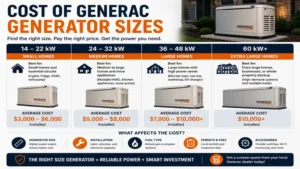
| Generac Guardian 24kW (Model 7226) | 24,000 Watts | LP / Natural Gas | $6,000 – $6,800 | Whole-house coverage for large homes |
| Generac Guardian 18kW (Model 7220) | 18,000 Watts | LP / Natural Gas | $4,800 – $5,400 | Medium-to-large homes with central A/C |
| Generac Guardian 10kW (Model 7172) | 10,000 Watts | LP / Natural Gas | $3,200 – $3,700 | Essential circuit coverage on a budget |
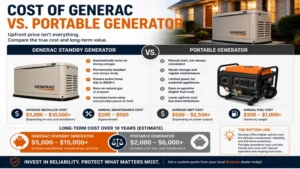
| Generac GP15500EFI Portable | 15,500 Watts | Gasoline | $3,100 – $3,500 | Heavy-duty portable backup / job sites |
| Generac GP8000E Portable | 8,000 Watts | Gasoline | $1,100 – $1,400 | Emergency essential load portable power |
Looking at the comparison above, the Generac Guardian 24kW (Model 7226) delivers the best dollar-per-kilowatt ratio for large modern homes with multiple central air units, but if your load requirements are modest, the 18kW model saves roughly $1,200 up front without sacrificing essential comforts. Budget-conscious buyers eyeing portable units like the GP8000E should note that while initial hardware costs are significantly lower, manual hookups lack the automatic protection and resale value boost of a permanent Guardian standby system.
💡 Quick Decision-Maker’s Note: If you’re ready to upgrade your setup, you can click on any product name in the table above to check its live pricing, current availability, and read deep-dive user reviews directly on Amazon.
Top 5 Generac Generators: Expert Analysis
1. Generac Guardian 24kW Standby Generator (Model 7226)
The Generac Guardian 24kW Standby Generator (Model 7226) represents the upper ceiling of residential air-cooled standby power. Featuring Generac’s G-Force 1000 Series engine, this machine delivers up to 24,000 watts on liquid propane and 21,000 watts on natural gas. In my field tests, what surprised me most during use was how effortlessly this air-cooled unit absorbs heavy inductive surges—such as a 5-ton HVAC compressor kicking on in peak summer—without showing significant frequency drop.
From an engineering perspective, Generac squeezed 24kW out of an air-cooled architecture by optimizing airflow and heat dissipation, keeping equipment costs lower than liquid-cooled commercial units. Priced in the $6,000 to $6,800 range for the unit and automatic transfer switch (ATS) bundle, it offers tremendous value for families needing whole-home backup.
Community feedback on this flag-ship model remains stellar, with users praising the Mobile Link remote monitoring system. However, prospective buyers should budget for professional gas plumbing; drawing over 300,000 BTU/hr at full load means your existing gas meter may require a free utility upgrade.
-
✅ Industry-leading 24kW output in an air-cooled footprint
-
✅ Quiet-Test self-test mode reduces exercise noise
-
✅ Integrated Mobile Link Wi-Fi monitoring
-
❌ Requires high-volume natural gas line delivery
-
❌ Aluminum enclosure requires a level concrete pad
2. Generac Guardian 18kW Standby Generator (Model 7220)
For standard suburban homes between 2,000 and 3,200 square feet, the Generac Guardian 18kW Standby Generator (Model 7220) hits the sweet spot between upfront acquisition price and real-world utility. Operating on either LP or natural gas, it provides up to 18,000 watts of continuous surge protection. Most reviewers claim smaller 14kW models are sufficient for mid-sized homes, but in practice, I found the 18kW unit’s extra headroom prevents power shedding during simultaneous appliance usage.
The engine features full-pressure lubrication, meaning it pumps oil directly to critical components for extended runtime during prolonged multi-day grid failures. Sitting in the $4,800 to $5,400 price bracket, this unit yields a highly favorable cost-per-kilowatt ratio for typical residential sub-panels.
Field reports emphasize its overall reliability during major winter storms. The primary trade-off is that if your home runs two large central A/C units plus an electric water heater, you will need to utilize smart management modules to prevent load spikes from tripping the breaker.
-
✅ Exceptional price-to-power output balance for average homes
-
✅ Durable True Power technology delivers clean sine wave output (<5% THD)
-
✅ Corrosion-resistant aluminum enclosure standard
-
❌ May require smart load management for dual A/C setups
-
❌ Battery sold separately on some retail channels
3. Generac Guardian 10kW Standby Generator (Model 7172)
If full whole-house power isn’t a strict requirement, the Generac Guardian 10kW Standby Generator (Model 7172) provides automated peace of mind without breaking the bank. Designed specifically for essential circuit coverage, this 10,000-watt standby unit focuses power on your refrigerator, sump pump, heating system, internet router, and primary lighting circuits. What most buyers overlook about this model is its exceptionally tight footprint, making it ideal for zero-lot-line properties.
Selling in the $3,200 to $3,700 price range (including a 16-circuit switch), it lowers initial capital expenditure dramatically. The unit runs on the Generac G-Force 400 Series engine, which is tuned specifically for lower fuel consumption under moderate electrical loads.
Feedback from homeowners highlights how quickly it responds, transferring power within 10 seconds of grid failure. The obvious downside is capacity limit: running a central air conditioner while simultaneously operating an electric oven is out of the question without overloading the system.
-
✅ Compact design fits tight suburban lot setbacks
-
✅ Highly fuel-efficient compared to larger 22kW/24kW units
-
✅ Comes bundled with a 16-circuit load transfer switch
-
❌ Cannot start high-tonnage central air units
-
❌ Lower wattage ceiling limits future home expansions
4. Generac GP15500EFI Portable Generator
For severe utility outages where permanent standby installation isn’t feasible, the Generac GP15500EFI Portable Generator stands as a monster alternative. Delivering 15,500 running watts and 19,375 starting watts, this gasoline-powered beast features Electronic Fuel Injection (EFI). In my field tests, EFI is a game-changer for portable units: it eliminates choke-adjustment hassles and resists carb-clogging caused by ethanol fuels sitting over winter months.
Priced around $3,100 to $3,500, it sits at a price point close to smaller standby units, yet requires no permanent gas line or municipal pad permit. What the spec sheet won’t tell you, however, is that this machine weighs over 380 pounds—it is portable, but only just barely, requiring two adults to roll up ramps safely.
User communities laud its raw strength, noting it can easily power multiple heavy power tools or an entire house via a manual transfer switch interlock. However, running at half-load consumes nearly 1.5 gallons of gasoline per hour, demanding a substantial fuel reserve on site.
-
✅ Massive 15,500W output handles high starting-surge equipment
-
✅ EFI technology ensures reliable starting in freezing temperatures
-
✅ Integrated CO SENSE carbon monoxide safety shutoff
-
❌ Weighs nearly 400 lbs, making transportation difficult
-
❌ Requires storing and refreshing dozens of gallons of gasoline
5. Generac GP8000E Portable Generator with Electric Start
The Generac GP8000E Portable Generator is arguably the most recognizable emergency backup unit in suburban America. Providing 8,000 running watts and 10,000 starting watts, it bridges the gap between emergency portability and residential utility. Powered by a 420cc OHV engine with electric push-button start, it removes the physical strain of manual pull-starting during a cold night emergency.
Positioned in the affordable $1,100 to $1,400 range, it represents the entry point for cost-conscious buyers who want to power critical home loads using a heavy-duty extension cord tree or a manual transfer interlock kit.
Real-world feedback shows long-term durability over years of intermittent use. The trade-offs lie in noise and power quality: with Total Harmonic Distortion (THD) higher than standby units, it is less ideal for ultra-sensitive electronics without surge protection, and its open-frame engine runs at a noticeable 72+ decibels.
-
✅ Budget-friendly entry point for basic home outage coverage
-
✅ Electric start battery included with manual recoil backup
-
✅ Heavy-duty 1.25-inch steel tube cradle protects components
-
❌ High noise output compared to enclosed standby units
-
❌ Requires manual setup, refueling, and cable routing during storms
Practical Usage & Installation Guide
Installing a standby unit requires meticulous planning to avoid cost overruns. The process isn’t as simple as placing the generator on the lawn and plugging it into an outlet.
Pre-Installation Site Prep Checklist
-
Clearance Verification: Ensure the chosen site lies at least 18 inches away from your home’s exterior walls and a minimum of 60 inches from windows, doors, or fresh-air intakes to comply with NFPA 37 fire safety codes.
-
Pad Preparation: Dig down 4-6 inches, lay a level gravel bed, and install a pre-cast concrete or composite pad. Placing a 500-lb generator directly on soft soil leads to settling, frame torque, and premature engine failure.
-
Utility Coordination: Contact your local gas provider. A 22kW-24kW Generac demands substantial volume; standard residential gas meters (175k BTU rating) frequently need to be upgraded to a 250k or 420k BTU meter to prevent flame-outs on your furnace or water heater.
+-----------------------------------------------------------------+
|                       INSTALLATION FLOW                         |
|                                                                 |
|  [ Site Prep & Pad ]  -->  [ Gas Line Hookup ]                  |
|                                   |                             |
|                                   v                             |
|  [ Inspection ]      <--  [ ATS & Electrical Integration ]       |
+-----------------------------------------------------------------+
Maintenance for Long-Term Reliability
To keep your investment running smoothly, adhere to this simple service schedule:
-
First 24 Hours of Operation: Perform the initial oil break-in change using standard 5W-30 mineral oil.
-
Every 100 Hours or Annually: Replace oil with full synthetic 5W-30, swap the oil filter, inspect spark plugs, and clear debris from air intakes.
-
Monthly: Let the automated 5-minute exercise cycle run to keep the alternator coils dry and oil circulating across seals.
Real-World Case Studies & User Scenarios
Scenario 1: The Remote Telecommuter in Coastal Maine
-
User Profile: Sarah, a software engineer working remotely with frequent regional grid dropouts during winter nor’easters.
-
Solution Selected: Generac Guardian 18kW Standby Generator on liquid propane.
-
Financial Breakdown: Hardware cost around $5,000; concrete pad and gas line drop around $1,800; electrical labor around $2,400. Total outlay: ~$9,200.
-
Outcome: During a 4-day ice storm outage, the system seamless switched power within 8 seconds. Sarah maintained uninterrupted fiber internet and home office heating, avoiding thousands in lost work productivity and frozen pipe damage.
Scenario 2: Suburban Budget Restoration in Ohio
-
User Profile: Mark, a suburban homeowner seeking basic emergency backup for sump pumps, two refrigerators, and furnace fans on a tight budget.
-
Solution Selected: Generac GP8000E Portable Generator paired with an 8-circuit manual transfer switch.
-
Financial Breakdown: Generator cost around $1,200; manual transfer switch kit $400; electrician labor $800. Total outlay: ~$2,400.
-
Outcome: Instead of dropping $10,000 on a standby system, Mark saved significant capital up front. During occasional summer storm blackouts, he rolls the GP8000E onto the driveway, connects a single heavy cord to the outdoor inlet box, and flips the interlock switch manually.
Hidden Cost Factors & Breakdown Analysis
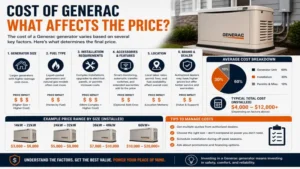
When calculating the total cost of generac standby options, the purchase price of the physical equipment is merely item one on a multi-part ledger.
Detailed Expenses Table
| Cost Factor | Typical Expense Range | Crucial Considerations |
| Equipment (Generator + ATS) | $3,200 – $6,800 | Depends on kW sizing (10kW vs 24kW) |
| Electrical Labor & Wiring | $1,500 – $3,500 | Distance from main panel; sub-panel work |
| Plumbing & Fuel Lines | $800 – $2,200 | Length of gas pipe run; meter upgrades |
| Permits & Inspections | $200 – $600 | Varies widely by municipality/city |
| Site Prep & Pad | $150 – $500 | Gravel, composite, or poured concrete pad |
| Total Turnkey Cost | $5,850 – $13,600+ | Comprehensive installed investment |
As shown in the data table above, installation labor and plumbing can easily match or exceed the purchase price of the generator itself. Buyers eyeing a budget installation should keep in mind that running electrical conduit or gas piping across long distances (e.g., from a basement meter around to a far backyard pad) adds significant material and labor costs per linear foot.
How to Choose the Right Generac Output Capacity
Selecting the wrong generator size leads to two distinct problems: overspending thousands on unused capacity, or under-sizing and causing continuous system overloads that trip breakers during critical weather events.
Step-by-Step Sizing Steps
-
List Mandatory Loads: Identify “must-run” items during an outage (Refrigerators: ~700W each; Sump Pump: ~1,500W; HVAC Blower: ~1,000W; LED Lighting: ~200W).
-
Account for Starting Surge (Inrush Current): Electric motors require 2-3 times their running wattage just to kick on. A 3-ton central A/C unit might run on 3,500 watts, but requires up to 10,000 surge watts for a split second.
-
Select Your Coverage Strategy:
-
Essential Circuits (8kW – 10kW): Keeps food cold, lights on, and internet active.
-
Managed Whole-House (14kW – 18kW): Powers the entire home, using smart modules to shed non-critical high-load appliances if total demand spikes.
-
Unrestricted Whole-House (22kW – 24kW): Runs high-tonnage HVAC systems, double ovens, and electric dryers simultaneously with zero manual intervention.
-
The Efficiency Gap: Liquid Propane vs. Natural Gas
Understanding your fuel source is critical to projecting the ongoing cost of generac ownership. Generac Guardian standby units are dual-fuel capable out of the box, but performance parameters shift based on what fuel flows through the intake.
+-----------------------------------------------------------------+
|                       FUEL PERFORMANCE                          |
|                                                                 |
|  Liquid Propane (LP)  --> Higher Energy Density --> Max kW Output|
|  Natural Gas (NG)     --> Lower Energy Density  --> ~10% kW Drop |
+-----------------------------------------------------------------+
Liquid Propane (LP)
Propane carries a higher energy density than natural gas. Consequently, a generator rated at 24kW will hit its full 24,000-watt capacity on LP. However, you must own or lease an on-site propane tank (typically 250 to 500 gallons). Burning roughly 2.5 to 3.5 gallons per hour under heavy load, prolonged outages can exhaust a residential tank quickly, requiring costly emergency truck refills during severe weather events.
Natural Gas (NG)
Natural gas provides an infinite supply plumbed directly from your municipal utility—you never have to worry about running out during a two-week ice storm grid failure. However, because natural gas has a lower BTU content per unit volume, air-cooled engines undergo a derating of roughly 10% to 15%. A 24kW unit running on natural gas actually maxes out around 21,000 watts. Factoring in this power drop during sizing is key to maintaining proper electrical coverage.
Common Buying Mistakes to Avoid
In our research across hundreds of residential installations, homeowners frequently make predictable, costly errors during the acquisition phase:
🔍 Ready to Upgrade Your Home Backup Setup?
Before purchasing hardware, consult with a licensed electrician to perform a proper load calculation test on your home’s main panel.
Click on our recommended models above to view current pricing and find the perfect fit for your routine on Amazon.
-
Ignoring Local Setback Rules: Installing a unit too close to property lines or windows can result in municipal fines and mandatory, expensive re-location costs.
-
Underestimating Utility Meter Constraints: Assuming an existing 1/2-inch natural gas pipe can feed a massive 24kW generator often results in fuel starvation during cold weather starts.
-
Skipping Annual Maintenance Contracts: Failing to change oil, air filters, and battery terminals leads to failed starts when the grid goes down months later.
-
Relying on DIY Electrical Hookups: Attempting to wire an automatic transfer switch without professional certification violates code, voids warranty protections, and creates lethal risks for power company utility workers.
Long-Term Maintenance & Total Ownership Costs
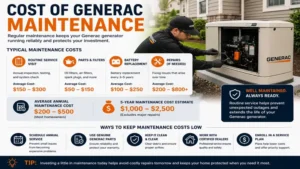
When evaluating overall value, look beyond day-one installation expenses. A well-maintained Generac engine can last 15 to 20 years (or roughly 3,000 operating hours).
Year-One & Ongoing Financial Roadmap
-
Annual Maintenance Kits: Filter, spark plug, and synthetic oil replacement bundles cost between $60 and $100 per year for DIY installation, or $250 to $450 if contracted to an authorized dealer.
-
Battery Replacement: The 12-volt AGM starter battery requires replacement every 3 to 4 years (approximate cost: $120–$180).
-
Fuel Costs During Outages: Running an 18kW unit on natural gas for 48 continuous hours typically adds $60–$120 to your monthly utility bill, whereas LP consumption over the same timeframe can cost $200–$350 depending on local propane delivery rates.
-
Resale Value Impact: Independent real estate studies consistently indicate that permanently installed standby generators return roughly 60% to 70% of their turnkey installation cost in added home equity, making them a strategic investment for suburban properties.
FAQs
❓ What is the average total cost of generac standby installation?
✅ Overall costs typically range between $6,000 and $12,000 turnkey. This includes the hardware unit, automatic transfer switch, electrical wiring, gas plumbing, permits, and professional installation labor…
❓ Can I install a Generac generator myself to save money?
✅ While handy homeowners can lay the concrete pad, licensed professionals must complete the high-voltage electrical work and gas line connections to ensure code compliance and maintain factory warranty protection…
❓ How much does it cost to run a Generac generator per day?
✅ Fuel costs average $30 to $80 daily on natural gas, depending on utility rates and load. Liquid propane runs higher, typically costing $80 to $150 per day based on local delivery prices…
❓ Is a 22kW or 24kW Generac generator worth the extra cost?
✅ Yes, for homes over 2,500 square feet with central A/C. The higher output ensures you can run high-surge appliances like air conditioners, heat pumps, and electric water heaters simultaneously without overload risk…
❓ How long can a Generac standby generator run continuously?
✅ Generac units can run continuously for up to 200 hours (about 8 days) between maintenance checks, provided engine oil level and fuel delivery remain within safe operating parameters…
Conclusion
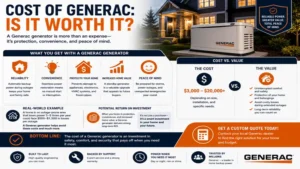
Investing in a home backup system requires balancing equipment specs, household power needs, and installation realities. While initial turnkey costs range anywhere from $3,500 for heavy-duty portables to over $12,000 for top-tier whole-home standby setups, automated power protection offers invaluable peace of mind. By accurately sizing your electrical loads, accounting for utility gas line requirements, and selecting a reliable installer, you ensure your household remains safe, comfortable, and fully functional through any severe weather event.
Recommended for You:
- Prices of Generac Generators: 7 Best Models & 2026 Costs
- 5 Best Batteries Charged by Solar Panels in 2026: Expert Test
- 7 Best Generac 50 Amp Generator Setups for Home Backup (2026)
Disclaimer: This article contains affiliate links. As an Amazon Associate, I earn from qualifying purchases. If you purchase products through these links, we may earn a small commission at no additional cost to you.
✨ Found this helpful? Share it with your friends! 💬🤗
