
In This Article
Finding the Best Battery for Solar Panels in 2026 ☀️🔋
Solar panels are generous all afternoon and completely useless at 9 p.m. That mismatch is the whole reason this guide exists. Choosing the best battery for solar panels decides whether your rooftop, RV, or cabin array actually keeps the lights on after sunset — or just hands its surplus back to the grid for pennies.
The U.S. Department of Energy puts it plainly in its overview of solar energy and storage basics: storage lets solar keep contributing when the sun isn’t shining, and it adds resilience during outages. The hard part is that “solar battery” now covers everything from a 60-pound lead-acid brick to a 4kWh wheeled power station with its own inverter.
So this guide does three things. First, it compares seven real batteries you can order on amazon.com, spanning budget AGM, mainstream 12V lithium, 48V server-rack storage, and all-in-one power stations. Second, it translates spec sheets into what you’ll actually notice: how many nights of fridge power, how many pounds to haul, and how many years before replacement. Third, it walks you through setup, sizing, safety standards, and the true cost per kilowatt-hour.
One honesty note before we dive in: nothing here comes from staged “hands-on testing.” Every recommendation is built from manufacturer spec sheets, published independent reviews, and the recurring themes in owner feedback — and where data is thin, we say so.
Whether you’re powering a weekend camper or building a home backup bank, the best battery for solar panels is the one that matches your voltage, your loads, your climate, and your budget. Let’s find yours.
What Is the Best Battery for Solar Panels?
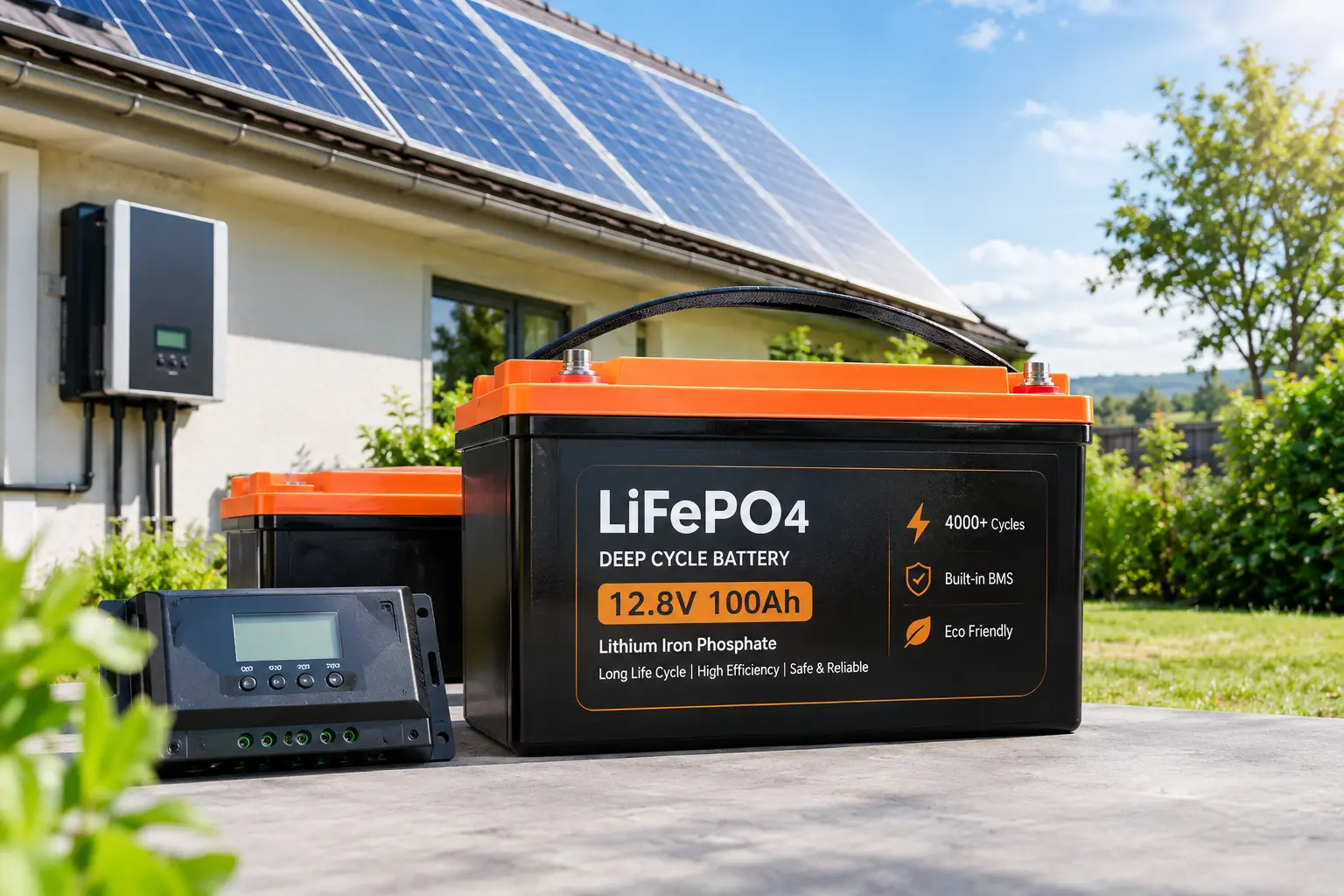
Short answer: For most people in 2026, the best battery for solar panels is a lithium iron phosphate (LiFePO4) battery with a built-in battery management system (BMS). It delivers 80–100% usable capacity, thousands of cycles, and better thermal stability than other lithium chemistries — making it the default for RVs, cabins, and home backup.
Here’s the slightly longer version. Lithium iron phosphate chemistry trades a bit of energy density for a big gain in safety and lifespan, which is exactly the trade you want in a battery that sits in your garage or under an RV bed for a decade. Lead-acid batteries, including AGM, still exist because they’re cheap upfront and tolerate charging in the cold, but they only like being drained to about 50%, so you need roughly twice as many of them for the same usable energy.
The “best” choice then narrows by system type:
- 🚐 Small mobile and cabin systems (12V): a 100Ah or 200Ah 12V LiFePO4 drop-in battery.
- 🏠 Home backup and larger off-grid builds (48V): a server-rack LiFePO4 battery that talks to your inverter.
- 🔌 No-wiring, plug-and-play backup: a large LFP power station with built-in solar charging.
- 💵 Tight budget or occasional use: a sealed AGM deep-cycle battery, accepting its weight and shorter life.
Quick Comparison: 7 Best Batteries for Solar Panels at a Glance
| Battery | Chemistry & Voltage | Usable Energy (approx.) | Price Range | Best for |
|---|---|---|---|---|
| LiTime 12V 100Ah LiFePO4 | LiFePO4, 12V | ~1.28kWh | $200–$300 | LiTime 12V 100Ah LiFePO4: first solar builds |
| Renogy 12V 100Ah Core Series | LiFePO4, 12V | ~1.0–1.28kWh | $250–$350 | Renogy 12V 100Ah Core Series: Renogy-based systems |
| Power Queen 12V 200Ah Plus | LiFePO4, 12V | ~2.56kWh | $400–$500 | Power Queen 12V 200Ah Plus: big inverters on 12V |
| Battle Born BB10012 | LiFePO4, 12V | ~1.28kWh | $500–$900 | Battle Born BB10012: long warranty, US support |
| ECO-WORTHY 48V 100Ah Server Rack | LiFePO4, 48V | ~4.1–5.12kWh | $900–$1,300 | ECO-WORTHY 48V 100Ah Server Rack: DIY home backup |
| EcoFlow DELTA Pro 3 | LFP power station | ~4.1kWh | $2,000–$3,500 | EcoFlow DELTA Pro 3: plug-and-play home backup |
| WEIZE 12V 100Ah AGM | AGM lead-acid, 12V | ~0.6kWh | $170–$250 | WEIZE 12V 100Ah AGM: lowest upfront cost |
Price ranges are approximate at the time of writing; prices may vary, so check the current price.
Looking at the table, the jump in usable energy matters more than the headline amp-hours: the WEIZE 12V 100Ah AGM and the LiTime 12V 100Ah LiFePO4 share the same “100Ah” label, yet the lithium unit delivers roughly twice the usable energy. Meanwhile, the ECO-WORTHY 48V 100Ah Server Rack stores about four times the energy of a 12V 100Ah battery, which is why 48V wins once you’re powering a house rather than a van.
💬 One click helps other shoppers make an informed choice too! 😊
Top 7 Best Battery for Solar Panels Picks: Expert Analysis
1. LiTime 12V 100Ah LiFePO4 — best overall value for first builds
The LiTime 12V 100Ah LiFePO4 (formerly sold as Ampere Time) is the battery most first-time solar builders end up with, and the reasons are refreshingly practical.
It stores 1,280Wh with a 100A BMS and a short 280A surge allowance, which comfortably runs a 1,000W inverter for a fridge, lights, and laptop charging. LiTime rates the cells at about 4,000 cycles at 100% depth of discharge, 6,000 at 80%, and up to 15,000 at 60% — so cycling it daily at 80% points to well over a decade of service on paper. Low-temperature protection stops charging at 32°F, which protects the cells, but it also means a cold-garage install needs a heated variant or some insulation.
Based on comparing the specs, this is the right pick for weekend campers, van builders, and anyone adding storage to a 200–600W array. It’s less ideal if you plan to run a 2,000W+ inverter from a single battery, because that 100A BMS caps continuous output near 1,280W.
Independent reviewers and DIY solar communities consistently treat it as the budget benchmark; the most common caveat in owner feedback is that Bluetooth monitoring only comes on certain variants, not the base model.
Pros:
- ✅ Excellent price per stored kilowatt-hour
- ✅ Light enough to carry, at roughly 24 pounds
- ✅ Huge user community for wiring help
Cons:
- ❌ 100A BMS limits single-battery inverter size
- ❌ Base model lacks built-in Bluetooth monitoring
At roughly $200–$300, it’s hard to beat on value for money.
2. Renogy 12V 100Ah Core Series — best for Renogy ecosystem builds
The Renogy 12V 100Ah Core Series makes the most sense when the rest of your system already wears the Renogy logo.
Renogy rates it for 5,000 cycles at 80% depth of discharge with a true 100A BMS, low-temperature charge cutoff, and IP65 protection, and it supports up to four in series and eight in parallel. In practice, that series support means you can build a 48V bank from four units later, and IP65 makes it reasonable for damp RV bays. Note that Renogy’s cycle rating assumes 80% DoD, so plan on about 1,000Wh of daily-usable energy if you want the rated lifespan.
What most buyers overlook is integration: pairing it with a Renogy charge controller, DC-DC charger, and monitoring app gives you one coherent dashboard instead of three mismatched ones. If you’re mixing brands anyway, the LiTime 12V 100Ah LiFePO4 usually costs less for the same capacity. The Pro version adds Bluetooth, self-heating, and a 7-year warranty if you camp in freezing weather.
Independent reviews praise the ecosystem fit, while a recurring criticism is that the 5-year warranty trails premium brands like Battle Born BB10012.
Pros:
- ✅ Seamless pairing with Renogy controllers and inverters
- ✅ IP65 housing handles damp, dusty spaces
- ✅ Flexible series and parallel expansion
Cons:
- ❌ Core model can’t charge below freezing
- ❌ Warranty shorter than premium competitors
At roughly $250–$350, it’s fair value if you’re already in Renogy’s world.
3. Power Queen 12V 200Ah Plus — most capacity per dollar on 12V
The Power Queen 12V 200Ah Plus doubles the energy of a 100Ah unit and, crucially, doubles the BMS too.
It holds 2,560Wh behind a 200A BMS, which supports roughly 2,560W of continuous load — enough for a 2,000W inverter running a microwave or a coffee maker without paralleling batteries. Power Queen rates the cells at 4,000 cycles at 100% DoD and backs it with a 5-year warranty. The catch is weight: at about 49.6 pounds it’s manageable for one adult, but not something you’ll casually swap between vehicles.
Here’s what to weigh: the standard 200Ah model has the same capacity but only a 100A BMS, so the “Plus” is the one to buy if you run high-wattage appliances. For RVers with a residential fridge or anyone who wants one-battery simplicity, it’s the sweet spot.
Several independent 2026 buyer’s guides name it a top budget 200Ah option, and owner feedback tends to highlight capacity for the money while flagging its heft and bulk.
Pros:
- ✅ 200A BMS supports bigger inverters
- ✅ One battery replaces two 100Ah units
- ✅ Low cost per kilowatt-hour
Cons:
- ❌ Heavy for single-person installs
- ❌ Takes up a larger footprint
At roughly $400–$500, it’s among the strongest values in 12V storage.
4. Battle Born BB10012 — longest warranty with U.S. support
The Battle Born BB10012 costs more than its rivals, and what you’re buying is mostly peace of mind.
It’s a 100Ah 12V LiFePO4 battery assembled in Reno, Nevada, with UL-listed cylindrical cells, 100A continuous output, a 200A surge for 30 seconds, and a rated 3,000–5,000 cycles. Battle Born’s spec notes that roughly 75–80% of capacity should remain after 3,000 cycles when charged at 0.5C or lower. Its BMS includes low-temperature charge protection and automatic cell balancing, and a heated variant (BB10012H) exists for cold climates.
On paper, the cycle rating is actually lower than budget brands claim — so why pay more? Because the 10-year warranty and U.S.-based technical support are the strongest in this list, and for a battery buried inside a boat or RV wall, easy warranty service matters. It’s the right pick for full-timers and marine owners who value support over savings.
Independent reviewers consistently describe it as the reliability benchmark for RVs and vans; the main complaint you’ll see is simply the price.
Pros:
- ✅ Industry-leading 10-year warranty
- ✅ U.S. assembly and responsive tech support
- ✅ Mount in any orientation
Cons:
- ❌ Costs far more per kilowatt-hour
- ❌ Rated cycle count trails budget rivals
At roughly $500–$900 depending on the seller, it’s a premium buy that pays off mainly in support.
5. ECO-WORTHY 48V 100Ah Server Rack — best for DIY whole-home backup
The ECO-WORTHY 48V 100Ah Server Rack (sold as the Cubix100) is where solar storage stops being a camping accessory and becomes home infrastructure.
Each unit stores 5.12kWh at 51.2V, delivers 100A continuous charge and discharge, and is rated for 6,000 cycles at 80% DoD with a 10-year warranty. It carries UL 1973 certification and UL 9540A test results, and ECO-WORTHY reports system-level UL 9540 testing — certifications that matter when an inspector looks at your garage install. RS485, RS232, and CAN ports let compatible hybrid inverters read the battery’s state of charge directly, which makes charging far more accurate than voltage guessing.
Who’s it for? Homeowners pairing a 48V hybrid inverter with a few kilowatts of panels, where one rack unit covers essentials overnight and two cover a fridge, furnace blower, and internet for a long evening. At around 103 pounds, plan on two people and a proper rack.
We couldn’t verify a large body of independent long-term reviews for this specific model, so lean on its certifications and warranty rather than crowd sentiment.
Pros:
- ✅ UL 1973 certified with UL 9540A testing
- ✅ Closed-loop communication with compatible inverters
- ✅ Scales by stacking parallel units
Cons:
- ❌ Heavy, two-person installation required
- ❌ Requires a 48V inverter system
At roughly $900–$1,300, it delivers excellent value per kilowatt-hour for home backup.
6. EcoFlow DELTA Pro 3 — best plug-and-play home backup
The EcoFlow DELTA Pro 3 is the answer for people who want solar backup without learning to crimp 2/0 cable.
It packs 4,096Wh of LFP storage, a 4,000W inverter with 120V and 240V output, and up to 2,600W of solar input across two PV ports, all on wheels. EcoFlow rates the battery for 4,000 cycles to 80% capacity with a 5-year warranty, and capacity expands with add-on batteries and linked units. In practice, the 240V output means it can run a well pump or a 240V appliance through a compatible transfer setup, which most portable units simply can’t.
Based on comparing the specs, it costs more per kilowatt-hour than a DIY rack battery, but that price includes the inverter, MPPT charge controllers, and AC charger you’d otherwise buy separately. It’s best for suburban homeowners and renters who want serious backup they can roll into a closet.
Independent reviews generally rate it among the most capable single-unit power stations; the recurring concerns are its price and its weight of roughly 115 pounds.
Pros:
- ✅ Inverter, charger, and MPPT built in
- ✅ 120V and 240V output from one unit
- ✅ Fast dual-port solar charging
Cons:
- ❌ Highest upfront cost in this lineup
- ❌ Heavy despite its wheels
At roughly $2,000–$3,500 depending on the bundle, it’s good value only if you need the all-in-one convenience.
7. WEIZE 12V 100Ah AGM — lowest upfront cost for occasional use
The WEIZE 12V 100Ah AGM is the budget fallback — a sealed, maintenance-free lead-acid battery for systems that only cycle occasionally.
It’s a Group 31 battery with a roughly 3% monthly self-discharge rate, a 30A maximum continuous charge current, and a weight of around 57–63 pounds depending on the listing. AGM charges more tolerantly in cold weather than lithium, and it works with older lead-acid charge controllers without any settings changes. However, you should only use about 50% of its capacity, so the usable energy is closer to 600Wh, and one third-party review cites about 800 cycles at 50% DoD.
It’s the right choice for a backup sump pump, a hunting cabin visited a few weekends a year, or anyone whose budget truly ends at $250. For daily cycling, the LiTime 12V 100Ah LiFePO4 usually costs only slightly more and lasts several times longer.
Owner feedback commonly praises the low price and spill-proof design while pointing to weight and modest lifespan as trade-offs.
Pros:
- ✅ Lowest purchase price in the lineup
- ✅ Works with legacy lead-acid chargers
- ✅ Tolerates cold-weather charging better
Cons:
- ❌ Only about half the capacity is usable
- ❌ Heavy and shorter-lived than lithium
At roughly $170–$250, it’s cheap upfront but expensive per kilowatt-hour over time.
Top 7 Side-by-Side: The Specs That Decide It
| Battery | Continuous Output | Rated Cycle Life | Weight (approx.) | Warranty | Best for |
|---|---|---|---|---|---|
| LiTime 12V 100Ah LiFePO4 | 100A (~1,280W) | 4,000 @ 100% DoD | 24 lbs | 5 years | LiTime 12V 100Ah LiFePO4: value builds |
| Renogy 12V 100Ah Core Series | 100A (~1,280W) | 5,000 @ 80% DoD | 23 lbs | 5 years | Renogy 12V 100Ah Core Series: ecosystem fit |
| Power Queen 12V 200Ah Plus | 200A (~2,560W) | 4,000 @ 100% DoD | 50 lbs | 5 years | Power Queen 12V 200Ah Plus: big 12V loads |
| Battle Born BB10012 | 100A (200A/30s) | 3,000–5,000 | 31 lbs | 10 years | Battle Born BB10012: full-time RV, marine |
| ECO-WORTHY 48V 100Ah Server Rack | 100A (~5,120W) | 6,000 @ 80% DoD | 103 lbs | 10 years | ECO-WORTHY 48V 100Ah Server Rack: home storage |
| EcoFlow DELTA Pro 3 | 4,000W AC | 4,000 to 80% | 115 lbs | 5 years | EcoFlow DELTA Pro 3: no-wiring backup |
| WEIZE 12V 100Ah AGM | High surge, low usable | ~800 @ 50% DoD | 57–63 lbs | 1–2 years | WEIZE 12V 100Ah AGM: occasional use |
Cycle ratings are manufacturer claims (or a third-party figure for the AGM) measured under different test conditions, so treat them as approximate rather than directly comparable.
The output column is the one most buyers skip, and it’s the one that causes the most frustration: a 2,000W inverter on the LiTime 12V 100Ah LiFePO4 will trip its BMS, while the Power Queen 12V 200Ah Plus handles it alone. Warranty length also tells a story — only the Battle Born BB10012 and the ECO-WORTHY 48V 100Ah Server Rack commit to a decade, which is a useful signal of how long the maker expects the cells to last.
✨ Don’t miss the right fit for your system!
🔍 Take your solar setup to the next level with this carefully curated lineup. Click a highlighted battery to check current pricing and availability. The right pick will keep your lights, fridge, and Wi-Fi running long after sunset! 🌙
How to Set Up and Maintain Your Solar Battery: The First 30 Days
A great battery installed badly becomes a mediocre battery fast. These steps cover the first month, when most avoidable mistakes happen. 🛠️
Day 1: Match your charge settings
Before connecting anything, set your charge controller and inverter-charger to the battery’s actual profile. Most 12V LiFePO4 batteries want a bulk/absorption voltage around 14.2–14.6V and a low or disabled float; Battle Born, for example, specifies 14.2–14.6V charging and float at 13.6V or lower. AGM batteries need a higher absorption stage and a float around 13.5–13.8V. Leaving a controller on its “flooded lead-acid” default is the single most common setup error, and it can trigger equalization voltages that lithium BMSs will reject.
Days 1–3: Do a full top-balancing charge
Charge the battery to 100% and let it sit at absorption long enough for the BMS to balance cells. This gives your state-of-charge reading an accurate starting point.
Week 1: Use proper cables and fuses
Size cables for your inverter’s maximum current, add a Class T fuse or appropriately rated breaker close to the positive terminal, and torque terminal bolts to spec — Renogy lists 8–10 N·m depending on the model. Loose lugs cause heat, voltage drop, and confusing BMS shutdowns.
Weeks 2–4: Learn your real consumption
Watch your monitor or shunt for a few weeks. Real usage almost always differs from the estimate, and knowing your true overnight draw tells you whether to add panels, add storage, or simply move loads to daylight.
Ongoing maintenance
LiFePO4 needs no watering; check connections every few months and keep it between roughly 32°F and 113°F while charging. For long storage, leave lithium near 50–60% and disconnect loads. AGM batteries should be stored fully charged, because sitting partially discharged causes sulfation.
Real-World Scenarios: Matching Your Solar Battery to Your Life
Specs only make sense when attached to a real situation. Here are three common profiles and the reasoning behind each match. 🧭
The weekend van camper (budget around $300)
Picture a 200W panel on a camper van, a 12V compressor fridge, LED lights, and phone charging — roughly 600–800Wh per day. One LiTime 12V 100Ah LiFePO4 covers a full day plus a cloudy-morning buffer, and its weight keeps the van’s payload in check. If you already run a Renogy controller and DC-DC charger, the Renogy 12V 100Ah Core Series is the smoother fit for a slightly higher price.
The full-time RV couple (budget around $1,000–$1,800)
Now add a residential fridge, a coffee maker, a microwave, and two laptops for remote work: 2,500–3,500Wh per day with 1,500–2,000W surges. Two Power Queen 12V 200Ah Plus batteries in parallel give about 5kWh and 400A of combined BMS capacity, enough for a 3,000W inverter. Couples who’d rather pay more for warranty service on the road often choose four Battle Born BB10012 units instead.
The suburban homeowner preparing for outages (budget $1,000–$3,500)
Keeping a fridge, a gas furnace blower, internet, and lights alive during a summer storm outage needs roughly 5–8kWh per day. A DIYer with an existing or planned 48V hybrid inverter gets the best cost per kilowatt-hour from one or two ECO-WORTHY 48V 100Ah Server Rack units. Someone who wants zero wiring — or rents — will be happier with the EcoFlow DELTA Pro 3, recharged from rooftop panels or a few portable ones on the patio.
Across all three, the pattern holds: estimate daily watt-hours first, then choose voltage, then chemistry, and only then a brand.
Problem → Solution: Fixing Common Solar Battery Headaches
Even good systems hit snags. Here are the five problems solar battery owners report most often, and what usually fixes them. 🔧
1. The battery won’t charge on cold mornings. This is the BMS doing its job: LiFePO4 cells shouldn’t be charged below about 32°F. Solution: move the battery into a heated space, insulate the compartment, or choose a self-heating model such as the Renogy Pro or the Battle Born heated variant.
2. The inverter shuts off when the microwave starts. Your inverter’s surge exceeds the BMS limit. Solution: parallel a second battery, or step up to a higher-current unit like the Power Queen 12V 200Ah Plus.
3. The state-of-charge reading jumps around. LiFePO4 voltage stays nearly flat between 20% and 90%, so voltage-based meters guess badly. Solution: install a shunt-based monitor or use a battery with built-in Bluetooth or inverter communication, like the ECO-WORTHY 48V 100Ah Server Rack.
4. The AGM battery loses capacity after one season. Usually it’s chronic undercharging or regular discharges below 50%. Solution: add panel wattage, set the correct absorption voltage, and keep the WEIZE 12V 100Ah AGM above half charge.
5. Two parallel batteries drain unevenly. Mismatched cable lengths create uneven resistance. Solution: use equal-length cables and connect the main positive and negative leads at opposite ends of the bank (diagonal wiring), or use a busbar.
How to Choose the Best Battery for Solar Panels
Use these seven steps in order; each one narrows the field before you ever compare brands. ✅
- Calculate your daily energy use in watt-hours. Multiply each device’s watts by its hours of use and add them up. Everything else depends on this number.
- Decide how many days of autonomy you need. Weekend campers might want one day; off-grid cabins in cloudy climates often want two or three.
- Pick a system voltage. Use 12V for small mobile systems, 24V for mid-size cabins, and 48V once you exceed roughly 3,000W of inverter power, because higher voltage means lower current and thinner cables.
- Choose chemistry. LiFePO4 wins on lifespan, weight, and usable capacity; AGM wins only on upfront price and cold charging.
- Match the BMS to your inverter. Divide your inverter’s continuous watts by battery voltage — a 2,000W inverter on 12V draws about 167A, so a 100A BMS won’t cut it alone.
- Check your climate. If the battery will see freezing temperatures while charging, budget for self-heating or an insulated location.
- Compare warranty and certifications. A longer warranty and UL listings reduce long-term risk, especially for indoor home installs.
To understand why lithium behaves so differently from lead-acid at the cell level, the Department of Energy’s explainer on how lithium-ion batteries work is a clear, jargon-light primer.
Lithium Battery for Solar Panels vs AGM: Which Chemistry Wins?
The lithium-versus-lead debate is mostly settled for daily cycling, but the reasons are worth understanding, because AGM still wins in a few narrow situations. ⚖️
A lithium battery for solar panels — specifically LiFePO4 — lets you use 80–100% of its rated capacity, while AGM performs best when you stop at about 50%. That single difference means a 100Ah lithium battery replaces two 100Ah AGM batteries in usable energy, at well under half the weight. Lithium also accepts charge faster, so short winter days put more energy into the battery.
Where AGM still holds on: it can be charged in freezing temperatures (at reduced rates), costs less on day one, and works with older chargers that lack lithium profiles. For a standby battery that sits full 360 days a year, those advantages can matter more than cycle life.
| Factor | LiFePO4 (e.g., LiTime 12V 100Ah LiFePO4) | AGM (e.g., WEIZE 12V 100Ah AGM) |
|---|---|---|
| Usable capacity of a 100Ah battery | ~80–100Ah | ~50Ah |
| Typical rated cycles | 4,000–6,000 | ~500–800 at 50% DoD |
| Weight per 100Ah | ~23–31 lbs | ~57–63 lbs |
| Charging below freezing | Blocked unless self-heated | Allowed at reduced rate |
| Upfront cost | Higher | Lower |
| Best for | Daily cycling, mobile systems | Rare-use standby, tight budgets |
The table makes the lifespan gap obvious: even if lithium cost twice as much upfront, its five-to-eight-times longer cycle life would still make it cheaper per kilowatt-hour delivered. AGM only makes financial sense when the battery barely cycles — a sump-pump backup, for instance — where cycle life never becomes the limiting factor.
How Much Battery Do You Need? Sizing a Deep Cycle Battery for Solar
Every deep cycle battery for solar should be sized from consumption, not from what fits the budget. Here’s the math, step by step. 📐
Step 1: Daily usage. Say you use 1,500Wh per day: a fridge at 900Wh, lights at 150Wh, internet and laptops at 450Wh.
Step 2: Autonomy. For two days without sun, you need 3,000Wh of usable storage.
Step 3: Adjust for usable capacity. With LiFePO4 at about 90% practical depth of discharge, you need roughly 3,300Wh of nominal capacity — about three 12V 100Ah lithium batteries (3,840Wh), or one Power Queen 12V 200Ah Plus plus one LiTime 12V 100Ah LiFePO4. Mixing models in parallel isn’t ideal, though, so matched units are the cleaner choice.
Step 4: Compare with AGM. At 50% DoD, the same job needs 6,000Wh nominal — five 100Ah AGM batteries weighing around 300 pounds combined. That’s the moment most buyers switch to lithium.
Step 5: Check the panel side. Storage only helps if your panels can refill it. As a rough rule, aim for enough panel wattage to replace your daily usage in about four to five peak sun hours; 1,500Wh per day suggests 400–500W of panels in sunny regions, more in cloudy ones.
What the spec sheet doesn’t say is that oversizing storage without matching panels just gives you a large, permanently half-empty battery. Balance both sides, and leave about 20% headroom for future loads.
12V vs 48V: Choosing the Right Off-Grid Solar Battery Voltage
Choosing an off-grid solar battery starts with voltage, and the right answer depends on how much power you push. 🔌
At 12V, everything is simple and widely compatible: RV appliances, vehicle alternators, and cheap inverters all speak 12V. The problem is current. A 3,000W inverter on 12V pulls around 250A, which requires thick, expensive cable and big fuses, and it wastes more energy as heat.
At 48V, the same 3,000W load draws only about 62A. Cables get thinner, voltage drop shrinks, and modern hybrid inverters with built-in MPPT controllers are designed around 48V. That’s why server-rack batteries like the ECO-WORTHY 48V 100Ah Server Rack dominate home and cabin builds, while 12V drop-ins like the Battle Born BB10012 dominate vehicles.
24V sits in between and suits mid-size cabins or boats, often built from two 12V batteries in series. Just confirm your battery supports series wiring — Battle Born allows series up to 48V, and Renogy’s Core supports up to four in series.
A practical rule: under 2,000W of inverter, stay at 12V; 2,000–4,000W, consider 24V; above 4,000W or for whole-home circuits, go 48V. If you’re unsure, the all-in-one EcoFlow DELTA Pro 3 sidesteps the question entirely, because its voltage architecture is handled internally.
Long-Term Cost and Maintenance: The Real Price per kWh
Sticker price is misleading for batteries. What matters is cost per kilowatt-hour delivered over the battery’s life. 💰
To estimate it, multiply usable kilowatt-hours by rated cycles, then divide the purchase price by that lifetime energy. These are back-of-the-envelope figures based on manufacturer cycle claims and mid-range prices, so treat them as directional:
| Battery | Approx. Lifetime Energy | Approx. Cost per kWh Delivered | Best for |
|---|---|---|---|
| ECO-WORTHY 48V 100Ah Server Rack | ~24,500kWh (6,000 × 4.1kWh) | ~$0.04–$0.05 | ECO-WORTHY 48V 100Ah Server Rack: lowest long-run cost |
| Power Queen 12V 200Ah Plus | ~10,200kWh (4,000 × 2.56kWh) | ~$0.04–$0.05 | Power Queen 12V 200Ah Plus: best 12V economics |
| LiTime 12V 100Ah LiFePO4 | ~5,100kWh (4,000 × 1.28kWh) | ~$0.04–$0.06 | LiTime 12V 100Ah LiFePO4: small-system value |
| WEIZE 12V 100Ah AGM | ~480kWh (800 × 0.6kWh) | ~$0.35–$0.50 | WEIZE 12V 100Ah AGM: rare-use backup only |
The gap is dramatic: the AGM option looks cheapest at checkout yet costs roughly eight to ten times more per kilowatt-hour delivered. Premium options like the Battle Born BB10012 and the EcoFlow DELTA Pro 3 land in between — the former because you’re paying for warranty and support, the latter because the price includes an inverter and chargers.
There’s also a 2026-specific cost factor to know about. The 30% federal Residential Clean Energy Credit that used to cover home battery storage no longer applies to new purchases: per the IRS guidance on the One, Big, Beautiful Bill changes, the Section 25D credit isn’t allowed for expenditures made after December 31, 2025. Some states and utilities still run their own storage incentives, so check locally before you buy.
Maintenance costs, by contrast, are close to zero for LiFePO4: no watering, no equalizing, and only periodic terminal checks.
Safety, Regulations, and Standards for Solar Batteries
A solar battery stores a lot of energy in a small box, so the standards behind it deserve a few minutes of your attention. 🛡️
UL 1973 covers batteries used in stationary and motive applications — it’s the certification to look for on a battery that lives in your home or garage. The ECO-WORTHY 48V 100Ah Server Rack carries it.
UL 9540 certifies a complete energy storage system (battery plus power electronics), while UL 9540A is a test method that evaluates how a battery behaves during thermal runaway. Many local building departments and fire officials reference these when approving indoor installs.
NFPA 855 and National Electrical Code Article 706 govern how energy storage systems are installed — spacing, ventilation, location, and disconnects. Requirements vary by state and municipality, and a permitted home install may require an inspection.
Cell-level listings such as UL 2054 and UL 62133, which Battle Born lists for the Battle Born BB10012, address the cells and battery pack safety, while UN38.3 certifies safe shipping.
Beyond certifications, a few practical rules apply everywhere: fuse every battery bank close to the positive terminal, never charge LiFePO4 below freezing unless it’s self-heating, keep batteries away from living spaces where possible, and don’t mix old and new batteries or different chemistries in one bank. LiFePO4’s chemistry is far more thermally stable than the NMC cells in many consumer electronics, but no battery is risk-free when wired carelessly.
Features That Actually Matter (and Ones That Don’t)
Battery listings are packed with marketing claims. Here’s how to separate signal from noise. 🎯
Features that actually matter:
- ⚡ Continuous BMS current. This decides which inverter you can run. It’s more important than amp-hours for many buyers.
- 🌡️ Low-temperature protection or self-heating. Essential anywhere charging happens below freezing.
- 📡 Inverter communication (CAN/RS485). On 48V systems, it makes state-of-charge readings accurate and charging gentler.
- 🧾 Warranty length and who honors it. A 10-year warranty from a company with U.S. support beats a vague longer claim.
- 🏷️ Real certifications. UL 1973 and UL 9540A matter for indoor home installs.
Features that matter less than you’d think:
- 🔢 “15,000 cycles” headlines. That figure usually assumes only 60% depth of discharge. Compare cycles at the same DoD, typically 80% or 100%.
- 📱 Bluetooth on small 12V batteries. It’s nice, but a single shunt monitor covers your whole bank more accurately.
- 💡 “Grade A cells” claims without traceability. Nearly every seller says it; warranty and independent testing tell you more.
- 🎨 Compact “mini” sizes. Helpful in tight spaces, but smaller cases can run warmer and usually cost more per kilowatt-hour.
The lesson: pay for the specs that change daily life — output current, cold handling, and support — and ignore the bragging rights.
Frequently Asked Questions About Solar Batteries
❓ Can I use a car battery for solar panels?
❓ How many solar batteries do I need to run a refrigerator overnight?
❓ Is it worth buying a solar battery without the federal tax credit in 2026?
❓ Can I mix lithium and AGM batteries in one bank?
❓ How long does a LiFePO4 solar battery last?
Conclusion: Choosing the Best Battery for Solar Panels With Confidence
The best battery for solar panels isn’t one product — it’s the one that matches your energy use, voltage, climate, and budget. Still, the 2026 picture is clearer than ever.
For most first builds, the LiTime 12V 100Ah LiFePO4 offers unbeatable value per kilowatt-hour. If your system is already built around Renogy gear, the Renogy 12V 100Ah Core Series keeps everything talking to each other. When you need big 12V power from one box, the Power Queen 12V 200Ah Plus delivers it with a 200A BMS. Full-time RVers and boaters who prize warranty service will appreciate the Battle Born BB10012.
For home backup, the ECO-WORTHY 48V 100Ah Server Rack gives DIYers certified, communicating storage at the lowest long-run cost, while the EcoFlow DELTA Pro 3 trades a higher price for genuine plug-and-play convenience. And if your battery will rarely cycle, the WEIZE 12V 100Ah AGM remains a budget-friendly fallback.
Whatever you choose, follow the order that matters: calculate your watt-hours, choose your voltage, pick LiFePO4 unless you have a specific reason not to, and match the BMS to your inverter. Do that, and your panels will finally keep working long after sunset. 🌅
🚀 Ready to power your nights with sunshine?
🔋 Click any highlighted battery above to check current pricing and availability on Amazon. The right pick today means quieter blackouts, longer camping trips, and more of your own solar energy put to work!
Recommended for You
- Whole House Battery Backup Without Solar: 7 Proven Picks for 2026
- Best Inverter Generator for RV: 7 Proven Quiet Picks for 2026
- Best power inverter for rv: 7 Top Picks That Won’t Fail You (2026)
Disclaimer: This post contains affiliate links. As an Amazon Associate, I earn from qualifying purchases made through these links, at no additional cost to you.
✨ Found this article helpful? Share it with someone who needs it! 💬🤗
