
In This Article
Why the Best Inverter Generator for Home Backup Matters More Than Ever in 2026
The lights flicker, the fridge goes silent, and suddenly your whole evening revolves around one question: how long will the food last? Choosing the best inverter generator for home backup is how you take that question off the table. Unlike the rattling open-frame units of the past, today’s inverter models are quiet enough to run overnight without annoying the neighbors, efficient enough to stretch a tank of fuel across a full day, and clean enough to power laptops, smart TVs, and furnace control boards without risk.
But here’s the catch: “inverter generator” now covers everything from a 90-pound unit that keeps a fridge and Wi-Fi alive to a 368-pound machine that can run central air. Pick too small and you’ll be unplugging things all night. Pick too big and you’ll pay thousands more than you needed to, then haul around a monster you can barely move. This guide helps you find the best inverter generator for home backup for your house, not someone else’s.
We compared manufacturer spec sheets, owner’s manuals, federal safety guidance, and the owner feedback we could actually verify. We did not hands-on test these units, so every verdict below is framed as analysis: what the numbers mean, where each model fits, and what trade-offs you’re accepting.
What Is the Best Inverter Generator for Home Backup?
The best inverter generator for home backup is a portable, fuel-powered generator that uses electronic inverter circuitry to produce stable, low-distortion power (typically under 3% total harmonic distortion), runs quietly with variable engine speed, and offers enough running watts, 240V outlets, and CO safety shutoff to keep your essential home circuits powered safely during an outage.
Quick Comparison: The 7 Top Picks at a Glance
| Model | Running / Peak Watts (gas) | Fuel | 240V Ready? | Approx. Price Range | Best for |
|---|---|---|---|---|---|
| Honda EU7000is | 5,500 / 7,000 | Gas (EFI) | Yes (L14-30R) | $4,500–$5,000 | Honda EU7000is: quietest premium backup |
| DuroMax XP16000iH | 13,000 / 16,000 | Gas + propane | Yes (two 50A) | $4,000–$5,000 | DuroMax XP16000iH: near-whole-home power |
| Westinghouse iGen12000DFc | 9,000 / 12,000 | Gas + propane | Yes (50A + 30A) | $2,500–$3,500 | Westinghouse iGen12000DFc: big-home value |
| Champion 201175 | 7,000 / 8,500 | Gas + propane | Yes (50A + 30A) | $2,000–$2,600 | Champion 201175: mid-size sweet spot |
| WEN DF680iX | 5,100 / 6,800 | Gas + propane | Yes (L14-30R) | $1,300–$1,600 | WEN DF680iX: budget 240V backup |
| Westinghouse iGen5000DFc | 3,900 / 5,000 | Gas + propane | No (120V only) | $1,000–$1,400 | Westinghouse iGen5000DFc: long, quiet essentials runs |
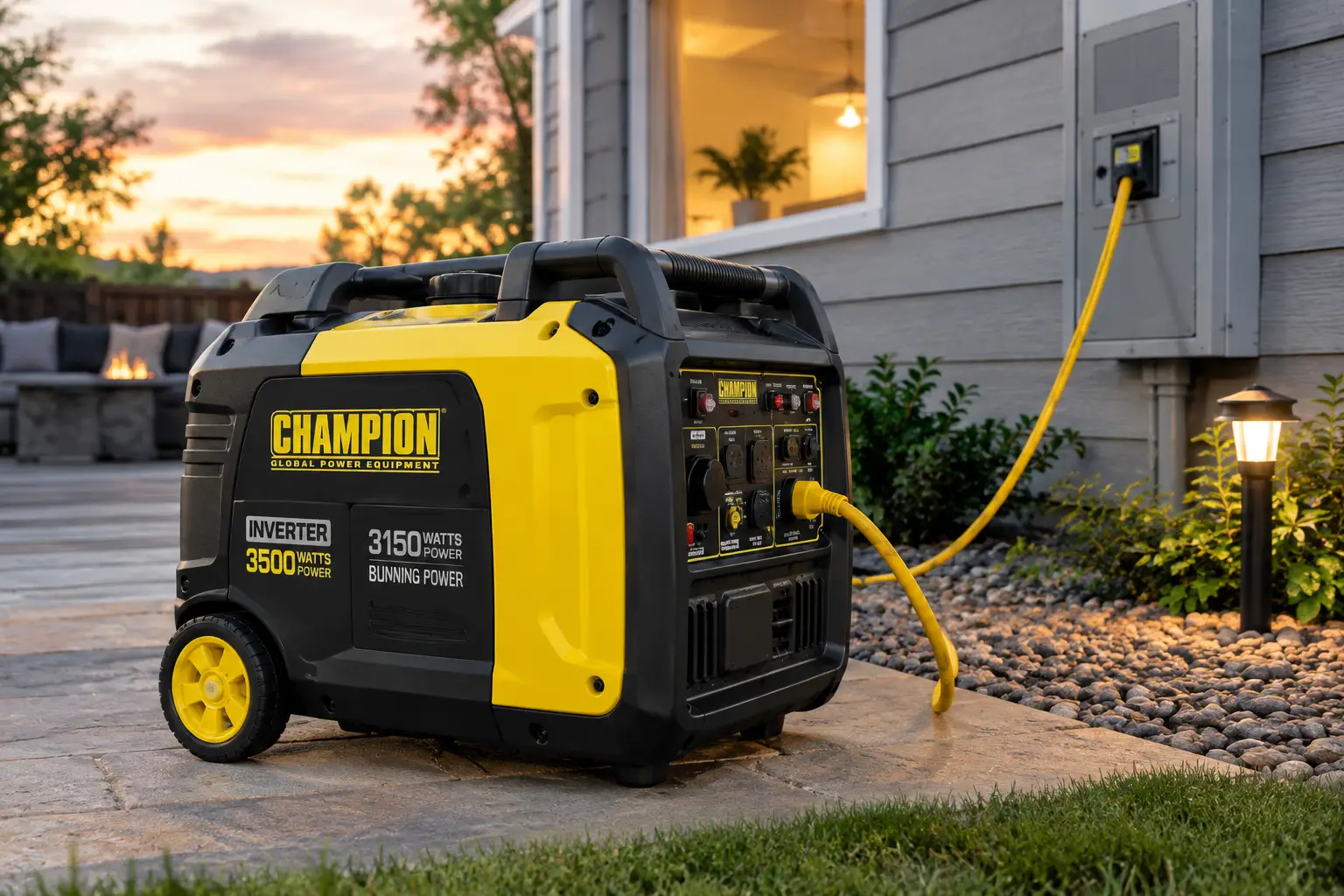
| Champion 201319 | 3,500 / 4,500 | Gas + propane | No (120V only) | $800–$1,100 | Champion 201319: entry-level essentials |
Prices are approximate ranges at the time of writing and change often; check the current price before buying.
Looking at the table, the dividing line isn’t really brand; it’s the 240V column. The Champion 201319 and Westinghouse iGen5000DFc are excellent essentials machines, but they can’t feed a 240V well pump or a two-pole transfer switch. If your house needs 240V, your realistic floor starts at the WEN DF680iX, and the Westinghouse iGen12000DFc is where “run most of the house” becomes affordable.
💬 One click helps other shoppers make an informed choice too! 😊
Top 7 Inverter Generators for Home Backup: Expert Analysis
1. Honda EU7000is — quietest premium whole-circuit backup
The Honda EU7000is is the benchmark other brands measure themselves against, mostly because it pairs big-inverter output with a fuel-injected engine. Honda rates it at 5,500 running and 7,000 peak watts from a GX390 EFI engine, with 120/240V output through an L14-30R twist-lock.
The electronic fuel injection is the feature that matters most for backup duty. Carburetors gum up when a generator sits for eleven months, which is exactly how backup generators live; EFI removes the choke and sharply reduces that stale-fuel failure mode. Honda lists noise at 52 dB(A) at quarter load and 60 dB(A) at rated load, and its Eco Throttle stretches the 5.1-gallon tank to roughly 6–18 hours depending on load.
Based on the specs, this is for homeowners who value reliability and quiet over raw wattage per dollar, especially in dense suburbs. The trade-off is weight: about 260 pounds, so it’s a “park it and wheel it out” machine. It’s also gasoline-only from the factory.
Owner feedback we found on forums and retailer pages consistently praises its fuel economy and low noise; the most common complaint is the price, not performance.
Pros:
- ✅ Fuel injection reduces stale-fuel starting problems
- ✅ Among the quietest outputs in its power class
- ✅ True 120/240V output for transfer switches
Cons:
- ❌ Gasoline only without aftermarket conversion
- ❌ Costs roughly double similar-wattage competitors
Expect to pay in the $4,500–$5,000 range; it’s worth it only if quiet and long-term reliability outrank watts per dollar.
2. DuroMax XP16000iH — most power in a portable inverter
The DuroMax XP16000iH exists for one reason: to push inverter-quality power into near-whole-home territory. DuroMax rates it at 13,000 running and 16,000 peak watts on gasoline, and 12,350/15,200 on propane.
In practice, 13,000 running watts means you can realistically run a central AC unit or a deep well pump alongside the fridge, lights, and electronics, rather than rotating loads. Its two 50-amp 240V outlets are built for an interlock or transfer switch, and the CO Alert sensor shuts the engine down when carbon monoxide builds up. On gasoline, DuroMax lists 18.2 hours at 25% load and 10.5 hours at 50%.
Here’s what to weigh: at about 368 pounds, this is one of the heaviest units in its class. It’s a better fit for homeowners with a concrete pad and a permanent inlet than for anyone who wants to store it in a shed and drag it out.
Walmart’s aggregated review summary highlights owners saying it covers the entire house and stays quiet at idle. We couldn’t verify a large Amazon review sample, so treat that as directional.
Pros:
- ✅ Runs central air and well pumps simultaneously
- ✅ Two 50A outlets simplify transfer switch hookups
- ✅ Long propane runtime with large tanks
Cons:
- ❌ Very heavy for a “portable” generator
- ❌ Louder than smaller inverters at load
Pricing lands roughly in the $4,000–$5,000 range; per running watt, that’s strong value for large homes.
3. Westinghouse iGen12000DFc — best big-home value
The Westinghouse iGen12000DFc hits the spot where most larger homes actually live: enough power for heavy loads without the DuroMax’s bulk. It’s rated at 9,000 running and 12,000 peak watts on gasoline, and 8,100/11,000 on propane.
The spec that stands out is the 7.9-gallon tank. Westinghouse lists up to 19 hours at 25% load, which translates into fewer 2 a.m. refueling trips during a multi-day outage. Its 14-50R 50A and L14-30R 30A outlets are both transfer switch and interlock ready, and noise starts as low as 64 dBA in Eco Mode. A CO sensor, low-oil shutdown, and remote-start key fob round it out.
Based on comparing the specs, this is the one we’d point most 2,000–3,000 square-foot homes toward: enough headroom for a well pump or a window AC plus essentials, with dual-fuel flexibility. At roughly 190 pounds (Amazon lists the tri-fuel sibling at 191 pounds), it’s still heavy but manageable on its wheels.
We couldn’t verify a large, consistent pool of owner reviews for this specific model, so we’re leaning on the spec sheet here.
Pros:
- ✅ Large tank delivers genuinely long runtimes
- ✅ Both 50A and 30A transfer-ready outlets
- ✅ Remote start is handy in bad weather
Cons:
- ❌ Too heavy for one person to lift
- ❌ Louder than the Honda at comparable loads
Expect roughly $2,500–$3,500 at the time of writing; it delivers the best watts-per-dollar in the big-inverter bracket.
4. Champion 201175 — mid-size sweet spot for most homes
The Champion 201175 targets the homeowner who needs 240V but not whole-house power. Champion rates it at 7,000 running and 8,500 starting watts on gasoline, and 6,300/8,500 on propane.
That 8,500-watt surge rating is identical on both fuels, which matters more than it sounds: motor-driven loads like well pumps and fridge compressors need that starting kick, and many dual-fuel units lose surge on propane. It runs up to 14 hours on the 5.3-gallon gas tank at 25% load, is rated at 61 dBA, and offers a 14-50R and L14-30R for home hookups. CO Shield auto-shutoff is built in, and the unit meets ANSI/PGMA G300-2018.
On paper, this is a strong “one-generator-for-everything” choice: backup for fridge, freezer, furnace blower, lights, and a well pump, plus RV duty when the weather’s nice. It’s also backed by a 3-year limited warranty and lifetime tech support.
Retailer feedback we saw tends to describe easy first starts; we couldn’t verify a large aggregated rating, so weigh the spec sheet most heavily.
Pros:
- ✅ Full surge wattage on both fuels
- ✅ Quiet 61 dBA for this power class
- ✅ Meets ANSI/PGMA G300-2018 CO standard
Cons:
- ❌ Not enough power for central air
- ❌ Heavy enough to need two people for loading
Typically in the $2,000–$2,600 range; excellent value if you need 240V without paying for 9,000+ watts.
5. WEN DF680iX — cheapest route to 240V inverter backup
The WEN DF680iX is the most affordable way we found to get inverter power and a 240V outlet. It’s rated at 5,100 running and 6,800 surge watts on gasoline, and 4,500/6,000 on propane.
WEN claims under 1.2% THD at full load, notably lower than the common “under 3%” spec, which means very clean power for furnace boards and electronics. The fuel shutoff lets the carburetor run dry before shutdown, a small feature that directly addresses the number-one reason backup generators fail to start. At 94.8 pounds with built-in wheels, it’s far easier to move than the big units.
What most buyers overlook: WEN specifies a bonded-neutral 240V configuration. That’s useful for EV charging, but it affects how the unit should connect to a home transfer switch, so have an electrician confirm compatibility. The 2.9-gallon tank also means about 6.1 hours at half load, so plan on refueling.
Reviews we could verify are limited, but retailer summaries and review sites repeatedly note the CO Watchdog shutdown and fuel shutoff as standout features.
Pros:
- ✅ Very low THD for sensitive electronics
- ✅ 240V output at a mid-range price
- ✅ Fuel shutoff protects the carburetor
Cons:
- ❌ Small tank means frequent refueling
- ❌ Bonded neutral needs transfer-switch planning
Usually in the $1,300–$1,600 range; strong value if you need 240V on a budget.
6. Westinghouse iGen5000DFc — longest quiet runs for essentials
The Westinghouse iGen5000DFc is built for households that just need the fridge, freezer, Wi-Fi, lights, and a few outlets to run all night. It delivers 3,900 running and 5,000 peak watts on gas, and 3,500/4,500 on propane.
Two numbers make it special: 52 dBA and 18 hours. Westinghouse lists the noise as low as 52 dBA, and the 3.4-gallon tank runs up to 18 hours at 25% load thanks to variable engine speed. In real-world terms, that’s a generator you can start at dinner and not touch until morning. It also includes remote start, an LED data center with runtime and fuel data, and CO shutdown.
The limitation is important: it’s 120V only (with a TT-30R RV outlet). It won’t run a 240V well pump or feed both legs of a standard transfer switch. At 105.8 pounds, it rolls easily on its wheels and telescoping handle.
We couldn’t verify a sizable, model-specific review pool, so the verdict is spec-driven: quiet and efficient, but only for 120V needs.
Pros:
- ✅ Very quiet at light loads
- ✅ Up to 18-hour runtime on gasoline
- ✅ Remote start and detailed LED display
Cons:
- ❌ No 240V output for well pumps
- ❌ Not enough power for central air
Expect roughly $1,000–$1,400; excellent value if your backup needs are 120V essentials only.
7. Champion 201319 — best entry-level essentials pick
The Champion 201319 is the budget-friendly starting point: 3,500 running and 4,500 starting watts on gasoline, and 3,150/4,500 on propane, from a 212cc engine.
Its propane runtime is the headline for backup use: up to 21 hours at 25% load on a 20-pound tank, versus 14 hours on the 2.3-gallon gas tank. Propane stores indefinitely, so this unit can sit ready for months without the fuel-stabilizer ritual. It’s rated at 61 dBA, includes electric start, CO Shield, and is parallel-capable, meaning you can link a second Champion inverter later to roughly double output.
Honest analysis: this is for apartments, condos, and smaller homes running a fridge, a few lights, phone chargers, a CPAP, and a modem. At 92.2 pounds it’s manageable, and the parallel option gives you an upgrade path instead of a dead end.
Owner feedback we could verify is thin, so treat the dual-fuel runtime and CO Shield as the proven, spec-backed selling points.
Pros:
- ✅ Very long propane runtime for its size
- ✅ Parallel-ready for future power upgrades
- ✅ Electric start with CO Shield shutoff
Cons:
- ❌ 120V only, no transfer-switch hookup
- ❌ Limited power for heavy appliances
Typically in the $800–$1,100 range; a smart, affordable entry into clean backup power.
✨ Don’t miss these exclusive deals!
🔍 Take your home backup plan to the next level with this carefully curated lineup. Click a highlighted model to check current pricing and availability. These picks will help you keep the fridge cold, the lights on, and the whole family comfortable when the grid goes dark!
How Many Watts to Run a House? A Step-by-Step Load Plan
Sizing is where most buyers go wrong, so before you commit to any model, spend 20 minutes on this. Westinghouse’s own owner’s manual walks through the same method, and it works for every brand.
Step 1: List only what you truly need during an outage ⚡
Think “comfort and safety,” not “normal life.” A typical list: refrigerator, chest freezer, furnace blower (or window AC in summer), sump or well pump, a few lights, Wi-Fi router, phone and laptop chargers, and possibly a CPAP or medical device.
Step 2: Add up running watts
Check each appliance’s label or manual. A modern fridge might draw a few hundred watts while running; a furnace blower commonly draws several hundred; lights and electronics add less than most people expect. Total these continuous numbers.
Step 3: Add the single largest starting surge
Motors need a brief kick to start. You don’t add every surge together, just the largest one, because appliances rarely start at the same instant. Westinghouse’s manual example totals 2,590 running watts plus the highest 1,600-watt starting load for about 4,190 starting watts needed.
Step 4: Keep 20–25% headroom 🔋
Running a generator at 100% continuously shortens its life and drains fuel fast. If your total is 4,000 running watts, a 5,000-watt-running generator is a comfortable fit.
Step 5: Check the voltage
If anything on your list is 240V (well pumps, central AC, electric dryer), you need a 240V-capable unit like the WEN DF680iX, Champion 201175, or larger. For a 120V-only list, the Westinghouse iGen5000DFc or Champion 201319 will do the job for less.
This one-page exercise often saves buyers $1,000 or more, because many people discover their true essentials need is far smaller than they assumed.
Real-World Scenarios: Which Generator Fits Your Home?
Numbers make more sense attached to real households. Here are four common profiles and the model that fits each, with the reasoning.
🏙️ Scenario 1: Suburban townhome, city water, 1–2 day outages
You need the fridge, a few lights, internet, and phone charging, and your neighbors are 15 feet away. Budget: under $1,500. The Westinghouse iGen5000DFc fits best: 52 dBA at light load keeps the peace, and 18 hours at 25% load means one fill-up per night. The Champion 201319 is the backup choice if budget is tighter.
🌲 Scenario 2: Rural home with a 240V well pump
No well pump, no water: no toilets, no showers, no cooking. You need 240V. Budget: $1,500–$2,600. The Champion 201175 is the smart pick, because its surge rating stays at 8,500 watts on propane, which matters for pump starts. The WEN DF680iX works if your pump is smaller and budget is under $1,600.
🌀 Scenario 3: Gulf Coast family, multi-day hurricane outages, summer heat
Multi-day outages plus AC needs. Budget: $2,500–$5,000. The Westinghouse iGen12000DFc offers the best balance, with a 7.9-gallon tank and 9,000 running watts. If you want central air on generator power, step up to the DuroMax XP16000iH.
🧑💻 Scenario 4: Remote worker in a noise-restricted HOA
Uptime for computers and quiet matter more than cost. The Honda EU7000is earns its premium: 52 dB(A) at quarter load, EFI reliability, and 240V for a transfer switch.
Notice the pattern: the right choice depends on voltage, runtime, and noise tolerance far more than on peak wattage.
First 30 Days: Setup, Break-In, and Maintenance
A generator bought in October and first started during a January ice storm is a generator that may not start. Here’s a practical first-month routine.
Week 1: Unbox, add oil, and do a proper break-in
Every model here ships without oil in the crankcase. Fill with the grade listed in the manual (10W-30 is common). Then follow the break-in guidance: Westinghouse’s manual, for example, advises keeping load under 50% of rated running watts for the first five hours. Skipping this is one of the most common early mistakes.
Week 2: Plan the connection 🔌
Decide how power reaches your house: heavy-duty extension cords to individual appliances, or a transfer switch/interlock installed by a licensed electrician. Never “backfeed” through a dryer outlet; it can energize utility lines and injure line workers.
Week 3: Store fuel correctly
Gasoline degrades in months. Add fuel stabilizer, or better, plan to run propane for storage (propane doesn’t go stale). If your unit has a fuel shutoff like the WEN DF680iX, use it every time to run the carburetor dry.
Week 4: Practice a full dry run
Roll the generator to its outdoor spot (at least 20 feet from doors, windows, and vents), start it, connect a load, and time how long setup takes. Do it in daylight now so you’re not learning in the dark later.
Ongoing maintenance schedule 🛠️
- Change oil after the first 20–25 hours, then per the manual.
- Start and run under load monthly for 15–20 minutes.
- Check the spark plug and air filter annually.
- Keep the starter battery on a maintainer between seasons.
How to Choose the Best Inverter Generator for Home Backup
Use these seven criteria, in this order, to narrow your shortlist quickly.
- Running watts, not peak watts. Peak is a seconds-long surge rating; running watts decide what you can actually power all night.
- 120V vs 240V output. If you have a well pump, central AC, or want a transfer switch, 240V is non-negotiable.
- Fuel type. Dual fuel gives you a fallback when gas stations go dark after storms; propane also stores indefinitely.
- Runtime at 25% and 50% load. Tank size plus engine efficiency determines how often you refuel at 2 a.m.
- CO shutoff certification. Look for a CO sensor and, ideally, certification to current PGMA G300 or UL 2201 standards.
- Noise at your likely load. Compare dBA at quarter load, where most overnight backup actually happens.
- Weight and mobility. If you’ll store it in a shed, a 100-pound unit and a 368-pound unit are very different daily realities.
| Priority | Best-fit model | Why |
|---|---|---|
| Lowest noise | Honda EU7000is | 52 dB(A) at quarter load plus EFI |
| Most power | DuroMax XP16000iH | 13,000 running watts |
| Best big-home value | Westinghouse iGen12000DFc | 9,000 W, 7.9-gal tank |
| Budget 240V | WEN DF680iX | 240V under $1,600 |
The table shows how quickly a single priority collapses the decision. If quiet is your top criterion, the Honda EU7000is stands alone; if you need 240V on a tight budget, the WEN DF680iX is the logical floor. Most buyers, though, will land on the Westinghouse iGen12000DFc or Champion 201175 because they balance all seven criteria reasonably well.
Inverter Generator vs Standby Generator vs Conventional Portable
Inverter generators aren’t the only path to backup power, so it’s worth understanding what you give up and gain against the alternatives.
| Type | Power quality | Noise | Installation | Best for |
|---|---|---|---|---|
| Inverter portable | Very clean (typically <3% THD) | Quiet | Cords or transfer switch | Most households; Champion 201175 tier |
| Conventional portable | Less stable | Loud (often mid-70s dBA) | Cords or transfer switch | Lowest cost per watt |
| Home standby | Clean | Moderate | Permanent, professional install | Automatic whole-home backup |
Conventional open-frame generators give you more watts per dollar, but you pay in noise and power quality. Champion’s own spec for a conventional 7,000-watt model lists 74 dBA, versus 61 dBA for the inverter Champion 201175 with the same running wattage. That’s a big perceptual difference at night.
Home standby generators start automatically and run on natural gas, but they involve permits, a concrete pad, and professional installation, typically costing far more than any portable here. For most homeowners, a 240V inverter plus a transfer switch captures most of the standby experience at a fraction of the cost, with one manual step: walking outside to start it.
Dual Fuel Inverter Generator for Home: Gas vs Propane
Six of our seven picks are dual fuel, and for home backup that’s not a coincidence. A dual fuel inverter generator for home gives you a fallback when gas stations lose power after storms, which is exactly when you need fuel most.
Gasoline: more power, shorter shelf life
Gas produces the highest output on every dual-fuel model. The Westinghouse iGen12000DFc, for example, makes 9,000 running watts on gas versus 8,100 on propane. The downside is storage: untreated gasoline degrades in months and gums carburetors.
Propane: less power, near-indefinite storage ⛽
Propane doesn’t go stale, doesn’t spill, and a stack of 20-pound tanks can sit in a shed for years. The power penalty is usually around 10%. Some models avoid the surge penalty entirely; the Champion 201175 keeps 8,500 starting watts on propane.
The practical strategy
Use propane as your default storage fuel and keep a few gallons of stabilized gas as a backup. Runtime math matters too: the Champion 201319 runs up to 21 hours on a 20-pound propane tank at 25% load, and the DuroMax XP16000iH reaches 27.75 hours on a 100-pound tank at the same load.
Transfer Switch Ready Inverter Generator: Connecting Safely
A transfer switch ready inverter generator is what turns a portable unit into a real home backup system. Instead of snaking extension cords through a cracked window, you plug one cord into an outdoor inlet and power selected circuits from your panel.
What “transfer switch ready” actually means
It means the generator has a 240V locking outlet (L14-30R or 14-50R) that matches common inlet boxes. The Honda EU7000is, WEN DF680iX, Champion 201175, Westinghouse iGen12000DFc, and DuroMax XP16000iH all qualify. The Westinghouse iGen5000DFc and Champion 201319 don’t, since they lack 240V.
30A vs 50A
A 30A inlet supports roughly 7,200 watts at 240V; a 50A inlet supports up to 12,000. Pairing a 50A-capable generator like the Westinghouse iGen12000DFc with a 30A inlet wastes capacity, so match the two.
The neutral question
Generators ship with either a floating or bonded neutral. Westinghouse lists a floating neutral on its 4500-series spec sheet, while WEN specifies a bonded-neutral 240V configuration on the WEN DF680iX. The correct setup depends on your transfer switch type, which is exactly why a licensed electrician should handle the installation and permit.
Safety, Regulations, and Standards
Generator safety isn’t a side note; it’s the difference between a comfortable outage and a tragedy. The CPSC warns that portable generators are among the leading causes of carbon monoxide deaths after storms, and that CO can kill within minutes, often before people notice symptoms. You can read the agency’s current guidance in its 2026 hurricane-season generator safety warning.
CO shutoff standards to look for ✅
CPSC recommends generators with a CO shut-off feature and points to models certified to PGMA G300-2023 and UL 2201-2023. Every generator on our list includes a CO sensor, and the Champion 201175 explicitly meets ANSI/PGMA G300-2018. The federal rulemaking behind these standards, including CPSC’s estimate of roughly 85 generator-related CO deaths per year in recent data, is documented in the Federal Register proposed safety standard for portable generators.
Non-negotiable placement rules
- Never run a generator indoors, in a garage, basement, crawlspace, shed, or on a porch.
- Keep the exhaust at least 20 feet from doors, windows, and vents, pointed away from the house.
- Install battery-backed CO alarms inside your home and test them before storm season.
A CO sensor on the generator is a backup layer, not a substitute. Champion itself notes that CO Shield doesn’t replace an indoor CO alarm.
Emissions compliance
Some models are sold in 49-state versions and aren’t available in California. The DuroMax XP16000iH, for instance, is listed as not for sale in California by at least one retailer, so California buyers should confirm CARB compliance before ordering.
Long-Term Cost and Maintenance
The sticker price is only part of what a backup generator costs you over ten years. Fuel, oil, and reliability matter just as much.
| Model | Approx. price range | Tank / runtime @25% | Cost-of-ownership note | Best for |
|---|---|---|---|---|
| Honda EU7000is | $4,500–$5,000 | 5.1 gal / up to ~18 hr | EFI lowers carb repairs | Honda EU7000is: lowest hassle |
| Westinghouse iGen12000DFc | $2,500–$3,500 | 7.9 gal / up to 19 hr | Fewer refuels on long outages | Westinghouse iGen12000DFc: long outages |
| Champion 201175 | $2,000–$2,600 | 5.3 gal / up to 14 hr | Strong propane efficiency | Champion 201175: balanced value |
| Champion 201319 | $800–$1,100 | 2.3 gal / up to 14 hr | Cheapest to own and fuel | Champion 201319: small budgets |
The table highlights that runtime and fuel system design drive long-term cost more than purchase price. The Honda EU7000is costs more upfront but EFI helps you avoid the carburetor cleanings that are the most common repair on stored generators. The Westinghouse iGen12000DFc reduces your fuel-logistics burden, which matters most in multi-day hurricane outages.
Where the money actually goes 💵
- Fuel: Inverters throttle down at light loads, often cutting consumption substantially versus fixed-speed generators.
- Oil changes: Small, cheap, and regular.
- Carburetor repairs: The most avoidable cost; use fuel stabilizer, propane storage, or a fuel shutoff.
- Warranty: Most models here carry 3-year limited coverage; confirm the warranty terms for residential use before buying.
Common Mistakes to Avoid When Buying an Inverter Generator
Even careful shoppers fall into these traps. Avoid them and you’ll be ahead of most buyers.
❌ Buying by peak watts
Marketing headlines lead with peak watts because they’re bigger. The DuroMax XP16000iH is a “16,000-watt” generator, but plan around its 13,000 running watts.
❌ Forgetting the 240V question
This is the costliest mistake. A 120V-only unit like the Westinghouse iGen5000DFc can’t run a well pump, no matter how quiet it is.
❌ Ignoring weight
A 368-pound generator stored in a detached shed may be nearly impossible to move alone during a storm. Be honest about your physical setup.
❌ Skipping the transfer switch budget
A professionally installed inlet and interlock or transfer switch adds real cost. Budget for it up front rather than treating it as an afterthought.
❌ Letting gas sit untreated
A backup generator that won’t start is useless. Stabilize fuel, store propane, or run the carburetor dry after every use.
❌ Assuming a CO sensor makes indoor use safe
It doesn’t. Outdoor placement 20 feet from openings plus indoor CO alarms remain essential.
FAQ: Best Inverter Generator for Home Backup
❓ What size inverter generator do I need to run a refrigerator and freezer?
❓ Can an inverter generator run central air conditioning?
❓ Is a dual fuel inverter generator for home backup worth the extra cost?
❓ Do I need an electrician to connect a generator to my house?
❓ How long will an inverter generator run on a tank of gas?
Conclusion: Choosing the Best Inverter Generator for Home Backup
The best inverter generator for home backup isn’t the biggest or the most expensive; it’s the one that matches your house’s voltage needs, your outage length, and your tolerance for noise and weight.
If you need only 120V essentials, the Westinghouse iGen5000DFc gives you quiet, all-night runtime, while the Champion 201319 is the affordable entry point with a parallel upgrade path. If you need 240V on a budget, the WEN DF680iX is the logical starting point. For most households with a well pump or larger loads, the Champion 201175 hits a genuine sweet spot, and the Westinghouse iGen12000DFc is our top value pick for bigger homes that face multi-day outages. For near-whole-home power, the DuroMax XP16000iH leads in raw output, and if quiet reliability matters above all, the Honda EU7000is remains the premium benchmark.
Whatever you choose, pair it with a professionally installed transfer switch, stored propane, indoor CO alarms, and a practice run before storm season. For more household preparation tips, the CPSC’s generator safety guidance and PSA is worth a read with your family.
⚡ Ready to keep the lights on when the grid goes down?
🔍 Compare the highlighted models above, check current pricing and availability, and pick the generator that fits your home. Your future self, sitting in a warm, lit house during the next outage, will thank you! 🏡
Recommended for You
- Whole House Battery Backup Without Solar: 7 Proven Picks for 2026
- Best Inverter Generator for RV: 7 Proven Quiet Picks for 2026
- Best power inverter for rv: 7 Top Picks That Won’t Fail You (2026)
Disclaimer: This post contains affiliate links. As an Amazon Associate, I earn from qualifying purchases made through these links, at no additional cost to you.
✨ Found this article helpful? Share it with someone who needs it! 💬🤗
