
In This Article
Why a 48v solar battery Is the Smart Choice in 2026
Picture this: a summer storm knocks out power on your street at 7 p.m. Your neighbors fire up loud gas generators, while your fridge, Wi-Fi, and window AC just keep humming — quietly, on sunshine you banked that afternoon. That’s the real promise of a 48v solar battery, and it’s why 48-volt systems have become the default for serious home backup and off-grid builds.
Here’s the short version of why. A 48v solar battery moves the same power as a 12V bank at one quarter of the current. Less current means thinner (cheaper) cables, less heat, fewer losses, and access to the big 5kW–12kW hybrid inverters that can actually run a whole house. A 12V system is great for a camper van; once you want to run a well pump, a mini-split, or an electric range, 48 volts is where the math starts working for you instead of against you.
The market has also matured fast. In 2026, you can order a 5kWh LiFePO4 server rack module or a 14kWh wall-mount “powerwall-style” unit online, often with Bluetooth monitoring, inverter communication, and UL safety certifications that used to be reserved for installer-only brands.
But the listings all look alike — “Grade A cells,” “smart BMS,” “6,000+ cycles.” This guide cuts through that. We compared real spec sheets, certification records, and the review themes we could actually verify for seven 48v solar battery options sold to US buyers, then translated the numbers into what they mean for your home, cabin, or shop. You’ll also get setup steps, sizing scenarios, a troubleshooting guide, and a straight talk about cost now that the federal tax credit has changed.
What Is a 48v solar battery?
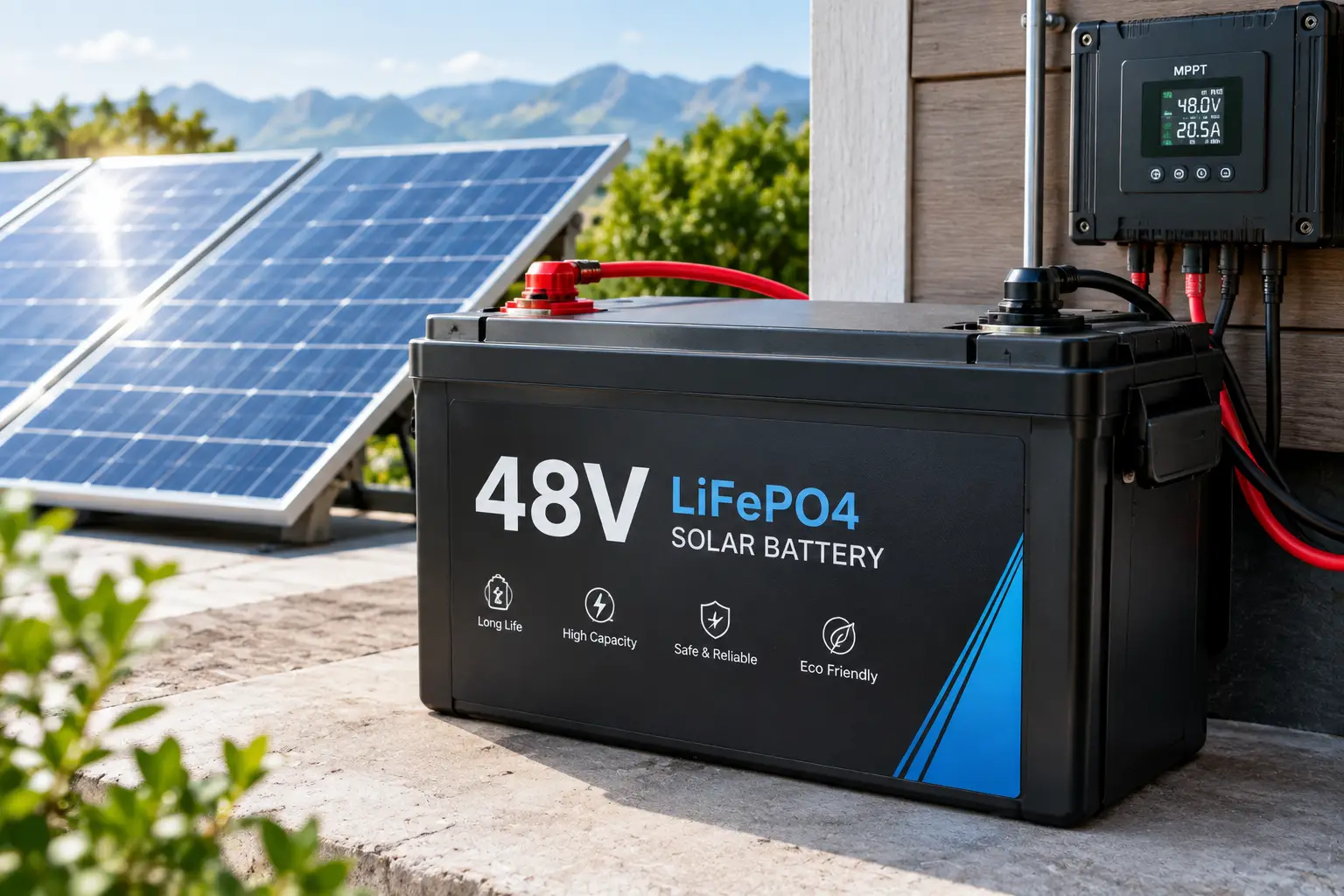
A 48v solar battery is a deep-cycle battery with a nominal voltage of about 48–51.2 volts that stores energy from solar panels for later use. Most modern models use lithium iron phosphate (LiFePO4) cells wired 16 in series, giving 51.2V nominal, 5–15kWh per unit, and thousands of charge cycles.
That “16 in series” detail matters more than it looks. Each LiFePO4 cell sits at 3.2V nominal, so 16 cells give you 51.2V — which is why you’ll see the same battery described as both “48V” and “51.2V.” A few budget models use 15 cells (48V nominal, about 4.8kWh per 100Ah), so always check the watt-hour figure, not just the voltage label.
LiFePO4 has become the standard chemistry for stationary storage for good reasons. According to the overview of the lithium iron phosphate battery on Wikipedia, the chemistry is valued for low cost, strong thermal stability, low toxicity, and long cycle life — exactly the traits you want in a box that lives in your garage for a decade. It holds less energy per pound than the nickel-based cells in phones and EVs, but for a battery bolted to a wall, weight is a minor concern and safety is a major one.
In practice, a 48v solar battery connects to a hybrid or off-grid inverter, which handles solar charging (through a built-in MPPT controller), grid or generator charging, and converting DC into the 120V/240V AC your home uses.
Quick Comparison: 7 Best 48v solar battery Options at a Glance
| Battery | Capacity | Standout Feature | Warranty | Approx. Price Range | Best for |
|---|---|---|---|---|---|
| ECO-WORTHY Cubix100 | 5.12kWh | UL 9540 certified, Bluetooth + Wi-Fi | 10 years | $1,000–$1,500 | ECO-WORTHY Cubix100: permitted home installs on a budget |
| EG4 LifePower4 V2 | 5.12kWh | Up to 64 units closed-loop | 10 years | $1,300–$1,600 | EG4 LifePower4 V2: large, expandable home banks |
| SOK SK48V100N | 5.12kWh | Built-in 100W heater | 7 years | $900–$1,300 | SOK SK48V100N: cold garages and cabins |
| LiTime 48V 100Ah Server Rack | 5.12kWh* | 400A 10-second surge | 5 years (check listing) | $1,000–$1,400 | LiTime 48V 100Ah Server Rack: heavy motor loads |
| Redodo 48V 100Ah | 5.12kWh* | Bluetooth app, 5-year warranty | 5 years | $900–$1,300 | Redodo 48V 100Ah: RVs, carts, small solar |
| Vatrer 48V 100Ah | 4.8kWh | Touchscreen + mobile app | Check listing | $1,000–$1,400 | Vatrer 48V 100Ah: hands-on monitoring fans |
| ECO-WORTHY 48V 280Ah Powerwall | 14.33kWh | 200A BMS, one-box whole-home storage | Check listing | $2,300–$3,000 | ECO-WORTHY 48V 280Ah Powerwall: whole-home backup |
*Some listings for these brands still show older 15-cell 4.8kWh versions — confirm the watt-hours before buying. Prices are approximate at the time of writing; check the current price on Amazon.
Looking at the table, five of the seven batteries share the same 5.12kWh building block, so the real differences are certifications, cold-weather handling, expansion limits, and warranty length — not raw capacity. The ECO-WORTHY 48V 280Ah Powerwall is the outlier: one unit stores nearly as much as three rack modules, which can simplify wiring for whole-home backup. If your local permit office requires UL 9540 paperwork, the ECO-WORTHY Cubix100 and EG4 LifePower4 V2 deserve a hard look first.
💬 One click helps other shoppers make an informed choice too! 😊
Top 7 48v solar battery Picks for 2026: Expert Analysis
1. ECO-WORTHY Cubix100 48V 100Ah — best certified value for home solar
The ECO-WORTHY Cubix100 48V 100Ah pairs a mid-range price with the kind of paperwork that usually costs extra. ECO-WORTHY lists it as UL 9540-certified, which matters because that certification covers the battery as a complete energy storage system — the document many inspectors ask for before signing off on an indoor install.
On the spec sheet, you get Grade A LiFePO4 cells, a 100A smart BMS, and three ways to talk to it: Bluetooth, Wi-Fi, and CAN/RS485. In practice, that means you can check state of charge from your phone and let a compatible inverter read the battery directly (closed-loop communication), so charging adjusts to actual battery conditions instead of voltage guesses. Expansion to 32 units in parallel is far more headroom than most homes will ever use.
Who is it for? First-time home-solar builders who want a recognized certification without paying installer-brand prices. The 10-year warranty also puts it on par with the pricier names in this list. One third-party roundup reported a 4.6-star average across roughly 250 reviews, with recurring notes that measured capacity matched the label and that closed-loop communication worked with EG4 and Victron inverters; treat that as one source’s snapshot rather than a guarantee.
Pros:
- ✅ UL 9540 certification helps with permitting
- ✅ Bluetooth, Wi-Fi, and CAN/RS485 monitoring options
- ✅ Ten-year warranty at a mid-range price
Cons:
- ❌ Wi-Fi setup adds one more app to manage
- ❌ Server-rack format still needs a cabinet or shelf
Expect roughly $1,000–$1,500 per module at the time of writing — strong value for a certified 5kWh block.
2. EG4 LifePower4 V2 48V 100Ah — built for big, expandable banks
The EG4 LifePower4 V2 48V 100Ah is the battery many DIY installers default to when a system might grow from 10kWh to 40kWh over the years. Its headline number is scale: EG4 rates it for up to 64 batteries in closed-loop communication, a theoretical 327kWh bank.
The internals are well documented: 16 UL-recognized 3.2V cells, a 100A BMS, and a rating of more than 6,000 cycles at 80% depth of discharge. The unit carries UL 1973 and UL 9540A, and Signature Solar notes a UL 9540 listing when paired with the EG4 18kPV hybrid inverter. That pairing detail is the practical takeaway: if you’re buying an EG4 inverter anyway, you get a matched, listed system with less permit friction. Auto-addressing, dual fire arrestors, and two positive plus two negative terminals round out a genuinely installer-friendly design. It weighs about 99.6 lb, so plan on two people.
This is best for homeowners building a serious, multi-module bank and anyone who values a large US user community for troubleshooting. Buyer feedback we could verify on dealer sites repeatedly praises EG4’s US-based support, while the most common complaint is price increases tied to tariffs rather than product performance.
Pros:
- ✅ Up to 64 units in closed-loop communication
- ✅ UL 9540 listed with matching EG4 inverter
- ✅ Strong US support reputation among owners
Cons:
- ❌ Pricier than most budget rack modules
- ❌ Amazon availability varies; stock often sits with dealers
Expect roughly $1,300–$1,600 at the time of writing — worth it if expansion and permitting are priorities.
3. SOK SK48V100N — winter-proof with a built-in heater
The SOK SK48V100N solves the problem that quietly kills lithium performance in cabins and unheated garages: cold charging. LiFePO4 cells shouldn’t charge below freezing, and this battery has a 100W internal heater to bring them back into a safe range.
Beyond the heater, SOK builds in a 100,000µF pre-charge circuit. That sounds obscure, but it protects the BMS from the huge inrush current when you first connect a big inverter’s capacitors — a common cause of blown fuses and damaged BMS boards in DIY builds. You also get RS485 and CAN communication, a rating of 6,000+ cycles at 80% depth of discharge, and a claimed 20-year typical lifespan. Owners on the DIY Solar Forum point out that the newer compact 3U design adds Bluetooth firmware updates and inverter-protocol switching from your phone.
Choose it if your battery will live anywhere that dips below 32°F. One honest caveat surfaced in that same forum thread: SOK confirmed the new version does not communicate with its older server rack batteries, so don’t mix generations in one bank. The warranty is listed as 7 years on most current pages, though at least one retailer page shows 10 — confirm at checkout.
Pros:
- ✅ Built-in 100W heater for cold climates
- ✅ Pre-charge circuit protects against inverter inrush
- ✅ Bluetooth firmware updates on the new design
Cons:
- ❌ Won’t communicate with older SOK rack batteries
- ❌ Shorter warranty than the 10-year leaders
Expect roughly $900–$1,300 at the time of writing — excellent value for cold-climate installs.
4. LiTime 48V 100Ah Server Rack — muscle for motor-heavy loads
The LiTime 48V 100Ah Server Rack stands out for surge handling. The current version is rated for a 400A peak for 10 seconds, which is the kind of reserve that keeps a well pump, air conditioner, or washing machine from tripping the BMS on startup.
LiTime’s newer model is a 5,120Wh unit rated for 4,000 cycles at 100% depth of discharge and expandable to 16 batteries in parallel. Its T5.0 BMS reports state of charge and temperature to Victron or LiTime inverters, so charging current can adjust automatically. Low-temperature charge cutoff, moisture and salt-spray resistance, a pressure relief valve, and an SPCC steel case point toward garage, barn, or boat-house use rather than just climate-controlled closets.
Based on comparing the specs, this is the pick for off-grid homesteads with big motor loads, especially if you run Victron gear. One caution: older LiTime listings describe a 4,800Wh, 15-cell version limited to 4 units in parallel, weighing about 96 lb. Both versions still circulate online, so verify the watt-hours and parallel limit on the exact listing you buy. We couldn’t verify a large, consistent body of US reviews for the newest version specifically, so weigh the spec sheet more heavily here.
Pros:
- ✅ 400A ten-second surge for motor startups
- ✅ Closed-loop reporting with Victron inverters
- ✅ Rugged steel case with pressure relief valve
Cons:
- ❌ Old and new versions are easy to confuse
- ❌ No built-in heater for sub-freezing charging
Expect roughly $1,000–$1,400 at the time of writing — fair value for high-surge households.
5. Redodo 48V 100Ah — flexible and friendly for mobile solar
The Redodo 48V 100Ah is the most versatile battery in this lineup: the same 51.2V platform shows up in Redodo’s solar, golf-cart, and RV listings, so it’s built to handle vibration and varied charging sources.
Its Bluetooth app shows state of charge, cycles, temperature, and overall battery health, and lets you power the battery off remotely. The BMS pauses charging below 32°F, resumes above 41°F, and stops discharge at -4°F — sensible cold protection, though not a heater. Redodo rates it for 4,000 cycles at 100% depth of discharge and up to 15,000 cycles at 60%, which tells you something useful: keeping daily cycling shallow dramatically extends life. With the matching 18A charger, a full charge takes around 5.6 hours.
This fits RV owners, van builders, tiny homes, and small cabins where one or a few batteries do the job. The trade-off is scale: current solar listings cap expansion at 4 units in parallel (20.48kWh), and closed-loop inverter communication isn’t its focus the way it is for rack brands. As with LiTime, an older Amazon listing describes a 15-cell 4.8kWh version, so check the energy figure. Verifiable review themes were limited; Redodo’s 5-year warranty and US warehouse shipping are the documented strengths.
Pros:
- ✅ Bluetooth app with remote power-off
- ✅ Handles solar, RV, and golf-cart duty
- ✅ Five-year warranty with US-based shipping
Cons:
- ❌ Maximum of four units in parallel
- ❌ Limited inverter closed-loop integration
Expect roughly $900–$1,300 at the time of writing — good value for mobile and small off-grid setups.
6. Vatrer 48V 100Ah — hands-on monitoring with a touchscreen
The Vatrer 48V 100Ah is for owners who want to see their battery at a glance without reaching for a phone. Its headline feature is a built-in touchscreen display, backed up by a mobile app.
Vatrer describes the pack as using automotive-grade prismatic cells and rates it at about 4.8kWh — the same energy as four 12V 100Ah LiFePO4 batteries wired in series. That’s a 15-cell design, so it holds roughly 6% less energy than the 5.12kWh units above. In practice, a one-touch power switch and dual terminal sets make it easy to shut down for maintenance and simple to wire into a small bank. The smart BMS covers the standard protections against overcharge, over-discharge, and short circuits.
Who should consider it? Hobbyists and first-time off-grid builders who like a physical display in the utility room and don’t need dozens of modules. What most buyers overlook is the 48V vs 51.2V difference: a 15-cell battery charges and cuts off at different voltages than 16-cell packs, so don’t mix it with 16-cell batteries in one bank, and set your inverter to the correct profile. We could not verify a substantial, consistent body of US customer reviews for this exact model, so confirm the current warranty terms on the listing before you buy.
Pros:
- ✅ Built-in touchscreen for instant status checks
- ✅ One-touch power switch simplifies maintenance
- ✅ Dual terminals ease small-bank wiring
Cons:
- ❌ 4.8kWh is less than 16-cell rivals
- ❌ Cannot mix with 51.2V packs
Expect roughly $1,000–$1,400 at the time of writing — reasonable if the display matters to you.
7. ECO-WORTHY 48V 280Ah Powerwall — whole-home storage in one box
The ECO-WORTHY 48V 280Ah Powerwall trades modularity for sheer capacity: 14.33kWh in a single floor-standing or wall-mount unit, roughly what you’d get from three server rack batteries.
Inside are 16 Grade A 280Ah cells managed by a 200A PACE BMS, plus a DC circuit breaker with shunt trip that disconnects both poles during an overload or short — resettable, unlike a blown fuse. A 7-inch color screen shows voltage, state of charge, temperature, and BMS status, while RS485, CAN, and RS232 ports cover most major inverter brands. ECO-WORTHY rates it for up to 96% depth of discharge and up to 15 units in parallel. The 200A BMS is the practical win: it supports roughly 10kW of continuous draw, enough to back a big hybrid inverter without stacking batteries just for current.
This suits homeowners who want serious backup with minimal wiring. The catch is physical: at about 297.6 lb and 20.5 × 9.9 × 29.3 inches, it ships on a pallet by truck, and Amazon listings ask buyers to confirm truck-accessible delivery. On the DIY Solar Forum, one owner posting ongoing cell-voltage logs described its behavior as uneventful and predictable, which is exactly what you want from a battery.
Pros:
- ✅ 14.33kWh in a single cabinet
- ✅ 200A BMS supports large inverters
- ✅ Resettable breaker with shunt-trip protection
Cons:
- ❌ Nearly 300 lb requires planned installation
- ❌ Pallet freight complicates delivery
Expect roughly $2,300–$3,000 at the time of writing — the lowest cost per kWh in this list.
Head-to-Head: Detailed Specs of the Top 7
| Battery | Cells / Nominal | Max Parallel | Cold Handling | Key Certs Listed | Best for |
|---|---|---|---|---|---|
| ECO-WORTHY Cubix100 | 16S / 51.2V | 32 | Standard protection | UL 9540, UL 1973, UL 9540A | ECO-WORTHY Cubix100: permitted indoor installs |
| EG4 LifePower4 V2 | 16S / 51.2V | 64 | Standard protection | UL 1973, UL 9540A, UL 9540 (with EG4 18kPV) | EG4 LifePower4 V2: multi-module growth |
| SOK SK48V100N | 16S / 51.2V | Check spec | 100W heater | Check current listing | SOK SK48V100N: freezing climates |
| LiTime 48V 100Ah Server Rack | 16S / 51.2V (new) | 16 (new) | Low-temp cutoff | UL 1973 (older version) | LiTime 48V 100Ah Server Rack: surge-heavy loads |
| Redodo 48V 100Ah | 16S / 51.2V (new) | 4 | Cutoff below 32°F | Check listing | Redodo 48V 100Ah: RV and small solar |
| Vatrer 48V 100Ah | 15S / 48V | Check listing | Standard protection | Check listing | Vatrer 48V 100Ah: display-first users |
| ECO-WORTHY 48V 280Ah Powerwall | 16S / 51.2V | 15 | Standard protection | Check listing | ECO-WORTHY 48V 280Ah Powerwall: whole-home backup |
Reading this table, the parallel limit is the spec most shoppers ignore until it’s too late: the Redodo 48V 100Ah stops at four units, while the EG4 LifePower4 V2 and ECO-WORTHY Cubix100 leave room for decades of growth. Cold handling is the second divider — only the SOK SK48V100N actively warms itself. Finally, “Check listing” in the certification column isn’t a knock; it means you should request the certificate from the seller before an inspector requests it from you.
How to Set Up Your First 48v battery bank: A Practical Start Guide
A new 48v battery bank doesn’t need to be complicated, but the first day sets the tone for the next ten years. Here’s a sequence that avoids the classic rookie errors.
🔧 Before power-on
- Match protocols first. Set the battery’s DIP switches or app setting to your inverter’s protocol (for example, the brand’s CAN profile) before connecting. Closed-loop communication only works when both sides speak the same language.
- Charge every module to full separately. Different factory states of charge cause one battery to do all the work at first. Top each one off individually, then connect them in parallel.
- Use equal-length cables and a busbar. Unequal cable runs make the closest battery work harder and age faster.
- Fuse or break every battery. A Class T fuse or properly rated DC breaker between each battery and the busbar is cheap insurance.
⚡ The first 30 days
Run a few full cycles so the BMS can calibrate state of charge; many owners report inaccurate percentages until this happens. Set your inverter’s low-voltage cutoff conservatively at first (for a 16-cell pack, SOK recommends around 44.8V as a low-voltage disconnect), then fine-tune once you know your usage. Check terminal torque after the first few weeks, since copper lugs can settle.
🗓️ Maintenance schedule
Monthly: glance at cell voltage spread in the app — a growing gap between the highest and lowest cell is your early-warning signal. Every six months: re-check torque and dust off vents. For storage, most manufacturers recommend holding LiFePO4 at around 50% state of charge. That’s it — no watering, no equalizing, no acid.
Real-World Scenarios: Matching the Right Battery to Your Life
Specs only mean something in context. Here are three realistic profiles and the reasoning behind each match.
🏡 Suburban homeowner, outage backup
Budget of $3,000–$5,000, grid-tied solar, outages a few times a year. Daily essentials (fridge, lights, internet, furnace blower, a few outlets) use about 8–12kWh. Two or three ECO-WORTHY Cubix100 modules give 10–15kWh with UL 9540 paperwork that simplifies permitting. Alternatively, a single ECO-WORTHY 48V 280Ah Powerwall covers the same need in one box if you can handle the delivery. The PNNL consumer guide to rooftop solar and home energy storage is a helpful, neutral read on whether storage pencils out under your utility’s rules.
🏔️ Mountain cabin, full off-grid
Budget of $4,000–$6,000, winter lows in the teens, daily use of 6–10kWh including a well pump. Cold charging is the deal-breaker, so three SOK SK48V100N units make sense: the heaters protect winter charging, and 15kWh gives about two days of autonomy for cloudy stretches. If summer surge loads dominate instead, the LiTime 48V 100Ah Server Rack handles pump startups better.
🚐 Full-time RV or van build
Budget around $1,000–$1,500, weight and space matter, daily use of 2–4kWh. One Redodo 48V 100Ah delivers 5.12kWh with Bluetooth monitoring and rugged build, and a 48V system lets you run a 3kW inverter on modest cabling. Its four-unit limit won’t matter at this scale.
The pattern: size for your daily kWh first, then filter by environment (cold, heat, space), then by how much you might expand.
Problem → Solution: Fixing Common 48v solar battery Headaches
Even a great 48v solar battery can act up. Most issues trace back to setup, not defects.
Problem 1: The battery reads 0V after arrival or a deep drain. ✅ Solution: The BMS has likely disconnected to protect the cells. Try the power button first; if it stays dark, use a lithium-compatible charger with an activation or “wake” mode, as Redodo notes for re-enabling Bluetooth after power-off.
Problem 2: The inverter shows “BMS communication fault.” ✅ Solution: Recheck the protocol setting, the cable pinout (CAN and RS485 ports are not interchangeable), and which battery is set as master. On the EG4 LifePower4 V2, auto-addressing reduces this, but mixed firmware versions can still cause trouble.
Problem 3: Charging stops on cold mornings. ✅ Solution: That’s low-temperature protection working correctly. Move the bank into a conditioned space, add an insulated enclosure, or choose a heated model like the SOK SK48V100N.
Problem 4: State of charge jumps from 40% to 5% suddenly. ✅ Solution: LiFePO4’s flat voltage curve confuses voltage-based estimates. Run a full charge to 100% so the BMS can recalibrate, and rely on closed-loop data or a shunt monitor.
Problem 5: One battery in a bank ages faster. ✅ Solution: Almost always cable length or torque. Rebalance cable runs, verify torque, and top-charge each battery individually once.
🔋 Ready to build a bank that just works?
🔍 Take your home energy setup to the next level with the carefully researched lineup above. Click any highlighted battery to check current pricing and availability — and pick the one that matches your climate, loads, and growth plans for backup power the whole family can count on!
How to Choose a 48v solar battery: 7 Steps
- Calculate daily kWh. Add up what you actually run; a typical US home uses 20–30kWh a day, but backup of essentials is often under 10kWh.
- Decide on autonomy. One day of storage covers overnight use; two to three days cover cloudy stretches off-grid.
- Confirm cell count. 16-cell (51.2V) and 15-cell (48V) packs shouldn’t be mixed, and they need different inverter settings.
- Match your inverter. Check the inverter’s battery compatibility list for closed-loop support with your chosen brand.
- Check certifications. Ask your permit office what it requires — UL 9540 is increasingly common for indoor installs.
- Plan for climate. Below-freezing locations need heated batteries or a conditioned space.
- Compare warranty terms. Look at years and cycle or energy-throughput limits, plus who handles claims in the US.
Why this order works: sizing and climate decide which batteries qualify, and compatibility and certifications decide whether they’ll pass inspection and talk to your inverter. The U.S. Department of Energy’s explainer on solar energy and storage basics is a good primer on why storage matters most in the late afternoon and evening, when solar output drops but household demand climbs — useful context when estimating how much battery your evenings really need.
48v lifepo4 battery vs Lead-Acid and 12V Banks
If you’re replacing an old flooded or AGM bank, a 48v lifepo4 battery changes the equation more than any single upgrade.
| Factor | 48v lifepo4 battery | 48V lead-acid (AGM/flooded) | 12V LiFePO4 bank (same kWh) | Best for |
|---|---|---|---|---|
| Usable capacity | 80–100% | ~50% | 80–100% | LiFePO4 at either voltage |
| Typical cycle life | 4,000–8,000 | 300–1,200 | 4,000+ | 48v lifepo4 battery |
| Maintenance | None | Watering/equalizing (flooded) | None | 48v lifepo4 battery |
| Current for 5kW load | ~100A | ~100A | ~400A | 48V systems |
| Weight per usable kWh | Low | Very high | Low | LiFePO4 |
The table’s biggest lesson sits in the current row: a 12V lithium bank is great chemistry trapped at the wrong voltage for home loads, since 400A needs massive cables and fuses. Lead-acid’s low upfront cost disappears once you account for only using half the capacity and replacing it several times over a decade. For stationary solar, a 48v lifepo4 battery wins on nearly every line except purchase price.
What this means in practice: one Redodo 48V 100Ah replaces a stack of lead-acid golf-cart batteries weighing hundreds of pounds more, and a 48v lifepo4 battery doesn’t gas, so indoor placement is far simpler. Lead-acid still has a niche for rarely-used, ultra-budget backup — but if you’ll cycle daily, lithium pays for itself.
48v server rack battery vs Wall-Mount Powerwall Units
The two form factors in this guide solve different problems, and choosing between them is mostly about how your system will grow.
A 48v server rack battery is a roughly 5kWh module designed to slide into a standard 19-inch rack or cabinet. The ECO-WORTHY Cubix100, EG4 LifePower4 V2, and SOK SK48V100N follow this format. The advantages are modularity and redundancy: you can start with two, add more later, and if one module fails, the rest keep running while it’s under warranty. The downsides are the extra cabinet cost, more cables, and more communication links to configure.
A wall-mount or floor-standing “powerwall” unit like the ECO-WORTHY 48V 280Ah Powerwall puts 14kWh behind one set of terminals and one BMS. Installation is simpler — fewer cables, one communication link — and cost per kWh tends to be lower. The trade-off is weight (nearly 300 lb), freight logistics, and a single point of failure.
Here’s what to weigh: if you expect your needs to grow in unpredictable steps or you want redundancy for critical loads like medical equipment, a 48v server rack battery bank is the safer bet. If you know your target (say, 14kWh for overnight whole-home backup) and want the cleanest install, one large unit is hard to beat. Many owners eventually combine both — just keep chemistry, cell count, and communication protocol compatible.
Features That Actually Matter (and Ones That Don’t) on a 51.2v lithium battery
Marketing on every 51.2v lithium battery listing sounds identical. Here’s how to separate signal from noise.
✅ Features that matter
Closed-loop communication. When the battery tells the inverter its real state of charge and temperature, charging becomes smarter and safer. It’s the difference between guessing and knowing.
BMS current rating vs your inverter. A 100A BMS on a 51.2v lithium battery supports roughly 5kW continuous. If your inverter is 12kW, you need at least three batteries in parallel — or a 200A unit — just for current, regardless of capacity.
Pre-charge circuits. Features like the SOK SK48V100N‘s pre-charge protect the BMS from inverter inrush, a real-world failure mode.
Low-temperature protection or heating. Essential anywhere near freezing.
Warranty administration. A 10-year warranty is only as good as the company’s US support.
❌ Features that matter less than advertised
“Up to 15,000 cycles.” That number is typically quoted at shallow depth of discharge. Compare cycle ratings at the same depth — 80% is a fair benchmark.
“Grade A cells” with no traceability. Nearly every seller claims it; LiTime’s per-cell identification is the more meaningful version of this promise.
Huge theoretical parallel limits. 64 units sounds impressive, but almost no home uses more than eight. Past about 32, the difference is academic.
Long-Term Cost and Maintenance of a 48v solar battery
Sticker price is only the opening chapter. The more useful number is cost per kWh delivered over the battery’s life.
| Option | Approx. Price Range | Energy | Rough Cost per Stored kWh | Best for |
|---|---|---|---|---|
| SOK SK48V100N | $900–$1,300 | 5.12kWh | ~$175–$255 | SOK SK48V100N: low entry cost |
| ECO-WORTHY Cubix100 | $1,000–$1,500 | 5.12kWh | ~$195–$295 | ECO-WORTHY Cubix100: value plus certification |
| EG4 LifePower4 V2 | $1,300–$1,600 | 5.12kWh | ~$255–$315 | EG4 LifePower4 V2: ecosystem buyers |
| ECO-WORTHY 48V 280Ah Powerwall | $2,300–$3,000 | 14.33kWh | ~$160–$210 | ECO-WORTHY 48V 280Ah Powerwall: lowest per-kWh cost |
The single-box ECO-WORTHY 48V 280Ah Powerwall leads on cost per kWh, but rack modules let you spread spending over time. Over a rated 6,000 cycles at 80% depth of discharge, a 5.12kWh battery could deliver more than 24,000kWh — which works out to a few cents per kWh of storage cost, far below lead-acid once replacements are counted. Real-world life depends on temperature and depth of cycling, so treat that as a ceiling, not a promise.
One big 2026 change: under the One Big Beautiful Bill Act, the 30% residential clean energy credit (Section 25D) ended. The IRS FAQ on the accelerated termination of energy credits states that the 25D credit is not allowed for expenditures made after December 31, 2025, and an expenditure counts as made when installation is completed. If you buy a 48v solar battery for your own home in 2026, budget without that federal credit. Leased or third-party-owned systems may still benefit indirectly through the commercial credit, and some states and utilities run their own incentives — worth checking before you buy. Maintenance costs, happily, are close to zero: no watering, no equalizing, just occasional torque checks.
Safety, Regulations, and Standards for a 48v solar battery
LiFePO4 is the most stable mainstream lithium chemistry, but a 48v solar battery still stores serious energy, and US codes treat it accordingly.
📋 The certifications that show up on permits
UL 1973 covers the battery itself for stationary use. UL 9540A is a fire test method that shows how a thermal event would spread. UL 9540 certifies the complete energy storage system (battery plus power electronics) and is increasingly what inspectors want for indoor residential installs. That’s why the EG4 LifePower4 V2‘s UL 9540 listing with a specific inverter and the ECO-WORTHY Cubix100‘s UL 9540 certification carry real practical value.
🔥 Installation codes
Local codes based on the National Electrical Code and NFPA 855 commonly limit how much energy you can store in certain rooms, specify clearances, and may prohibit batteries in living spaces. Garages, utility rooms, and exterior walls are typical approved locations — but rules vary by jurisdiction, so call your permit office before buying.
⚡ Practical safety checklist
Use properly sized DC breakers or Class T fuses on every battery, keep terminals covered, never mix 15-cell and 16-cell packs, and keep the bank away from direct sun and standing water. Server rack units are usually rated IP20, meaning indoor use only. If you’re not comfortable working with DC at these currents, hire a licensed electrician — a 51.2V bank can deliver thousands of amps into a short circuit.
Common Mistakes to Avoid When Buying a 48v solar battery
Mistake 1: Buying by amp-hours instead of watt-hours. A 100Ah label can mean 4.8kWh or 5.12kWh. Always compare kWh.
Mistake 2: Ignoring the inverter compatibility list. Without closed-loop support, you lose accurate state of charge and smart charging. Check the list before you pay.
Mistake 3: Undersizing for current. A 10kW inverter on a single 100A battery will trip the BMS during peak loads. Size for current as well as capacity.
Mistake 4: Mixing generations or brands. Different BMS firmware, cell counts, or protocols in one bank causes imbalance — as SOK owners learned when the new version wouldn’t talk to older units.
Mistake 5: Skipping the permit conversation. An uncertified battery might be cheaper today and far more expensive when an inspector, insurer, or future home buyer asks questions.
Frequently Asked Questions About the 48v solar battery
❓ How long will a 48v solar battery run my house?
❓ Can I charge a 48v solar battery without solar panels?
❓ Is a 48v solar battery worth it without the federal tax credit?
❓ Can I install a 48v solar battery myself?
❓ Where should I buy a 48v solar battery — Amazon or a solar dealer?
Conclusion: Picking Your 48v solar battery with Confidence
A 48v solar battery is no longer a niche purchase for off-grid purists — it’s the practical foundation for quiet, fuel-free backup power and real energy independence. The right one depends less on marketing claims than on four questions: how many kWh you need, how cold your install location gets, which inverter you’re pairing it with, and whether your permit office wants UL 9540 paperwork.
For most homeowners, the ECO-WORTHY Cubix100 delivers the best mix of price, certification, and warranty. If you’re building big, the EG4 LifePower4 V2 ecosystem is hard to beat. Cold climates point clearly to the SOK SK48V100N, surge-heavy homesteads to the LiTime 48V 100Ah Server Rack, and RVs or small cabins to the Redodo 48V 100Ah. Display lovers will appreciate the Vatrer 48V 100Ah, and anyone who wants whole-home storage in a single cabinet should size up the ECO-WORTHY 48V 280Ah Powerwall.
Whatever you choose, start with an honest energy audit, confirm compatibility, and install it properly. Do that, and your battery will quietly do its job for a decade or more — the next outage will just be a slightly darker evening for your neighbors.
✨ Ready to take control of your power?
🔍 Take your solar setup to the next level with this carefully researched lineup. Click a highlighted battery to check current pricing and availability. These picks will help you build reliable, quiet backup power the whole family can depend on!
Recommended for You
- 1 Kilowatt Solar Panel: 7 Best Picks That Actually Deliver in 2026
- 15k Generator 2026: 7 Best Proven Picks for Whole-Home Backup
- Solar Power Inverter for RV: 7 Best Picks That Won’t Fail (2026)
Disclaimer: This post contains affiliate links. As an Amazon Associate, I earn from qualifying purchases made through these links, at no additional cost to you.
✨ Found this article helpful? Share it with someone who needs it! 💬🤗
