
In This Article
200 Watt Solar Panel Number of Cells: What You’re Really Asking
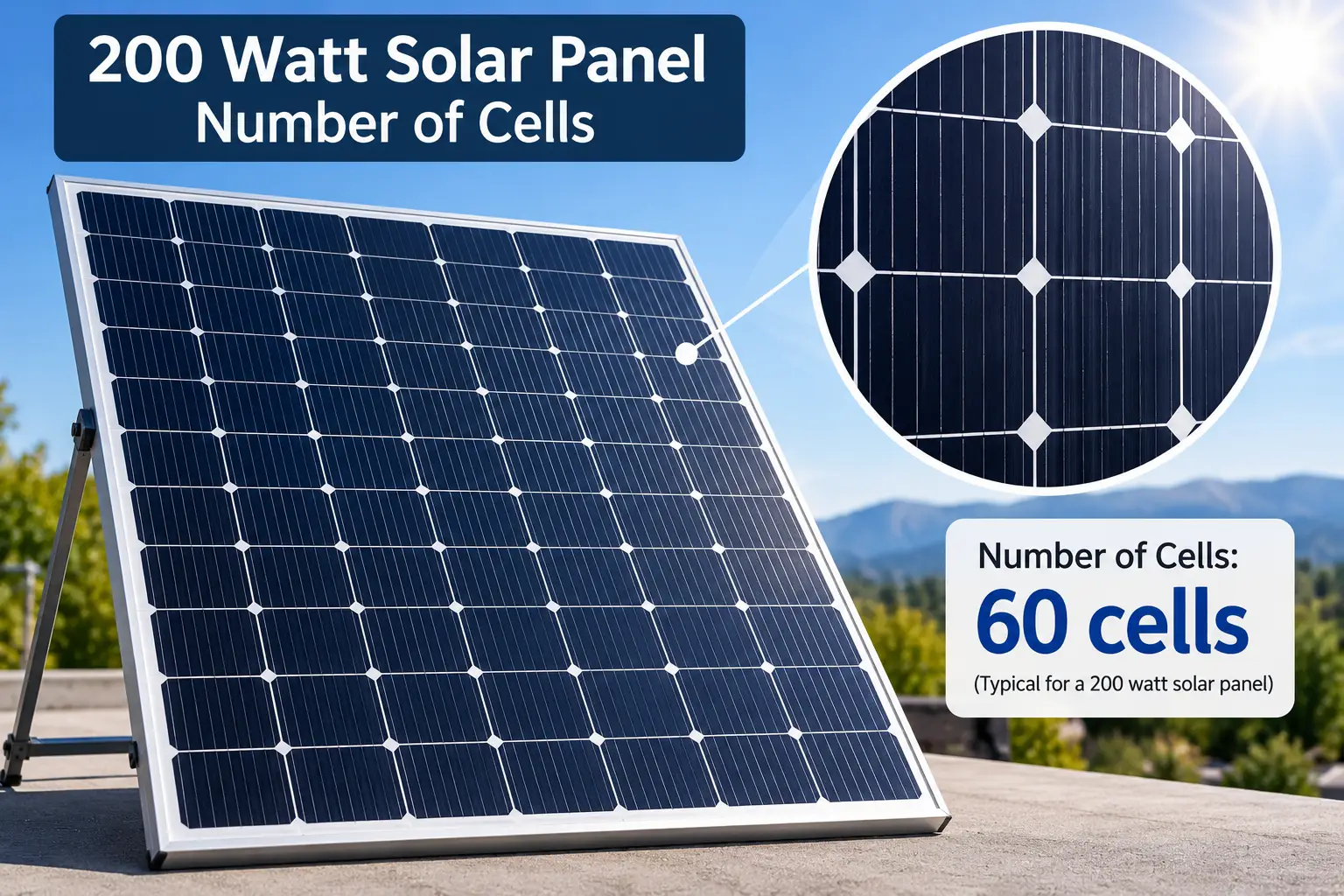
The 200 watt solar panel number of cells is how many silicon photovoltaic cells are wired together inside one 200W module. A traditional 12V panel uses 36 full cells or 72 half-cut cells. A 24V panel uses about 72 full-size-equivalent cells. Newer N-type panels built on larger wafers can reach 200W with roughly 30-40 cells.
That’s the snippet answer. The more useful answer takes a few more steps, and that’s why you’re here.
Cell count on its own isn’t a quality score. What it really tells you is voltage. According to the U.S. Energy Information Administration’s explainer on photovoltaics, the PV cell is the basic building block, and cells are grouped into panels and arrays to produce useful power. Every crystalline silicon cell adds roughly 0.6-0.7 volts of open-circuit voltage to the chain. So the number of cells wired in series decides whether a panel suits a 12V battery, a 24V battery, or a portable power station with a wide input window.
Here’s where many shoppers get tripped up. Two 200W panels can have very different cell counts, 30 or 72 for example, and still deliver the same wattage. Wattage depends on total cell area multiplied by efficiency. Voltage depends on the series count. Mix those two ideas up and you can end up with a panel that looks fine on paper but won’t fully charge your battery through a cheap PWM controller on a hot July afternoon.
In this guide, you’ll learn to read any spec sheet and work out the real cell layout, even when the manufacturer hides it. You’ll also get honest analysis of seven real 200W-class panels sold to US buyers, covering rigid, flexible, and folding designs. We work only from published spec sheets and real review data. There are no invented test results and no made-up testimonials, just the reasoning you need to buy the right panel the first time. ⚡
Quick Comparison: 7 Top 200W Panels at a Glance
| Panel | Cell Type | Voltage Class | Weight | Price Range | Best for |
|---|---|---|---|---|---|
| Renogy 200W N-Type 16BB | N-type, 16BB | 12V/24V | Lighter than Renogy’s prior 200W | $150-$200 | Renogy 200W N-Type 16BB: tight van roofs |
| Rich Solar MEGA 200 | N-type TOPCon, 16BB | 12V (24V MAX variant) | 24 lb | $200-$250 | Rich Solar MEGA 200: classic 12V builds |
| BougeRV 200W N-Type Bifacial | N-type TOPCon, bifacial | 12V or 24V | Mid-weight rigid | $160-$250 | BougeRV 200W N-Type Bifacial: raised mounts |
| Newpowa 200W 12V 9BB | Mono PERC, 210mm cells | 12V | Mid-weight rigid | Under $200 | Newpowa 200W 12V 9BB: budget DIY |
| Renogy 200W Flexible | Mono, 72 small cells | 12V | Very light | $280-$350 | Renogy 200W Flexible: curved roofs, boats |
| Jackery SolarSaga 200W | TOPCon, bifacial folding | Power-station input | ~14 lb | $400-$600 | Jackery SolarSaga 200W: Jackery owners |
| EcoFlow NextGen 220W Bifacial | TOPCon, bifacial folding | Power-station input | 15.4 lb | $300-$500 | EcoFlow NextGen 220W Bifacial: EcoFlow owners |
Prices are approximate ranges at the time of writing and change often. Check the current price before buying.
The pattern is easy to see. The rigid glass panels (Renogy 200W N-Type 16BB, Rich Solar MEGA 200, BougeRV 200W N-Type Bifacial, and Newpowa 200W 12V 9BB) cost the least per watt and suit permanent installs. The folding Jackery SolarSaga 200W and EcoFlow NextGen 220W Bifacial cost about twice as much because you’re paying for portability and plug-and-play cabling. The Renogy 200W Flexible is the specialty pick. It’s worth considering only when a flat glass panel physically can’t go where you need it.
💬 One click helps other shoppers make an informed choice too! 😊
Top 7 200W Solar Panels: Expert Analysis by Cell Layout
1. Renogy 200W N-Type 16BB — most compact rigid 200W
The Renogy 200W N-Type 16BB is built for buyers whose limiting factor is roof space rather than budget. Renogy says it is 7.5% smaller and 11.7% lighter than its previous 200W panel while keeping the same output.
The panel uses N-type cells with 16 busbars. Renogy rates them at 25% cell efficiency (module efficiency is always lower, so don’t compare the two numbers directly). In practice, more busbars mean shorter paths for current and less loss from micro-cracks, which matters on a vehicle that shakes down washboard roads. Renogy markets it as a 24V-class panel that can also work with 12V batteries. That tells you its series string is longer than a classic 36-cell 12V panel, so you should pair it with an MPPT controller rather than PWM.
Based on the specs, this suits Class B van owners and anyone expanding an existing 24V system. A beginner on a 12V PWM setup should look elsewhere.
In published reviews, one independent tester reported roughly 160-185W under clear midday sun, which is realistic for a 200W panel. Another review roundup noted buyers measuring output close to rating. Neither is lab-grade proof, but both are consistent.
Pros:
- ✅ Smaller footprint than most rigid 200W panels
- ✅ N-type cells handle heat better than older P-type
- ✅ Works with both 12V and 24V battery banks
Cons:
- ❌ Really needs an MPPT controller to shine
- ❌ Cell count isn’t prominent in marketing materials
At around $150-$200, it’s strong value for space-constrained builds. Check the current price, since Renogy runs frequent promotions.
2. Rich Solar MEGA 200 — textbook 12V spec sheet
The Rich Solar MEGA 200 is the panel to study if you want to learn what a “normal” 12V 200W spec sheet looks like, because its numbers line up well with 12V charging.
Its published ratings are 18.4V at maximum power (Vmp), 10.9A operating current, and 21.8V open-circuit voltage (Voc). An 18.4V Vmp gives enough headroom to push a 12V battery to its roughly 14.4V absorption voltage even after heat drags the voltage down. One authorized retailer lists 30 N-type TOPCon cells. At about 0.7V Voc per TOPCon cell, 30 cells works out to almost exactly the 21.8V rating, so the math checks out.
This is the panel for the classic RV or cabin builder running a 12V lithium or AGM bank. It’s also forgiving enough to work acceptably with a PWM controller. If you run 24V, Rich Solar sells the MEGA 200 MAX variant at 36.3V Vmp and 43.5V Voc, which is effectively a doubled series string.
We couldn’t verify a large pool of reviews for this exact N-type revision. On Rich Solar’s own site, verified buyers of the 24V MAX variant mention strong early-morning and late-afternoon production.
Pros:
- ✅ Clean 12V voltage window for simple systems
- ✅ Rated for 5400Pa snow and 35mm hail
- ✅ IP67 junction box and 14 pre-drilled holes
Cons:
- ❌ 24 lb is heavy for a single rooftop lift
- ❌ Full-size footprint compared with compact rivals
Priced around $200-$250, it’s fair value for a panel with this build rating.
3. BougeRV 200W N-Type Bifacial — free bonus watts from below
The BougeRV 200W N-Type Bifacial has a transparent back, so it can catch light reflected up from the surface underneath it. That’s a real advantage when you can mount it with an air gap.
BougeRV uses N-type TOPCon cells with 16 busbars and claims up to 25% cell efficiency. It rates rear-side gain at 80% bifaciality, meaning the back is up to 80% as sensitive as the front. In practice, the rear side only helps if light reaches it. Over white gravel, snow, or a light-colored deck you’ll see a meaningful bump. Bolted flat to a dark RV roof, you’ll see very little. The brand’s “up to 30% more output” is a best-case number, not a daily expectation. It sells 12V and 24V versions, so check which one you’re buying, because the cell string is different.
This is the pick for ground mounts, pergolas, and tilted racks. It’s also about 26% smaller than older 200W panels, according to BougeRV.
Deal listings show frequent promotional pricing, and retailer write-ups generally describe it as a compact, well-built panel. We found limited long-term reliability data, so treat durability claims as unproven beyond the warranty.
Pros:
- ✅ Rear-side generation on reflective surfaces
- ✅ Available in both 12V and 24V versions
- ✅ Compact footprint for a 200W rigid panel
Cons:
- ❌ Bifacial gain nearly disappears when flush-mounted
- ❌ Easy to order the wrong voltage version
Usually found in the $160-$250 range, it’s good value if your mount lets the back see daylight.
4. Newpowa 200W 12V 9BB — fewer, bigger cells for less money
The Newpowa 200W 12V 9BB shows how large 210mm wafers change the cell-count math. Bigger cells mean fewer of them are needed to reach 200W.
The listing describes 9-busbar 210mm cells in a module measuring about 47.24 × 34.57 inches. That’s shorter and wider than the typical 58-59-inch-long 200W panel, which can be exactly what solves an awkward roof layout. Larger cells carry more current each, so good MPPT tracking matters. Newpowa itself recommends a true MPPT controller. It’s also rated for 2400Pa wind and 5400Pa snow loads.
Based on the specs, this is a budget-minded DIYer’s panel, suited to shed and cabin systems where a slightly lower efficiency than N-type is an acceptable trade for a lower price. Its squarer shape also suits some Sprinter-style roof racks.
In individual US Amazon reviews we found, one buyer reported getting about 87% of rated output, and another noted cosmetic dents on arrival. The takeaway is simple: inspect every panel before you mount it.
Pros:
- ✅ Squarer shape fits some awkward roofs
- ✅ Budget pricing for a rigid 200W panel
- ✅ Strong snow-load rating for the price
Cons:
- ❌ P-type-era cells lose more output in heat
- ❌ Some buyers report shipping damage
Typically under $200, it offers some of the best watts-per-dollar here if you check it carefully on delivery.
5. Renogy 200W Flexible — bends where glass can’t
The Renogy 200W Flexible is for curved surfaces: boat bimini tops, rounded Airstream-style roofs, and places where drilling glass-panel mounts isn’t an option.
Its spec sheet is refreshingly transparent. It lists 72 monocrystalline cells arranged 18 × 4, each about 6.5 × 3.3 inches, along with 20.1V Vmp, 23.9V Voc, 10.02A operating current, and 16.7% module efficiency. The detail most buyers overlook is this: 72 cells in one series string would produce well over 40V, yet the Voc is 23.9V. So these small cells must be wired as parallel groups. The spec sheet doesn’t say this, but the math strongly suggests two parallel strings of about 36. That’s a standard 12V panel’s voltage built from smaller pieces.
Choose this if weight and curvature matter more than lifespan. It bends up to 240°, according to Renogy. The trade-off is lower efficiency (16.7%) and more heat buildup, because a flexible panel usually sits directly on the surface with no cooling air gap.
We couldn’t verify a large body of long-term reviews for the current revision. Across the flexible-panel category, the recurring complaint is faster degradation than glass panels, so plan accordingly.
Pros:
- ✅ Transparent spec sheet lists exact cell layout
- ✅ Mounts on curved roofs and boat canvas
- ✅ Much lighter than glass panels
Cons:
- ❌ Lower efficiency than rigid N-type panels
- ❌ Heat buildup when adhered flat
At around $280-$350, you’re paying a premium for flexibility, not for watts.
6. Jackery SolarSaga 200W — the native match for Jackery stations
The Jackery SolarSaga 200W makes the most sense if you already own a Jackery Explorer. The cabling, connectors, and voltage window are designed around those power stations.
The current version uses TOPCon cells rated at up to 25% efficiency with a bifacial design and an IP68 rating. It weighs about 14 lb. Built-in USB-A and USB-C ports let you top off a phone straight from the panel, which is handy at camp. Listed Voc figures vary between retailer spec sheets, roughly 22V to about 25V depending on revision. That suggests a 12V-class series string, which suits almost every power station’s input range. Still, check the label on your unit before pairing it with a non-Jackery device.
It’s aimed at campers, tailgaters, and people preparing for outages who want zero wiring decisions. It isn’t meant for a permanent roof.
One independent reviewer measured about 155W in clear conditions when running it into a third-party power station via an adapter. That’s typical of real-world output from portable panels.
Pros:
- ✅ Plug-and-play with Jackery Explorer stations
- ✅ IP68 rating with bifacial rear gain
- ✅ Built-in USB ports for small devices
Cons:
- ❌ Costs far more per watt than rigid panels
- ❌ Non-Jackery stations may need an adapter
Expect roughly $400-$600 (check the current price). That’s worth it for portability, but overkill for a fixed install.
7. EcoFlow NextGen 220W Bifacial — extra headroom for portables
The EcoFlow NextGen 220W Bifacial gives you 20 extra rated watts over a 200W panel, which helps offset the angle and heat losses every portable panel suffers.
EcoFlow rates the front at 220W and the rear at 175W, with TOPCon cells at up to 25% efficiency. The panel weighs 15.4 lb and is rated IP68. Its kickstand adjusts from 30 to 60 degrees and includes a built-in angle guide, which is the most underrated feature on the list. A portable panel propped at the wrong angle can easily lose a big share of its output, and the guide takes the guesswork out of aiming. It ships with an MC4-to-XT60i cable for EcoFlow stations.
This is the pick for EcoFlow owners, and a sensible one for anyone who wants a bit more than 200W in a folding format.
Retailer descriptions consistently highlight the compact fold and the angle guide. We couldn’t verify aggregated Amazon rating data for this revision, so check current reviews before buying.
Pros:
- ✅ 220W rating offsets real-world losses
- ✅ Built-in angle guide improves aiming
- ✅ Bifacial rear side adds reflected energy
Cons:
- ❌ Heavier than some folding rivals
- ❌ Best cable support is for EcoFlow stations
Usually $300-$500, it’s solid value for EcoFlow users, especially when bundled with a station.
Side-by-Side Spec Comparison
| Panel | Published Cell Info | Vmp / Voc | Best for |
|---|---|---|---|
| Rich Solar MEGA 200 | 30 N-type TOPCon (retailer listing) | 18.4V / 21.8V | Rich Solar MEGA 200: PWM-friendly 12V |
| Renogy 200W Flexible | 72 cells (18 × 4) | 20.1V / 23.9V | Renogy 200W Flexible: curved mounts |
| Older Renogy 200W rigid (datasheet) | 40 cells (4 × 10), 156mm | 21.0V / 24.1V | Reference: legacy 12V layout |
| Rich Solar MEGA 200 MAX (24V variant) | Doubled series string | 36.3V / 43.5V | Rich Solar MEGA 200 MAX: 24V banks |
This table makes the core lesson visible. Cell counts vary widely (30, 40, 72), yet the three 12V panels all land at a Voc of about 22-24V. That’s because they were designed to a voltage target, not a cell-count target. The 24V Rich Solar MEGA 200 MAX roughly doubles that voltage, which is why it needs an MPPT controller on a 12V battery.
✨ Found your match? Don’t wait for the sunny season!
🔍 Take your off-grid setup to the next level with this carefully curated lineup. Click a highlighted panel to check current pricing and availability, and start turning sunshine into free, quiet power you can count on! ☀️🔋
Getting Started: Read Any Spec Sheet and Find the Real Cell Count
Manufacturers don’t always print the cell count, but they always print voltage. That’s all you need.
Step 1: Find Voc
Look for “Open Circuit Voltage (Voc)” on the back label or datasheet.
Step 2: Divide by the per-cell voltage
Use about 0.6V per cell for older P-type/PERC cells and about 0.7V for N-type TOPCon. A 21.8V Voc ÷ 0.72 ≈ 30 TOPCon cells, which matches the Rich Solar MEGA 200 listing. A 24.1V Voc ÷ 0.6 ≈ 40 cells, which matches the legacy Renogy datasheet.
Step 3: Compare with the physical count
Count the cells you can see. If the visible count is roughly double your Step 2 result, the panel uses half-cut cells or small cells in parallel groups. The Renogy 200W Flexible is a clear example: 72 visible cells, but only about 36 in each series path.
Step 4: Check current
Divide 200W by Vmp. About 10-11A indicates a 12V-class panel, and about 5.5A indicates a 24V-class panel.
Common mistakes in your first 30 days
- ✅ Testing Voc on a cold morning and panicking. Voltage rises in cold weather, so a reading above the label is normal.
- ✅ Judging output at noon on a flat roof in winter. Low sun angle can cut production sharply.
- ✅ Skipping a quick visual check. Look for cracked glass or lifted junction-box seals before you mount the panel. That matters most with panels that arrived with dented boxes.
Doing this once teaches you something no product listing will: whether a panel’s voltage actually fits the battery and controller you already own.
Real-World Scenarios: Matching Cell Layout to Your Setup
Specs only matter once they meet your real use. Here are three common buyer profiles.
🚐 Profile 1: Weekend van camper, 12V lithium, PWM controller
Budget: under $250. Use: two to three weekends a month.
A PWM controller pulls the panel down to battery voltage, so every volt above about 15V is wasted. You want a classic 12V panel with Vmp around 18V. The Rich Solar MEGA 200 (18.4V Vmp) is the natural fit. Avoid 24V-class panels like the Renogy 200W N-Type 16BB unless you upgrade to MPPT, which is honestly a smart $80-$150 upgrade anyway.
🏡 Profile 2: Cabin owner, 24V battery bank, MPPT controller
Budget: $400-$600 for two panels. Use: daily, year-round.
Higher-voltage panels mean lower current, which means thinner, cheaper wire over long runs from a ground mount. Two BougeRV 200W N-Type Bifacial 24V panels on a tilted ground rack over light gravel would make good use of their rear-side gain. The Rich Solar MEGA 200 MAX is the monofacial alternative.
⛺ Profile 3: Power-station owner, emergency prep plus camping
Budget: $300-$600. Use: a few times a year, plus power outages.
Cell layout matters less here, because modern power stations accept wide voltage ranges. Brand ecosystem matters more. Match the Jackery SolarSaga 200W to a Jackery and the EcoFlow NextGen 220W Bifacial to an EcoFlow to avoid adapter headaches.
The key insight across all three profiles is that your controller determines how much cell count matters, far more than the panel brand does.
Problem → Solution: Fixing Common 200W Panel Headaches
Problem 1: “My 200W panel only makes 120W.” Solution: Check the angle, temperature, and time of day first. A panel at 60°C cell temperature loses a noticeable chunk of output. With a temperature coefficient around -0.3% to -0.38%/°C, a panel 35°C above standard test conditions can lose roughly 10-13%. N-type panels like the Renogy 200W N-Type 16BB lose less than older P-type panels.
Problem 2: “Output collapses when a vent pipe shades one corner.” Solution: Bypass diodes route current around shaded cell groups, but most panels have only 2-3 diodes. Shading a single cell can knock out a whole group. Move the panel, or choose a design with more subdivision. BougeRV’s ShadePower 200W variant advertises 24 bypass diodes for this exact problem.
Problem 3: “My battery never reaches full charge on hot days.” Solution: This is a classic sign of too few cells in series for a PWM controller. Heat lowers voltage until Vmp drops close to battery voltage. Switch to MPPT, or use a panel with more voltage headroom.
Problem 4: “My flexible panel lost output after two summers.” Solution: Flat-adhered flexible panels like the Renogy 200W Flexible run hot. Add a thin corrugated spacer or mount them on standoffs where possible to let air circulate.
Problem 5: “The power station shows an input error.” Solution: Series-connecting two 24V-class panels can exceed a station’s maximum input voltage. Add up the Voc values and compare the total against the station’s limit before wiring.
How Many Cells in a 200 Watt Solar Panel? 36, 40, 72, or 30?
The honest answer to how many cells in a 200 watt solar panel is: it depends on the cell size and the target voltage. Here are the four layouts you’ll actually see on US shelves in 2026.
36 full cells (the classic 12V layout)
This is the original design for charging a 12V battery. It gives about 18V Vmp and about 21-22V Voc. Early 200W panels built this way used large 156mm-class cells.
40 full cells
This is a slightly longer string that adds voltage headroom for hot climates. The legacy Renogy 200W datasheet (4 × 10 layout, 21.0V Vmp) is a good example.
72 half-cut or small cells
This layout looks like a lot of cells, but it’s electrically similar to 36. The cells are cut in half and wired as two parallel groups, so the voltage stays at 12V-class while each cell carries half the current. The Renogy 200W Flexible follows this pattern.
~30 large N-type cells
Big modern wafers (182-210mm) with higher per-cell voltage can reach 12V-class voltage with fewer cells. The Rich Solar MEGA 200 listing shows 30.
For 24V-class panels, you’ll typically see a doubled series string, around 72 full-size-equivalent cells or more. The takeaway: never assume a higher cell count means more power. The NREL photovoltaics research overview is a good primer on why cell efficiency and area, not the count, drive power output.
36 Cell vs 72 Cell Solar Panel: Traditional vs Modern Designs
The 36 cell vs 72 cell solar panel debate is really a comparison between old full-cell design and modern half-cut design. It helps to separate the two meanings of “72 cells.”
| Feature | Traditional 36 Full-Cell (P-type) | Modern 72 Half-Cut / N-type | Best for |
|---|---|---|---|
| Voltage class | 12V | 12V (parallel halves) or 24V (series) | Match to your battery |
| Current per cell | Full current | Half current, so about ¼ the resistive loss | Hot climates |
| Partial-shade behavior | Whole string suffers | Top/bottom halves work independently | Shaded roofs |
| Heat loss (temp. coefficient) | Higher | Lower with N-type | Summer-heavy use |
| Example | Legacy full-cell panels | Renogy 200W Flexible layout; BougeRV 200W N-Type Bifacial | Most buyers in 2026 |
The half-cut advantage comes from basic physics. Resistive loss scales with the square of current, so halving the current in each cell cuts that loss to about a quarter. That’s why a half-cut cell solar panel usually runs cooler and resists hotspots better. The practical takeaway: a 72 half-cut panel and a 36 full-cell panel can both be “12V,” but the half-cut design typically handles shade and heat more gracefully. That makes it the better default in 2026 unless you’re buying purely on price.
How to Choose a 200 Watt Panel by Cell Count (7 Steps)
- Start with your battery voltage. A 12V bank calls for a 12V-class panel, unless you’re using MPPT.
- Identify your controller. With PWM, stick to a Vmp of about 17-21V. With MPPT, a higher-voltage 24V-class panel works and cuts wire losses.
- Estimate the series cell count from Voc. Divide Voc by 0.6-0.7V. This reveals the real string length even when the cell count isn’t listed.
- Prefer half-cut or N-type cells for shade and heat. They lose less when conditions aren’t perfect, which is most of the time.
- Check the physical size against your roof or rack. 200 watt solar panel size varies more than you’d expect. Glass panels here range from about 47 × 35 inches (Newpowa 200W 12V 9BB) to about 59 × 27 inches (Rich Solar MEGA 200).
- Compare weight if you’re lifting it yourself. Rigid panels in this class often weigh 20-25 lb, while folding panels come in around 14-16 lb.
- Read the warranty terms, not just their length. “25-year 80% output” is standard. The workmanship warranty (for example, Renogy’s 10 years versus shorter terms elsewhere) is what covers junction boxes and frames.
Follow these steps in order and you’ll rarely end up with a mismatched system. Most mistakes happen when buyers start at Step 5 (looks and size) and skip Steps 1-3.
200W Solar Panel Voltage, Cell Count, and Your Charge Controller
200W solar panel voltage is where cell count turns into a practical decision, so it’s worth slowing down here.
PWM controllers: cell count matters a lot
A PWM controller acts like a switch. It connects the panel directly to the battery and pulls panel voltage down to battery voltage. If your panel’s Vmp is 18.4V and your battery sits at 13.2V, the extra voltage is simply lost. In that case, a 36-cell-equivalent panel is close to ideal. A 24V-class panel on PWM wastes roughly half its potential output.
MPPT controllers: cell count matters less
An MPPT controller converts excess voltage into extra charging current. With MPPT, a 24V-class panel like the Rich Solar MEGA 200 MAX (36.3V Vmp) charges a 12V battery efficiently. You also get the bonus of lower current in the wires, which reduces voltage drop on long cable runs.
Power stations: built-in MPPT, but with a voltage ceiling
Portable stations include MPPT, so the Jackery SolarSaga 200W and EcoFlow NextGen 220W Bifacial don’t care much about cell layout. They do enforce a maximum input voltage, though. Two 24V-class panels in series (about 87V combined Voc) can exceed some stations’ limits.
The practical rule: if you’re not sure which controller you’ll end up with, a 12V-class panel is the safer purchase, because it works on both PWM and MPPT.
Features That Actually Matter (and Ones That Don’t)
✅ Features that matter
- Temperature coefficient. It shapes real summer output. The difference between -0.29%/°C and -0.38%/°C looks tiny, but on a 65°C roof it adds up to several watts, every sunny hour, for years.
- Workmanship warranty length. Junction boxes and connectors are what usually fail first, not the cells.
- Snow and wind load ratings. A 5400Pa snow rating (as on the Rich Solar MEGA 200) matters a lot in northern states.
- Honest voltage specs. You need Voc and Vmp to design anything. Be wary of any listing that omits them.
❌ Features that are overhyped
- “25% efficiency” headlines. This is usually cell efficiency. Module efficiency is typically 19-22% for rigid panels, and 16.7% for the Renogy 200W Flexible.
- Busbar count as a selling point on its own. 16BB versus 9BB is a real improvement, but it’s a small one. It won’t rescue a poorly angled panel.
- Maximum bifacial gain claims. Those figures assume bright reflective surfaces and elevated mounting. Flush-mounted on a dark roof, the gain from the BougeRV 200W N-Type Bifacial is minimal.
- Raw cell count. As this guide has shown, 30 cells can match 72 cells on power.
Long-Term Cost and Maintenance
| Panel | Approx. Price Range | Est. $/Watt | Best for |
|---|---|---|---|
| Newpowa 200W 12V 9BB | Under $200 | ~$0.70-$1.00 | Newpowa 200W 12V 9BB: lowest upfront cost |
| Renogy 200W N-Type 16BB | $150-$200 | ~$0.75-$1.00 | Renogy 200W N-Type 16BB: value plus heat tolerance |
| Rich Solar MEGA 200 | $200-$250 | ~$1.00-$1.25 | Rich Solar MEGA 200: harsh-weather durability |
| EcoFlow NextGen 220W Bifacial | $300-$500 | ~$1.35-$2.25 | EcoFlow NextGen 220W Bifacial: portable value |
A rigid 200W panel sized for your location might produce very roughly 250-350 kWh a year. You can model your own ZIP code with NREL’s free PVWatts calculator. Spread across a 20-plus-year life, that brings the cost per kWh generated by a sub-$250 rigid panel down to pennies. Portable panels cost more per watt and typically see fewer sun-hours of use, so their long-term payback is weaker. You’re buying flexibility, not return on investment.
Maintenance schedule
- Monthly: Rinse off dust and bird droppings with plain water and a soft brush. Skip pressure washers.
- Seasonally: Check MC4 connectors for corrosion, and check mounting bolts for looseness, especially on vehicles.
- Yearly: Measure Voc on a clear day and compare it with last year’s reading. A steady drop beyond normal degradation (well under 1% a year for quality panels) is an early warning sign.
Safety, Regulations, and Standards
A 200W panel seems small, but its DC voltage and current still deserve respect.
Listings to look for
In the US, look for a UL 61730 listing (the safety standard for PV modules). Many quality panels also carry IEC 61215 performance testing. Home-attached installations that require inspection generally need listed equipment. Several panels in this guide (for example, the Rich Solar MEGA 200 MAX) advertise UL certification.
Cold-weather voltage
The National Electrical Code (NEC) Article 690 requires you to calculate maximum system voltage at the lowest expected temperature, because voltage rises in the cold. A panel rated at 21.8V Voc can exceed that on a frigid January morning. When you wire multiple panels in series, calculate against the lowest local temperature, not the label.
Fusing and wiring
Respect the panel’s maximum series fuse rating (15A is common in this class). Use properly rated PV wire, and add a breaker or fuse between the controller and the battery.
Vehicles and boats
Mechanical attachment matters as much as electrical safety. Use through-bolted or VHB-rated mounts designed for highway speeds, and seal every roof penetration.
If your project connects to your home’s wiring or the grid, check your local permitting rules and hire a licensed electrician. Requirements vary by state and utility.
FAQ: 200 Watt Solar Panel Number of Cells
❓ Is a 200 watt solar panel with 72 cells better than one with 36 cells?
❓ Can I buy a 200 watt solar panel number of cells listing directly on Amazon?
❓ What size battery pairs with a 200W solar panel?
❓ Should I buy one 200W panel or two 100W panels?
❓ Do N-type 200W panels last longer than PERC panels?
Conclusion: Cell Count Is a Voltage Clue, Not a Power Score
If you remember one thing, make it this: the 200 watt solar panel number of cells is mainly a clue about voltage, not a measure of quality or power. Thirty large TOPCon cells, forty classic cells, and seventy-two half-cut cells can all produce 200W. What changes is whether the panel fits your battery, your controller, and your climate.
Here’s the short version of our analysis:
- Classic 12V with any controller: the Rich Solar MEGA 200
- Tight roof plus MPPT: the Renogy 200W N-Type 16BB
- Reflective ground mount: the BougeRV 200W N-Type Bifacial
- Stretching every dollar: the Newpowa 200W 12V 9BB
- Curves and weight limits: the Renogy 200W Flexible
- Power-station owners: stay in your ecosystem with the Jackery SolarSaga 200W or EcoFlow NextGen 220W Bifacial
Before you click “buy,” do the 30-second check from this guide. Find the Voc, divide by the per-cell voltage, and confirm the result matches your controller. For a deeper dive into how cells work, the Wikipedia article on solar cells is a solid technical reference.
Get the voltage right, and your panel will quietly earn its keep for decades. ☀️
🚀 Ready to power up the smart way?
🔍 Take your solar setup to the next level with a panel that truly fits your system. Click any highlighted panel above to check current pricing and availability. These picks will help you enjoy reliable, quiet off-grid power on every trip and through every outage! ⚡🔋
Recommended for You
- 1 Kilowatt Solar Panel: 7 Best Picks That Actually Deliver in 2026
- 15k Generator 2026: 7 Best Proven Picks for Whole-Home Backup
- Solar Power Inverter for RV: 7 Best Picks That Won’t Fail (2026)
Disclaimer: This post contains affiliate links. As an Amazon Associate, I earn from qualifying purchases made through these links, at no additional cost to you.
✨ Found this article helpful? Share it with someone who needs it! 💬🤗
