
In This Article
Picture this: you’re boondocking in the desert, it’s pushing 95°F, and the generator is either out of fuel or simply too loud for the quiet campsite you fought for. That’s the exact moment an inverter for rv ac earns its keep. It’s the box that turns the DC power sitting in your battery bank into the clean AC power your rooftop air conditioner’s compressor actually needs to spin up and keep spinning, no shore power or generator required.
Most RV owners don’t think much about their inverter for rv ac until the day the air conditioner won’t start on a small generator, or the battery bank drains to nothing in under an hour. This guide walks through seven real, currently available pure sine wave inverters capable of running an RV air conditioner, breaks down the wattage math nobody bothers to explain clearly, and digs into the soft-start trick that lets a smaller, cheaper inverter punch above its weight class. Whether you’re outfitting a teardrop with a single 13,500 BTU rooftop unit or a Class A with dual air conditioners, you’ll walk away knowing which inverter actually fits your rig — and why the others don’t.
Along the way, we’ll cover how surge wattage differs from continuous wattage, how a soft starter changes your sizing math entirely, and how to sidestep the single most expensive mistake first-time buyers make: undersizing the system and frying a budget inverter on day one.
What Is an Inverter for RV AC?
An inverter for rv ac is a pure sine wave power inverter, typically rated 2,000-3,000 watts continuous, that converts 12V or 24V DC battery power into 120V AC power clean enough to start and run an RV rooftop or mini-split air conditioner’s compressor motor without shore power or a generator running.
The key word is “pure sine wave.” A power inverter works by switching DC current back and forth to approximate an AC waveform, and how cleanly it does that determines whether a motor-driven appliance like an air conditioner compressor starts smoothly or struggles, overheats, and eventually fails. Cheaper “modified sine wave” units skip the extra filtering circuitry, which keeps the price low but leaves compressor motors running hotter and less efficiently over time — something we’ll unpack later in this guide.
Quick Comparison: Top Inverters for RV AC at a Glance
| Inverter | Continuous / Surge Power | Best For |
|---|---|---|
| Renogy PUH 3000W | 3000W / 6000W | Best overall pick |
| Victron MultiPlus-II 3000VA | 2400W / 4800W+ | Best high-end system |
| AIMS Power 3000W Inverter Charger | 3000W / 6000-9000W | Most rugged, industrial |
| Xantrex Freedom XC 2000 | 2000W / 4000W | Best compact, single AC |
| Go Power GP-ISW3000-12 | 3000W / 6000W | Best RV-industry OEM pick |
| LiTime 3000W Inverter | 3000W / 6000W | Best budget value |
| BELTTT 3000W Inverter | 3000W / 6000W | Best lightweight backup |
Looking at the table, notice that continuous wattage clusters around 2,000-3,000W across nearly every serious contender — that’s not a coincidence, it’s roughly what most 13,500 BTU rooftop RV air conditioners need once you account for compressor startup. The real differentiator isn’t raw wattage; it’s surge capacity, build quality, and whether the unit includes a transfer switch and smart charger baked in. Xantrex Freedom XC 2000 sits lower on continuous power but earns its spot because, paired with a soft starter (more on that below), 2,000W continuous is plenty for a single rooftop unit.
💬 Ready to stop sweating through your boondocking trips? Check today’s pricing on any of these picks below before you head out! 😊
Top 7 Inverters for RV AC: Expert Analysis
Before diving into each pick, here’s the fuller picture — features, approximate price range, and where each inverter actually shines.
| Inverter | Key Feature | Price Range | Best For |
|---|---|---|---|
| Renogy PUH 3000W | Built-in transfer switch + Bluetooth | around $450-$550 | All-around RV setups |
| Victron MultiPlus-II 3000VA | PowerAssist load-sharing | around $1,300-$1,600 | Full-time / off-grid living |
| AIMS Power 3000W Inverter Charger | ETL-listed, 100A charger | around $600-$750 | Heavy-duty, frequent boondocking |
| Xantrex Freedom XC 2000 | Compact 2-second surge design | around $750-$950 | Single AC, tight storage bays |
| Go Power GP-ISW3000-12 | RV-industry ecosystem integration | around $850-$1,050 | Newer PowerTrak-equipped RVs |
| LiTime 3000W Inverter | Budget pure sine wave | under $250 | Budget-conscious first upgrade |
| BELTTT 3000W Inverter | 23-ft wired remote, dual outlets | around $220-$300 | Backup / secondary system |
The gap between the LiTime 3000W Inverter and the Victron MultiPlus-II 3000VA is roughly six-fold in price, but the extra money buys battery-charging sophistication, remote monitoring depth, and multi-unit parallel capability that casual weekend campers simply don’t need. For most RV owners running one rooftop AC a few nights a month, the Renogy PUH 3000W or AIMS Power 3000W Inverter Charger land in the sweet spot between capability and cost.
1. Renogy PUH 3000W Pure Sine Wave Inverter — best all-around RV pick
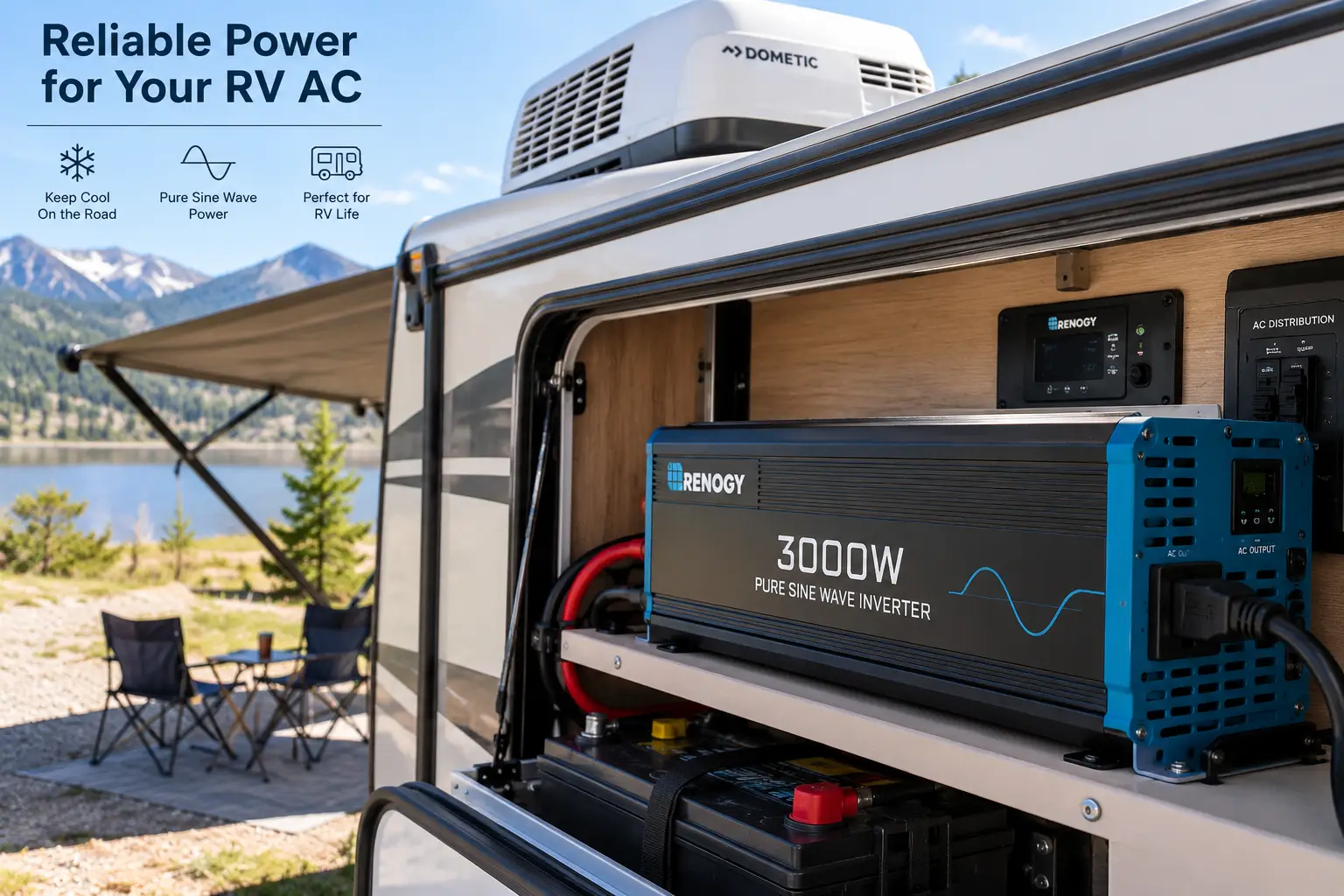
The Renogy PUH 3000W earns the top overall spot because it bundles the three things most RV owners shop for separately: a 3000W pure sine wave inverter, a built-in transfer switch, and Bluetooth monitoring, all in one enclosure. That transfer switch matters more than it sounds — it automatically flips between shore power and battery power in milliseconds, so your air conditioner never hiccups when you plug into a campground pedestal.
On paper, the 6000W surge rating and 92% efficiency mean less battery drain converting power to heat, which on a 2-3 day off-grid trip can translate to noticeably more usable runtime. The Renogy app displays real-time wattage draw, letting you spot which appliance is your actual power hog instead of guessing.
This model is the right call for RV owners who want a single unit that “just works” without a separate transfer switch purchase, and who value being able to check inverter status from their phone rather than walking out to the storage bay. Reviews consistently report reliable startup performance on 13,500 BTU rooftop units, with occasional notes that the cooling fan runs audibly under sustained heavy load.
Pros:
- ✅ Built-in 30A transfer switch included
- ✅ Bluetooth app monitoring of real-time load
- ✅ Supports lithium, AGM, gel, and flooded batteries
Cons:
- ❌ Fan noise noticeable under continuous heavy draw
- ❌ Remote control cable length limits mounting flexibility
Expect the Renogy PUH 3000W in the $450 to $550 range at the time of writing, which is a strong value proposition once you factor in the transfer switch most competitors sell separately.
2. Victron MultiPlus-II 3000VA — best for full-time, off-grid living
The Victron MultiPlus-II 3000VA is the inverter serious off-gridders graduate to, and the reason is PowerAssist: it blends inverter power with whatever limited shore power or generator input you have, preventing the nuisance breaker trips that plague smaller systems when the AC and microwave both kick on.
Its 2400W continuous rating at moderate temperatures sounds lower than the 3000W competitors, but Victron’s engineering means that number is a genuinely reliable continuous figure rather than an optimistic peak dressed up as continuous — a distinction reviewers who’ve compared multiple brands repeatedly flag as the difference between “rated” and “actually usable” wattage. Up to six units can be paralleled for larger rigs running dual rooftop ACs, which no other inverter on this list supports natively.
This is the pick for full-time RVers and serious boondockers who view their electrical system as infrastructure, not an accessory — the kind of buyer who wants VRM remote monitoring from anywhere and doesn’t blink at professional installation. Reviews and RV forum threads consistently describe multi-year reliability with minimal service issues, though the learning curve for configuration is real.
Pros:
- ✅ PowerAssist prevents shore power breaker trips
- ✅ Parallel/stackable up to six units for big rigs
- ✅ UL458-certified, professional-grade build quality
Cons:
- ❌ Premium price relative to every other pick here
- ❌ Configuration complexity intimidates casual DIY installers
Expect the Victron MultiPlus-II 3000VA to run in the $1,300 to $1,600 range, making it the priciest pick — but for full-timers, the total cost of ownership often comes out ahead once you factor in fewer failures and better battery longevity.
3. AIMS Power 3000W Pure Sine Inverter Charger — most rugged, industrial-grade build
The AIMS Power 3000W Inverter Charger (model PICOGLF30W12V120V) leans into low-frequency, transformer-based architecture rather than the lighter high-frequency designs most competitors use. In practice, that means a heavier unit, but also one that tends to shrug off sustained heavy loads and voltage sag better than lighter-weight alternatives.
The 100A multi-stage smart charger with power-factor correction pulls 20-30% less energy from AC input than a standard charger when recharging your battery bank, which matters if you’re topping off from a small portable generator and don’t want to trip its breaker. ETL listing to UL 458 standards backs the 2-year warranty with real third-party safety verification, not just a marketing claim.
This is the inverter for buyers who prioritize brute reliability over sleek design — food truck operators, overlanders, and full-timers who’ve had a lighter-duty inverter fail on them before. Reviews commonly praise the charger’s ability to recover a depleted battery bank quickly, with occasional mentions that the unit runs warm and benefits from generous ventilation clearance.
Pros:
- ✅ Power-factor corrected 100A charger saves generator fuel
- ✅ ETL listed to UL 458 safety standard
- ✅ Handles gel, AGM, lead-acid, and lithium batteries
Cons:
- ❌ Heavier and bulkier than high-frequency competitors
- ❌ Runs warmer under sustained load, needs airflow
The AIMS Power 3000W Inverter Charger typically lands around $600 to $750, a reasonable middle ground between the budget picks and the Victron’s premium tier.
4. Xantrex Freedom XC 2000 — best compact pick for a single AC unit
The Xantrex Freedom XC 2000 proves that you don’t always need 3000W to run one rooftop AC. Its 2000W continuous rating with a 4000W, 2-second surge is enough to start and run most 13,500 BTU units, especially when paired with a soft starter, and the compact 15.4″ x 10.8″ x 4″ footprint fits storage bays where bigger inverters simply won’t.
What most buyers overlook with this model is the extended surge rating designed specifically around inductive loads — refrigerators and AC compressors — rather than a generic peak number that only holds for a fraction of a second. The built-in 30A transfer switch and ignition-control feature (which can power the inverter down automatically when the engine turns off) protect against accidental battery drain, a common complaint with cheaper units that lack this safeguard.
This is the right choice for owners of smaller trailers and truck campers with one AC unit and limited storage space, who don’t need — or want to pay for — 3000W of headroom they’ll rarely use. Reviews frequently mention long-term reliability across temperature extremes, since the unit is rated for full output from -4°F to 104°F.
Pros:
- ✅ Compact footprint fits tight storage bays
- ✅ Ignition control prevents accidental battery drain
- ✅ Rated for full output across extreme temperatures
Cons:
- ❌ 2000W ceiling means no headroom for a second AC
- ❌ Optional Bluetooth remote panel sold separately
Pricing on the Xantrex Freedom XC 2000 generally falls in the $750 to $950 range, putting it above budget inverters but below premium full-system units — fair for its niche.
5. Go Power GP-ISW3000-12 — best pick for newer, ecosystem-connected RVs
The Go Power GP-ISW3000-12 is the inverter you’ll find pre-installed in a growing number of newer travel trailers, and for good reason: it’s PowerTrak compatible, meaning it talks natively to Go Power solar controllers, lithium battery managers, and Dometic’s monitoring app if your rig already has that ecosystem.
Dual GFCI receptacles with full overload protection and a thermostatically controlled cooling fan round out a design built specifically for RV duty cycles rather than adapted from generic off-grid use. The 6000W surge handles rooftop AC startup reliably, and reviewers on RV forums consistently note that OEM integration — being able to see inverter status alongside solar and battery data on one screen — is the standout feature over standalone competitors.
This pick makes the most sense for owners whose RV already shipped with Go Power or Dometic components, since the ecosystem payoff (one app, one dashboard) is the entire value proposition; buying it standalone for a rig with unrelated brands sacrifices that advantage. Feedback on long-term durability is generally positive, with occasional notes that replacement remotes and accessories carry a premium price tag.
Pros:
- ✅ Native integration with Go Power and Dometic apps
- ✅ Dual GFCI outlets with overload protection
- ✅ RV-duty-cycle-specific engineering, not adapted marine gear
Cons:
- ❌ Ecosystem lock-in reduces value outside Go Power setups
- ❌ Replacement accessories priced at a premium
Expect the Go Power GP-ISW3000-12 in the $850 to $1,050 range, positioning it as a mid-to-upper-tier choice best justified by existing ecosystem compatibility.
6. LiTime 3000W Pure Sine Wave Inverter — best budget value pick
The LiTime 3000W Inverter is proof that a genuinely usable pure sine wave inverter doesn’t have to break $250. With a 6000W surge rating, LCD remote control, and both USB-A and USB-C charging ports, it covers the essentials without the premium features — Bluetooth app control, built-in transfer switch — that drive up the price elsewhere on this list.
The tradeoff for that price is manual switching between shore power and inverter power rather than an automatic transfer switch, and a more basic charging profile than the multi-stage smart chargers found on pricier inverter/charger combo units. Silent adaptive cooling keeps noise under 20dB with the fan off, rising to a still-reasonable 60dB under heavy load — worth knowing if you’re running your AC overnight near a sleeping area.
This is the pick for budget-conscious buyers testing whether an inverter-powered AC setup fits their camping style before investing in a premium system, or for anyone supplementing an existing setup with a lightweight backup unit. Reviews consistently describe it as reliable for its price point, running microwaves, laptops, and a single rooftop AC without issue, with occasional reports of shorter lifespan under daily heavy-duty commercial use.
Pros:
- ✅ Full 6000W surge rating at a budget price
- ✅ USB-A and USB-C charging built in
- ✅ Quiet adaptive cooling fan design
Cons:
- ❌ No automatic transfer switch, manual only
- ❌ Basic charging profile compared to premium units
At under $250, the LiTime 3000W Inverter delivers strong value-for-money for anyone easing into off-grid AC power without a big upfront commitment.
7. BELTTT 3000W Pure Sine Wave Inverter — best lightweight backup system
The BELTTT 3000W Inverter rounds out this list as a genuinely solid secondary or backup unit, distinguished by its unusually long 23-foot wired remote control — handy if your battery bank lives in a rear storage bay far from where you’d want a status display. Dual AC outlets plus a 20A hardwire port give installation flexibility that some budget competitors skip.
Its LCD display shows real-time input voltage, output wattage, and battery percentage, translating what would otherwise be an abstract number into something you can act on before your battery bank hits a critical low. The 6000W surge capacity handles AC compressor startup reliably for a unit in this price tier, though the lack of an integrated charger means you’ll need a separate converter or charge controller if you don’t already have one.
This inverter suits buyers who already have a charging system in place (solar, alternator charging, or an existing converter) and just need a dedicated, no-frills inverter for running the AC and a few other loads — or anyone who wants a spare unit as insurance against their primary inverter failing mid-trip. Reviews commonly praise the remote cable length and straightforward setup, with some noting the plastic casing feels less premium than metal-bodied competitors.
Pros:
- ✅ 23-ft wired remote reaches distant storage bays
- ✅ Dual AC outlets plus hardwire port
- ✅ Real-time LCD monitoring of voltage and load
Cons:
- ❌ No built-in battery charger
- ❌ Plastic housing feels less durable than metal units
Pricing typically sits in the $220 to $300 range, making the BELTTT 3000W Inverter a smart secondary-system or backup purchase rather than most buyers’ sole inverter.
How to Size an Inverter for RV AC
Getting the wattage math right the first time saves you from either overspending on capacity you’ll never use, or worse, buying an inverter that trips offline the first time your compressor kicks on. Here’s the process:
- Find your AC’s running and starting watts. Check the nameplate on your rooftop unit — a typical 13,500 BTU RV AC draws roughly 1,200-1,500 running watts and 1,800-2,800 starting watts without a soft starter.
- Add your other simultaneous loads. Tally anything likely to run at the same time — a residential fridge (600-800W), a microwave (800-1,200W), or charging electronics.
- Compare against continuous, not surge, ratings. An inverter’s surge number only holds for a few seconds; your day-to-day comfort depends on the continuous rating covering your running watts plus margin.
- Size 20-25% above your calculated load. This buffer absorbs voltage sag, temperature derating, and the reality that inverters rarely hit their rated efficiency in real-world heat.
- Decide if a soft starter changes your math. Cutting starting-watt demand by 65-75% can let a 2000W inverter do what would otherwise require 3000W — see the dedicated section below.
- Match your battery bank’s discharge capacity. A university extension guide on off-grid solar system components is a useful primer if you’re building or upgrading a battery bank alongside your inverter purchase — undersized wiring or battery capacity can bottleneck even the best inverter.
- Confirm inverter and battery bank voltage match. A 12V inverter needs a 12V bank; mismatches here are one of the most common wiring mistakes in DIY installs.
Getting Your RV AC Running on Inverter Power: A Practical Setup Guide
Once you’ve picked an inverter, the install itself determines whether it performs to spec or underdelivers. Start by mounting the unit in a ventilated storage bay, away from where it can get wet, with at least a few inches of clearance on all sides for airflow — inverters derate output as internal temperature climbs, so a cramped, poorly ventilated bay can quietly cost you hundreds of watts of usable capacity.
Cable gauge matters more than most first-timers expect. Undersized DC cable between your battery bank and inverter creates voltage drop that shows up as an inverter that “should” handle your AC on paper but trips or underperforms in practice; most 3000W 12V inverters need 2/0 AWG cable or heavier for runs under 5 feet. A fused disconnect between the battery and inverter is non-negotiable for safety, not optional.
Here’s a common power-source comparison worth understanding before you commit:
| Power Source | Noise Level | Runs AC Continuously? | Best For |
|---|---|---|---|
| Inverter + battery bank | Silent | Limited by battery capacity | Quiet campsites, short cycles |
| Portable inverter generator | Moderate (50-55 dBA) | Yes, fuel-dependent | Extended off-grid stays |
| Traditional open-frame generator | Loud (65+ dBA) | Yes, fuel-dependent | Budget backup, non-sensitive loads |
The table makes the tradeoff clear: an inverter-and-battery system wins on silence and simplicity but is ultimately capped by how much energy you’ve stored, while a generator trades noise for indefinite runtime. Most serious boondockers eventually run both — battery power for quiet overnight AC cycling, generator backup for battery recovery and extended heat waves.
In your first 30 days, avoid the two most common new-owner mistakes: running the AC continuously without monitoring your battery’s state of charge, and skipping a load test before your first real off-grid trip. Start the AC on inverter power at home first, note the wattage draw on your inverter’s display, and you’ll have a real baseline instead of a guess.
Real-World Scenarios: Matching the Right Inverter to Your Camping Style
The weekend warrior. A couple with a 22-foot travel trailer, one 13,500 BTU rooftop AC, and a 200Ah lithium battery bank, camping 4-6 nights a month at developed campgrounds with occasional off-grid stops. The LiTime 3000W Inverter or BELTTT 3000W Inverter covers this use case comfortably — moderate AC runtime, no need for automatic transfer switching since they’re rarely relying on it overnight.
The frequent boondocker. A solo full-timer in a van or small Class C who dry camps 2-3 weeks a month in hot climates, running the AC for sleep comfort most nights. This buyer needs the reliability and charger sophistication of the Renogy PUH 3000W or AIMS Power 3000W Inverter Charger, paired with a soft starter to stretch battery runtime across multiple nights without a generator.
The full-time off-grid family. A family of four in a fifth wheel with dual rooftop ACs, living off-grid most of the year with substantial solar input. Here, the Victron MultiPlus-II 3000VA‘s parallel capability and PowerAssist load-sharing aren’t luxuries — they’re the only realistic way to run two AC units without constant breaker trips or an oversized, expensive single unit.
✨ Not sure which scenario fits your setup? Compare specs side-by-side and lock in your pick before your next hot-weather trip.
Soft Start Technology: The Fix for Running RV AC on a Smaller Inverter
Here’s a problem every inverter-for-rv-ac shopper eventually runs into: your air conditioner’s compressor draws 3-9 times its running wattage for a split second at startup — locked-rotor amperage, in electrical terms — and that spike is what forces buyers toward bigger, pricier inverters than their day-to-day running load actually requires.
The solution is a soft starter, and the Micro-Air EasyStart 364 is the category leader for RV applications. It sits between your AC’s compressor and its power supply, using a self-optimizing 4-part start ramp to reduce that startup current spike by 65-75% compared to the compressor’s unmanaged locked-rotor amperage. In practice, that means an inverter or even a small Honda-class generator that couldn’t start your AC unassisted suddenly can — reviewers consistently report AC units starting reliably on setups that previously tripped breakers or stalled out.
Beyond enabling smaller inverters, a soft starter reduces the audible “thump” of compressor startup (useful for anyone sleeping near the unit) and, according to the manufacturer’s engineering data, reduces mechanical stress on the compressor itself over its lifespan. Installation typically takes under an hour with the included kit, working with common RV AC brands like Coleman Mach and Dometic DuoTherm. If you’re deciding between spending an extra $200-$300 on a bigger inverter versus a similar amount on a soft starter for your existing unit, the soft starter route is usually the smarter first move.
Common Mistakes to Avoid When Buying an Inverter for RV AC
Even careful shoppers trip over a handful of recurring pitfalls. The first is trusting a listing’s surge wattage as if it were the continuous rating — manufacturers aren’t lying, but a 6000W surge number only tells you what the unit handles for 2-5 seconds, not what it sustains.
The second mistake is ignoring temperature derating. Every inverter loses continuous output capacity as ambient and internal temperature rises, and RV storage bays in July easily hit 100°F+ — the exact conditions under which you’ll actually be trying to run your AC. Buying to the rated wattage with zero margin means you’re already undersized on the hottest days you need it most.
Third, buyers frequently skip checking their existing wiring and battery bank capacity, assuming a new inverter alone solves their power problem. An inverter is only as good as the battery bank feeding it and the cable gauge connecting them — pairing a premium inverter with undersized 6-gauge wire or a tired lead-acid battery bank wastes most of what you paid for.
Pure Sine Wave vs Modified Sine Wave Inverters for RV Air Conditioners
A pure sine wave inverter for RV air conditioner use produces AC output that closely mirrors the smooth waveform your home’s utility grid delivers, with low total harmonic distortion. A modified sine wave inverter approximates that waveform with a rougher, stepped output — cheaper to manufacture, but rougher on motor-driven loads.
For an air conditioner compressor specifically, that difference isn’t cosmetic. Compressor motors running on modified sine wave power tend to run hotter, less efficiently, and with more audible buzzing than on pure sine wave power, and over time that added heat stress can shorten compressor lifespan. Every inverter featured in this guide is pure sine wave for exactly this reason — running an RV AC on a modified sine wave inverter is technically possible on some units, but it’s a false economy that trades a lower upfront price for real long-term risk to expensive HVAC equipment.
The only scenario where modified sine wave still makes sense is powering simple resistive loads — basic lighting, a hair dryer, non-electronic power tools — where waveform quality genuinely doesn’t matter. For anything with a motor or sensitive electronics, including your AC, pure sine wave isn’t a premium feature; it’s the baseline requirement.
What to Expect: Everyday Performance Running Your RV AC on Battery Power
Translating spec sheets into lived experience: a 200Ah lithium battery bank paired with a 3000W pure sine wave inverter will typically run a single 13,500 BTU rooftop AC for roughly 3-5 hours of continuous cycling before needing a recharge, depending on ambient temperature, insulation quality, and how often the compressor cycles on and off rather than running continuously.
Startup is the moment of truth — you’ll hear the inverter’s fan spin up and, on the display-equipped units in this guide, watch the wattage reading spike briefly before settling into a steady running draw. What most buyers don’t expect is how much that running draw fluctuates: a well-insulated RV in moderate shade might see the compressor cycle off entirely for stretches, while a black-roofed rig in direct desert sun runs closer to continuous.
Nighttime use is where inverter noise becomes relevant — most of the inverters in this guide run under 60dB under load, comparable to a quiet conversation, and several drop below 20dB with the cooling fan off. Pairing any of these units with a soft starter noticeably softens the startup “thump,” which matters if your bed is anywhere near the AC unit or your battery storage bay.
12V vs 24V Inverter Systems for RV Air Conditioners
Most RVs run 12V house battery systems, which is why the majority of inverters in this guide — including the Renogy PUH 3000W, AIMS Power 3000W Inverter Charger, and Go Power GP-ISW3000-12 — are built around 12V input. A 12v to 120v inverter for rv ac setup keeps things simple if you’re retrofitting an existing 12V battery bank, since you’re not rewiring your entire DC system.
24V systems, more common in larger fifth wheels, toy haulers, and custom-built rigs, carry a meaningful advantage: for the same wattage output, 24V systems draw roughly half the amperage a 12V system would, which means thinner, lighter, cheaper cable runs and less voltage drop over longer distances. The Victron MultiPlus-II and several AIMS Power models are available in 24V configurations for exactly this reason.
If you’re building a system from scratch rather than retrofitting, and especially if you’re running dual air conditioners or a battery bank located far from the inverter, 24V is worth the extra planning. For anyone upgrading an existing 12V setup, staying at 12V and choosing an appropriately sized inverter is almost always the more practical, less expensive path.
Long-Term Cost and Maintenance of an RV Inverter System
The sticker price of an inverter for rv ac is only part of the real cost. Efficiency matters over years of ownership: a unit rated at 92% efficiency versus one at 85% might sound like a rounding error, but across hundreds of charge cycles, that gap compounds into meaningfully more battery wear and more generator runtime to compensate for the losses.
Maintenance itself is refreshingly low for quality inverters — periodically clearing dust from ventilation openings, checking that terminal connections haven’t loosened from vehicle vibration, and confirming cooling fans spin freely covers most of what’s needed. Where costs creep in is around the inverter: battery bank replacement (lithium banks often run 8-10+ years versus 3-5 for lead-acid), cable and fuse upgrades if you undersized the initial install, and eventually a soft starter if you didn’t buy one upfront and find yourself fighting startup surge.
Total cost of ownership over a 5-year span typically favors spending more upfront on a reputable mid-tier inverter with a real charger and transfer switch, like the Renogy PUH 3000W or AIMS Power 3000W Inverter Charger, over repeatedly replacing budget units that fail under repeated heavy AC cycling. That said, for occasional users, a budget pick like the LiTime 3000W Inverter can genuinely last years without ever hitting its limits.
Safety, Regulations, and Standards for RV Inverters
Every inverter in this guide should carry UL 458 listing (or ETL certification to the same standard) — the recognized safety benchmark for power converters and inverters used in RVs, marine, and mobile applications in the US. This isn’t a nice-to-have; it’s the certification that confirms independent third-party testing of overload protection, short-circuit protection, and electrical isolation.
GFCI outlets on your inverter (or on the RV circuit it feeds) matter more than most owners realize, especially in a mobile environment prone to moisture exposure. According to the Consumer Product Safety Commission’s GFCI fact sheet, ground-fault circuit interrupters detect current imbalances as small as 0.006 amperes and cut power in a fraction of a second — a meaningful safety margin when you’re plugging sensitive electronics and appliances into a system that’s constantly moving and vibrating.
Beyond UL/ETL listing and GFCI protection, confirm your inverter installation includes a properly rated DC fuse or breaker between the battery bank and inverter, sized to the cable gauge you’re using — this single component is what prevents a wiring fault from becoming a fire risk rather than just a tripped breaker.
Features That Actually Matter (and Ones That Don’t)
Cutting through the spec-sheet noise: surge wattage headroom, true continuous rating (not an inflated peak number), and pure sine wave output are the three features that determine whether your AC starts reliably, full stop. A built-in transfer switch matters if you frequently move between shore power and battery power; it’s less critical if you’re primarily boondocking and rarely plug into shore power at all.
Bluetooth app monitoring is genuinely useful for spotting power hogs and catching a draining battery before it’s critical, but it’s a convenience feature, not a performance one — don’t pay a significant premium for it if budget is tight and a basic LCD display already shows you voltage and load. Similarly, USB charging ports built into the inverter are a nice-to-have, not a differentiator worth choosing between two otherwise similar units over.
What doesn’t matter nearly as much as marketing suggests: total wattage far beyond your calculated need (that headroom sits unused and adds cost), and cosmetic display flourishes that don’t add functional monitoring depth. Spend your budget on the fundamentals — surge capacity, build quality, and a proper charger if you need one — before chasing extras.
FAQs
❓ What size inverter do I need to run my RV air conditioner?
❓ Can I run my RV AC on a 2000 watt inverter?
❓ How long will a battery bank run an RV air conditioner on inverter power?
❓ Do I need a soft starter with my inverter for rv ac?
❓ Is a pure sine wave inverter really necessary for an RV air conditioner?
Conclusion
Choosing the right inverter for rv ac ultimately comes down to matching real numbers — your AC’s starting and running watts, your battery bank’s capacity, and how often you’ll realistically be off-grid — against a unit’s true continuous rating, not its flashiest surge number. For most RV owners running a single rooftop unit a few nights a month, the Renogy PUH 3000W delivers the best balance of capability and price, while full-timers running dual air conditioners off-grid year-round will get real, measurable value out of the Victron MultiPlus-II 3000VA‘s PowerAssist and parallel capability.
Don’t overlook the soft starter conversation, either — pairing something like the Micro-Air EasyStart 364 with a smaller, less expensive inverter is often the smarter financial move than buying more inverter than you need. And as with any advertising or endorsement content online, it’s worth remembering that the FTC’s disclosure guidance exists precisely so readers can weigh a recommendation with full knowledge of any financial relationship behind it — which is exactly why the disclosure below this article is here.
Whichever inverter you land on, get the fundamentals right first: correct wiring gauge, a properly rated fuse, adequate battery capacity, and realistic expectations about runtime. Do that, and any of the seven picks above will keep you cool on the next hot, off-grid night.
🔍 Ready to upgrade your rig’s power system? Check current pricing and availability on your top pick below and get set for your next off-grid adventure!
Recommended for You
- 12000 Watt Inverter Generator: 7 Best Options for Home Backup Power
- 12 000 Watt Generator: 7 Best Picks for Whole-Home Backup (2026)
- 100W Portable Solar Panel: 7 Best Picks for 2026 (Tested)
Disclaimer: This post contains affiliate links. As an Amazon Associate, I earn from qualifying purchases made through these links, at no additional cost to you.
✨ Found this article helpful? Share it with a fellow RVer who needs it! 💬🤗
