
In This Article
If you’ve ever tried to sleep in a stuffy cabin at 2 a.m. with nothing but a box fan pushing hot air around, you already understand why off grid ac has become one of the most searched cooling topics among cabin owners, van-lifers, and RV boondockers. Going off the grid used to mean giving up climate control entirely — you had a solar setup for lights and a phone charger, and that was it. Cooling was whatever the shade and a good cross-breeze could manage.
That’s no longer true. A new generation of DC-powered mini splits, battery-backed portable units, and solar-hybrid compressors has made real, honest-to-goodness air conditioning possible without a utility hookup. The catch is that not every “solar air conditioner” on Amazon is actually built to run on solar and battery power — plenty are just standard 120V units with a green sticker slapped on the box, and pairing one of those with a battery bank is a fast way to drain your power system in an afternoon.
This guide breaks down seven real, verifiable off grid ac products currently sold in the US, spanning true 12V rooftop RV units all the way up to 24,000 BTU hybrid mini splits that can run an entire cabin. For each one, we’ll dig into the actual specs, what the compressor technology means for your battery bank, and what buyers are genuinely reporting after using them — not marketing copy. We’ll also walk through sizing your system, common mistakes, and long-term costs, so you can pick a setup that actually works for your space instead of guessing.
What Is an Off-Grid AC?
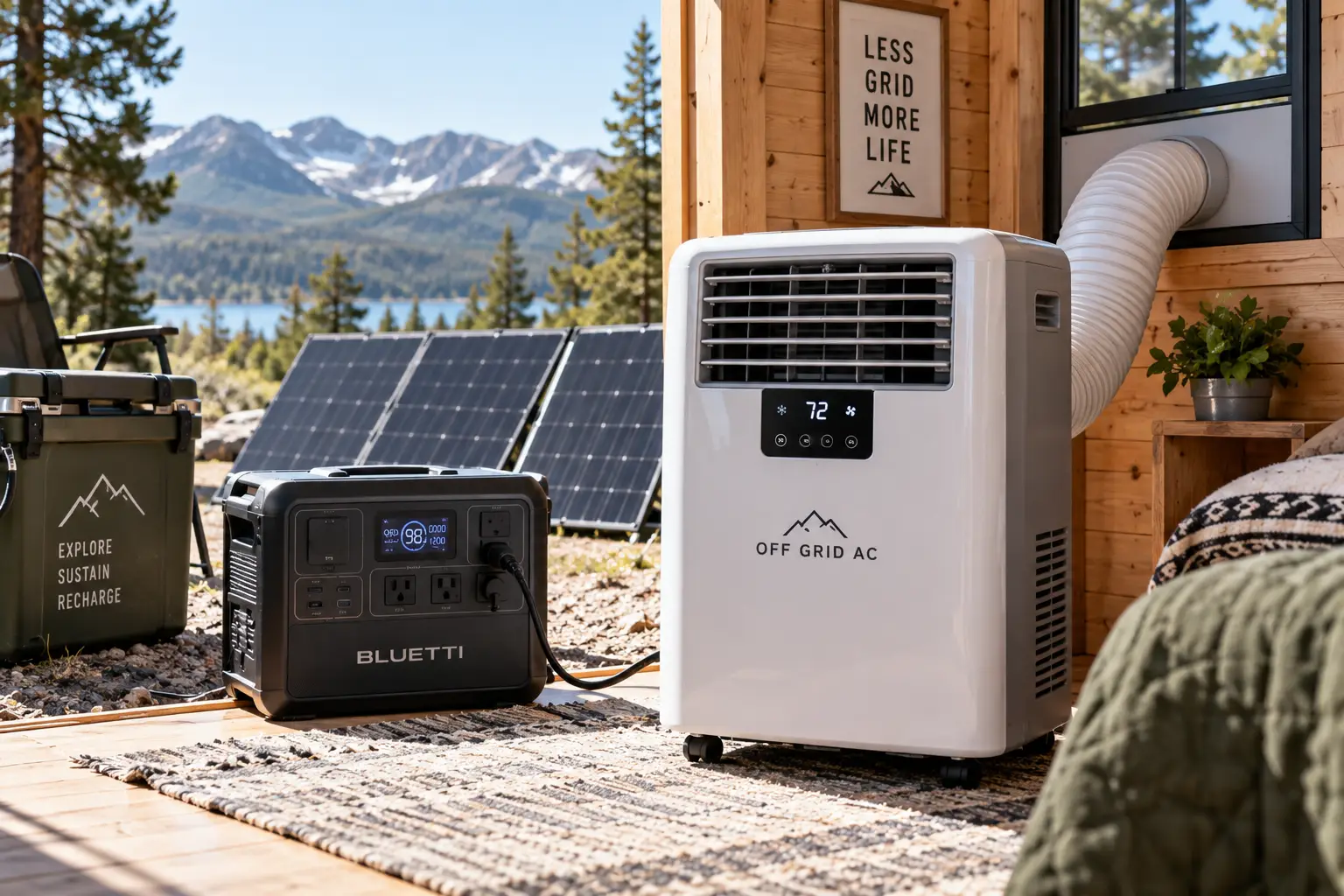
An off grid ac is an air conditioning system engineered to run directly on DC power from batteries or solar panels — either through a native DC compressor that skips the inverter entirely, or through a battery-integrated portable unit designed for low, steady power draw. Unlike a standard window or central AC, it’s built around the reality that solar and battery power are limited, variable resources.
Off Grid AC at a Glance: Quick Comparison
Before diving into the full breakdown, here’s a snapshot of how these seven units stack up on the numbers that matter most for a power-limited setup.
| Product | Cooling Capacity | Power Type | Best For |
|---|---|---|---|
| Somokg 12V RV Air Conditioner | 11,000 BTU | 12V DC, direct battery | Vans, truck campers, small trailers |
| Zero Breeze Mark 3 | 5,280 BTU | 48V battery pack / solar | Tents, rooftop tents, ultra-light rigs |
| EcoFlow Wave 3 (with Add-on Battery) | 6,100 BTU cooling | LFP battery, AC/solar/car charging | RVs, overlanding, larger vans |
| MRCOOL DIY 5th Gen 12K Mini Split | 12,000 BTU | 115V AC (inverter-fed) | Cabins, sheds, tiny homes |
| HotSpot Energy ACDC12C | 12,000 BTU | Direct solar DC + AC hybrid, no battery required | Off-grid cabins with strong daytime sun |
| HotSpot Energy DC4812VRF | 12,000 BTU | Pure 48V DC, battery-fed | Remote cabins, telecom shelters, full off-grid living |
| EG4 24K Hybrid Mini Split | 24,000 BTU | 90–380 VDC solar or AC grid, auto-switching | Whole off-grid homes, larger cabins |
Looking at the table above, the spread here is deliberate: the Somokg 12V RV Air Conditioner and Zero Breeze Mark 3 cover small, mobile spaces where every watt-hour counts, while the EG4 24K Hybrid Mini Split and HotSpot Energy DC4812VRF are built for people cooling an entire structure. The HotSpot Energy ACDC12C occupies a unique middle ground — it’s the only unit here that can run entirely off solar panels during the day with zero batteries in the loop. If you’re not sure which tier fits your setup, the sizing section further down walks through exactly how to match BTU capacity to your battery bank and panel array.
💬 Bookmark this comparison — you’ll want to reference it again once you’ve read the full battery-sizing math below. 😊
Top 7 Off Grid AC Options for 2026: Expert Analysis
Each of these units is a real, currently available product. Prices below are approximate ranges in USD — always check the current listing for the exact figure, since Amazon and manufacturer pricing shifts regularly.
1. Somokg 12V RV Air Conditioner — best budget entry point for vans and small trailers
This 11,000 BTU rooftop unit is built specifically around the reality of boondocking: no inverter, no shore power, just a direct connection to your 12V battery bank. The distinguishing feature here is the soft-start compressor, which is worth understanding in practical terms rather than just as a spec-sheet bullet.
Its high-frequency compressor cools a space in as little as three minutes, and the integrated soft-start technology cuts the startup power surge by roughly 70% — that matters enormously off-grid, because a traditional AC’s inrush current is often what trips an undersized inverter or forces you to run an oversized battery bank just to survive the first two seconds of operation. At 35dB and a scroll compressor design, it’s also one of the quieter 12V options in this category, which is a real consideration when you’re sleeping four feet from the unit. Manufacturer guidance suggests a 300Ah+ lithium battery bank for roughly 6-8 hours of continuous eco-mode cooling, or about 12 hours on a 400Ah bank.
Based on comparing the specs against similar 12V rooftop units, the Somokg 12V RV Air Conditioner is the strongest fit for anyone converting a cargo van, teardrop trailer, or truck camper who wants genuine off-grid cooling without redesigning their entire electrical system around a bigger inverter. Aggregated owner feedback across RV and van-life communities consistently flags the low noise level and the reduced battery drain from the soft start as the standout traits, with the 250-300 sq. ft. cooling range holding up well in enclosed, insulated cabins.
Pros:
- ✅ True 12V DC design — no inverter required
- ✅ Soft start cuts battery surge draw by ~70%
- ✅ Quiet 35dB operation for sleeping close by
Cons:
- ❌ Cooling drops off fast in larger or poorly insulated spaces
- ❌ Requires a 300Ah+ lithium bank for meaningful runtime
At the time of writing, this unit typically runs in the $700 to $950 range. For the price, it’s hard to beat as a first off-grid AC — the value proposition holds up especially well against gas-generator alternatives that cost more to run over a season.
2. Zero Breeze Mark 3 — lightest true battery-powered AC on the market
The Mark 3 leads with portability: at just under 22 pounds, it’s the lightest 5,280 BTU portable air conditioner available, built around a custom 3.9-pound 48V micro-compressor instead of the bulkier 18-26 pound compressors found in typical “portable” units.
That compressor is the whole story here. Because it’s purpose-built for battery operation rather than adapted from a wall-outlet design, the Mark 3 pulls meaningfully less power than a converted household portable AC running through an inverter. It cools 20°F in about 5 minutes and maintains temperatures between 61°F and 88°F across 100-150 sq. ft. The detachable 1,022Wh battery pack supports a wide 12-60V DC input range with a built-in 500W MPPT solar controller, meaning you can charge it straight from panels without a separate charge controller in the chain — a genuine convenience most competitors don’t offer.
What most buyers overlook with this model is that its small footprint is a trade-off, not a bonus feature without cost: it’s excellent in a sealed van or rooftop tent, but reviews indicate it struggles in loosely sealed canvas tents where hot air infiltrates faster than the compact compressor can remove it. One recurring theme in owner feedback is a split experience based on the space: van and RV owners report strong, consistent cooling, while a subset of tent campers found performance underwhelming compared to expectations, particularly in humid or poorly insulated setups.
Pros:
- ✅ Lightest 5,280 BTU battery AC available
- ✅ Built-in 500W MPPT solar charging on the battery
- ✅ Rapid cooling — 20°F drop in about 5 minutes
Cons:
- ❌ Underperforms in loosely sealed tents versus enclosed cabins
- ❌ Battery pack sold separately drives up total cost
Expect to pay roughly $1,000 to $1,300 for the air conditioner alone, with the battery pack adding another $700-900 — so a complete kit typically lands in the $1,700 to $2,200 range. Given the genuine weight and MPPT-charging advantages, it’s a reasonable value for anyone prioritizing portability over raw efficiency.
3. EcoFlow Wave 3 (with Add-on Battery) — best all-in-one battery and solar ecosystem
The EcoFlow Wave 3 pairs a custom-designed compressor with a 1,024Wh LFP battery, delivering 6,100 BTU of cooling and 6,800 BTU of heating in a single 20-inch, luggage-style unit.
What sets this apart from a bare compressor unit is the charging ecosystem: 1,000W fast charging brings the battery to full in about 75 minutes using combined AC and solar input, and EcoFlow’s alternator charger lets you top off while driving. Solar charging alone (up to 400W) reaches full charge in roughly 3 hours. In practice, that means you’re not choosing between “plugged in” or “off-grid” — the system is designed to blend both seamlessly, which is genuinely useful for someone splitting time between campgrounds with hookups and dispersed boondocking sites. The R290 refrigerant used here also has a materially lower environmental footprint than older refrigerants still found in budget units.
Here’s what the spec sheet doesn’t say outright: the app-controlled Pet Care mode and 44dB sleep mode are aimed squarely at the specific anxiety of leaving an animal in a parked RV — the unit auto-activates cooling if the cabin temperature climbs past a set threshold and pushes a phone alert. Aggregated customer ratings on major retail sites currently sit solidly above 4 out of 5 stars across a meaningful number of reviews, with cooling speed and app control cited most often as strengths, and battery runtime under heavy heat load as the most common point of criticism.
Pros:
- ✅ 8 hours of cordless runtime on a full charge
- ✅ Multiple charging paths: AC, solar, car, and alternator
- ✅ Pet Care mode with automatic overheat protection
Cons:
- ❌ Runtime drops noticeably in extreme heat or full sun
- ❌ Heavier and bulkier than compressor-only competitors
Pricing for the AC-plus-battery bundle generally falls between $1,900 and $2,100. It’s a premium price point, but the combination of fast multi-source charging and app-based automation genuinely justifies it for anyone who wants a turnkey off grid ac setup without assembling separate components.
4. MRCOOL DIY 5th Gen 12,000 BTU Mini Split — the mid-range workhorse for cabins and sheds
Unlike the portable units above, the MRCOOL DIY 5th Gen is a wall-mounted mini split — meaning it’s not battery-native, but its exceptionally low power draw makes it one of the most realistic mini splits to run off a solar-plus-inverter setup.
The key figures here are 23.5 SEER2 efficiency and a 12.5 EER rating, both of which translate directly into smaller solar arrays and smaller inverters than a comparable central AC would demand. Its variable-speed DC inverter compressor ramps up and down with demand instead of cycling fully on and off, which practically means it avoids the brutal startup surge that trips undersized off-grid inverters — a detail cabin builders often learn the hard way with cheaper units. The pre-charged, pre-cut 25-foot quick-connect line set also means no HVAC certification or refrigerant handling is required for installation, a genuine cost and time saver for a DIY off-grid build.
Reviews and installer commentary consistently describe this as the most popular DIY mini split on the market for a reason: it’s approachable for a competent DIYer with basic tools, and the Wi-Fi app control plus Alexa/Google Home compatibility are unusually full-featured for a unit in this price bracket. What most buyers overlook is that 115V units like this one still require a pure sine wave inverter sized comfortably above the running wattage — pairing it with a modified sine wave inverter is a common and avoidable mistake.
Pros:
- ✅ 23.5 SEER2 — genuinely efficient for a solar-fed setup
- ✅ Pre-charged line set skips refrigerant licensing
- ✅ Wi-Fi app control with smart home compatibility
Cons:
- ❌ Needs a properly sized pure sine wave inverter
- ❌ Professional-grade install still recommended for larger runs
Prices typically range from $1,100 to $1,700 depending on retailer, bundle, and any included line-set length upgrades. For a fixed cabin or tiny home application, it’s arguably the best value-for-efficiency pick on this list.
5. HotSpot Energy— the only battery-free solar hybrid on this list
This is the outlier of the group, and worth understanding on its own terms: the HotSpot Energy ACDC12C accepts raw DC voltage directly from a solar panel string — no inverter, no charge controller, and no batteries required to operate.
Its variable-speed BLDC compressor takes 100-320 Vmp DC input from 3 to 6 panels (290-500W each) wired in series, and automatically blends in AC grid power to cover any shortfall when solar output drops. At a 22 SEER rating without solar assistance, it’s already an efficient heat pump before you factor in the fact that daytime cooling demand and peak solar production line up almost perfectly — the ENERGY STAR program has long emphasized this kind of load-matching as one of the biggest efficiency levers available in residential cooling.
What the spec sheet doesn’t fully convey is how this changes the economics of an off-grid cooling setup: because there’s no battery bank required for daytime operation, you avoid the single most expensive and highest-maintenance component of a typical off-grid power system. Real-world feedback from cabin owners running the unit on a three-panel array describes it running “all day for free” with no battery bank in the loop, staying quiet, and keeping the space cold — though it’s worth noting this kind of result depends heavily on consistently strong, direct sun exposure, and performance will dip on overcast days without the AC backup engaged.
Pros:
- ✅ Runs on raw solar DC with zero batteries required
- ✅ 22 SEER efficiency even before solar savings
- ✅ Automatic AC backup fills gaps when solar output drops
Cons:
- ❌ Needs 3-6 specific panels wired correctly — not plug-and-play
- ❌ Performance is genuinely sun-dependent without the AC assist running
This unit is priced roughly in the $2,200 to $3,000 range and is typically sourced through authorized solar HVAC dealers rather than standard Amazon retail listings, so availability and current pricing are worth confirming directly before ordering. For a cabin with strong, consistent daytime sun, the elimination of a battery bank is a legitimate long-term cost advantage.
6. HotSpot Energy— purpose-built for full off-grid independence
Where the ACDC12C is a hybrid, the HotSpot Energy DC4812VRF is a true, 100% DC air conditioner: it runs entirely on 48V DC power from batteries, with no AC power used or needed at any point in the system, indoor or outdoor unit.
That distinction matters for anyone truly off the utility grid with no backup plan — telecom shelters, remote cabins, and off-grid homesteads are the typical use cases. Because solar voltage naturally fluctuates throughout the day, this unit can’t connect directly to panels the way the ACDC12C does; it requires a stable DC source, meaning a properly sized battery bank sits between your solar array and the compressor. Depending on conditions, an entry-level setup using four 250W panels can support up to 10 hours of daily runtime. Discussions among off-grid and expedition-vehicle builders note that the nearest comparable product line, Cruise N Comfort, starts above $4,000 — positioning this unit as a genuinely more accessible entry point into true full-DC HVAC.
Here’s what to weigh with a system like this: a 48V architecture is powerful and efficient, but it’s a bigger commitment than a 12V or 24V setup, generally requiring a 12kWh+ battery bank for 24 hours of cooling and correspondingly large solar input to keep pace. This isn’t a weekend-project install — it typically calls for an HVAC technician for the split-system connection, and integrating 48V into a smaller RV or van electrical system (most of which run 12V) adds real design complexity.
Pros:
- ✅ Zero AC power needed anywhere in the system
- ✅ Meaningfully more affordable than premium DC competitors
- ✅ Scales to serious off-grid loads with the right battery bank
Cons:
- ❌ Requires a large, dedicated 48V battery bank
- ❌ Professional HVAC installation strongly recommended
Pricing generally falls between $2,500 and $3,800 before batteries and panels are factored in, and — like the ACDC12C — it’s most reliably sourced through HotSpot Energy’s direct dealer network rather than standard Amazon listings. For anyone building a genuinely permanent off-grid structure, this is one of the most complete DC-native solutions available.
7. EG4 24K Hybrid Mini Split — the highest-capacity option for whole-cabin cooling
Rounding out the list at the high end, the EG4 24K Hybrid Mini Split is built for people cooling an entire small home rather than a single room. Its defining feature is true hybrid operation: it runs on 90-380 VDC solar power, standard AC grid power, or both simultaneously, with automatic switching between sources.
At 24,000 BTU and 22.5 SEER2, it can comfortably condition up to roughly 1,000-1,200 sq. ft., and it accepts up to 2,200W of direct DC solar input with no inverter required for off-grid or hybrid configurations — a meaningful engineering simplification for anyone designing a solar HVAC system from scratch. The pre-charged R32 refrigerant line and quick-connect fittings echo the DIY-friendly approach seen in the MRCOOL unit above, and built-in Wi-Fi control extends that convenience to remote monitoring, which matters more the farther your cabin is from cell service and the more you’re relying on the system to self-manage through variable solar conditions.
Based on comparing this unit’s dual AC/DC input capability against the rest of this list, it’s the closest thing here to “central air for an off-grid home” — most of the other units are sized for single rooms or vehicles. Because this is a newer entry in EG4’s hybrid lineup, verified long-term owner reviews are still relatively limited on major marketplaces; early feedback from solar-community forums highlights the seamless source-switching as the standout feature, though as with any newer SKU, it’s worth checking current review volume and installer availability before committing.
Pros:
- ✅ 24,000 BTU covers a full small cabin or home
- ✅ True automatic hybrid switching between solar and grid
- ✅ Accepts up to 2,200W of DC solar with no inverter
Cons:
- ❌ Requires a substantial solar array to run off-grid
- ❌ Limited long-term review history as a newer product
Expect a price range of roughly $3,000 to $4,200, plus professional installation costs for a system this size. It’s sourced primarily through solar equipment retailers and authorized dealers rather than typical Amazon marketplace listings, so confirm current availability before you commit to a build around it.
Off Grid AC: Full Product Comparison
| Product | SEER / Efficiency | Power Source | Est. Price Range | Best For |
|---|---|---|---|---|
| Somokg 12V RV Air Conditioner | N/A (DC direct) | 12V battery | $700-$950 | Budget van/trailer builds |
| Zero Breeze Mark 3 | N/A (DC direct) | 48V battery + solar | $1,700-$2,200 (bundle) | Lightest portable option |
| EcoFlow Wave 3 | N/A (DC direct) | LFP battery, multi-source | $1,900-$2,100 | Turnkey RV/overlanding |
| MRCOOL DIY 5th Gen | 23.5 SEER2 | 115V AC (solar-fed inverter) | $1,100-$1,700 | Fixed cabins, tiny homes |
| HotSpot Energy ACDC12C | 22 SEER | Solar DC hybrid, no battery | $2,200-$3,000 | Sunny climates, no-battery builds |
| HotSpot Energy DC4812VRF | N/A (DC direct) | 48V battery, pure DC | $2,500-$3,800 | Full off-grid homesteads |
| EG4 24K Hybrid Mini Split | 22.5 SEER2 | 90-380 VDC hybrid solar/grid | $3,000-$4,200 | Whole-cabin, high-capacity needs |
The table above makes the trade-off pattern clear: the closer a unit gets to true DC-native operation with no inverter in the chain, the more efficient it tends to be per watt of solar input, but that efficiency usually comes bundled with a bigger upfront commitment to a properly designed battery bank or panel array. If your space is under 300 sq. ft., the Somokg 12V RV Air Conditioner or Zero Breeze Mark 3 will get you there for a fraction of the cost of the EG4 24K Hybrid Mini Split, which only makes sense once you’re cooling a genuinely full-size structure.
💬 One click helps other off-gridders make an informed choice too — check current pricing on the option that fits your space! 😊
How to Size Your Off-Grid AC System
Sizing is where most off-grid AC projects succeed or fail — undersize the battery bank and panels, and even the most efficient unit above will leave you sweating by 4 p.m.
Step 1: Calculate your daily energy need in watt-hours. Take the AC’s running wattage (not the BTU rating) and multiply by expected daily runtime. A 12V RV unit like the Somokg drawing roughly 400-600W running for 8 hours needs 3,200-4,800Wh per day just for cooling.
Step 2: Size your battery bank around days of autonomy, not just daily use. Most off-grid guides recommend sizing storage for at least one full day without meaningful solar input, which means your battery bank should comfortably exceed your single-day energy need — 1.5x to 2x is a common conservative target.
Step 3: Use real solar data, not rough guesses, to size your panel array. NREL’s PVWatts calculator lets you plug in your specific location and get real peak-sun-hour data rather than a generic national average — critical because a system sized for Arizona sun will underperform badly in the Pacific Northwest.
Step 4: Always size the inverter above the AC’s startup surge, not just its running wattage. This is the single most common mistake with 115V mini splits like the MRCOOL — a compressor’s inrush current on startup can briefly spike 3-5x higher than its running draw.
Step 5: Budget a maintenance day into your first month. Check line-set connections, clean intake filters, and confirm your charge controller settings after the first real heat wave — components settle and small leaks or loose fittings show up fastest under sustained load.
Real-World Off-Grid AC Scenarios: 3 Buyer Profiles
The weekend van-lifer. If you’re converting a cargo van for occasional weekend trips with a 200Ah lithium battery and a 400W rooftop solar setup, the Zero Breeze Mark 3 or EcoFlow Wave 3 make the most sense — both are designed to run standalone off a battery pack without requiring you to rebuild your van’s entire electrical architecture around a bigger inverter.
The full-time off-grid cabin owner in a sunny climate. With a fixed structure, strong daytime sun, and a budget that allows for a proper panel array, the HotSpot Energy ACDC12C is worth serious consideration specifically because it removes the battery bank from the cooling equation entirely — a real long-term maintenance and cost advantage over a lifetime of use.
The family building a permanent off-grid homestead. For a 1,000+ sq. ft. cabin meant to be lived in full-time, the EG4 24K Hybrid Mini Split or HotSpot Energy DC4812VRF are the realistic options — both are engineered for sustained, whole-structure loads rather than single-room or vehicle-scale cooling.
Off Grid AC Problems and Solutions
Problem: The AC trips your inverter on startup. This is almost always an undersized inverter relative to compressor inrush current. Solution: size your inverter to at least 3x the unit’s rated running wattage, and favor units with soft-start technology like the Somokg 12V RV Air Conditioner, which specifically reduces this surge.
Problem: Battery drains faster than expected. Solution: check for inverter conversion losses if you’re running a 115V unit like the MRCOOL DIY 5th Gen off an inverter — DC-native units like the Zero Breeze Mark 3 skip that conversion loss entirely.
Problem: Cooling underperforms in a tent or loosely sealed space. Solution: seal gaps and add reflective barriers before assuming the unit is underpowered; compact compressors like the one in the Zero Breeze Mark 3 are genuinely sensitive to air infiltration.
Problem: Solar output can’t keep pace with AC demand on cloudy days. Solution: hybrid units with automatic grid or generator backup, like the HotSpot Energy ACDC12C and EG4 24K Hybrid Mini Split, handle this gracefully; pure battery-only setups need a generator as a manual backup plan.
Problem: You don’t know if your existing solar array can support a new AC unit. Solution: rerun your sizing math from scratch using actual panel wattage and real peak-sun-hour data for your location rather than assuming your existing lighting-and-electronics setup has headroom.
How to Choose an Off-Grid AC
- Start with your space, not the BTU number. A 24,000 BTU unit in a 150 sq. ft. van wastes money and power; match capacity to actual square footage.
- Decide whether you want DC-native or inverter-fed. DC-native units skip conversion losses but limit you to specific voltage architectures; inverter-fed mini splits are more flexible but need a properly sized pure sine wave inverter.
- Check the compressor’s startup behavior. Soft-start or variable-speed compressors are dramatically easier on batteries and inverters than fixed-speed units.
- Confirm your solar array can realistically support it. Use real location-based sun-hour data rather than nameplate panel wattage alone.
- Factor in installation complexity honestly. DIY-friendly pre-charged line sets save real money; 48V systems like the HotSpot Energy DC4812VRF generally call for a professional.
- Weigh battery-free hybrid options if your climate supports it. In consistently sunny regions, a unit like the HotSpot Energy ACDC12C can eliminate the most expensive component of the system entirely.
- Price the total system, not just the AC unit. Panels, batteries, charge controllers, and inverter upgrades often cost more than the air conditioner itself.
Off-Grid AC vs Traditional Central or Window AC
| Factor | Off-Grid AC | Traditional Central/Window AC |
|---|---|---|
| Power source | Battery, solar DC, or hybrid | Grid AC power only |
| Startup surge handling | Often soft-start or variable-speed | Frequently fixed-speed, high inrush |
| Typical install location | Vans, RVs, cabins, remote sites | Homes with existing utility service |
| Upfront system cost | Higher (includes panels/batteries) | Lower (grid power already available) |
| Location flexibility | Works anywhere with sun or battery | Requires grid connection |
Looking at the comparison above, the honest trade-off is upfront cost versus location independence. A traditional window unit is cheaper if you already have grid power, but it’s simply not an option for a remote cabin or a van with no shore power hookup. Off-grid units like the MRCOOL DIY 5th Gen close much of that cost gap over time through efficiency, since a 23.5 SEER2 rating burns meaningfully less energy per BTU than a typical 10-12 EER window unit — savings that compound daily whether you’re grid-tied or fully off it.
Common Mistakes to Avoid When Buying an Off-Grid AC
Buyers new to off-grid cooling consistently make a handful of avoidable errors. The first is sizing the AC to the room without accounting for insulation quality — an uninsulated van or poorly sealed cabin needs meaningfully more cooling capacity than the square footage alone suggests. The second is underestimating startup surge; a unit’s running wattage looks manageable on paper, but the brief inrush spike is what actually determines your minimum inverter size, and skipping this math is the single most common reason off-grid AC installs fail on day one.
A third mistake is assuming any “12V” or “solar” labeled AC on Amazon is genuinely DC-native — some listings repackage standard 120V units with a small inverter bundled in, which adds conversion losses and heat that a purpose-built unit like the Somokg 12V RV Air Conditioner avoids entirely. Finally, buyers often skip real location-based solar data in favor of rough national averages, which can leave a system 20-30% undersized in lower-sun-hour regions.
Off-Grid AC for RVers, Cabin Owners, and Tiny Homes
RVers and van-lifers generally prioritize weight, DC-native operation, and minimal electrical redesign — which is why battery-integrated units like the Zero Breeze Mark 3 and rooftop 12V options like the Somokg 12V RV Air Conditioner dominate that segment. Cabin owners have more flexibility for a permanent install and larger battery banks, making inverter-fed mini splits like the MRCOOL DIY 5th Gen or hybrid units like the HotSpot Energy ACDC12C more practical, since they’re not constrained by a vehicle’s existing 12V system.
Tiny home builders sit in between: enough fixed structure to justify a wall-mounted mini split, but often tight enough on budget and roof space that a mid-capacity unit makes more sense than the full 24,000 BTU EG4 24K Hybrid Mini Split, which is better suited to a larger cabin or small permanent home with a correspondingly larger panel array already planned into the build.
Long-Term Cost and Maintenance of an Off-Grid AC
The sticker price of the AC unit itself is often the smallest line item in the true cost of ownership. A complete off-grid cooling system includes the battery bank, solar panels, charge controller, and — for inverter-fed units — a properly sized pure sine wave inverter, all of which frequently cost more combined than the air conditioner. That said, the ongoing savings are real: unlike a gas generator running an AC, a solar-fed system has no fuel cost and dramatically lower noise and maintenance once installed correctly.
Routine maintenance is modest across every unit on this list — rinsing or replacing air filters, keeping outdoor coils free of dust and debris, and checking line-set and battery terminal connections once a season covers most of it. Lithium battery banks, the backbone of nearly every system here, typically carry multi-thousand-cycle lifespans when kept within recommended charge ranges, which for most owners translates to a decade or more of service before replacement becomes a consideration.
✨ Ready to stop sweating through summer nights? Browse current listings and pricing on the off-grid AC that fits your setup — availability and deals shift often, so check today’s price before you decide. 🔋
Safety, Regulations, and Standards for Off-Grid Cooling
Off-grid cooling systems combine two categories with real, well-documented safety considerations: refrigerant-based compressors and lithium battery banks. On the refrigerant side, look for units carrying ETL or UL listing and, where applicable, ENERGY STAR certification — these confirm the unit has passed independent electrical and performance testing rather than relying on manufacturer claims alone. Several units on this list, including the HotSpot Energy ACDC12C, are explicitly ETL/UL listed and AHRI certified.
On the battery side, lithium battery banks carry genuine fire-safety considerations that shouldn’t be glossed over. The Consumer Product Safety Commission’s guidance on battery standards is a useful reference point: buy only batteries and chargers that meet recognized safety standards such as UL 2054 or UL 1642, always use the charger specified by the manufacturer, and never charge a lithium battery bank unattended overnight in an enclosed space, particularly in a vehicle. For any 48V system like the HotSpot Energy DC4812VRF, professional installation isn’t just a convenience recommendation — high-voltage DC wiring carries real electrical hazards that go beyond what most DIYers handle in a standard 12V build.
Frequently Asked Questions
❓ What is the best off grid ac for a small cabin?
❓ How many solar panels do I need to run an off grid ac?
❓ Can a 12V air conditioner run all night on batteries?
❓ Is off grid ac worth it compared to running a generator?
❓ Do off-grid AC units need a professional installer?
Conclusion
Off grid ac has moved well past the novelty stage — the seven units covered here prove that real, meaningful cooling is achievable whether you’re converting a cargo van, building a remote cabin, or trying to make a tiny home genuinely livable through a heat wave. The right choice comes down to matching your space, your existing battery and solar setup, and your budget honestly against what each unit actually delivers, rather than chasing the highest BTU number on the page.
If you’re just starting out with a smaller rig, the Somokg 12V RV Air Conditioner or Zero Breeze Mark 3 offer a low-risk entry point into true DC cooling. If you’re building something more permanent, the HotSpot Energy ACDC12C and EG4 24K Hybrid Mini Split represent genuinely different philosophies — battery-free solar-direct versus full hybrid flexibility — and either can serve a cabin well depending on your climate and budget. Whatever you choose, run the sizing math from the section above before you buy; it’s the single step that separates a cooling system that actually works from one that leaves you disappointed by the first hot afternoon.
Recommended for You
- What Does a Generac Generator Cost: 7 Best Options to Consider
- Condo Generator: 7 Safe Backup Power Picks for 2026
- 7 Best Dual Fuel Inverter Generators for 2026 (No Regrets)
Disclaimer: This post contains affiliate links. As an Amazon Associate, I earn from qualifying purchases made through these links, at no additional cost to you.
✨ Found this article helpful? Share it with someone who needs it! 💬🤗