As an Amazon Associate I earn from qualifying purchases. Links in this article may be affiliate links. How we choose gear
A watt rating is a poor way to pick a truck inverter kit. O Trucking’s buyer guide lists buying on surge watts alone among its common mistakes, and Victron’s wiring documentation states that a too-thin cable directly hurts system performance. At 12 volts, a 2000-watt inverter at full load draws roughly 180 amps, so the cable, the fuse and the batteries behind it decide what the label really delivers in a 2027 sleeper.
The short answer for a solo sleeper: a pure sine inverter around 2000 watts continuous, a fuse within inches of the battery, and a short run of heavy cable. That is the profile O Trucking’s guide gives for a driver running a CPAP, a fridge, a laptop and an occasional microwave. The steps below follow maker spec sheets and manuals, Victron’s installation tables, a long owner thread on The Truckers Report and the review pages on each listing, and they end with two inverters and two solar-and-battery bundles.
A truck power inverter kit that draws from the truck’s own batteries is a different purchase from a solar bundle that brings its own battery, so the two are kept apart here.
Heavy duty power inverter for truck sleepers: the method, from load list to fuse
Six decisions, made in this order, keep the build from needing rework.
Add up what runs together. O Trucking’s guide says to total every load that might run at the same moment, add 25 to 30 percent headroom, and buy continuous watts at that number. Samlex draws a similar line: 400 and 600 watt units for laptops, phones, CPAP machines and TVs, and 1000 to 3000 watts for microwaves, coffee makers and refrigerators. Sample calculation, with assumed loads: a 100-watt laptop-and-fan load plus a 1,000-watt microwave is 1,100 watts, and 30 percent headroom makes 1,430 watts. That points to a 1500- or 2000-watt unit, not a 3000-watt one.
Confirm the truck’s battery voltage. Inverters are built for one input voltage. Renogy’s FAQ says its 2000W model works only on a 12-volt battery system and that a 24-volt connection may damage it. Samlex lists 24-volt versions in its NTX line, but the 3000-watt models named in its truck article are 12-volt.
Pick the waveform for the loads, not the price. The first reply in a long Truckers Report thread is blunt: skip the cheap modified sine wave unit. The thread is not unanimous, though. Two posters with modified sine inverters report no trouble with TVs, microwaves and laptops, while two others note that some refrigerators and computers are sensitive to them. O Trucking lists a modified sine inverter feeding a CPAP as a mistake, which settles it for anything medical.
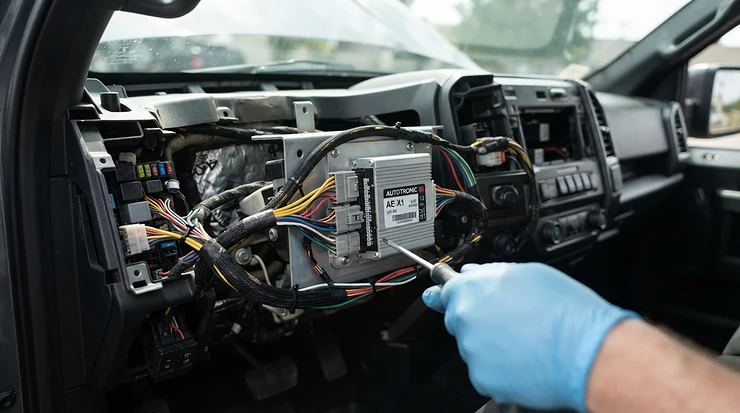
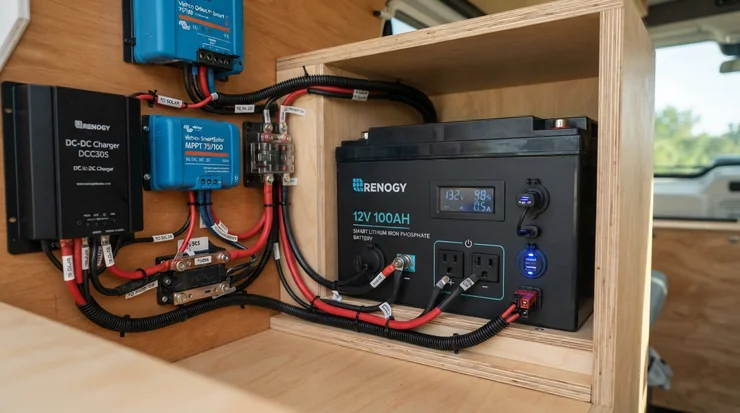
Keep the DC run short, heavy and fused. O Trucking calls for short, heavy cable on 2000 to 3000 watt units and a fuse or breaker within inches of the battery positive terminal. Victron’s installation tables for its 2,000-VA 12-volt inverters list a 300A DC fuse and 70 mm² cable, roughly 2/0 AWG, for runs under about 5 meters. A Solar4RVs fusing guide reaches a similar place by arithmetic: about 193 amps at 11.5 volts for a 2000-watt unit, and a 125 percent minimum on top, which is about 240 amps before rounding up to the next standard fuse.
Plan the batteries and the cutoff together. The inverter only drains what the bank can give. Renogy lists a low-battery alarm near 11.0 volts and shutdown near 10.0 volts, and O Trucking advises testing the cutoff at installation. For scale, the same guide puts AGM batteries at about $180 to $320 each and lithium iron phosphate at about $800 to $2,500, both labeled illustrative.
Give it air and a reachable remote. O Trucking names mounting in a sealed foam cubby as a mistake. Renogy’s page suggests mounting under a semi seat, and both Renogy and Samlex use thermally controlled fans, so clearance matters. Keep the remote where the driver can reach it from the bunk.
Step 4 draws the most owner comment about truck inverters, which is why the failures get their own section next.
Wrong cable, missing fuse, empty batteries: how installs fail
Current climbs in step with wattage, and the cable has to follow it.
AC load
Battery draw at 12.5 V and about 90% efficiency
100 W
about 9 A
600 W
about 53 A
1,500 W
about 133 A
2,000 W
about 178 A
2,500 W
about 222 A
The 2,000-watt row applies the formula in O Trucking’s guide (AC watts divided by battery volts divided by efficiency); the other rows are the guide’s own. Moving from 600 to 2,000 watts more than triples the current, which is why a cable that suits a small laptop inverter overheats on a microwave-class unit.
Three failures recur in the sources.
Long or thin cable. Three Truckers Report posters in one thread agree that shorter DC runs are better. One of them uses about 4 feet of 1/0 AWG cable and says the long factory run to the passenger side had been costing him power. Another soldered lugs on both ends of short, stranded 1/0 wire. O Trucking’s list of common mistakes names 10-gauge cable on a 2000-watt unit, and its advice is to upsize if the cable feels warm under load.
No fuse, or one placed far from the battery. One poster in the same thread runs a 300A fuse block at the battery, which matches Victron’s table for a 2,000-VA 12-volt unit. Fuses protect the wire, not the inverter, so the fuse belongs at the source of the current.
Engine-off drain and audio hum. O Trucking lists draining starter batteries nightly and running a microwave, an induction cooktop and a fridge on a weak bank with the engine off. Two Truckers Report posters say they simply run the microwave while the truck is running. A different poster reported a 60-cycle hum coming through an amplifier while driving with the inverter on; an audio filter cured it. That is one report, but it shows that a noisy inverter can reach the cab’s audio gear.
The repair for most of these is the same: shorten the run, upsize the cable, add or move the fuse, test the cutoff.
A 200 watt solar panel kit with battery and inverter versus a 400 watt one
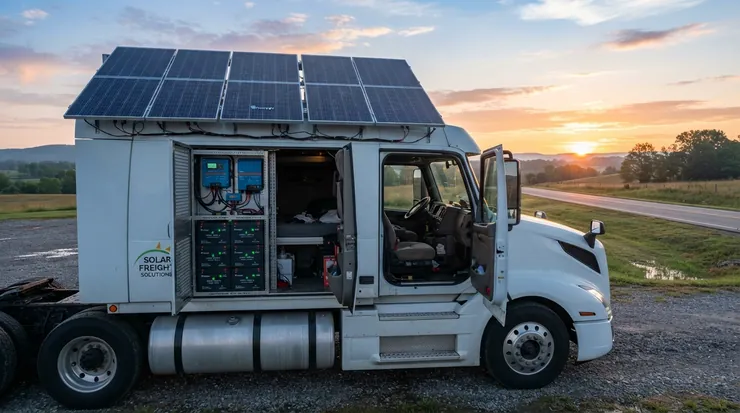
Solar bundles are a separate path. They carry their own battery and a small inverter, and they fit a parked truck, a work trailer or a shed better than a sleeper’s main bank.
NACFE’s solar report, as covered by Heavy Duty Trucking, says a 100-watt panel ideally makes 7 to 8 amps but that real conditions often cut that by about 30 percent. It also says output in the eastern United States runs about two-thirds of what Phoenix sees, that fuel savings are small, and that the main gain is longer battery life and fewer roadside calls. Thin flexible panels suit curved surfaces; trailers offer more room.
Sample calculation, with stated assumptions: take NACFE’s 30 percent cut and five strong sun hours. A 200-watt array gives about 700 watt-hours a day (200 x 0.7 x 5). A 400-watt array gives about 1,400. The makers’ own claims are a little higher. ECO-WORTHY’s 200-watt listing says up to 800 watt-hours a day and its 400-watt listing says 1.6 kWh, which equals four full-power hours with no losses. Apply the same 30 percent cut and those become roughly 560 and 1,120 watt-hours.
Kit (maker listings)
Array
Battery
Inverter
Controller
ECO-WORTHY 200 Watt 12V Complete Solar Panel Starter Kit
2 x 100 W
12.8 V 100Ah LiFePO4 (1,280 Wh) in one variant
1100 W in that variant
30A PWM
ECO-WORTHY 1.6KWH Complete Solar Panel Kit 400W 12V
4 x 100 W
12 V 100Ah in one variant; two 100Ah in the Pro variant
1100 W; 2000 W in the Pro variant
40A MPPT
Variants of both kits carry different batteries and inverters, and the listing text shows it: one 200-watt variant pairs a 50Ah battery with a 600-watt inverter. The table shows two combinations from the listings, not every one.
A 400 watt solar panel kit with battery and inverter produces twice the energy of the 200-watt version, but its inverter is still the weak link for a microwave-class load, and the Pro variant’s 2000-watt unit is the only one in this comparison that approaches a sleeper’s peak demand. Both kits ship rigid glass-and-aluminum panels at about 35 by 23 inches each, so a flat trailer roof or a lot-side stand suits them better than a curved sleeper roof.
Inverters and bundles that fit these steps
Two inverters for a truck’s own batteries come first, then the two solar bundles for a parked rig.
For a driver who wants the inverter, the DC cables and a remote in one order, this is the nearest thing to a ready-made truck inverter kit in the group. Renogy’s package list shows the inverter, two 3-foot 1/0 AWG cables, a 16.4-foot wired remote, an RJ11 cable and a manual. The spec sheet gives 2000W continuous and 4000W peak, efficiency above 90 percent, no-load draw under 2 amps, a thermally controlled fan, 17.8 by 8.6 by 4 inches and 11.7 pounds.
One detail conflicts. The spec table lists two 1/0 AWG cables, while the FAQ on the same page says two pairs of 4 AWG cable. If the box holds 4 AWG, it would be thin next to the 2/0-class cable that O Trucking and Victron’s table point to, so the cable in the box deserves a look before the first install. Renogy’s page gives no fuse size either, so the fuse is a separate purchase.
Renogy’s own page shows 413 reviews, 81 percent of them five-star and 17 percent four-star, with praise for quiet operation, GFCI-protected outlets, ETL certification and the remote. Complaints include a faulty GFCI where the buyer says only a 10 percent refund was offered, and a dead-on-arrival unit replaced after a month. One reviewer who uses it in a commercial service truck says the ETL listing helped get it approved for commercial use. The warranty is 1 year on material and workmanship. O Trucking’s guide puts 2000-watt pure sine units at roughly $220 to $450, and Renogy’s own store listing falls inside that band.
Read the package-contents line on the listing before ordering, since the cable size is where the page contradicts itself.
Renogy 2000W 12V Pure Sine Wave InverterSee current price, sizes and reviews on Amazon.
The price tier is the main trade here. Dealer pages list the Samlex NTX-2000-12 between about $610 and $630, well above the band O Trucking gives for 2000-watt pure sine units. What that buys, per Samlex’s product page, is 2000W continuous and 4000W surge, a weight of 8.6 pounds, two GFCI-protected outlets, Hypersurge technology for starting high-surge loads, and an LCD remote (NTX-RC) included with every model in the line.
Noise is a design focus: the maker describes a single variable-speed fan controlled by temperature and load, and the line carries ETL and FCC certifications. The warranty is 2 years, double Renogy’s.
The line also covers the other ends of the market. For smaller loads Samlex lists a 24-volt NTX-600-24, which a Renogy 12-volt unit cannot match. For a team cooking hot meals, O Trucking suggests planning for 3000 watts, and Samlex’s NTX-3000S-12 is the heavy duty inverter for truck use in its own truck article, with three standard GFCI outlets and no adapter needed. The 2000-watt model needs separately bought DC cable and fuse; O Trucking puts that hardware, with a remote, at roughly $80 to $250.
Samlex NTX-2000-12See current price, sizes and reviews on Amazon.
A parked truck, a work trailer or a tool shed is where this bundle makes sense. The 100Ah variant listed by ECO-WORTHY holds two 100-watt panels, a 30A PWM controller, a 12.8-volt 100Ah LiFePO4 battery rated at 1,280 watt-hours, and a 1100-watt inverter. The maker claims up to 800 watt-hours a day, which by the earlier arithmetic is closer to 560 after real-world losses.
Buyer reports on retailer listings are mixed. One 200-watt variant (50Ah battery, 600-watt inverter) shows 4.2 stars across 334 reviews. One buyer says the inverter kept showing an F04 fault code even when connected to a pickup, and that ECO-WORTHY sent a replacement once support worked through it. Another says the inverter shuts itself off under low winter sun because a camera and a battery charger keep drawing power the panels cannot cover. A third says the kit works only when everything is wired in parallel, which limits the array to 12 volts. Two buyers add panels, batteries or a bigger inverter afterwards.
Pros:
Panels, controller, battery and inverter arrive as one set
Lithium battery with a rated 3,000-plus deep cycles, per the listing
Rigid panels about 35 by 23 inches each
Cons:
A 1100-watt inverter will not start a large microwave
Two buyers report inverter shutdowns or faults
Check the current price on Amazon.com.
ECO-WORTHY 200 Watt 12V Complete Solar Panel Starter KitSee current price, sizes and reviews on Amazon.
This is the larger bundle: four 100-watt panels and a 40A MPPT controller. The single-battery variant adds a 12-volt 100Ah lithium battery and an 1100-watt inverter, while the Pro variant lists dual 100Ah batteries, bifacial panels, a 2000-watt inverter and a Bluetooth module.
Ratings vary by listing. The Pro variant shows 4.0 stars across 148 reviews and another 400-watt listing shows 4.1 across 58. One shed owner says it charges tools, runs a long LED light and a small heater for a short while, and scales with added batteries and panels. One buyer calls the panels great but says they supply too much power for the controller and inverter in the bundle, and recommends upgrading both. Another had the battery replaced under warranty after it would not charge with one panel connected. One buyer says the controller’s Bluetooth would not pair on three units, and another says the kit shipped with no manual and could not be taken off standby after two weeks of trying.
The pattern across these reports is that the hardware arrives and works for many buyers, while setup support is where the problems cluster. For anyone who wants more than a small starter bank, ECO-WORTHY’s variants span a wide range, and the inverter listed in the title of the variant matters more than the 400-watt figure.
ECO-WORTHY 1.6KWH Complete Solar Panel Kit 400W 12VSee current price, sizes and reviews on Amazon.
Sleeper wiring, battery drain, and solar: short answers
What size inverter does a semi sleeper need?
O Trucking's guide says to add up everything that may run together, add 25 to 30 percent headroom, and buy continuous watts at that number. A solo sleeper with a CPAP, fridge, laptop and occasional microwave fits roughly 2000 watts continuous.
Is a modified sine wave inverter fine for a truck?
Owners disagree. Two Truckers Report posters run TVs, microwaves and laptops on modified units without trouble, while two other posters note that some refrigerators and computers dislike them. O Trucking lists modified sine for a CPAP as a mistake, so pure sine is the safer choice.
Can an inverter run with the engine off?
Yes, but the batteries carry everything. Renogy's inverter sounds a low-battery alarm near 11.0 volts and shuts down near 10.0 volts, and O Trucking warns against draining starter batteries nightly. A separate house bank or a cutoff checked at installation protects engine starting.
Will a 12-volt inverter work in a 24-volt truck?
No. Renogy states its 2000-watt model works only on a 12-volt battery system and that a 24-volt connection may damage it and void the warranty. Samlex lists a 24-volt 600-watt model for smaller loads, so match the inverter's input voltage to the truck first.
Can a 200 or 400 watt solar kit run a sleeper?
It can refill batteries, not run big loads directly. NACFE says real conditions cut panel output by about 30 percent, so 200 watts yields roughly 700 watt-hours over five sun hours and 400 watts about 1,400, assuming those hours. A microwave still needs the battery bank.
Choosing a path: inverter only, inverter with cables, or a solar bundle
A truck inverter kit succeeds or fails on the DC side. The label wattage matters less than the cable, the fuse and the battery behind it, and the owner reports and installation tables above agree on that. A driver who wants cables and a remote in one order has the Renogy 2000W 12V Pure Sine Wave Inverter, with the cable-size conflict on its page to resolve. A driver who prefers a quieter, longer-warranted unit and will buy the cable separately has the Samlex NTX-2000-12.
For a parked truck, trailer or shed, the ECO-WORTHY 200 Watt 12V Complete Solar Panel Starter Kit suits light loads, and the ECO-WORTHY 1.6KWH Complete Solar Panel Kit 400W 12V adds array size and, in its Pro variant, a 2000-watt inverter. Neither replaces a sleeper’s main bank.
Pick the voltage first, size the watts from a real load list, then spend on cable and fuse before spending on a bigger inverter.