
In This Article
Why a 1 Kilowatt Solar Panel Setup Hits the Sweet Spot in 2026
Heads-up: this guide contains affiliate links. If you buy through them, we may earn a commission at no extra cost to you. Our analysis is based on published spec sheets and publicly available reviews, not on paid placement.
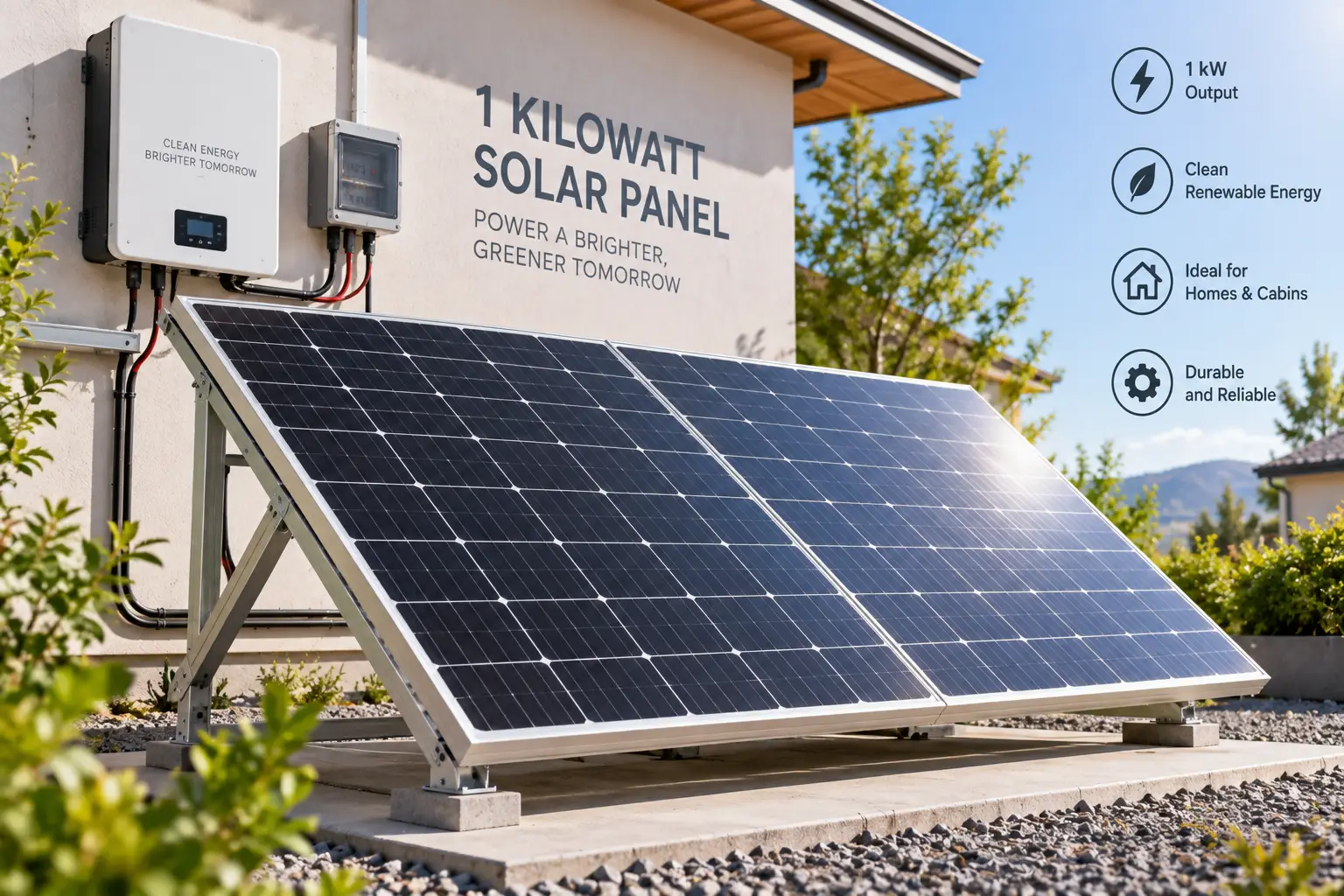
Here’s the first thing most product pages won’t tell you: there’s almost no such thing as a single 1 kilowatt solar panel. Even the biggest residential-format modules you can order on Amazon top out around 495 watts each. So when you shop for a 1 kilowatt solar panel, you’re really shopping for an array (two big panels, five mid-size ones, or ten small ones) plus the charge controller, battery, and wiring that make that power usable.
Why does 1 kW keep coming up? Because it’s the Goldilocks size. It’s big enough to keep a fridge cold, a well pump running, and a laptop charged at a cabin, yet small enough that a handy weekend DIYer can mount and wire it without a crane. For perspective, the Department of Energy’s Homeowner’s Guide to Going Solar notes that national lab analyses use an average home system of roughly 7 kilowatts. In other words, a 1 kW array isn’t a whole-house replacement; it’s a workhorse for RVs, off-grid cabins, sheds, farms, and outage backup.
2026 also changed the math. N-type cells rated around 25% efficiency are now common at budget prices, which means fewer panels and less roof space for the same kilowatt. On the flip side, the federal residential solar tax credit is gone for systems installed this year, so every dollar you spend has to earn its keep on its own merits.
That’s exactly what this guide is built for. Below, you’ll find seven real, orderable options, the honest production math, a first-30-days setup playbook, and the safety rules that keep your investment (and your insurance policy) intact.
What Is a 1 Kilowatt Solar Panel?
A 1 kilowatt solar panel setup is a photovoltaic array whose combined nameplate rating equals about 1,000 watts under Standard Test Conditions (STC). Because single panels rarely exceed 500 watts, “1 kW” almost always means several panels wired together, producing roughly 3 to 4.5 kilowatt-hours per day in typical US sun.
That definition hides two details that matter a lot when you’re spending real money.
First, “1 kW” is a lab number. STC assumes 1,000 watts of sunlight per square meter hitting cells at a comfortable 77°F (25°C). On a July rooftop in Phoenix, your cells can run 60°F hotter than that, and every panel loses a little output with each degree of heat. Real-world output from a nominal 1 kW array usually lands somewhere around 750 to 850 watts at midday, before wiring and conversion losses.
Second, panels alone don’t power anything. A working 1kW solar panel system needs four pieces:
- ✅ Panels to harvest sunlight (the array itself)
- ✅ A charge controller, ideally MPPT, to feed a battery safely
- ✅ A battery bank, usually LiFePO4 lithium in 2026, to store energy for night and cloudy days
- ✅ An inverter to turn DC battery power into 120V AC for household plugs
Some kits bundle all four; others sell panels only. Knowing which one you’re looking at is the single biggest shortcut to a smart purchase, which is why the comparison below flags exactly what each option includes.
Quick Comparison: 1000 Watt Solar Panel Kit and Array Picks at a Glance
| Product | How You Reach ~1 kW | Cell Tech / Efficiency | What’s Included | Best For | Price Range* |
|---|---|---|---|---|---|
| ECO-WORTHY 1000W Solar Panel Kit | 10 × 100W (1,000W) | Polycrystalline, ~14.5% | Panels + 60A MPPT | Budget ground mounts | ~$850–$1,100 |
| Callsun N-Type 16BB 400W Bifacial (2 × 200W) | 3 two-packs (1,200W) | N-type bifacial, up to 25% | Panels only | Shaded RV and van roofs | ~$250–$350 per pack |
| STAR 990W Bifacial Solar Panel (2 × 495W) | 2 × 495W (990W) | N-type bifacial, 25.6% | Panels only | Fewest panels, 24V/48V builds | ~$500–$800 |
| Renogy 450W Bifacial Solar Panel (2-Pack) | 2 × 450W (900W) | PERC bifacial, ~22.8% | Panels only | Brand-backed ground arrays | ~$600–$800 |
| Renogy 600W 12V/24V Premium Kit | Kit + 4 extra 100W panels | Monocrystalline, ~17.9% | Panels + 60A MPPT + fusing | Expandable starter system | ~$700–$1,000 (kit) |
| EcoFlow 400W Portable Solar Panel | 3 panels (1,200W) | Monocrystalline, ~22.4% | Panel + kickstand case | Portable power-station users | ~$700–$1,000 each |
| ECO-WORTHY 1200W 24V Off-Grid Solar System | 6 × 195W (1,170W) | Monocrystalline | Panels, MPPT, 3000W inverter, ~7.2 kWh LiFePO4 | Turnkey cabin power | ~$2,000–$3,000 |
Prices fluctuate constantly; figures are approximate ranges at the time of writing. Check the current price before you buy.
Looking at the table, the split is obvious: the ECO-WORTHY 1000W Solar Panel Kit and the Renogy 600W 12V/24V Premium Kit hand you a controller, while the STAR 990W Bifacial Solar Panel (2 × 495W) and Renogy 450W Bifacial Solar Panel (2-Pack) reach nearly a kilowatt with just two panels but expect you to supply the rest. If you want zero guesswork, the ECO-WORTHY 1200W 24V Off-Grid Solar System costs the most up front but is the only pick here that includes storage and AC output out of the box.
One more pattern worth noticing: efficiency dictates footprint. Ten 14.5% poly panels cover roughly 74 square feet, while two 25.6% N-type modules deliver about the same wattage in a fraction of that space. On an RV roof, that difference decides whether the array fits at all.
💬 One click helps other shoppers make an informed choice too! Share this comparison with a friend who’s planning an off-grid build. 😊
The 7 Best 1 Kilowatt Solar Panel Setups: Expert Analysis
Each pick below was chosen from real, orderable Amazon listings, covering budget, mid-range, and premium tiers. Our commentary comes from comparing spec sheets and available review data; we don’t claim hands-on testing we haven’t done.
1. ECO-WORTHY 1000W Solar Panel Kit — cheapest path to a true kilowatt
This is the most literal answer to the question “Where can I buy a full kilowatt in one box?” The kit pairs ten 100W polycrystalline panels (18V Vmp, 5.55A Imp each) with a 60A MPPT controller, a 5-meter cable, and branch connectors. In practice, the math favors a 24V battery bank: a 60A controller charging a 12V battery tops out around 850 watts, so part of your kilowatt would simply be clipped on sunny afternoons.
Based on comparing the specs, this kit suits people with lots of open ground (a hobby farm, a hunting cabin, a backyard shed) where panel size doesn’t matter. Each panel measures about 40 × 26 inches and weighs 16.5 pounds, so the full array covers roughly 74 square feet and totals about 165 pounds. That’s fine on a ground rack, but a poor match for an RV roof. Polycrystalline cells are older technology, and at roughly 14.5% efficiency they’re the least space-efficient option here.
At the time of writing, we couldn’t verify a large pool of US reviews for this exact listing, so check recent buyer photos and comments on connector quality before ordering.
Pros:
- ✅ Full 1,000W nameplate in a single order
- ✅ Includes an MPPT controller, not a cheaper PWM unit
- ✅ Ten small panels are easy for one person to lift
Cons:
- ❌ Poly cells need far more space than N-type panels
- ❌ Battery, inverter, and mounting racks cost extra
Usually listed around $850–$1,100; it’s strong value per watt if you have space to spare.
2. Callsun N-Type 16BB 400W Bifacial (2 × 200W) — shade-tolerant roof hero
Callsun’s party trick is a split-panel design that keeps half of each module producing when a branch or vent shadows the other half. Each 200W panel uses N-type cells rated up to 25% efficiency, 16 busbars that spread current and reduce hot-spot risk, and a clear backsheet that harvests reflected light. On a white RV roof or over gravel, that bifacial gain is real, though the “up to 30%” claim assumes ideal reflective surfaces; expect much less over dark shingles.
What most buyers overlook is the -0.3%/°C temperature coefficient. On a scorching roof, that means noticeably less heat-related loss than older P-type panels. To reach a kilowatt, you’d buy three two-packs (1,200W) so you can wire even series-parallel strings, since five panels don’t split cleanly. Each panel measures about 51 × 30 inches, a practical size for van and trailer roofs.
The review signal is encouraging. The independent outdoor site ONYX/WILD bought a set for a well pump and power stations and reported the panels comfortably beat their modest expectations. Callsun also advertises at least 84.5% output after 25 years.
Pros:
- ✅ Split-cell design keeps producing under partial shade
- ✅ Low temperature coefficient suits hot climates
- ✅ Compact footprint fits most RV roof layouts
Cons:
- ❌ Panels only; controller and cabling sold separately
- ❌ Reaching exactly 1 kW means buying odd quantities
Typically around $250–$350 per two-pack; excellent value per usable watt.
3. STAR 990W Bifacial Solar Panel (2 × 495W) — a kilowatt in just two panels
If you want the smallest number of modules between you and 1 kW, this pair gets you to 990 watts with two panels. The spec sheet lists N-type 16BB cells at 25.6% efficiency, UL 61730 certification, IP68 connectors, and bifacial glass. The frameless dual-glass design helps rain, dust, and snow slide off rather than collecting along an aluminum lip.
Based on comparing specs, this is a builder’s panel. Its voltage is designed for 24V and 48V systems, so it pairs naturally with a modern all-in-one inverter-charger rather than a small 12V RV setup. Here’s what to weigh: frameless modules need mounting clamps rated for frameless glass, and standard Z-brackets won’t bolt on. Two large panels also mean big, heavy glass, so plan for a second person during installation.
The UL 61730 listing matters more than it sounds. Many building inspectors look for that certification on residential modules, and plenty of budget imports don’t carry it. We couldn’t verify a meaningful volume of US reviews for this listing at the time of writing, so treat it as a promising but less-proven brand.
Pros:
- ✅ Nearly 1 kW from only two modules
- ✅ UL 61730 certification helps with permitting
- ✅ Frameless glass sheds snow and dust easily
Cons:
- ❌ Requires frameless-rated clamps, not standard brackets
- ❌ Not suited to small 12V-only systems
Generally in the $500–$800 range; exceptional watts per dollar if your system runs 24V or 48V.
4. Renogy 450W Bifacial Solar Panel (2-Pack) — the brand-backed ground-mount choice
Renogy is one of the most established names in DIY solar, and this pair brings its support network to a near-kilowatt array. Each panel uses PERC half-cut cells with 10 busbars, a 41.25V open-circuit voltage, and a 13.89A short-circuit current. Renogy rates it for snow loads up to 5,400 Pa (about 113 pounds per square foot). The half-cell layout helps with shade, and the bifacial back adds real gain on a ground rack over light-colored gravel.
Here’s an honest caveat: PERC is a generation behind the N-type cells in the Callsun and STAR options, with roughly 22.8% efficiency versus 25% or more. You get a trusted brand, broad ETL and TÜV certifications, and a 25-year performance warranty in exchange for slightly more roof area. We also noticed that some listings still advertise eligibility for a 30% residential clean energy credit, which no longer applies to systems installed in 2026 (see the cost section below).
Review volume on the pack sizes we checked is thin. One Walmart listing showed a 4.0 average from just six ratings, which is too small a sample to draw firm conclusions from.
Pros:
- ✅ Established brand with a US support network
- ✅ High snow-load rating for northern climates
- ✅ Bifacial output shines on elevated ground racks
Cons:
- ❌ PERC cells trail N-type efficiency
- ❌ Some listings still cite an expired tax credit
Around $600–$800 per pair; a solid value if brand support outranks peak efficiency on your list.
5. Renogy 600W 12V/24V Premium Kit — the smartest grow-into-a-kilowatt starter
This kit is designed to scale: start at 600W now and add panels until you pass a kilowatt. You get six 100W monocrystalline panels, a Rover 60A MPPT controller, a BT-1 Bluetooth module for app monitoring, Z-brackets, cables, and both in-line and ANL fuses. Renogy says the controller supports up to 800W on a 12V bank and 1,600W on a 24V bank, so four more matching panels on 24V puts you at exactly 1 kW with headroom to spare.
Based on the spec sheet, the included fusing is the underrated win. Many first-time builders skip overcurrent protection, and this kit hands it to you. Renogy estimates 2.5–3 kWh per day for the 600W configuration under five sun hours, which works out to about 4.2–5 kWh per day once you’ve expanded to 1 kW. Module efficiency is a modest 17.9%, so the array needs more space than newer N-type panels.
Aggregated sentiment on Renogy’s starter kits generally centers on straightforward installation and the value of app monitoring. Verify current listing reviews, though, because bundle contents change between versions.
Pros:
- ✅ Complete wiring and fusing included
- ✅ Controller headroom reaches 1,600W on 24V
- ✅ Bluetooth monitoring through Renogy’s app
Cons:
- ❌ Reaching 1 kW requires buying four extra panels
- ❌ Lower efficiency means a larger footprint
Roughly $700–$1,000 for the kit; best value for buyers who want to expand in phases.
6. EcoFlow 400W Portable Solar Panel — a kilowatt you can fold and carry
This is the pick for people who don’t want anything permanently bolted down. Each panel folds into a carry case that doubles as a kickstand, adjustable from 40° to 80°. Specs list roughly 22.4% efficiency, an ETFE-coated IP68 surface, 48V open-circuit voltage, and an MC4 connector. EcoFlow’s guidance pairs up to three panels with a DELTA Pro for about 1,200W of input, which is effectively a portable 1 kW array.
Here’s what to weigh: at about 35 pounds per panel (42 pounds with the case), three units total over 100 pounds and cover more than 27 square feet unfolded. Portability comes with a real advantage, though. Being able to chase the sun and re-aim every few hours can recover much of the gap versus a fixed rooftop array. The trade-off is price. Per watt, this is the most expensive panel-only option on the list.
Owner sentiment tends to praise the setup speed and build quality. Complaints typically focus on bulk and cost, and some retailers list only a 12-month warranty, far shorter than rigid-panel warranties.
Pros:
- ✅ Sets up in minutes with no mounting hardware
- ✅ Adjustable kickstand makes sun-tracking easy
- ✅ Pairs natively with EcoFlow power stations
Cons:
- ❌ Highest cost per watt among these picks
- ❌ Short warranty compared with rigid panels
Around $700–$1,000 per panel; worth it only if portability is non-negotiable.
7. ECO-WORTHY 1200W 24V Off-Grid Solar System — turnkey cabin power, battery included
This is the complete package: panels, a controller, storage, and AC power in one order. You get six 195W mono panels (1,170W), a 60A MPPT controller, a 3000W pure sine wave inverter, and two 12.8V 280Ah LiFePO4 batteries. Wired in series on 24V, those batteries store roughly 7.2 kWh. The “4.68 kWh” in the listing title appears to reflect estimated daily generation (1,170W × 4 sun hours), not battery capacity, and that’s a distinction many shoppers miss.
On paper, 7.2 kWh of storage against about 4–5 kWh of daily harvest is a well-balanced ratio. You can run an efficient fridge, lights, a well pump, and devices through the night with a cloudy-day cushion. The 3000W inverter is also sized to handle motor start-up surges from tools and pumps. For someone building a first off-grid cabin, removing the component-matching guesswork is worth real money.
We couldn’t verify a substantial review base for this exact bundle; ECO-WORTHY sells several close variants, some with 314Ah batteries. Confirm the precise contents before you buy.
Pros:
- ✅ Includes storage, controller, and inverter
- ✅ Balanced ratio of storage to daily harvest
- ✅ 3000W inverter handles motor start-up surges
Cons:
- ❌ Highest up-front cost on this list
- ❌ Bundle variants make listings easy to confuse
Roughly $2,000–$3,000; strong value compared with buying each component separately.
Head-to-Head: How the 7 Stack Up Where It Counts
| Product | Nameplate to ~1 kW | Panels Needed | Controller | Battery / Inverter | Best For |
|---|---|---|---|---|---|
| ECO-WORTHY 1000W Solar Panel Kit | 1,000W | 10 | 60A MPPT | No / No | Wide-open ground |
| Callsun N-Type 16BB 400W Bifacial (2 × 200W) | 1,200W | 6 | No | No / No | Hot, shaded roofs |
| STAR 990W Bifacial Solar Panel (2 × 495W) | 990W | 2 | No | No / No | 48V all-in-one builds |
| Renogy 450W Bifacial Solar Panel (2-Pack) | 900W | 2 | No | No / No | Snowy ground racks |
| Renogy 600W 12V/24V Premium Kit | 1,000W (expanded) | 10 | 60A MPPT | No / No | Phased expansion |
| EcoFlow 400W Portable Solar Panel | 1,200W | 3 | In power station | Power station / Power station | Mobile setups |
| ECO-WORTHY 1200W 24V Off-Grid Solar System | 1,170W | 6 | 60A MPPT | Yes / Yes | Turnkey cabins |
The table exposes a hidden cost: the panel-only picks look cheapest, but the STAR 990W Bifacial Solar Panel (2 × 495W) and Callsun N-Type 16BB 400W Bifacial (2 × 200W) still need a controller, fusing, and storage before they power anything. Meanwhile, the ECO-WORTHY 1200W 24V Off-Grid Solar System looks expensive until you price its battery and inverter separately. Compare finished-system cost, not sticker price.
⚡ Ready to Power Up Your Off-Grid Life?
🔍 Take your solar setup to the next level with this carefully curated lineup. Click any highlighted product to check current pricing and availability, and build the 1 kW array that keeps your lights on, your fridge cold, and your weekends worry-free! ☀️
How to Set Up Your 1kW Solar Panel System: A First-30-Days Playbook
A kilowatt of panels only pays off if the first month goes right. Here’s a practical sequence that product listings rarely spell out.
Week 1: Audit before you mount. List every device you’ll run, its wattage, and its hours of use per day. The University of Illinois Extension’s homeowner’s guide to solar energy recommends working from real usage in kilowatt-hours, and the same logic applies at cabin scale. If your daily total exceeds about 4 kWh, a 1 kW array alone won’t keep up.
Week 1: Pick 24V (or 48V), not 12V. At 1,000 watts, a 12V bank forces high currents, thicker cables, and controller clipping. Doubling the voltage halves the current.
Week 2: Mount, then wire in daylight with care. Panels produce voltage the moment light hits them. Cover them with a blanket while connecting, and always connect the battery to the controller before connecting the panels.
Week 2: Fuse everything. Place a fuse or breaker between the panels and controller, and another between the battery and everything else.
Weeks 3–4: Watch the data. Use your controller’s app to log daily harvest. If a sunny day delivers less than 3 kWh, something is off: shade, tilt, or a loose MC4 connector.
Common Mistakes in the First 30 Days
- ❌ Mixing panel brands in one string (mismatched current drags everything down)
- ❌ Ignoring cold-weather voltage rise, which can exceed controller limits in winter
- ❌ Laying panels flat, which sacrifices winter output and collects dirt
- ❌ Draining LiFePO4 batteries to 0% while “testing” the system
Real-World Scenarios: Matching a 1 kW Off Grid Solar System to Your Life
Specs only mean something in context, so here are three realistic buyer profiles matched to the best-fit picks.
Scenario 1: The Weekend Cabin in Arizona 🏜️
Budget: $2,500–$3,000. Use: Friday through Sunday, year-round. Loads: An efficient chest fridge, LED lights, a Starlink dish, and a small well pump.
Best match: ECO-WORTHY 1200W 24V Off-Grid Solar System. Desert sun often delivers six or more peak sun hours, so 1,170W can realistically harvest 5–6 kWh on clear days. The roughly 7.2 kWh battery refills during the week while the cabin sits empty, so you arrive to a full bank every Friday. Since everything comes in one box, there’s no component-matching headache.
Scenario 2: The Full-Time RVer in the Pacific Northwest 🚐
Budget: $1,000–$1,500 for panels and a controller (the rig already has a lithium bank). Use: Daily, under frequent cloud and tree cover.
Best match: Callsun N-Type 16BB 400W Bifacial (2 × 200W), three two-packs. The split-cell design keeps half of each panel producing when a Douglas fir shades a corner, and N-type cells handle overcast mornings better than older poly panels. Their compact footprint also fits around vents and AC units.
Scenario 3: The Hurricane-Season Backup in Florida 🌀
Budget: $3,000+ including a power station. Use: A few outages a year, plus occasional tailgating.
Best match: EcoFlow 400W Portable Solar Panel, three units with a compatible power station. Nothing stays on the roof to face 120 mph winds; you store the panels in a closet, then deploy them in the backyard once the storm passes. When the grid is down for days, the ability to re-aim toward the sun every couple of hours squeezes out extra harvest.
Problem → Solution: Fixing the 5 Most Common 1 Kilowatt Solar Panel Headaches
Even a well-designed 1 kilowatt solar panel array can underperform. Here are the issues buyers report most often and how to fix them.
Problem 1: “My 1,000W array never shows more than 700W.” ✅ Solution: That’s often normal. Heat, sun angle, and wiring losses typically cut 15–25% from nameplate. If output sits below 60% at noon in clear summer sun, check for shade and dirty glass before blaming the panels.
Problem 2: “The controller maxes out at 60A and wastes power.” ✅ Solution: You’re probably on a 12V battery. Moving to 24V lets the same 60A controller in the Renogy 600W 12V/24V Premium Kit or ECO-WORTHY 1000W Solar Panel Kit handle roughly double the wattage.
Problem 3: “Output collapses when one corner is shaded.” ✅ Solution: Rewire strings so shaded panels share a string, or choose split-cell designs like the Callsun N-Type 16BB 400W Bifacial (2 × 200W). Even one shaded cell can bottleneck an entire series string.
Problem 4: “My batteries die overnight.” ✅ Solution: Your loads outrun your storage. Either add capacity (the ECO-WORTHY 1200W 24V Off-Grid Solar System ships with about 7.2 kWh) or trim phantom loads like inverters idling all night.
Problem 5: “Winter output is terrible.” ✅ Solution: Increase the tilt toward your latitude plus 15°, clear snow promptly, and consider bifacial panels like the Renogy 450W Bifacial Solar Panel (2-Pack), which benefit from snow reflecting light onto their backs.
How Much Power Does a 1kW Solar Panel Produce? Everyday Performance Explained
This is the question that decides whether a 1 kilowatt solar panel array fits your life, so let’s make the math concrete.
The simple formula is array watts × peak sun hours × system efficiency = daily watt-hours. “Peak sun hours” means the equivalent number of hours at full 1,000 W/m² intensity. It’s not the same as daylight hours. Most of the continental US averages between about 3.5 and 6 peak sun hours depending on region and season, and system efficiency typically lands around 75–85% after heat, wiring, and controller losses.
Here’s what that looks like in practice for a nominal 1 kW array:
- ☀️ Southwest summer (6 sun hours): about 4.5–5 kWh per day
- 🌤️ Midwest average (4.5 sun hours): about 3.4–3.8 kWh per day
- 🌥️ Pacific Northwest winter (2 sun hours): about 1.5–1.7 kWh per day
What does 3.5 kWh buy you? Enough for an energy-efficient full-size fridge (roughly 1–1.5 kWh per day), LED lighting, phone and laptop charging, a Wi-Fi router, and a few hours of a small TV, with a little left over. It won’t run central air, an electric range, or an electric water heater. Those loads need a system many times larger.
Seasonal swing is the part that surprises people most. In northern states, December output can be less than half of June’s. That’s why off-grid builders often oversize the array (hence the 1,200W configurations above) or keep a small generator as a winter backup.
Annually, a well-sited 1 kW array typically produces somewhere around 1,100–1,600 kWh, depending on location. For comparison, a typical US home uses roughly 10,000 kWh or more per year. That’s a helpful reality check on what “1 kW” really covers.
How to Choose a 1 Kilowatt Solar Panel: 7 Expert Steps
- Calculate your daily load in kWh. Add up watts × hours for every device. This number determines everything else, including whether 1 kW is even the right size for you.
- Model your site’s real sun. Plug your ZIP code into the free PVWatts calculator, which estimates production from local weather data and now includes a bifacial module option. It’s far more reliable than the “per day” claims on product listings.
- Choose your system voltage first. Pick 24V or 48V for a full kilowatt. This decision determines which controller, inverter, and panel string configurations will work together.
- Prioritize N-type cells when space is tight. At about 25% efficiency, N-type panels deliver the same power in roughly 40% less area than older poly panels, and they typically degrade more slowly.
- Match voltage to your controller, including winter cold. Open-circuit voltage rises as temperatures drop. Two Renogy 450W Bifacial Solar Panel (2-Pack) modules in series (about 82V) sit comfortably under a 150V controller limit, but three in series could approach it on a frigid morning.
- Look for certifications. UL 61730 on modules and UL 1741 on grid-interactive inverters make inspections smoother and suggest the product passed real safety testing.
- Decide kit versus à la carte. Kits like the ECO-WORTHY 1200W 24V Off-Grid Solar System remove matching risk, while panel-only buys like the STAR 990W Bifacial Solar Panel (2 × 495W) give experienced builders more flexibility and better panels for the money.
1kW Solar Panel Price and Long-Term Cost of Ownership
Sticker price is the least useful number in solar. What matters is what a finished, working system costs and how long it lasts.
The 2026 Tax Credit Reality Check
For years, a 30% federal credit softened the blow. That’s over for homeowners who buy their own systems. As the Congressional Research Service explains in its analysis of the Residential Clean Energy Credit’s expiration, the 2025 reconciliation law ended the credit for expenditures made after December 31, 2025, and an expenditure counts as “made” when installation is completed. If a listing still advertises a 30% credit, treat that as outdated marketing. State and utility incentives may still exist, so check your state energy office.
Finished-System Cost Comparison
| Setup | Approx. Finished Cost for a Working 1 kW System | Expected Lifespan | Best For |
|---|---|---|---|
| ECO-WORTHY 1000W Solar Panel Kit + 24V LiFePO4 + inverter | ~$1,800–$2,600 | Panels 20+ yrs; battery thousands of cycles | Budget DIY |
| STAR 990W Bifacial Solar Panel (2 × 495W) + all-in-one inverter-charger + battery | ~$2,000–$3,000 | Panels 25+ yrs | Performance per dollar |
| ECO-WORTHY 1200W 24V Off-Grid Solar System | ~$2,000–$3,000 | Panels 20+ yrs; LiFePO4 thousands of cycles | Turnkey buyers |
| EcoFlow 400W Portable Solar Panel ×3 + power station | ~$4,500+ | Shorter panel warranty | Portability first |
Approximate ranges only; prices vary, so check current pricing.
The takeaway: once you add storage and an inverter, most fixed-mount 1 kW systems converge in the $2,000–$3,000 range, so panel quality and support should drive your choice more than a $100 difference in panel price. Portable systems carry a steep premium you’re paying for flexibility, not energy.
What About Payback?
At a US residential electricity price of roughly 17–18 cents per kWh, 1,300 kWh a year is worth about $220–$235. That means a $2,500 off-grid system won’t “pay back” like a grid-tied rooftop system would. Its real ROI comes from avoided costs instead: gasoline you don’t burn, a utility line extension you don’t pay for (often thousands of dollars to a remote cabin), and spoiled food you don’t throw out during outages.
Maintenance is refreshingly cheap. Plan on rinsing the panels a few times a year, checking connections annually, and replacing an inverter or controller once in the panels’ lifetime.
1 Kilowatt Solar Panel vs Gas Generator vs Standalone Power Station
Most shoppers weighing a 1 kilowatt solar panel array are really comparing it to two alternatives: a portable gas generator or a battery power station charged from the wall. Each has a legitimate place.
| Factor | 1 kW Solar Array + Battery | Portable Gas Generator | Power Station (Wall-Charged Only) |
|---|---|---|---|
| Fuel cost | Free sunlight | Ongoing gasoline | Grid electricity |
| Noise | Silent | Loud | Silent |
| Indoor/garage safety | Safe (battery placed properly) | Carbon monoxide hazard | Safe |
| Works in long outages | Yes, recharges daily | Only while fuel lasts | No, it can’t recharge |
| Up-front cost | Highest | Lowest | Moderate |
| Best for | Off-grid living, multi-day outages | Short, high-power bursts | Brief outages, camping |
The table makes the trade-off clear: generators win on up-front cost and raw burst power, but they lose badly on noise, fuel logistics, and safety. Carbon monoxide from generators run too close to homes is a well-documented danger. A wall-charged power station is quiet and safe, but it becomes a paperweight on day three of an outage.
A 1 kW solar array fills that gap. It’s the only option that keeps recharging when gas stations are closed and the grid is down. Honestly, many savvy buyers end up with a hybrid: the EcoFlow 400W Portable Solar Panel or a fixed array for daily energy, plus a small generator reserved for snowy weeks and heavy-load days. Solar handles 90% of the hours; the generator handles the 10% that would otherwise force you to oversize everything.
Safety, Regulations, and Standards You Shouldn’t Skip
A kilowatt of DC power deserves respect. At 24V, a full-sun array can push 40+ amps, which is more than enough to melt undersized wire and start a fire.
Certifications Worth Checking 🔍
- ✅ UL 61730: the main US safety standard for PV modules. The STAR 990W Bifacial Solar Panel (2 × 495W) lists it explicitly; many budget panels don’t.
- ✅ UL 1741: the standard for inverters that interact with the grid.
- ✅ UL 1973 / UL 9540: increasingly expected for stationary battery systems, especially indoors.
- ✅ ETL or TÜV listings, like those on the Renogy 450W Bifacial Solar Panel (2-Pack), which indicate independent testing.
Code and Permits
Most US jurisdictions follow the National Electrical Code (NEC), and Article 690 covers PV systems: proper conductor sizing, overcurrent protection, grounding, disconnects, and, for arrays on buildings, rapid shutdown requirements. Ground-mounted off-grid systems at remote cabins sometimes need no permit, while rooftop arrays on homes almost always do. Call your local building department before you buy, not after.
The Plug-In Grid-Tie Trap ⚠️
You’ll see 1 kW “plug-and-play” grid-tie kits with microinverters that plug into a wall outlet. Treat these with caution. In most US jurisdictions, feeding power into your home’s wiring requires utility approval and an interconnection agreement, and backfeeding during an outage can endanger line workers. A few states have begun creating rules for small plug-in systems, so check your state’s current regulations and your utility’s policy before connecting anything to an outlet.
Battery Placement
LiFePO4 is much more stable than older lithium chemistries, but it still belongs in a ventilated, temperature-controlled space. Keep it away from living-area exits, and make sure it’s protected by a properly sized fuse within inches of the positive terminal.
FAQ: Buying a 1 Kilowatt Solar Panel in 2026
❓ Is a 1 kilowatt solar panel kit worth buying in 2026?
❓ Can a 1kW solar panel system run a refrigerator 24/7?
❓ How many batteries do I need for a 1000 watt solar panel kit?
❓ Can I still get a tax credit for a 1 kilowatt solar panel system?
❓ Can I plug a 1 kW solar kit directly into a wall outlet?
Conclusion: Your Kilowatt, Your Way
Buying a 1 kilowatt solar panel setup in 2026 isn’t really about finding one magic panel. It’s about choosing the right combination for your space, your voltage, and your life.
If you want a complete system without the homework, the ECO-WORTHY 1200W 24V Off-Grid Solar System is the most turnkey path to reliable cabin power. If you’d rather build in phases, the Renogy 600W 12V/24V Premium Kit gives you a fused, monitored foundation that grows past a kilowatt on 24V. Tight, shaded roof? The Callsun N-Type 16BB 400W Bifacial (2 × 200W) is built for exactly that. Want the fewest panels possible for a 24V or 48V build? The STAR 990W Bifacial Solar Panel (2 × 495W) hits 990W with just two modules. Brand loyalists with snowy winters will appreciate the Renogy 450W Bifacial Solar Panel (2-Pack). The ECO-WORTHY 1000W Solar Panel Kit remains the budget king for wide-open ground, and the EcoFlow 400W Portable Solar Panel is the choice when nothing can be bolted down.
Whatever you choose, remember the three rules that separate happy solar owners from frustrated ones: size to your real kWh, wire at 24V or higher, and never skip the fuses. Get those right, and your kilowatt will quietly pay you back in cold drinks, charged batteries, and calm nights through every storm.
☀️ Your Energy Independence Starts Today!
🔍 Don’t let another outage or another noisy generator weekend catch you off guard. Click any highlighted product above to check current pricing and availability, and pick the 1 kW setup that keeps your world powered, quietly and cleanly! ⚡
Recommended for You
- 15k Generator 2026: 7 Best Proven Picks for Whole-Home Backup
- Solar Power Inverter for RV: 7 Best Picks That Won’t Fail (2026)
- 7 Best Inverter for RV AC in 2026: Run Your Air Conditioner Anywhere
Disclaimer: This post contains affiliate links. As an Amazon Associate, I earn from qualifying purchases made through these links, at no additional cost to you.
✨ Found this article helpful? Share it with someone who needs it! 💬🤗
