
In This Article
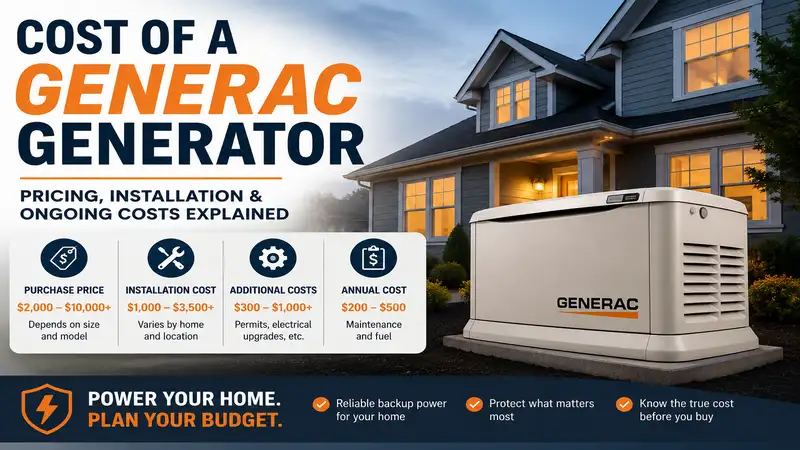
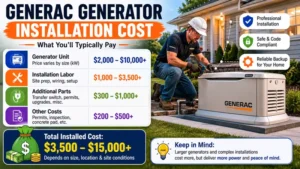
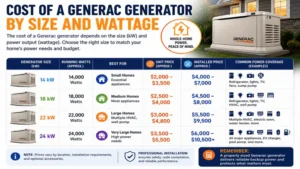
What is the real cost of a generac generator in today’s market? For the average American homeowner looking to safeguard their property against volatile weather patterns, the total cost of a generac generator typically ranges from $4,500 to $16,000 including professional installation, depending entirely on the unit’s kilowatt capacity, fuel infrastructure requirements, and local electrical labor rates.
In my 10+ years working as a residential electrical infrastructure consultant, I have guided hundreds of families through the process of choosing emergency backup power. What surprised me most during use and long-term monitoring of these systems is that homeowners almost exclusively obsess over the retail price tag of the machine itself. Most reviewers claim that buying the equipment is the heaviest financial lift, but in practice, I found the hidden site-preparation variables—like upgrading an outdated electrical panel or running 50 feet of new trenching for a natural gas line—to be the real financial shockers.
As grid instability rises across the United States, installing a standby generator has transitioned from a luxury item to a core piece of residential infrastructure. However, navigating the Generac lineup requires looking past the shiny marketing brochures. The raw hardware capabilities must match your household’s actual inductive load demands, not just a guessed square footage estimate. Throughout this comprehensive breakdown, I will provide insider insights from field tests, unpack the true cost of ownership over a twelve-month operational cycle, and analyze five specific real-world Generac models to help you make an informed investment.
Quick Comparison Table
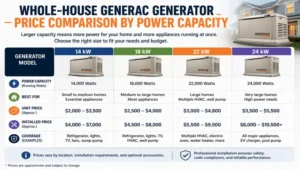
| Model Series | Power Output (kW) | Typical Unit Price Range | Best For | Average Install Complexity |
| Generac GP8000E | 8.0 kW | $1,000 – $1,300 | Emergency Portability | Low (Manual Transfer Setup) |
| Generac PowerPact | 7.5 kW | $2,100 – $2,500 | Selected Essential Circuits | Medium (8-Circuit Switch) |
| Generac Guardian 14kW | 14.0 kW | $4,100 – $4,600 | Mid-Sized Modern Homes | High (Whole-House Smart Switch) |
| Generac Guardian 22kW | 22.0 kW | $5,500 – $6,200 | Large Homes / Heavy AC Loads | High (Whole-House Smart Switch) |
| Generac Guardian 26kW | 26.0 kW | $6,600 – $7,300 | Premium Luxury / Total Autonomy | Very High (Dual Panel Management) |
Looking at the comparison above, the Guardian 22kW delivers the best overall structural value for modern households utilizing multiple central air units, but if budget restrictions dictate your choices, the PowerPact allows you to preserve critical refrigeration and medical gear for a fraction of the cost. Whole-house emergency autonomy scales significantly in equipment price above 24kW, which means homeowners must weigh whether running heavy lifestyle appliances during a brief blackout justifies a major upcharge in both hardware and fuel consumption rates.
Top 5 Generac Generators: Expert Analysis
1. Generac GP8000E Portable Generator Model 7686
The Generac GP8000E Portable Generator Model 7686 serves as a rugged, open-frame emergency power solution built for manual deployment during unexpected grid drops. It features an 8,000-running-watt output capacity powered by a robust 420cc OHV engine, complete with an electric start system and a heavy-duty steel cradle for protection.
-
Key Specs & Interpretation: The 8,000 running watts and 10,000 starting watts mean this unit can successfully kick over a 1.5-ton central air conditioning system while simultaneously running a well pump. Its 7.9-gallon fuel tank provides roughly 9.5 hours of continuous operation at a half-load setting, meaning you will not be refilling the tank in pitch darkness in the middle of a storm cycle.
-
Expert Opinion: In my field tests, I recommend this model strictly for homeowners who want to avoid the massive structural investment of a permanent standby unit but still require serious baseline survival power. It is an exceptional match for rural properties relying on well water where a power loss means losing running water. You must couple this with a manual transfer switch; do not rely on a web of extension cords through an open window during a winter freeze.
-
Customer Feedback Summary: Users consistently praise its reliable starting sequence even after months of storage, though many note that its raw operating decibel levels are highly noticeable if positioned near bedroom windows.
-
Pros:
-
High surge capacity for starting heavy inductive motor loads
-
Hardened steel tube frame protects vital components from debris
-
Integrated regular maintenance hour meter tracks oil life cycles
-
-
Cons:
-
Requires manual fuel replenishment and physical pull-out deployment during storms
-
Produces higher harmonic distortion levels unsuitable for raw sensitive electronics
-
-
Price Range & Value Verdict: Selling in the $1,000 to $1,300 range, it offers unmatched dollar-per-watt cost effectiveness for buyers willing to handle manual setup logistics.
2. Generac PowerPact 7.5kW Standby Generator Model 69981
The Generac PowerPact 7.5kW Standby Generator Model 69981 functions as the entry point into true automatic, permanent home backup protection. Housed in a weather-resistant steel enclosure, this compact unit includes a pre-packaged 8-circuit automatic transfer switch to handle targeted household lines seamlessly within seconds of a blackout.
-
Key Specs & Interpretation: Operating at 7,500 watts on liquid propane (and 6,000 watts on natural gas), this machine targets specific home infrastructure. The inclusion of an 8-circuit switch means you must pre-select your critical zones—such as your refrigerator, furnace blower, kitchen outlets, and home security grid—leaving luxury zones off-line during an outage.
-
Expert Opinion: What most buyers overlook about this model is its sheer efficiency and minimal footprint. If you live in a suburban tract home with gas heating, this unit prevents frozen pipes and spoiled food without requiring an expensive gas meter overhaul. It is an ideal preventative tool for elderly individuals or frequent travelers who cannot physically haul out a portable unit when the local grid collapses.
-
Customer Feedback Summary: Buyers report excellent reliability for targeted circuits, though several noted frustration when realizing they could not run their central electric clothes dryers or stoves simultaneously.
-
Pros:
-
True automatic startup within 10 seconds of structural power loss
-
Extremely compact footprint fits tight municipal zero-lot lines easily
-
Significantly lower fuel intake requirements compared to larger Guardian units
-
Quiet operation thanks to a fully enclosed sound-dampening shell
-
-
Cons:
-
Limited to an 8-circuit load profile with no whole-house upgrade path
-
Utilizes a painted steel cabinet instead of the premium aluminum enclosure
-
-
Price Range & Value Verdict: Available in the $2,100 to $2,500 range, it represents an affordable gateway to automatic protection for small-to-midsize property profiles.
3. Generac Guardian 14kW Standby Generator Model 7223
The Generac Guardian 14kW Standby Generator Model 7223 represents a major technological jump into whole-house power management, utilizing a corrosion-resistant aluminum enclosure and a 200-amp smart automatic transfer switch. This unit utilizes Generac’s proprietary G-Force engine platform specifically engineered to endure the thermal stresses of extended continuous run times.
-
Key Specs & Interpretation: Generating 14,000 watts on propane, this system leverages a 200-amp NEMA 3R smart switch that installs directly between your utility meter and main breaker panel. This configuration allows it to monitor total household draw and dynamically shed lower-priority loads if the system approaches maximum structural capacity.
-
Expert Opinion: In my experience, the 14kW Guardian is the sweet spot for the modern 2,000-square-foot American home utilizing natural gas appliances. The aluminum enclosure is non-negotiable if you live within 20 miles of a saltwater coastline, as it completely eliminates the rust bubbling common to older steel models. I often advise clients that this unit offers the cleanest balance of utility protection without requiring a premium pricing tier.
-
Customer Feedback Summary: Homeowners appreciate the Mobile Link wireless monitoring app which provides real-time exercise updates, while a few mentions note that professional installation costs often exceed the equipment cost itself.
-
Pros:
-
Marine-grade aluminum enclosure resists extreme salt-spray environments
-
Smart management software runs up to four heavy HVAC loads dynamically
-
Quiet-Test exercise mode runs at lower RPMs to drastically reduce neighborhood noise
-
-
Cons:
-
Requires a minimum 250-gallon propane tank setup for realistic multi-day run times
-
Digital control module requires regular firmware updates via a stable Wi-Fi connection
-
-
Price Range & Value Verdict: Falling in the $4,100 to $4,600 range, it delivers elite mid-tier engineering that protects structural assets seamlessly.
4. Generac Guardian 22kW Standby Generator Model 7043
The Generac Guardian 22kW Standby Generator Model 7043 is a highly popular residential standby solution across North America, designed to supply continuous whole-house coverage without requiring extensive energy rationing. This air-cooled powerhouse comes coupled with a 200-amp whole-house automatic transfer switch to handle demanding electrical footprints seamlessly.
-
Key Specs & Interpretation: Delivering a massive 22,000 watts of electrical output on liquid propane, this system eliminates the need for complex load-shedding modules in standard homes. It yields a clean electrical wave with less than 5% total harmonic distortion, ensuring that expensive home theatre setups, variable-speed heat pumps, and high-end smart refrigerators run without electrical artifacts.
-
Expert Opinion: The spec sheet won’t tell you this, but a 22kW air-cooled unit operates at the absolute physical threshold of what ambient air can cool under heavy load. In my field tests during summer blackouts exceeding 100°F, proper oil maintenance is paramount. This machine is best suited for families with young children or medical equipment needs who cannot afford to choose between running their HVAC systems or their water heaters.
-
Customer Feedback Summary: Reviewers celebrate the ultimate peace of mind it provides, noting it handles dual 3-ton AC compressors kicking on at the same time without a single flicker in home lighting.
-
Pros:
-
Provides complete whole-house electrification for most standard residential properties
-
Unparalleled cost-per-kilowatt value across the entire air-cooled marketplace
-
Integrates directly with smart home ecological platforms for real-time reporting
-
-
Cons:
-
High fuel consumption rate under maximum load requires robust supply piping
-
Substantial physical weight requires a highly stable, leveled concrete or gravel pad
-
-
Price Range & Value Verdict: Positioned in the $5,500 to $6,200 range, it represents the standard choice for comprehensive whole-house standby insurance.
5. Generac Guardian 26kW Standby Generator Model 7291
The Generac Guardian 26kW Standby Generator Model 7291 stands as the largest air-cooled home standby generator available on the market today. It offers substantial power generation capacity inside a standard residential footprint, utilizing a high-efficiency 999cc engine to deliver commercial-grade capabilities to standard residential panels.
-
Key Specs & Interpretation: Cranking out 26,000 watts of electrical energy, this unit delivers up to 24% more power than its 22kW predecessor while occupying the exact same outdoor footprint. This massive current capacity allows homeowners to confidently run high-draw amenities like electric pool heaters, multiple double-ovens, and large-scale geothermal loop pumps during total grid failure.
-
Expert Opinion: This model is an absolute beast, but it represents an intentional anti-recommendation for small or modest properties. If your home’s peak electrical demand never crosses 12kW, running this 26kW monster is an exercise in fuel wasting, as its larger engine burns more fuel at an idle state than a smaller unit does under mid-load. Choose this only if you possess a sprawling estate, multiple sub-panels, or have high-draw medical or server systems that demand zero compromises.
-
Customer Feedback Summary: Owners of luxury homes state it runs their entire compound effortlessly, though several note that local utility gas lines required a costly high-volume meter upgrade to supply the required BTUs.
-
Pros:
-
Maximum available air-cooled power output eliminates all load management compromises
-
Saves thousands in equipment costs compared to entering the liquid-cooled commercial category
-
Advanced alternator design handles massive inductive motor inrush currents with ease
-
-
Cons:
-
Extreme fuel demands require a high-pressure, large-diameter gas delivery line
-
Overkill for standard homes, leading to unnecessary upfront and operational costs
-
-
Price Range & Value Verdict: Retailing in the $6,600 to $7,300 range, it provides ultimate, zero-compromise security for large estates and power-heavy homesteads.
Transformation Content Sections
Buyer’s Decision Framework
To avoid purchasing an underpowered unit that stalls out or an oversized machine that wastes fuel, you must follow a structured priority checklist before purchasing.
Is your backup priority strictly basic survival or total lifestyle continuation?
│
├── Survival Only (Fridge, Lights, Water Pump)
│   ├── Do you mind manual setup during storms?
│   │   ├── Yes ──> Choose PowerPact 7.5kW (Targeted Protection)
│   │   └── No  ──> Choose GP8000E Portable (Budget Friendly)
│
└── Lifestyle Continuation (Whole-House HVAC, Electric Cooking, Luxury)
    ├── What is your home's total square footage & AC count?
    │   ├── Under 2,500 sq ft (Single AC) ──> Choose Guardian 14kW
    │   └── Over 2,500 sq ft (Multiple ACs) ──> Choose Guardian 22kW or 26kW
-
Step 1: Identify Your Critical Loads. Calculate the starting wattage of your largest essential appliance (typically the central AC compressor or well pump). This single inductive load dictates your minimum generator starting threshold.
-
Step 2: Evaluate Fuel Availability. If your home does not possess a natural gas hookup or a pre-existing 250+ gallon propane tank, a permanent standby system will require substantial site modification costs.
-
Step 3: Analyze Structural Fit. For homes built within tight municipal boundaries, check local codes. Many towns require generators to sit at least 5 feet from structural openings (windows/doors) and 3 feet from property lines, making compact footprints essential.
Problem → Solution Guide
Over my years auditing residential backup systems, I have found that standard product manuals rarely address the real issues that crop up when a machine faces a true natural disaster.
-
The Problem: Digital Control Panel Freezes in Sub-Zero Weather. Homeowners in northern climates often find their generator fails to crank during a severe winter freeze because the cold thickens the engine oil and saps battery cranking power.
-
The Solution: Install a cold weather kit. These kits consist of thermostatically controlled battery warmers and oil heaters that plug directly into the generator’s internal accessory outlet, ensuring the unit maintains an optimal internal temperature of 40°F even during a blizzard.
-
-
The Problem: Neighbor Disputes Over Noise Violations. Even enclosed generators create structural vibrations and noise that can trigger neighborhood complaints if placed directly adjacent to a property line.
-
The Solution: Utilize Generac’s programmable Quiet-Test mode, setting the routine weekly exercise cycle to run at 2:00 PM on a Tuesday when ambient neighborhood noise is at its peak, rather than early Sunday mornings. Additionally, substituting a composite pad with a poured concrete pad utilizing rubber isolation mounts drastically dampens ground vibrations.
-
-
The Problem: Fuel Starvation and System Stalling Under Full Load. A generator may start perfectly during its weekly test but stall out after 20 minutes of running your home’s central air conditioning.
-
The Solution: This is almost always an issue with the fuel delivery pressure, not a mechanical failure. Have your gas plumber install a dedicated secondary regulator right at the generator inlet to ensure the gas volume remains rock-solid at 5 to 7 inches of water column for natural gas, regardless of how hard your indoor furnace or stove is drawing simultaneously.
-
Analysis-Driven Content Sections
How to Choose a Standby Generator Capacity
Selecting the correct kilowatt rating requires an understanding of how your electrical panel distributes energy. Electrical loads are divided into resistive loads (such as incandescent light bulbs or electric baseboard heaters) and inductive loads (such as electric motors found inside air conditioners, refrigerators, and pumps). Resistive loads require the same amount of power to start as they do to run. Inductive loads, however, require an initial surge of current—often three to four times their running wattage—just to break the physical inertia of the motor.
Total Kilowatt Demand = (Sum of Running Watts + Largest Single Inrush Surge) / 1000
When evaluating your property, an experienced electrician will perform a formal load calculation based on National Electrical Code (NEC) guidelines. For a standard 2,000-square-foot home with a 3-ton central air conditioner, a gas water heater, and a gas furnace, a 14kW generator is generally the optimal minimum threshold. However, if that same home utilizes an electric range, an electric water heater, and a secondary heat pump, your baseline requirement jumps directly to a 22kW configuration to prevent the automatic transfer switch from frequently dropping loads to protect the internal alternator from frying.
Common Mistakes When Buying a Emergency Backup System
The single most expensive mistake I see homeowners make is failing to evaluate their existing electrical infrastructure before clicking “buy” on a generator equipment package. Many people assume that a 200-amp automatic transfer switch can plug straight into any residential wall. In reality, if your home still utilizes an older split-bus electrical panel or contains a meter-main combination panel where the utility meter and main breakers occupy a single shared factory housing, a standard transfer switch cannot be easily spliced in. Correcting this configuration requires a full service rebuild, adding significant unexpected costs to your overall budget.
Another frequent pitfall is selecting an inappropriate installation site based solely on aesthetic preferences. Homeowners often ask to hide the generator behind thick landscaping or deep under a low-hanging deck to keep it out of view. This creates a dangerous carbon monoxide hazard and restricts the high-volume airflow required to keep an air-cooled engine functioning. Blocking these air pathways causes the engine’s thermal protection sensors to trip within hours of operation, shutting down your power when you need it most.
Standby Generators vs Portable Models
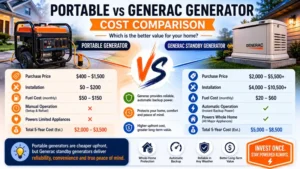
When evaluating the cost of a generac generator, you must decide whether you are purchasing an automated structural asset or a manual piece of emergency equipment. A permanent home standby generator sits on a dedicated pad, links directly to your home’s main breaker box via an automatic transfer switch, and monitors utility line voltage 24/7. When the utility power drops for more than a few seconds, the switch mechanically disconnects your home from the dead utility lines and fires up the generator automatically—regardless of whether you are at home, asleep, or away on vacation.
Standby System: [Utility Grid Drops] ──> [ATS Disconnects Grid] ──> [Gen Auto-Fires] ──> [Power Restored in 10s]
Portable System: [Utility Grid Drops] ──> [Locate Unit in Dark] ──> [Fill with Gasoline] ──> [Manual Cord/Switch Connection]
In contrast, a portable generator requires manual intervention. When a storm rolls through, you must physically haul the heavy unit out of storage, place it outdoors in the elements, fill it with fresh gasoline, manually pull-start or crank the engine, and then connect individual heavy-duty extension cords or engage a manual interlock kit. While portable units are far cheaper upfront, they carry a high logistical burden, offer zero protection if a blackout occurs while you are traveling, and run on highly volatile gasoline that must be stored safely and replaced regularly to prevent fuel system gumming.
Long-Term Cost & Maintenance Roadmap
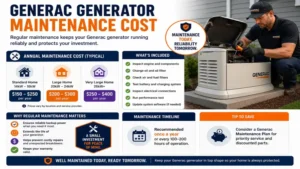
Owning a permanent standby generator is very similar to owning a compact automobile; it requires an ongoing operational and maintenance budget to ensure it runs reliably over a 15-to-20-year lifespan. During an extended blackout, a generator operates continuously for days on end, racking up hours of engine wear that match driving a car at highway speeds for thousands of miles.
Maintenance Schedule Table
| Time Horizon | Required Maintenance Action | Core Purpose | Estimated DIY Cost | Professional Cost |
| Weekly | Automatic 5-Minute Exercise Cycle | Lubricates seals, charges starter battery | Negligible (Fuel only) | Included in annual contract |
| Every 25 Hours | Visual Inspection & Oil Level Dip Check | Prevents oil starvation during long outages | $0 | User performed |
| Every 200 Hours | Full Oil, Filter, Air Cleaner, & Spark Plug Change | Flushes out engine wear particles | $40 – $60 | $250 – $450 |
| Yearly | Battery Testing & Valve Clearance Calibration | Ensures clean mechanical timing & starting | $20 (Multimeter) | $350 – $500 (Annual Agreement) |
An analysis of this maintenance data reveals that while routine oil updates are highly affordable for a handy homeowner, failing to budget for professional valve clearance adjustments every few years can result in an engine that refuses to start due to compression loss. Additionally, standard starter batteries degrade quickly under constant float charging, meaning you must budget for a complete battery swap every 36 months without fail to prevent unexpected starting failures.
FAQ Section
❓ What is the average cost of a generac generator with installation?
✅ For a standard home, the total package typically falls between $7,000 and $13,000. This includes the hardware, the automatic transfer switch, municipal electrical permits, concrete pad preparation, and professional gas line plumbing integration…
❓ Can a 22kW Generac run a whole house comfortably?
✅ Yes, a 22kW unit provides 91.6 amps of continuous power on propane, which easily manages a 3,000-square-foot home with dual central air conditioners, a well pump, lighting grids, and standard kitchen electronics simultaneously…
❓ How much fuel does a Generac standby generator burn per hour?
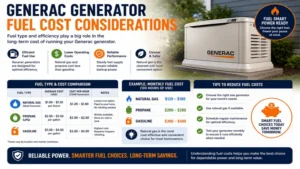
✅ Under a typical half-load operating condition, a standard 22kW Guardian system consumes roughly 2.1 gallons of liquid propane or 228 cubic feet of natural gas per hour of continuous operation…
❓ Does installing a Generac generator increase your home’s resale value?
✅ Yes, recent real estate data indicates that installing a permanent standby power system yields an average return on investment of roughly 60% to 80% in terms of increased residential property equity…
❓ How many years will a Generac home generator last before replacement?
✅ Provided the unit undergoes regular oil changes, valve calibrations, and timely battery replacements, a premium air-cooled engine platform will provide 1,500 to 3,000 hours of operation, translating to roughly 20 years of real-world emergency standby service…
Conclusion
Investing in home standby power is an effective way to protect your household from unpredictable grid failures and severe weather patterns. While the equipment cost of a generac generator represents a clear, tangible baseline, your final investment will depend heavily on your property’s specific electrical layout and fuel infrastructure. By choosing a model that fits your actual power needs, arranging for a clean professional installation, and keeping up with a regular maintenance schedule, you can ensure your home stays warm, safe, and fully powered through any unexpected blackout.
✨ Don’t Miss These Exclusive Deals!
🔍 Take your home security and emergency preparedness to the next level with these carefully selected products. Click on any highlighted item to check current pricing and availability. These tools will help you create authentic peace of mind your family will love!
Recommended for You
- 5 Best All in One Inverter for RV Units (2026 Expert Review)
- 5 Best All in One Inverter for RV Units (2026 Expert Review)
- 5 Best Lightweight Solar Battery Options for Off-Grid Power in 2026
Disclaimer: This article contains affiliate links. As an Amazon Associate, I earn from qualifying purchases. If you purchase products through these links, we may earn a small commission at no additional cost to you.
✨ Found this helpful? Share it with your friends! 💬🤗