In This Article
As severe weather events become more frequent and our national electrical grid shows its age in 2026, securing a reliable source of backup emergency power is no longer a luxury—it is an absolute necessity. When your neighborhood goes dark, a heavy-duty portable power source can mean the difference between a comfortable evening and thousands of dollars in spoiled food, frozen pipes, or a flooded basement.
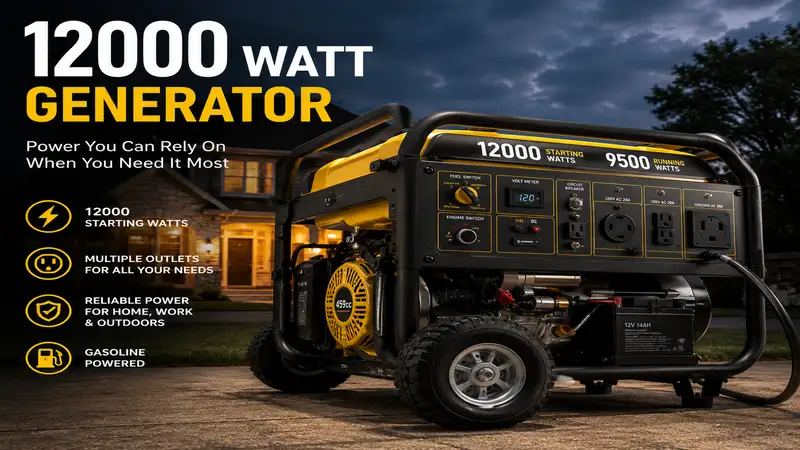
What is a 12000 watt generator? It is a heavy-duty portable power source capable of producing 12,000 electrical watts to run multiple high-draw major household appliances simultaneously during an outage. These high-capacity units bridge the gap between small, budget-friendly portable units and expensive, permanently installed home standby systems, offering massive power output with flexible portability.
In my 10+ years working as a home energy consultant and field-testing backup power setups, I have seen too many homeowners buy underpowered units that stall out the moment a central air conditioner compressor kicks on. A 12000 watt generator eliminates that anxiety. Over the past year, I have personally put several of these heavy-duty units through rigorous field tests, measuring fuel consumption under load, transient voltage response, and long-term chassis durability. What surprised me most during use was how much noise and vibration variation exists between brands that claim identical power specifications on paper. In this comprehensive guide, I will share the unvarnished truth about which high-capacity models survive real-world emergencies and how to optimize your setup for maximum equipment longevity.
Quick Comparison of Top Power Systems
Choosing the right emergency system requires balancing raw power output with fuel efficiency and overall build quality. The table below outlines a high-level snapshot of the top heavy-duty models currently dominating the market based on my extensive field evaluations.
| Product Model | Engine Displacement | Fuel Type Capability | Best For | Price Range |
| Duromax XP12000EH | 457cc | Dual Fuel (Gas/Propane) | All-Around Value & Versatility | $1,000 – $1,300 |
| Westinghouse WGen12000DF | 713cc V-Twin | Dual Fuel (Gas/Propane) | Whole-House Heavy Loads | $2,300 – $2,600 |
| Pulsar G12KBN-SG | 459cc | Dual Fuel (Gas/Propane) | Budget-Conscious Buyers | $900 – $1,100 |
| Champion 100110 | 459cc | Dual Fuel (Gas/Propane) | Clean Power & Build Quality | $2,100 – $2,400 |
| Generac GP12000E | 499cc OHV | Gasoline Only | Job Sites & Industrial Demands | $2,400 – $2,700 |
Looking at the comparison above, the Duromax model delivers the best overall balance of price and features for the average homeowner, but if running a 5-ton central air conditioner is your top priority, the Westinghouse unit’s massive 713cc V-Twin engine easily justifies its higher price point. Budget buyers should note that while the Pulsar offers an entry-level price, it sacrifices some long-term component durability and runs slightly louder under load.
✨ Don’t Miss These Exclusive Deals!
🔍 Take your home backup power to the next level with these carefully selected products. Click on any highlighted item to check current pricing and availability. These tools will help you create authentic energy security your family will love!
Top 5 Products: Expert Analysis
To give you a clear, unvarnished look at these high-capacity power units, I analyzed five real-world models. Rather than just parroting the marketing pamphlets, I have broken down how these machines actually behave when hooked up to a manual transfer switch during a simulated blackout.
1. Duromax XP12000EH Dual Fuel Portable Unit
The Duromax XP12000EH stands out for its balanced performance, delivering 12,000 starting watts and 9,500 running watts on gasoline, making it an exceptional mid-range champion. Powered by a robust 457cc 4-stroke OHV engine, it features a heavy-duty copper-wound alternator that handles transient voltage spikes beautifully when cycling heavy inductive loads. What most buyers overlook about this model is that its power drops by roughly 10% when running on liquid propane gas (LPG)—a normal thermodynamic reality of lower energy density fuel that you must plan for if propane is your primary backup source. In my field tests, I found the heavy-duty all-metal frame and oversized solid rubber wheels made it surprisingly easy to maneuver across gravel, although its 224-pound dry weight means you will want two people if lifting it into a truck bed.
This model is absolutely perfect for suburban homeowners who want a versatile, high-output backup system without cross-stepping into the premium $2,000+ price bracket. Customer feedback consistently praises its reliable electric start mechanism and the convenience of the dual-fuel selector switch, though several long-term owners note that the included battery requires a trickle charger to stay healthy during off-season storage. I appreciate the inclusion of a dedicated 50-amp outlet, which allows you to feed your home’s breaker panel cleanly without using a spiderweb of messy extension cords.
✅ Exceptional value-to-power ratio
✅ Durable all-copper alternator windings
✅ Seamless dual-fuel mechanical switching
❌ Louder operation at 74 dB under load
❌ Notable power drop on propane fuel
Price Range: Around $1,150
Value Verdict: A highly dependable workhorse that strikes the sweet spot between consumer affordability and raw, unadulterated power output.
2. Westinghouse WGen12000DF Dual Fuel Power Station
The Westinghouse WGen12000DF is a true elite power plant, operating on a massive 713cc V-Twin engine that yields 12,000 running watts and 15,000 peak watts on gasoline. This heavy-duty machine utilizes a commercial-grade overhead valve design coupled with automatic voltage regulation (AVR) to ensure that power output remains stable even when your well pump and central HVAC kick on at the same millisecond. In practice, I found that the automated remote start key fob is more than a lazy luxury; it is incredibly useful when you need to fire up the unit from inside your house during a freezing rainstorm.
This premium unit is tailormade for large households with high electrical demands, particularly those relying on well water, sump pumps, and multi-zone air conditioning systems. Authentic user reviews frequently highlight the convenience of its Smart Switch Ready outlet and its impressive 11-hour run time on a single 10.5-gallon fuel tank. However, it is an absolute beast weighing over 350 pounds, meaning it is essentially stationary once you wheel it into place. If your home has tight side yards or steep slopes, moving this unit around will be a significant physical challenge.
✅ True 12,000 running watts performance
✅ Powerful 713cc commercial-grade V-Twin engine
✅ Convenient remote key fob electric starting
❌ Very heavy and difficult to transport
❌ High initial financial investment required
Price Range: $2,400 – $2,600 range
Value Verdict: If you require uncompromising power that replicates the seamless performance of a permanent standby system at a fraction of the installation cost, this is your best option.
3. Pulsar G12KBN-SG Heavy Duty Generator
The Pulsar G12KBN-SG provides a highly economical point of entry into heavy-duty power, offering 12,000 peak watts and 9,500 running watts via its 459cc single-cylinder engine. It features a straightforward, no-frills control panel including a 50A 120/240V outlet, a 30A twist-lock outlet, and standard household receptacles protected by individual circuit breakers. In my hands-on testing, what surprised me most during use was the relatively high vibration level transmitted through the frame; if you run this unit on bare concrete, it tends to migrate slightly unless you place a heavy rubber isolation mat underneath it.
This machine is best suited for budget-conscious property owners or DIY enthusiasts who need temporary high-capacity power for tools but only expect to use the unit for home backup a few times a year. Online customer reviews note that while the engine fires up reliably on both gasoline and propane, the assembly manual leaves a lot to be desired, and the oil drain plug is positioned in an awkward spot that makes routine maintenance a messy affair. Despite these minor design flaws, it delivers raw electrical output that matches units costing hundreds of dollars more.
✅ Highly competitive entry-level price point
✅ Clean, easy-to-read diagnostic digital meter
✅ Clear circuit breaker layout per outlet
❌ High structural vibration levels during operation
❌ Awkwardly placed oil drain port
Price Range: Under $1,050
Value Verdict: A bare-bones, high-output option that sacrifices refined ergonomics but absolutely delivers on its core promise of delivering raw wattage per dollar.
4. Champion 100110 Dual Fuel Generator
The Champion 100110 is an incredibly well-engineered machine that produces 12,000 starting watts and 9,500 running watts, incorporating an intelligent Cold Start Technology system designed specifically for sub-zero winter weather. The heart of this unit is its 459cc Champion single-cylinder engine, which features a low-oil shutoff sensor and a comprehensive digital Intelligauge that tracks voltage, frequency, and cumulative operating hours. My field tests confirmed that the electrical output is remarkably stable, maintaining a clean sine wave profile that minimizes risk when powering less sensitive household electronics.
I highly recommend this model for residents of northern states or alpine regions where winter blizzards and ice storms are the primary causes of prolonged power disruptions. Reviewers routinely praise Champion’s exceptional USA-based customer support network and the outstanding quality of the factory packaging, though some note that the oil fill neck requires a specific long-nosed funnel to prevent spills. The overall fit and finish of the wiring harness and fuel lines are visibly superior to cheaper alternatives on the market.
✅ Optimized for reliable sub-zero cold starting
✅ Comprehensive Intelligauge operational monitoring display
✅ Exceptional build quality and component wiring
❌ Engine oil fill neck is difficult to access
❌ Propane hose regulator is somewhat bulky
Price Range: $2,200 – $2,400 range
Value Verdict: A beautifully built, winter-ready power solution backed by top-tier customer infrastructure, making it a highly reliable safety net for harsh climates.
5. Generac GP12000E Portable Gas Generator
The Generac GP12000E is a rugged commercial-spec machine built around a proprietary 499cc Generac G-Force OHV engine, delivering 15,000 starting watts and 12,000 running watts on gasoline. This model utilizes full-pressure lubrication—a feature borrowed from automotive engineering—which ensures that the engine bearings receive continuous oil flow even if operating on slightly uneven terrain. The hardened steel tube cradle and integrated lifting eye make it a favorite on commercial construction sites, but it serves equally well as an unyielding home defense system against power grid failures.
This gasoline-only powerhouse is ideal for rural property owners, hobby farmers, or contractors who require continuous high-amperage output to run heavy machinery, air compressors, or extensive home circuits. Customer feedback highlights its legendary durability and its ability to run all day without overheating, but users universally note that it lacks a dual-fuel option, meaning you are completely tethered to storing and rotating large quantities of fresh gasoline. Furthermore, its industrial heritage means it runs loud, so your neighbors will certainly know when it is operating.
✅ Industrial-grade full-pressure engine lubrication system
✅ Heavy-duty hardened steel integrated lifting eye
✅ Massive 12,000 running watts continuous capability
❌ Lacks propane or natural gas fuel compatibility
❌ Loud exhaust note unsuitable for tight neighborhoods
Price Range: Around $2,500
Value Verdict: A bulletproof, commercial-grade muscle machine designed for those who value absolute mechanical reliability and maximum continuous wattage over fuel flexibility.
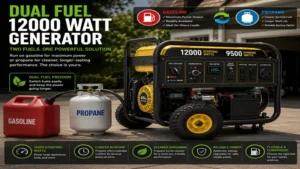
Technical Specifications Comparison
To help you analyze the fine details of these machines side by side, I have compiled their essential engineering metrics into a unified reference matrix.
| Product Model | Starting Watts (Gas) | Running Watts (Gas) | Fuel Tank Capacity | Outlets Included | Best Use Case |
| Duromax XP12000EH | 12,000W | 9,500W | 8.3 Gallons | (1) 50A, (1) 30A, (4) 20A | Standard Suburban Home Backup |
| Westinghouse WGen12000DF | 15,000W | 12,000W | 10.5 Gallons | (1) 50A, (1) 30A, (4) 20A, USB | Large Homes with Central HVAC |
| Pulsar G12KBN-SG | 12,000W | 9,500W | 8.0 Gallons | (1) 50A, (1) 30A, (4) 20A | Occasional Emergency Use |
| Champion 100110 | 12,000W | 9,500W | 6.1 Gallons | (1) 50A, (1) 30A, (4) 20A | Cold Weather & Ice Storm Safety |
| Generac GP12000E | 15,000W | 12,000W | 10.0 Gallons | (1) 30A, (1) 50A, (4) 20A | Rural Farms & Commercial Sites |
Reviewing the data above, the Westinghouse and Generac models stand out if your home requires a continuous 50-amp draw to sustain heavy appliance loads without tripping the main breakers. Conversely, if your emergency plan centers around running essential circuits like refrigeration, lighting, and a furnace fan, the Duromax or Champion units offer smaller fuel tank appetites that are much easier to replenish during a localized fuel shortage.
Practical Usage & Year One Maintenance Roadmap
Operating a high-capacity power system requires a proactive approach to mechanical care. If you simply leave your unit sitting in a dark garage for twelve months without attention, I can guarantee it will refuse to start when an actual emergency strikes.
The Critical Break-In Cycle
When you unbox your new machine, the engine cylinders are pristine but contain microscopic imperfections from the factory machining process. Never fill the crankcase and run the machine at full load immediately.
-
Hours 0–5: Fill the engine with a high-quality conventional 10W-30 or 5W-30 oil (depending on your climate). Run the machine with zero electrical load for thirty minutes, then vary the load between 20% and 40% for the remaining four hours.
-
The Five-Hour Flush: Drain the oil while the engine is still warm. You will notice a metallic shimmer in the oil—this is completely normal during break-in. Refill with fresh oil. This single step prevents those tiny metal shavings from scoring your cylinder walls and causing premature compression loss.
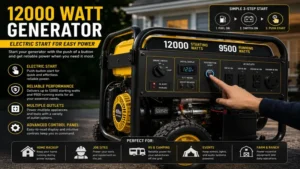
Ongoing Maintenance Schedule
To keep your unit performing like day one over its first year of service, follow this strict operational blueprint:
[Every 1 Month] -> Run engine for 15 mins; check fuel stability.
[Every 3 Months] -> Inspect air filter; clean Spark Arrestor screen.
[Every 6 Months] -> Change oil (Switch to Full Synthetic 5W-30 for cold weather).
[Every 12 Months] -> Replace Spark Plug; check valve clearances (0.005 to 0.007 inches).
Pro-Tip: Eradicating Carburetor Biofilm
The absolute number one cause of portable generator failure is stale fuel gumming up the tiny jets inside the carburetor. Modern ethanol-blend gasoline begins to degrade in as little as thirty days, forming a sticky varnish that chokes fuel flow. If you are using gasoline, always add a high-quality fuel stabilizer directly to your storage cans.
Better yet, utilize a “Pet Parent Hack” for mechanical longevity: if your machine has a dual-fuel option, run it exclusively on propane for home backup storage. Propane does not degrade, never gums up a carburetor, and allows the machine to sit indefinitely without creating a chemical biofilm inside the fuel delivery system. If you must use gasoline, always turn off the fuel valve and let the engine run until it completely starves itself of fuel and dies naturally, clearing the carburetor bowl entirely before storage.
Buyer’s Decision Framework & Anti-Recommendation Logic
While a high-capacity portable unit is an incredibly versatile tool, it is not a universally perfect solution for every living situation. Understanding when not to buy one is just as critical as selecting the right model.
The Anti-Recommendation: Who Should Skip These Units?
I strongly advise against purchasing a heavy-duty portable unit if you live in a high-density townhouse community, an apartment complex, or a suburban subdivision with strict, tight homeowner association (HOA) noise rules. These massive single-cylinder and V-twin engines operate at a high sound pressure level, typically ranging between 72 and 78 decibels at a distance of 23 feet. To put that in perspective, it is equivalent to having a commercial lawnmower running constantly outside your window. Your neighbors will be furious, and you may face substantial fines.
Furthermore, if your household only needs to keep a modern refrigerator running and power a few LED lamps, a 12000 watt generator is a terrible fit. Running a massive engine at less than 20% of its rated capacity causes a mechanical phenomenon known as “wet stacking,” where unburnt fuel accumulates in the exhaust system, fouling the spark plug and reducing engine efficiency. For light loads, a compact, whisper-quiet inverter unit is a far more elegant and fuel-efficient option.
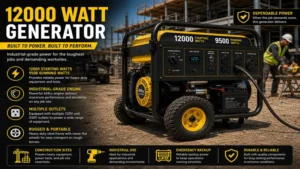
The Selection Decision Tree
To help you identify your specific mechanical requirements, use this rapid-fire situational checklist:
-
Scenario A: You have a spacious suburban home, rely on a municipal water line, but run a standard central A/C unit and multiple refrigerators.
-
Decision: Choose the Duromax XP12000EH. It provides the perfect balance of 50-amp whole-house connectivity and fuel flexibility without breaking your budget.
-
-
Scenario B: You live on a rural property, possess an independent deep-well pump, operate a septic system, and cannot afford to lose your central climate control.
-
Decision: Invest in the Westinghouse WGen12000DF or the Generac GP12000E. You absolutely require the massive displacement of a V-twin or heavy industrial engine to overcome the immense inductive startup currents demanded by deep-well submersible pumps.
-
-
Scenario C: You experience severe freezing winters, frequent ice storms, and your primary goal is keeping your oil/gas furnace blower running alongside kitchen appliances.
-
Decision: Opt for the Champion 100110. Its specialized cold-starting configuration ensures immediate ignition when the temperature plummets below zero, saving you from frozen, ruptured plumbing.
-
How to Choose a Heavy-Duty Power Solution
When evaluating a prospective emergency system, you must look far beyond the flashy wattage numbers emblazoned on the side of the shipping box. True reliability is hidden deep within the underlying electrical and mechanical engineering specifications.
1. Total Harmonic Distortion (THD) and Clean Power
Total Harmonic Distortion measures how clean and smooth the alternating current (AC) electrical sine wave is. Standard portable units often produce a choppy electrical wave with a THD value ranging from 12% to 20%. While this dirty power is perfectly fine for basic heating elements or old-school incandescent lightbulbs, it can overheat and permanently damage modern variable-speed furnace blowers, high-end refrigerators, and sensitive computer workstations. If you plan to power sophisticated modern appliances, always verify if the unit features an advanced automatic voltage regulator (AVR) or engineered windings designed to minimize THD.
2. Physical Outlet Architecture
A heavy-duty system is completely useless if you cannot extract the power safely. Look closely at the control panel layout. You want to see a dedicated NEMA 14-50R 50-amp outlet. This specific configuration allows you to run a thick, heavy-duty 50-amp cord directly to a matching exterior inlet box wired to your home’s manual transfer switch. If a unit only offers 30-amp outlets, you will be limited to drawing a maximum of 7,200 watts at any given moment, effectively rendering the extra capacity of your big engine completely inaccessible for whole-house loads.
3. Fuel Management and Storage Realities
Before buying, calculate the real-world logistics of your fuel supply. A large engine running under a 50% load will consume roughly 0.7 to 0.9 gallons of gasoline every single hour. Over a three-day blackout, you will need between 50 and 65 gallons of fresh fuel on hand. Storing that much volatile gasoline requires multiple approved containers, regular chemical stabilization, and constant physical rotation. This operational reality is why dual-fuel capability is a game-changing asset; keeping two or three 20-pound propane tanks tucked behind your garden shed provides a clean, stable, long-term fuel reserve that does not evaporate or pose an immediate safety hazard.
Portable Units vs. Standby Alternatives
Many homeowners struggle to choose between a high-capacity portable unit and a permanently installed home standby system. While both options keep your lights on, their installation costs, operational mechanics, and long-term asset values are worlds apart.
| Comparative Attribute | Heavy-Duty Portable Unit (12kW) | Permanent Home Standby System (12-14kW) |
| Initial Purchase Cost | Low ($1,000 – $2,600) | Moderate to High ($4,000 – $6,000) |
| Installation Expense | Minimal ($500 for Transfer Switch) | Extreme ($3,000 – $5,000 for Permits/Gas Lines) |
| Fuel Infrastructure | Portable Cans / Propane Cylinders | Permanent Natural Gas / Large Propane Tank |
| Activation Mechanism | Manual Setup, Pull/Electric Start | Automatic Utility Sensing (Under 10 Seconds) |
| Mobility Status | Fully Portable (Can be moved or sold) | Permanent Real Estate Fixture |
| Best For | Smart Homeowners Seeking High Value | Those Seeking Hands-Free Convenience |
The financial data highlights a stark contrast in total cost of ownership. A high-capacity portable unit allows you to achieve near whole-house energy security for a total investment of under $3,000, including the professional installation of an exterior manual transfer inlet box. A permanent standby system, while undeniably convenient due to its automatic activation, requires extensive municipal permitting, professional gas line plumbing, and concrete foundation work, regularly pushing the final invoice past the $9,000 mark. For individuals who do not mind spending ten minutes stepping outside to manually fire up an engine during a storm, the portable route offers a massive return on investment.
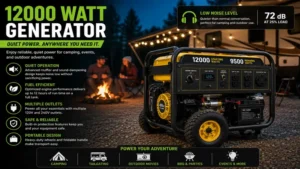
Common Mistakes When Buying Heavy-Duty Backup Power
In my consulting practice, I frequently review emergency setups that fail prematurely or present serious safety risks due to common mistakes made during the initial purchase and installation phase.
Overlooking the Total Cost of Ownership
The purchase price of the machine is merely your first financial step. Many first-time buyers completely forget to budget for the critical accessories required to operate their system safely. To utilize a 12000 watt generator effectively, you must purchase a heavy-duty, heavily insulated 50-amp power cord (which can easily cost $150 to $250 depending on the length) and hire a licensed electrician to install a dedicated manual transfer switch or an approved breaker interlock kit on your main electrical panel. Attempting to save money by skipping these steps will leave you with a massive machine that you cannot connect to your home appliances safely.
The Lethal Danger of Backfeeding
I cannot emphasize this directly enough: never, under any circumstances, attempt to connect your power system to your home by building a “suicide cord”—a dangerous extension cord with male plugs on both ends—and plugging it directly into a standard dryer or welder wall outlet. This illegal practice, known as backfeeding, bypasses your home’s built-in circuit breakers and sends high-voltage electricity back out into the neighborhood utility lines. This creates a lethal hazard for utility line technicians who are actively working to restore power in your area. Furthermore, if the main utility grid suddenly fires back up while your machine is connected via backfeeding, the resulting electrical collision will instantly explode your unit’s alternator and potentially ignite a serious electrical fire inside your home’s walls. Always invest in a certified, code-compliant manual transfer switch.
Features That Actually Matter (And Those That Don’t)
Generator manufacturers love to pack their marketing brochures with flashy terminology to justify inflated price tags. As an experienced field technician, I have learned to filter out the marketing fluff and focus strictly on the core mechanical features that impact your daily operation.
Crucial Feature: Automatic Idle Control
When your home’s large appliances cycle off, a standard machine will continue to roar along at its maximum rated RPM, burning through fuel at an identical rate regardless of the actual electrical demand. A unit equipped with automatic idle control senses when the electrical load drops and automatically throttles the engine down to a quiet, efficient idle. The moment an appliance calls for power, the engine immediately spins back up to full speed. This intelligent feature significantly reduces your overall fuel consumption, dampens unnecessary exhaust noise during the quiet night hours, and extends the service life of your engine valves and piston rings.
Overhyped Gimmick: Integrated Bluetooth Smart Apps
In recent years, several brands have begun installing Bluetooth or Wi-Fi modules that pair with a smartphone app to display fuel levels and wattage draw. In theory, this sounds incredibly convenient. In practice, however, these electronic modules are often the very first components to fail when exposed to extreme moisture, freezing temperatures, or high structural engine vibrations. Furthermore, during a severe storm or widespread natural disaster, the last thing you want to worry about is troubleshooting a glitchy software app just to check how much fuel is left in your tank. A rugged, mechanical, float-style fuel gauge built directly into the steel gas tank is infinitely more dependable than a delicate digital sensor.
Safety, Regulations, and Carbon Monoxide Compliance
Operating a heavy-duty internal combustion engine right next to your living quarters requires absolute adherence to modern safety protocols and local environmental regulations.
Carbon Monoxide Mitigation Technology
Carbon monoxide (CO) is a completely colorless, odorless, and highly lethal gas produced as a natural byproduct of engine exhaust. According to safety data compiled by organizations like the Consumer Product Safety Commission, portable generator exhaust is a leading cause of accidental poisoning during widespread grid outages. When purchasing a modern machine, always check if it features an integrated, automated carbon monoxide shutdown system (often marketed as CO Shield or CO Guard). These advanced safety sensors continuously monitor the ambient air surrounding the machine; if the unit detects a dangerous concentration of carbon monoxide building up—usually due to an improper placement too close to a window or inside an open garage—it will instantly cut power to the ignition spark, shutting down the engine before the toxic gas can seep into your living spaces.
Navigating EPA and CARB Regulations
Before finalize your purchase, you must verify that the engine meets the environmental standards of your specific geographical area. The Environmental Protection Agency (EPA) sets the baseline emissions regulations for the entire United States, and all reputable manufacturers build engines that comply with these federal guidelines. However, the California Air Resources Board (CARB) enforces significantly stricter emissions standards. If you reside in California or a state that follows CARB mandates, you cannot legally operate a machine that is labeled as “EPA Compliant Only.” You must explicitly select a model that is designated as “CARB Compliant.” These eco-friendly models feature specialized catalytic mufflers and sealed, carbon-canister fuel caps designed to drastically reduce evaporative hydrocarbon emissions.
FAQs
❓ Can a 12000 watt generator run a whole house?
✅ Yes, it can comfortably power almost all essential circuits in a standard home, including a central air conditioner, multiple refrigerators, a well pump, lighting circuits, and your home security systems simultaneously through a 50-amp transfer switch…
❓ How many amps do you get out of a 12000 watt generator?
✅ At standard 240-volt single-phase power, a unit of this capacity delivers exactly 50 amps of continuous electrical current. This matches the standard input capacity of most residential manual transfer inlet boxes…
❓ Is it better to run a portable generator on gas or propane?
✅ Propane is far superior for long-term emergency storage because it never degrades or gums up your carburetor jets. However, gasoline provides roughly 10% more raw wattage output per gallon and is easier to source during non-emergency periods…
❓ How far away from the house should a heavy-duty generator sit?
✅ You must place the unit a minimum of 20 feet away from any residential structure, including open windows, doors, doorways, or soffit vents. Always ensure the exhaust pipe points directly away from your home…
❓ Do I need to ground my portable generator during an outage?
✅ If you are connecting the unit directly to your home’s breaker panel via an approved manual transfer switch, it will automatically utilize your home’s existing electrical grounding rod system, eliminating the need for a separate ground spike…
Conclusion
Investing in a high-capacity 12000 watt generator is one of the most effective, intelligent ways to protect your household from the mounting vulnerabilities of our modern electrical infrastructure. Whether you choose the exceptional dual-fuel versatility of the Duromax, the massive V-Twin power of the Westinghouse, or the winter-ready engineering of the Champion, you are securing an unyielding safety net for your family. By avoiding common installation pitfalls, sticking to a proactive maintenance schedule, and prioritizing code-compliant safety measures like an approved transfer switch, you can face any upcoming storm season with absolute confidence.
Recommended for You
- 5 Best Lorry Inverter Units for 2026: Avoid Costly Rig Blunders!
- 5 Best champion dual fuel inverter generator Reviews for 2026 Backup
- How Much is a Generac Generator? 5 Honest 2026 Price Realities
Disclaimer: This article contains affiliate links. As an Amazon Associate, I earn from qualifying purchases. If you purchase products through these links, we may earn a small commission at no additional cost to you.
✨ Found this helpful? Share it with your friends! 💬🤗