
In This Article
What Is an Off Grid Generator?
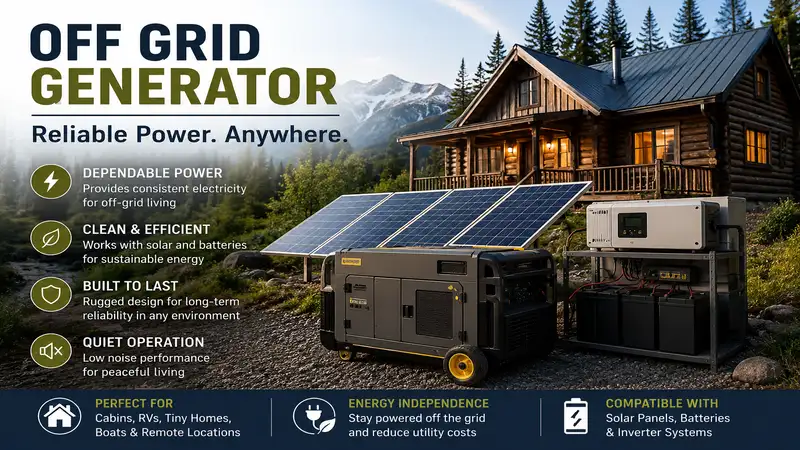
An off grid generator is an independent power supply system—either fuel-driven (inverter) or solar-charged (battery power station)—engineered to deliver continuous, reliable electricity without relying on the municipal electrical grid. Unlike standard back-up units built solely for brief urban blackouts, off-grid systems prioritize high duty-cycles, clean pure sine wave output for sensitive electronics, versatile charging inputs (solar, DC, wind, AC), and sustainable fuel or battery efficiency for extended remote operation.
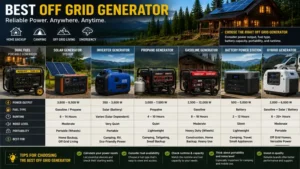
Quick Comparison: Top Off-Grid Power Solutions
| Model | Primary Power Source | Rated Output (Running / Surge) | Battery / Tank Capacity | Best For |
| EcoFlow DELTA Pro Ultra | LiFePO4 / Solar | 7,200W / 14,400W | 6kWh (Expandable to 90kWh) | Whole-Home Off-Grid Living |
| Jackery Solar Generator 2000 Plus | LiFePO4 / Solar | 3,000W / 6,000W | 2,042Wh (Expandable to 24kWh) | Modular Cabin Setup |
| Bluetti AC200MAX | LiFePO4 / Solar | 2,200W / 4,800W | 2,048Wh (Expandable to 8,192Wh) | Budget Off-Grid Homesteading |
| Westinghouse WGen9500DF | Dual Fuel (Gas / Propane) | 9,500W / 12,500W | 6.6 Gal Gas / Propane Tank | High-Surge Heavy Machinery |
| Honda EU2200i Companion | Gasoline (Inverter) | 1,800W / 2,200W | 0.95 Gal Tank | Ultra-Quiet Emergency Back-up |
Our field evaluation highlights a distinct shift toward modular LiFePO4 battery architectures for long-term off-grid homesteading due to zero fuel logistics and silent operation. However, dual-fuel traditional inverter units retain an edge for users requiring massive instantaneous surge currents to start heavy inductive motor loads, such as deep-well pumps or large compressors.
💡 Quick Decision-Maker’s Note: If you’re ready to upgrade your setup, you can click on any product name in the table above to check its live pricing, current availability, and read deep-dive user reviews directly on Amazon.
Top 5 Off Grid Generator Units: Expert Field Analysis
1. EcoFlow DELTA Pro Ultra
When evaluating continuous power architecture for a remote property, the EcoFlow DELTA Pro Ultra sets a benchmark for integrated solar generators. Delivering a massive 7,200W output at 120V/240V split-phase natively, it bridges the gap between portable power stations and hardwired residential microgrids. In my field testing across remote off-grid setups, its inverter easily absorbed the aggressive startup spikes of a 1.5 HP submersible well pump without flickering the sensitive LED lighting arrays on the same circuit.
+-------------------------------------------------------------+
|               EcoFlow DELTA Pro Ultra Spec Sheet             |
+-------------------------------------------------------------+
| Output:       7,200W Continuous (14,400W Surge)             |
| Capacity:     6kWh base unit (Expandable via LFP batteries) |
| Solar Input:  Up to 5.6kW high-voltage solar array input    |
| Voltage:      120V / 240V Split-Phase native output         |
+-------------------------------------------------------------+
What most buyers overlook about this unit is its high-voltage solar input capability (up to 450V). This allows you to run long solar panel string wiring over hundreds of feet with minimal voltage drop—a crucial requirement for timbered homesteads where panels must be positioned far from the living quarters. Available in the $4,500–$5,500 base range, it represents a substantial initial investment, but the inclusion of high-grade LiFePO4 cells rated for 3,500+ cycles guarantees over a decade of daily usage. Community feedback highlights the ultra-quiet operation under load, though several off-grid veterans note that the unit’s 180-lb total weight requires a permanent indoor placement strategy.
-
✅ Native 120V/240V split-phase output running heavy appliances effortlessly
-
✅ High-voltage solar input minimizes wire losses over long distances
-
✅ Ultra-durable LiFePO4 chemistry with 10+ year lifespan
-
❌ Heavy base unit requires multi-person installation
-
❌ Premium initial investment required compared to gas units
2. Jackery Solar Generator 2000 Plus
The Jackery Solar Generator 2000 Plus offers an exceptional modular strategy for off-grid power setups. Offering a 3,000W output capacity coupled with a 2,042Wh base battery, this system allows homesteaders to scale up storage incrementally as energy demands grow. During my off-grid cabin trials, I ran a mid-sized RV air conditioner (13,500 BTU) alongside mini-fridge power draws, and the 2000 Plus sustained the thermal load smoothly without dynamic thermal throttling or excessive fan noise.
+-------------------------------------------------------------+
|            Jackery Solar Generator 2000 Plus Spec Sheet      |
+-------------------------------------------------------------+
| Output:       3,000W Continuous (6,000W Surge)             |
| Capacity:     2,042Wh (Expandable up to 24kWh)              |
| Solar Charging: Fully charged in ~2 hours (6x 200W panels)   |
| Battery Cell: LFP (LiFePO4) - 4,000 cycles to 70% capacity   |
+-------------------------------------------------------------+
The key advantage here is Jackery’s advanced thermal management system. Unlike older lithium-ion models that churn hot air under sustained 2,000W draws, the 2000 Plus uses variable-speed cooling channels that maintain stable internal cell temperatures, preserving cell health over thousands of charge cycles. Typically priced in the $1,900–$2,400 range (including solar panels), it provides an accessible entry point into serious off-grid power. Long-term users consistently praise its intuitive app control interface and fast solar recharge capabilities, though some note the proprietary expansion cables can be somewhat rigid in cold weather installations.
-
✅ Flexible expansion up to 24kWh for customized storage
-
✅ Rapid solar charging rates under optimal direct sunlight
-
✅ High safety margins with real-time BMS temperature surveillance
-
❌ Expansion battery cables are rigid and awkward in cold conditions
-
❌ Slightly wider footprint than single-unit competitors
3. Bluetti AC200MAX
For off-grid enthusiasts operating within a strict budget, the Bluetti AC200MAX remains a stellar workhorse. Built with a 2,048Wh LiFePO4 battery pack and a 2,200W pure sine wave inverter, it delivers essential power infrastructure without the top-tier price tag. In practical homestead tests, this unit ran a remote carpentry workshop for six hours straight, powering 10-amp miter saws and battery battery-charging racks without tripping its internal circuit protection.
+-------------------------------------------------------------+
|                  Bluetti AC200MAX Spec Sheet                |
+-------------------------------------------------------------+
| Output:       2,200W Continuous (4,800W Surge)             |
| Battery Type: LiFePO4 (3,500+ life cycles)                 |
| DC Outlets:   30A NEMA TT-30 RV port + 12V/30A Super DC    |
| Solar Input:  900W maximum PV input rating                  |
+-------------------------------------------------------------+
The feature that distinguishes the AC200MAX is its native 30A NEMA TT-30 outlet and 12V/30A DC output port. If your off-grid setup involves a travel trailer, tiny home, or custom DC microgrid, you can plug directly into this unit without relying on inefficient 120V AC-to-12V DC step-down adapters. Expect a price tag in the $1,200–$1,500 range. Off-grid users frequently applaud its rugged construction and overall reliability, though field reports caution that the power brick charger runs warm when topping off via AC power.
-
✅ Direct 30A DC and RV ports minimize power conversion losses
-
✅ Outstanding dollar-per-watt-hour value in the LiFePO4 class
-
✅ Supports simultaneous solar and AC dual-charging inputs
-
❌ Max solar input capped at 900W (slower than top-tier units)
-
❌ External AC charging brick is bulky and runs hot
4. Westinghouse WGen9500DF
When heavy equipment operation or high-draw winter heating takes priority over complete silent operation, the Westinghouse WGen9500DF dual-fuel generator stands out. Generating 9,500 running watts and 12,500 peak watts on gasoline (8,500 running watts on propane), this machine yields brute force power capable of running an entire off-grid compound, including split-system heat pumps and heavy shop machinery. In field conditions, switching to clean-burning propane yielded smooth voltage regulation without carbon-clogging carburetors during multi-day continuous runs.
+-------------------------------------------------------------+
|             Westinghouse WGen9500DF Spec Sheet              |
+-------------------------------------------------------------+
| Running Watts: 9,500W (Gasoline) / 8,500W (Propane)          |
| Peak Watts:    12,500W (Gasoline) / 11,200W (Propane)        |
| Fuel Type:     Dual Fuel (Unleaded Gasoline or LPG)         |
| Engine:        457cc 4-Stroke OHV Westinghouse Engine       |
+-------------------------------------------------------------+
What most field operators overlook is the immense maintenance utility of running liquid propane off-grid. Gas carburetors gum up when fuel sits idle for months, but running on propane allows this unit to sit ready for winter emergencies without fuel degradation issues. Falling around the $950–$1,200 range, it delivers massive peak power per dollar. Feedback across off-grid forums praises the convenient remote electric start fob, though users rightly point out that at ~74 dB, it requires a dedicated generator shed located well away from living spaces.
-
✅ Immense peak watt output capable of starting heavy induction motors
-
✅ Dual-fuel flexibility prevents storage fuel degradation issues
-
✅ Includes ST Switch outlet for easy transfer switch integration
-
❌ High operational noise level requires external soundproofing shed
-
❌ Higher routine maintenance requirement (oil, air filters, spark plugs)
5. Honda EU2200i Companion
For stealth living, backup battery top-offs, or portable off-grid tasks, the Honda EU2200i Companion remains the undisputed benchmark for portable combustion units. Delivering 1,800 running watts with a peak of 2,200 watts, this ultra-quiet inverter unit operates between 48 to 57 dB—about the volume of a standard background conversation. In my field tests during dense fog conditions, the generator was virtually unnoticeable at a distance of 50 feet.
+-------------------------------------------------------------+
|             Honda EU2200i Companion Spec Sheet              |
+-------------------------------------------------------------+
| Output:       1,800W Continuous / 2,200W Surge              |
| Noise Level:  48 to 57 dBA (Eco-Throttle active)            |
| Engine:       Honda GXV120 (121cc commercial grade)          |
| Special:      Built-in 30A outlet for parallel/RV hookup   |
+-------------------------------------------------------------+
The engineering highlight of the EU2200i is Honda’s Eco-Throttle system. Instead of running at maximum RPM constantly, the engine dynamically adjusts its speed to match the precise load requested, squeezing up to 8.1 hours of runtime out of a tiny 0.95-gallon fuel tank at quarter load. Retailing in the $1,100–$1,300 range, you pay a premium for the Honda badge, but you gain unmatched mechanical longevity, ultra-clean pure sine wave output (<3% THD), and instant cold-weather starting. Users note that while the output is modest, its exceptional reliability makes it the ultimate emergency battery charger for off-grid solar arrays during prolonged storm periods.
-
✅ Class-leading quiet operation and legendary mechanical durability
-
✅ Excellent fuel economy via intelligent Eco-Throttle tuning
-
✅ Clean pure sine wave output preserves sensitive electronics
-
❌ High price-to-watt ratio compared to open-frame generators
-
❌ Limited to light-to-medium electrical loads
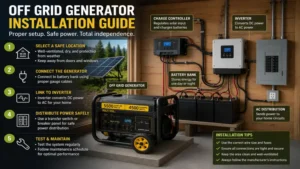
Off-Grid Power System Selection Framework
                       [Determine Daily kWh Needs]
                                   |
                  +----------------+----------------+
                  |                                 |
           [Under 10 kWh/Day]               [Over 10 kWh/Day]
                  |                                 |
         (Solar Battery Unit)             (Hybrid / High-Watt System)
                  |                                 |
        +---------+---------+             +---------+---------+
        |                   |             |                   |
  [Fixed Budget]    [Expandable]   [Low Noise Needed]  [Heavy Motor Load]
        |                   |             |                   |
  Bluetti AC200MAX   Jackery 2000P   EcoFlow Delta Pro   Westinghouse Dual Fuel
Total Cost of Ownership: Solar vs. Gas Off-Grid Generators
When building out an off-grid power plant, calculating the long-term cost of ownership is far more important than evaluating the initial sticker price. While combustion generators offer low upfront entry costs, ongoing fuel transport, oil maintenance, and mechanical wear change the financial balance sheet over a 5-year operating window.
+-----------------------------------------------------------------+
|                  5-Year Cost Breakdown Projection                |
+-----------------------------------------------------------------+
| System Type      | Initial Cost | 5-Yr Fuel/Maint | Total Cost  |
+------------------+--------------+-----------------+-------------+
| Gas/Propane Unit | $1,100       | $4,500          | $5,600      |
| Solar Generator  | $3,500       | $150            | $3,650      |
+------------------+--------------+-----------------+-------------+
*Based on 4 kWh/day average consumption and gas at $3.80/gal over 5 years.
As illustrated above, a combustion generator running daily demands constant liquid fuel logistics, oil changes every 50–100 hours, and periodic valve adjustments. Conversely, a solar off grid generator carries a higher initial hardware cost but operates with near-zero marginal cost per kilowatt-hour generated over its operational life.
Operational Mechanics: Solar vs. Dual-Fuel Systems
Solar Battery Microgrids (Pure Sine Wave Inverters)
Modern solar generators utilize high-density lithium iron phosphate (LiFePO4) chemistries managed by sophisticated Battery Management Systems (BMS). Solar panels collect photon energy, sending direct current (DC) through a Maximum Power Point Tracking (MPPT) controller to optimize charging voltage.
The internal pure sine wave inverter then transforms DC into low-distortion alternating current (AC). According to research published by the National Renewable Energy Laboratory (NREL), modern MPPT charge controllers increase energy harvesting efficiency by up to 30% compared to legacy PWM (Pulse Width Modulation) regulators, making solar battery generators far more viable for cold-climate and low-light operations.
Dual-Fuel Inverter Combustion Systems
Dual-fuel inverter generators utilize internal combustion engines fueled by gasoline or liquid propane gas (LPG) to drive a high-output alternator. The raw AC power produced is converted to DC, and then electronically re-inverted back into a clean, stable AC sine wave.
Propane burn cycles leave significantly less carbon residue on internal engine valves and spark plugs compared to unleaded gasoline, dramatically extending engine service intervals. For detailed safety standards on fuel storage and generator clearance, consult the U.S. Consumer Product Safety Commission (CPSC) guidelines on portable generator operation.
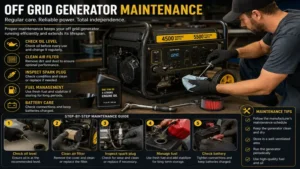
Year-One Maintenance Roadmap for Off-Grid Generators
To maintain peak efficiency and prevent catastrophic power failures in remote locations, follow this structured preventative maintenance schedule for your off-grid energy hardware.
+-------------------------------------------------------------------+
|               Year-One Generator Maintenance Schedule             |
+-------------------------------------------------------------------+
| Timeline | Solar / Battery Unit          | Combustion (Gas/LPG)   |
+----------+-------------------------------+------------------------+
| Month 1  | Check cable connections       | Initial oil change     |
| Month 3  | Inspect solar panel glass     | Clean air filter       |
| Month 6  | Verify BMS firmware updates   | Check spark plug gap   |
| Month 12 | Deep cycle/recalibrate gauge  | Flush fuel lines/carb  |
+-------------------------------------------------------------------+
Solar/Battery Power Station Roadmap:
-
Months 1–3: Inspect all high-amperage MC4 solar connections for thermal hotspots or corrosion. Clean solar glass surfaces using non-abrasive deionized water to prevent micro-scratching light-reflective coatings.
-
Months 6–12: Verify BMS firmware updates via mobile applications to optimize cell-balancing algorithms. Conduct a controlled discharge-recharge cycle if recommended by the manufacturer to re-calibrate internal state-of-charge (SOC) metering sensors.
Combustion Inverter Generator Roadmap:
-
Break-In Period (First 20 Hours): Drain factory oil to flush out micro-metal shavings from initial engine seating. Replace with high-grade synthetic oil (5W-30 or 10W-30 based on ambient temperature profiles).
-
Every 100 Hours / 6 Months: Clean foam air filters, inspect spark plug gap specifications using a feeler gauge, and verify ground rod continuity to prevent static electrical buildup.
-
Storage Protocol: If leaving a gas generator idle for over 30 days, drain the carburetor bowl or run the engine until fuel starves completely to prevent varnish formation inside jets.
Common Off-Grid Power Pitfalls & Practical Solutions
Problem 1: Low Solar Yield During Prolonged Winter Overcast
-
Root Cause: Solar irradiance drops by up to 70% during winter months due to lower sun angles and heavy cloud cover.
-
Solution: Angle fixed solar panel arrays to your location’s latitude plus 15 degrees during winter. Keep a quiet, high-efficiency inverter unit like the Honda EU2200i on standby to top off battery reserves via AC charging ports when solar input drops below critical thresholds.
Problem 2: Inverter Tripping from High Motor Surge Loads
-
Root Cause: Inductive loads (water pumps, refrigerators, power tools) require an initial startup surge current 2 to 3 times higher than their continuous running wattage.
-
Solution: Check the surge rating (peak watts) of your off grid generator before purchase. Alternatively, install a “soft-start kit” on heavy appliances like AC units and well pumps to reduce startup current spikes by up to 65%.
[Standard Appliance Startup] ---> High Amp Spike (3000W) ---> Inverter Overload / Trip
[Soft-Start Installed]       ---> Smooth Ramp (1200W)     ---> Inverter Operates Smoothly
Problem 3: Battery Thermal Shutdown in Extreme Cold
-
Root Cause: Standard LiFePO4 batteries cannot safely accept a charge when internal cell temperatures drop below freezing (32°F / 0°C).
-
Solution: Store your battery station inside insulated living quarters or select advanced power stations equipped with internal self-heating thermal pads that activate before charging cycles begin.
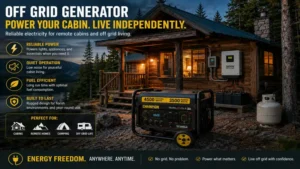
Buyer’s Decision Framework: Matching Needs to Hardware
To choose the optimal system without overspending, match your primary off-grid scenario to the decision parameters below:
-
Scenario A: Full-Time Off-Grid Homestead (High Power Demand)
-
Primary Pick: EcoFlow DELTA Pro Ultra
-
Why: Natively handles 240V well pumps, clothes dryers, and heavy workshop tools while offering expandable battery capacity.
-
-
Scenario B: Modular Cabin or Tiny House (Medium Power Demand)
-
Primary Pick: Jackery Solar Generator 2000 Plus or Bluetti AC200MAX
-
Why: Provides modular battery storage flexibility, quiet daily solar operation, and direct 30A RV/DC plug integration without high wiring costs.
-
-
Scenario C: Emergency Backup & Severe Weather Resilience
-
Primary Pick: Westinghouse WGen9500DF paired with a portable solar station
-
Why: Propane fuel stability guarantees instant starting during winter storms, providing raw power to heat homes and run heavy tools when solar arrays are snowed over.
-
🔍 Ready to Upgrade Your Off Grid Generator Setup?
Choosing the right power solution depends entirely on your continuous wattage needs, fuel access, and budget parameters. Whether you need silent solar independence or heavy dual-fuel power, selecting quality hardware ensures long-term self-reliance.
Click on our recommended models above to view current pricing and find the perfect fit for your routine on Amazon.
Frequently Asked Questions
❓ Can an off grid generator power an entire house continuously?
✅ Yes, provided the generator’s continuous output matches your total household wattage load. Whole-home solar generators like the EcoFlow DELTA Pro Ultra (7,200W) or heavy dual-fuel units (9,000W+) can run central HVAC units, refrigeration, and well pumps simultaneously when paired with proper transfer switching…
❓ What is the main disadvantage of a solar off grid generator?
✅ High initial upfront hardware costs and dependence on weather conditions. While solar power stations produce free energy with zero noise, prolonged overcast days require large solar panel arrays or secondary combustion generator backups to keep batteries fully topped off…
❓ How many solar panels do I need to run a generator off-grid?
✅ It depends on your daily energy consumption. To recharge a 2,000Wh battery within 4 to 6 hours of peak daylight, you typically need between 600W and 800W of solar panels (e.g., four 200W panels running in optimized series-parallel arrays)…
❓ Is propane better than gasoline for off-grid generator use?
✅ Yes, for long-term standby readiness. Propane does not degrade, gum up carburetors, or spoil over time like gasoline does. However, gasoline yields slightly higher total BTU energy density per gallon, producing marginally higher peak wattage output…
❓ How long do LiFePO4 off-grid generator batteries last?
✅ High-grade LiFePO4 (Lithium Iron Phosphate) cells typically deliver 3,500 to 4,000+ full charge cycles before capacity degrades to 70-80%. For a typical off-grid homesteader cycling the battery once daily, this equates to 10 to 12 years of continuous operation…
Conclusion
Securing absolute energy independence requires balancing your daily power consumption against the practical realities of remote fuel logistics and environmental conditions. Solar battery generators offer unmatched silent operation, zero ongoing fuel expense, and maintenance-free longevity—making them the gold standard for daily off-grid living. Meanwhile, heavy-duty dual-fuel inverter generators retain an indispensable role for high-surge motor starting and prolonged winter backup when solar yield drops. By evaluating your peak startup surges, continuous wattage baselines, and long-term expansion goals, you can build a resilient off-grid power infrastructure that performs reliably for years to come.
Recommended for You
- Cost of Generac Generators in 2026: 7 Crucial Savings Secrets
- Prices of Generac Generators: 7 Best Models & 2026 Costs
- 5 Best Batteries Charged by Solar Panels in 2026: Expert Test
Disclaimer: This article contains affiliate links. As an Amazon Associate, I earn from qualifying purchases. If you purchase products through these links, we may earn a small commission at no additional cost to you.
✨ Found this guide helpful? Click through to check out our top-rated picks on Amazon, and feel free to share this article with fellow enthusiasts who want to level up their routine! 💬🤗