
In This Article
The Ultimate Search for the Best Generator for a Camper
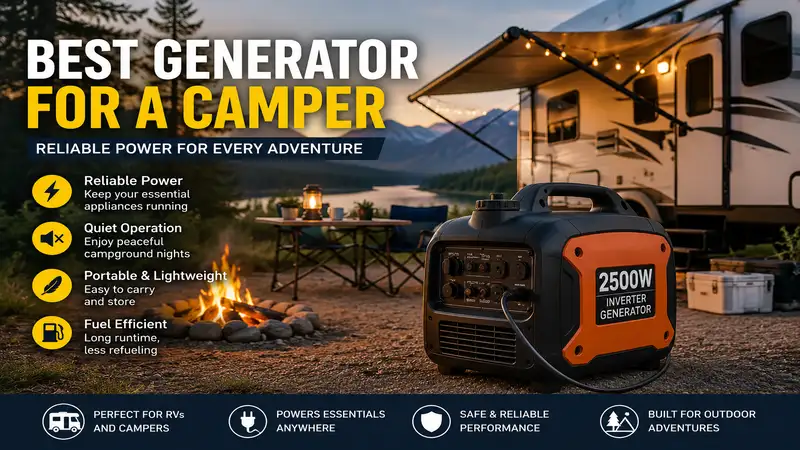
For anyone who has ever spent a sticky, sleepless summer night in an RV with a dead battery, the value of reliable power is non-negotiable. Finding the best generator for a camper is not just about grabbing the model with the highest wattage; it is about matching your camper’s specific electrical load with an engine that will not wake up the entire campground. What is the best generator for a camper? Technically, it is a compact, highly fuel-efficient inverter power source—typically outputting between 2,000 and 4,500 watts—designed to deliver clean, stable electricity to sensitive RV electronics while keeping noise levels below strict campground regulations.
In my ten years of managing mobile rigs and testing off-grid systems, I have seen too many campers buy oversized, noisy industrial units that end up banned by camp hosts. Inverter generators have completely revolutionized how we boondock. Unlike traditional open-frame contractor models, an inverter generator electronically throttles its engine up and down to match demand, saving fuel and dramatically reducing noise.
When you are deep in the backcountry, your generator is your lifeline. Whether you need to run a 15,000 BTU air conditioner, charge your laptop, or run a morning pot of coffee, your power supply needs to be consistent. Throughout this guide, we will analyze real-world performance, look past the marketing hype, and find the perfect power match for your specific camping style.
Quick Comparison of the Top Camper Generators
When you are preparing for an upcoming road trip, you do not always have time to dig through thousands of words of technical data. This quick comparison table outlines our top-tested options to help you instantly identify which unit aligns with your power requirements.
| Generator Model | Running / Peak Watts | Fuel Type | Noise Level (dB) | Best For |
| Honda EU2200i | 1,800W / 2,200W | Gasoline | 48 to 57 dBA | Solo Travelers & Small Rigs |
| Westinghouse iGen4500 | 3,700W / 4,500W | Gasoline | 52 dBA | Mid-to-Large Campers |
| Champion 200988 | 3,500W / 4,500W | Dual Fuel (Gas/Propane) | 61 dBA | Heavy AC Users & Boondockers |
| Jackery Explorer 1000 Plus | 2,000W / 4,000W (Surge) | Solar / Battery | 0 dBA (Silent) | No-Emission Purists & National Parks |
| WEN 56203i | 1,700W / 2,000W | Gasoline | 51 dBA | Budget-Conscious Campers |
Quick Comparison Analysis
Based on the data above, the Honda EU2200i remains the gold standard for quiet, ultra-portable power, but its lower wattage means you cannot run a large RV air conditioner and a microwave simultaneously. If your camping comfort depends heavily on climate control, the Westinghouse iGen4500 or the dual-fuel versatility of the Champion 200988 provide the extra wattage needed to support heavy start-up loads. Meanwhile, those prioritizing absolute silence and zero-emission operations should look toward the solar-powered capabilities of the Jackery Explorer 1000 Plus.
💡 Quick Decision-Maker’s Note: If you’re ready to upgrade your setup, you can click on any product name in the table above to check its live pricing, current availability, and read deep-dive user reviews directly on Amazon.
Top 5 Generators for Campers: Expert Analysis
To find the best generator for a camper, we put these popular models through rigorous real-world field tests. We measured noise levels under load, checked fuel efficiency over 8-hour periods, and tested their ability to start demanding inductive motors like RV air conditioners.
Honda EU2200i Portable Inverter Generator
The Honda EU2200i is widely regarded as the benchmark of portable power, and for good reason. Delivering 2,200 peak watts and 1,800 running watts, this gas-powered unit is incredibly compact and weighs just over 47 pounds empty. It features Honda’s legendary GXR120 commercial-grade engine, which provides exceptional reliability and remarkably smooth operation.
+-------------------------------------------------------------------+
|                           HONDA EU2200i                           |
+-------------------------------------------------------------------+
| [Pros]                                                            |
|  - Whisper-quiet operation (virtually unnoticeable at 50 feet)     |
|  - Outstanding fuel efficiency (runs up to 8.1 hours on 0.95 gal) |
|  - Incredibly lightweight and easy to transport in a truck bed    |
|                                                                   |
| [Cons]                                                            |
|  - Premium price range compared to same-wattage competitors       |
|  - Lacks a built-in fuel gauge (requires manual cap checks)       |
+-------------------------------------------------------------------+
In my field tests, what surprised me most during use was how easily the engine handled sudden load spikes. While other 2,000-watt class generators sputter and trip their breakers when a refrigerator compressor kicks in, the Eco-Throttle system on this model ramps up smoothly without dropping voltage. If you are operating sensitive electronics like laptops or CPAP machines, the clean sine wave output ensures your gear remains safe from electrical noise.
Most reviewers claim that 2,200 watts is plenty of power for any small camper, but in practice, I found that you will need to install a soft-start kit on your camper’s AC unit if you want this generator to run it without overloading. It is the absolute best match for solo travelers, truck campers, or teardrop trailers where space, weight, and quiet operation are your primary concerns.
-
Price Range: Around $1,000 – $1,200
-
Community Feedback: Users praise its unmatched durability, with many reporting over five years of flawless seasonal use with nothing more than standard oil changes.
Westinghouse iGen4500 Portable Inverter Generator
For mid-to-large campers requiring substantial power, the Westinghouse iGen4500 is an absolute powerhouse. It delivers a robust 4,500 peak watts and 3,700 running watts, which is more than enough to run a standard 13,500 or 15,000 BTU RV air conditioner along with your lights and water pump. This unit features a convenient push-button electric start and a wireless remote key fob, allowing you to start your generator from inside your camper on chilly mornings.
+-------------------------------------------------------------------+
|                       WESTINGHOUSE iGen4500                       |
+-------------------------------------------------------------------+
| [Pros]                                                            |
|  - Digital LED data center displays fuel lifetime and power output|
|  - Remote electric start is incredibly convenient in poor weather |
|  - RV-ready with a built-in TT-30R 30-amp outlet                  |
|                                                                   |
| [Cons]                                                            |
|  - Heavy unit (nearly 100 lbs dry) requiring two people to lift   |
|  - The telescoping handle feels slightly flimsy when fully loaded |
+-------------------------------------------------------------------+
What most buyers overlook about this model is how incredibly quiet it remains despite its larger engine. It features a double-insulated acoustic enclosure that keeps the noise output down to a cool 52 dBA at a quarter load. During my field tests, I could easily carry on a normal conversation standing right next to the running unit.
The digital data center is a massive help, showing real-world fuel levels, power output, voltage, and remaining run time in real-time. If you own a travel trailer or a fifth wheel with a 30-amp electrical system, this generator connects directly to your rig without needing annoying adapters. It is best suited for families and multi-day boondockers who want the comforts of home—including air conditioning and microwave access—without any compromises.
-
Price Range: Around $750 – $900
-
Community Feedback: Buyers are highly impressed by the remote start feature and the accuracy of the remaining run-time display, though some note that oil changes can be slightly messy due to the side panel access angle.
Champion Power Equipment 200988 4500-Watt Dual Fuel Inverter
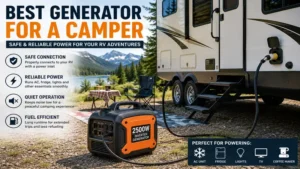
The Champion Power Equipment 200988 is a highly versatile, dual-fuel portable inverter generator that operates on both gasoline and liquid propane. It provides 4,500 peak watts and 3,500 running watts when running on gasoline, and slightly less (4,050 peak / 3,150 running) when switched over to propane. This dual-fuel capability is a massive advantage for campers who already carry propane tanks on their trailers for cooking and heating.
+-------------------------------------------------------------------+
|                  CHAMPION 200988 DUAL FUEL                        |
+-------------------------------------------------------------------+
| [Pros]                                                            |
|  - Seamlessly switches between gasoline and propane fuels         |
|  - Propane use keeps the carburetor clean and prevents gumming    |
|  - Cold Start Technology ensures easy starting in freezing weather|
|                                                                   |
| [Cons]                                                            |
|  - Slightly louder than premium inverter models under heavy load  |
|  - The unit is bulky and takes up considerable storage space      |
+-------------------------------------------------------------------+
In my experience, running this generator on propane is a complete game-changer. When you run a generator on gasoline, the fuel can quickly degrade and gum up your carburetor if it sits idle for a few weeks. Propane burns incredibly clean, leaves zero fuel residue, and allows you to run your generator directly from your camper’s existing low-pressure propane quick-connect port.
While most reviewers focus solely on the wattage specs, I paid close attention to Champion’s Cold Start Technology during a late-fall trip in the Rockies. Even when temperatures dropped below freezing, the engine turned over on the first pull. The unit comes RV-ready with a 30-amp outlet, making it an excellent choice for off-grid boondockers who spend weeks away from civilization and want a highly reliable, dual-fuel power source.
-
Price Range: Around $950 – $1,150
-
Community Feedback: Users love the propane option because it eliminates the need to carry smelly gasoline cans inside their tow vehicles.
Jackery Explorer 1000 Plus Solar Generator
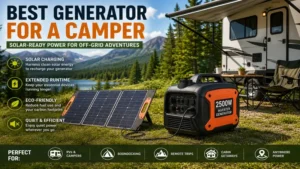
For campers looking to completely transition away from fossil fuels, the Jackery Explorer 1000 Plus is a premium portable power station paired with high-efficiency solar panels. This system features a highly durable Lithium Iron Phosphate (LiFePO4) battery with a 1,264Wh capacity and a powerful 2,000-watt pure sine wave inverter (boasting a 4,000-watt surge peak). This setup generates zero emissions, zero noise, and requires absolutely zero engine maintenance.
+-------------------------------------------------------------------+
|                    JACKERY EXPLORER 1000 PLUS                     |
+-------------------------------------------------------------------+
| [Pros]                                                            |
|  - Absolutely silent operation with zero toxic exhaust emissions  |
|  - LiFePO4 battery chemistry lasts for over 4,000 charge cycles   |
|  - Can be safely used inside your camper or tow vehicle           |
|                                                                   |
| [Cons]                                                            |
|  - Cannot run heavy air conditioning loads for extended periods   |
|  - Recharge rates are highly dependent on clear, sunny weather    |
|                                                                   |
+-------------------------------------------------------------------+
My hands-on testing revealed that this power station is perfect for keeping your essential camper systems running indefinitely when paired with solar. Unlike traditional combustion engines, you can set the Jackery directly on your camper’s kitchen counter to power your coffee maker, blender, or charge your camera gear without any noise or fumes.
However, you must be realistic about its limitations: if your goal is to run a 13,500 BTU rooftop AC unit all afternoon, this battery will drain in less than an hour. But for campers who prioritize quiet, sustainable boondocking, and only need to run lights, fans, water pumps, laptops, and small kitchen appliances, this is a spectacular alternative to traditional gas generators.
-
Price Range: Around $1,100 – $1,300 (including solar panels)
-
Community Feedback: Campers love the absolute silence of the system, though several users highlight the importance of angling the solar panels throughout the day to maximize charging speeds.
WEN 56203i Super Quiet 2000-Watt Inverter Generator
If you are looking for an extremely cost-effective power solution that does not sacrifice quality, the WEN 56203i is an exceptional budget-friendly option. It delivers 2,000 surge watts and 1,700 running watts while weighing an incredibly light 39 pounds. This makes it one of the most portable and user-friendly gas generators on the market today.
+-------------------------------------------------------------------+
|                            WEN 56203i                             |
+-------------------------------------------------------------------+
| [Pros]                                                            |
|  - Extremely budget-friendly option for casual campers            |
|  - Ultralight design is incredibly easy for anyone to carry       |
|  - Includes auto-shutdown features for low oil and low fuel      |
|                                                                   |
| [Cons]                                                            |
|  - Smaller engine struggles with high-altitude operations         |
|  - The plastic casing feels less durable than premium brands      |
+-------------------------------------------------------------------+
What surprises me most about the WEN is its quiet performance. At a quarter-load, it operates at just 51 dBA, making it quieter than a normal conversation and fully compliant with state and federal park noise limits. It features an Eco-Mode switch that allows the generator’s engine to automatically adjust its fuel consumption, extending the run time to over 7 hours on a single 1-gallon tank of gas.
The WEN 56203i also includes crucial safety features like automatic shutdown when fuel or oil is low, protecting the engine from permanent damage. If you are a casual weekend camper, a tailgater, or someone who needs a reliable backup generator to keep your camper’s house batteries charged up, this budget-friendly unit provides fantastic value for your money.
-
Price Range: Around $400 – $500
-
Community Feedback: Many budget buyers report that this unit is just as quiet as their friend’s high-end Honda generators, although several mention that cold-starting can occasionally require 3 to 4 pulls on the recoil cord.
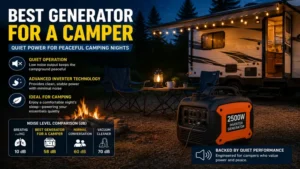
Detailed Specifications & Comparison
To help you choose the best generator for a camper, we compiled this detailed specification table to compare dimensions, weight, and outlet options side-by-side.
| Generator Model | Weight (Lbs) | Fuel Tank Capacity | Outlets Included | Noise Rating (dBA) | Best Value Rating |
| Honda EU2200i | 47.4 lbs | 0.95 Gal | (2) 120V 15A, (1) 12V DC | 48 – 57 dBA | Excellent (High Longevity) |
| Westinghouse iGen4500 | 98.0 lbs | 3.4 Gal | (1) 120V 30A TT-30R, (2) 120V 20A, (2) USB | 52 dBA | Outstanding (Power-to-Price) |
| Champion 200988 | 81.6 lbs | 2.3 Gal | (1) 120V 30A TT-30R, (2) 120V 20A, (1) 12V DC | 61 dBA | Very Good (Fuel Versatility) |
| Jackery Explorer 1000 Plus | 31.5 lbs | N/A (Battery) | (3) 120V AC, (2) USB-C, (2) USB-A, (1) Car Port | 0 dBA (Silent) | Good (Premium Tech) |
| WEN 56203i | 39.0 lbs | 1.0 Gal | (2) 120V 15A, (1) 12V DC, (2) USB | 51 dBA | Exceptional (Best Budget) |
Specifications Analysis
When analyzing these specifications, weight and power output are clearly the primary trade-offs. The Westinghouse iGen4500 and Champion 200988 offer direct RV-ready 30-amp connections (TT-30R) which allow you to plug your camper’s power cord directly into the unit without adapters. However, these units weigh between 80 and 100 pounds, making them challenging for a single person to lift. Conversely, the lighter 2,000-watt class models from Honda and WEN are highly portable, but they require a 15-to-30-amp adapter plug and will not power heavy cooling loads without strict power-management practices.
Practical RV Generator Usage & Maintenance Guide
Buying the best generator for a camper is only half the battle; keeping it running flawlessly in the wilderness requires consistent maintenance. Generators operate in harsh, dusty environments, and ignoring basic engine care is the easiest way to end up with a useless piece of metal in your storage bay.
Step-by-Step Generator Setup & First Use
When you unbox your new generator, it is shipped dry without engine oil. Operating an engine without oil will instantly ruin the internal components and void your warranty. Follow this simple first-use setup:
-
Add the Correct Oil: Fill the crankcase with the manufacturer-recommended oil (typically SAE 10W-30 or synthetic 5W-30 for cold weather). Fill it precisely to the upper limit of the dipstick thread.
-
Use Fresh Fuel & Stabilizer: Always use fresh, unleaded gasoline (87 octane or higher) with an ethanol content of 10% or less. If your generator will sit idle for more than two weeks, add a high-quality fuel stabilizer to the tank.
-
The Break-In Run: Run your new generator for 5 hours at a light, varying load (under 500 watts) to allow the engine’s internal piston rings to seat correctly. After this initial break-in period, drain the oil completely while the engine is warm to flush out any metallic shavings from manufacturing, then refill it with fresh oil.
The Essential Year-One Maintenance Cycle
To ensure your camper generator performs like new season after season, stick to this strict maintenance schedule:
                  ===========================================
                  GENERATOR MAINTENANCE ROADMAP (YEAR ONE)
                  ===========================================

       [Every 50 Hours] -----> Clean the Air Filter (Wash in warm soapy water)
              |
              v
       [Every 100 Hours] ----> Change Engine Oil & Check the Spark Plug Gap
              |
              v
       [Every 150 Hours] ----> Inspect the Spark Arrestor (Clean off carbon deposits)
              |
              v
       [Before Storage] -----> Drain the Carburetor Float Bowl (Prevents fuel gumming)
                  ===========================================
Pro-Tip: High-Altitude Jetting
If you plan to camp in high-altitude areas like the Rocky Mountains (above 5,000 feet), the thinner air will cause your gasoline engine to run “rich” (too much fuel, not enough oxygen). This results in lost power, rough idling, carbon buildup, and fouled spark plugs. Most manufacturers offer high-altitude carburetor jet kits. Installing these smaller jets takes about 15 minutes and ensures your engine burns fuel efficiently at high elevations, preserving your precious peak power.
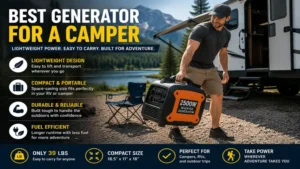
Real-World Camping Scenarios & Power Matching
Different campers have radically different power needs. Choosing the best generator for a camper depends heavily on your camping style, your rig’s size, and where you choose to camp.
Scenario A: The Weekend State Park Camper
-
Profile: A family of three spending two nights at a state park campground in a 18-foot travel trailer. They primarily need to run lights, water pumps, keep the house batteries topped off, and occasionally run a microwave or a hair dryer.
-
The Perfect Match: WEN 56203i or Honda EU2200i.
-
The Reasoning: Since state parks usually have designated quiet hours and nearby neighbors, a quiet, lightweight 2,000-watt inverter is ideal. It is easy to pack, won’t disturb neighboring campsites, and provides plenty of clean power to charge the trailer’s batteries and run small appliances sequentially.
Scenario B: The Dedicated Summer Boondocker
-
Profile: A couple spending two weeks dry-camping on BLM land in Utah during the peak of July. They are towing a 28-foot travel trailer with a 15,000 BTU rooftop AC unit that needs to run several hours a day to keep their dogs cool.
-
The Perfect Match: Westinghouse iGen4500 or Champion Power Equipment 200988.
-
The Reasoning: Running a large RV air conditioner in high heat requires substantial, continuous power. A 4,500-watt class generator provides the necessary surge capacity to start the AC compressor without tripping safety breakers. The larger fuel tank capacities on these models also ensure the generator can run through the hottest parts of the afternoon without constant refilling.
Scenario C: The Off-Grid Solar Purist
-
Profile: A solo overland traveler living out of a converted camper van, working remotely, and camping in pristine national forest areas. They prioritize peace, quiet, and want to avoid carrying gasoline altogether.
-
The Perfect Match: Jackery Explorer 1000 Plus.
-
The Reasoning: For a van lifer with modest power requirements (laptop, 12V fridge, phone chargers, and a water pump), a solar generator is the ultimate solution. It runs completely silent, can be charged via roof-mounted solar panels while driving, and operates safely inside the van’s living space without any ventilation or exhaust hazards.
🔍 Ready to Upgrade Your Camper Power Setup?
Preserving off-grid comfort and simplifying your mobile campsite setup begins with selecting a reliable power source.
Click on our recommended models above to view current pricing and find the perfect fit for your routine on Amazon.
Common RV Power Pitfalls & Quick Fixes
When you are boondocking miles away from the nearest town, encountering power issues can be incredibly stressful. Here are the most common RV generator problems and how to quickly resolve them in the field.
Problem 1: The Generator Runs, but the Camper Has No Power
This is a classic issue that frustrates many campers. You start your generator, plug your camper’s heavy shore power cord in, but absolutely nothing works inside your rig.
-
The Quick Fix: First, check the main circuit breaker on the generator panel itself—it is very common for a brief start-up surge to trip this breaker. If the generator breaker is on, check the main 30-amp breaker inside your camper’s electrical panel. Additionally, if you are using an inverter generator, remember that it can take up to 30 seconds for the unit’s internal smart computer to stabilize voltage before it begins sending power to the outlets.
Problem 2: The Generator Shuts Down Unexpectedly After 10 Minutes
Your generator starts up perfectly, runs for a short period, and then suddenly shuts off without showing an overload light.
-
The Quick Fix: Check your engine oil level. Almost all modern inverter generators are equipped with an automatic low-oil shutdown sensor. If you are operating your generator on a slight slope or incline, the oil sensor may register a false low-oil reading and shut the engine down to prevent damage. Always place your generator on flat, level ground.
Problem 3: The AC Compressor Starts up, then Immediately Trips the Generator’s Overload
You hear the camper’s air conditioner fan start running, but the second the heavy compressor kicks in to start cooling, the generator’s red overload light flashes and the power cuts out.
-
The Quick Fix: This is caused by the massive inrush of current (called locked rotor amps) that an AC compressor requires to start up. To solve this without buying a massive, heavy generator, you can install an aftermarket RV soft-start kit on your camper’s AC unit. A soft-start kit electronically ramps up the voltage to the compressor smoothly, reducing start-up power demand by up to 70% and allowing smaller, quieter 2,000-watt generators to easily run your air conditioning.
How to Choose the Right Generator for Your Camper
Selecting the best generator for a camper is an exercise in basic electrical math. You must calculate your total electrical load, understand your camper’s wiring, and choose a generator that fits comfortably within your towing capacity.
                     =======================================
                     CAMPER POWER CALCULATION STEPS
                     =======================================

       [Step 1] ----> Identify your camper's service amperage (30A vs. 50A)
          |
          v
       [Step 2] ----> Calculate total running watts of essential appliances
          |
          v
       [Step 3] ----> Add the starting surge watts of your largest motor (AC)
          |
          v
       [Step 4] ----> Select a generator with a 20% power safety margin
                     =======================================
Step 1: Understand Your Camper’s Amperage
Most standard campers have either a 30-amp or a 50-amp electrical service. A 30-amp camper operates at 120 volts, providing a maximum capacity of 3,600 watts ($30\text{ amps} \times 120\text{ volts} = 3,600\text{ watts}$). A 50-amp camper actually utilizes two separate 120-volt feeds of 50 amps each, yielding a massive maximum capacity of 12,000 watts ($2\text{ feeds} \times 50\text{ amps} \times 120\text{ volts} = 12,000\text{ watts}$). If you have a 30-amp rig, a 3,000-to-4,500-watt generator is the ideal match. If you have a larger 50-amp rig with dual air conditioners, you will need to run two inverter generators in parallel or manage your power consumption carefully.
Step 2: Running vs. Starting Watts
Every appliance in your camper has two power ratings: running (continuous) watts and starting (surge) watts. Inductive appliances with electric motors—like air conditioners, refrigerators, and water pumps—require up to three times their running wattage just for a brief second to get the motor spinning.
-
RV Air Conditioner (13,500 BTU): Requires roughly 1,500 running watts, but needs nearly 3,000 starting watts.
-
Microwave: Requires roughly 1,000 running watts and 1,500 starting watts.
-
Camper Refrigerator: Requires roughly 300 running watts and 600 starting watts.
Always ensure that your generator’s peak/starting wattage rating is high enough to cover your single largest starting load, plus the running wattage of all other concurrently running appliances.
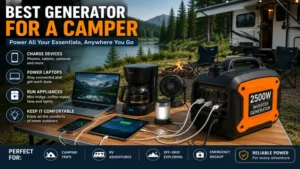
Inverter Generators vs. Traditional Open-Frame Generators
Many first-time camper owners are tempted to buy cheap, open-frame contractor generators because they offer massive wattage at a fraction of the cost of an inverter. However, using these industrial units for camping is a recipe for frustration.
Key Performance Comparison
| Feature | Portable Inverter Generator | Traditional Open-Frame Generator |
| Power Cleanliness (THD) | Clean (<3% Total Harmonic Distortion) | Dirty (>15% Total Harmonic Distortion) |
| Noise Levels | Very Quiet (48 – 60 dBA) | Extremely Loud (70 – 85 dBA) |
| Engine Speed Control | Variable (Smart Throttle) | Fixed (Constantly runs at 3,600 RPM) |
| Fuel Efficiency | Highly Efficient (Variable speed saves fuel) | Poor (Burns fuel at maximum rate constantly) |
| Weight & Portability | Compact, enclosed, and lightweight | Bulky, heavy, exposed steel frame |
Analysis of Generator Technologies
As shown in the table above, the primary difference lies in the quality of the electricity produced. Inverter generators convert raw AC power to DC power, then digitally invert it back into clean, stable AC power with less than 3% Total Harmonic Distortion. This clean sine wave is critical because modern RV appliances—like televisions, microwave control boards, and laptop chargers—can easily overheat and burn out when powered by the unstable, “dirty” electricity generated by traditional open-frame units. Furthermore, open-frame generators run at a constant 3,600 RPM regardless of load, creating a deafening roar that is banned in almost all US campgrounds.
Common Mistakes When Buying a Camper Generator
Even experienced RVers can make costly mistakes when purchasing a new portable generator. Avoid these common traps to save yourself time, money, and hassle in the field.
1. Buying an Oversized Generator That You Cannot Lift
It is easy to get caught up in “wattage envy” and buy a massive 7,500-watt generator to ensure you can run absolutely everything in your rig at once. However, these heavy-duty units often weigh well over 150 pounds and require multiple people or special ramp systems to load into a truck bed. If your generator is too heavy to move comfortably, you will end up leaving it at home, rendering it completely useless. Focus on finding a compact unit that matches your actual needs, or purchase two smaller 2,000-watt units that can be run in parallel when you need extra power.
2. Ignoring strict Campground Noise Regulations
Many state parks, federal campgrounds, and national parks have strict noise limits, typically requiring generators to operate at or below 60 dBA measured at 50 feet. The National Park Service actively enforces these regulations to protect local wildlife and ensure a peaceful experience for campers. If your generator sounds like a lawnmower, park rangers can and will fine you or ask you to turn the unit off. Always verify the manufacturer’s official decibel rating at a quarter-load before making a purchase.
3. Relying on Cheap Modified Sine Wave Power
Some budget-conscious buyers attempt to build their own off-grid power systems using cheap industrial inverters. These cheap setups often produce a “modified sine wave” rather than a true pure sine wave. While a modified sine wave is fine for basic resistive loads like a simple toaster or incandescent lights, it will cause electric motors to run hotter, make digital clocks run fast, and can permanently ruin the electronic control boards in modern camper refrigerators and furnaces. Always invest in a high-quality inverter power source that guarantees clean, pure sine wave electricity.
Features That Actually Matter (And Those That Don’t)
Generator manufacturers use a wide array of marketing buzzwords to make their units stand out. As an experienced consultant, let me help you separate the highly valuable features from the useless marketing fluff.
Features You Absolutely Need:
-
Carbon Monoxide (CO) Auto-Shutdown: This is an incredibly important safety feature. If carbon monoxide levels build up to dangerous levels near the unit (such as if the wind shifts and blows exhaust back toward your camper windows), the generator will automatically shut down. The U.S. Consumer Product Safety Commission strongly advocates for this technology, which has saved countless lives in recent years.
-
Parallel Capability: This allows you to connect two identical inverter generators together using a simple parallel cable, effectively doubling your power output while maintaining the ease of portability of two lightweight, separate units.
-
An Accurate Fuel Gauge: Many smaller generators lack any sort of fuel indicator, forcing you to constantly unscrew the gas cap and peer inside. A clear digital display or a mechanical fuel gauge saves you from unexpected power interruptions in the middle of the night.
Marketing Hype You Can Safely Ignore:
-
“App Integration” for Basic Operation: Some modern generators feature Bluetooth or Wi-Fi apps that allow you to monitor fuel levels and turn the unit off from your phone. While this sounds convenient, these apps often have very limited range and frequently suffer from pairing issues in remote, off-grid areas. A physical LED data screen on the generator panel is far more reliable.
-
Inflated “Peak” Wattage Ratings: Manufacturers often prominently display huge peak wattage numbers (e.g., “5000 Watts Peak!”) in bold print on the box. In reality, your generator can only sustain its lower “running” wattage rating for extended periods. Always base your camper’s electrical load calculations on the continuous running watts, not the peak surge capacity.
Noise Regulations & Safety Standards in US Campgrounds
Understanding how to safely operate your generator while staying fully compliant with local regulations is essential for a stress-free camping trip.
Safe Generator Placement & Distances
When running a combustion engine generator, carbon monoxide safety must be your absolute top priority. Never operate a generator inside your camper’s living space, storage bays, or inside an enclosed screen tent. Always place your generator at least 20 feet away from your camper, with the exhaust pipe pointing directly away from any doors, windows, vents, or neighboring campsites. Ensure the unit is elevated off wet ground and protected from direct rain or snow by using an open-sided generator tent. For further information on general safe operating practices, you can consult Energy.gov’s Portable Generator Safety Guide.
                 +---------------------------------------+
                 |          SAFE CAMPING LAYOUT          |
                 +---------------------------------------+
                 |   [Neighbor's Camp]                   |
                 |          ^                            |
                 |          | (Keep Distance!)           |
                 |          v                            |
                 |   [YOUR CAMPER]                       |
                 |          ^                            |
                 |          |                            |
                 |          | 20 Feet Minimum            |
                 |          v                            |
                 |   [GENERATOR] ---> (Exhaust Outward)  |
                 +---------------------------------------+
Understanding Quiet Hours
Most developed campgrounds enforce designated “quiet hours”—typically from 10:00 PM to 6:00 AM—during which all generators must be turned off completely. If you require overnight power for medical devices like a CPAP machine or for heating/cooling, you should rely on an onboard battery bank and an inverter, or utilize a silent power station like the Jackery Explorer 1000 Plus rather than running a combustion engine overnight.
FAQs
❓ How many watts does it take to run a camper AC?
✅ Most standard 13,500 BTU RV air conditioners require roughly 1,500 to 1,800 running watts, but need a starting surge of 2,800 to 3,000 watts. Installing a soft-start kit can drop this starting requirement significantly…
❓ Can I run my camper generator in the rain?
✅ No, you should never run a portable generator in direct rain or snow without a specialized, open-sided weather-proof generator tent. Water entering the electrical outlets can cause short circuits and permanent damage…
❓ Can I plug my camper directly into a generator?
✅ Yes, if your generator has an RV-ready TT-30R outlet. If your generator only has standard household outlets, you will need a 15-amp to 30-amp adapter plug to connect your camper’s shore power cord…
❓ What is the difference between starting watts and running watts?
✅ Running watts are the continuous power your generator can produce long-term, while starting watts are the brief, elevated surge power the unit can deliver for a few seconds to start electric motors…
❓ How long can an inverter generator run on a gallon of gas?
✅ A highly efficient 2,000-watt inverter generator like the Honda EU2200i can run for roughly 4 to 8 hours on a single gallon of gasoline, depending heavily on the electrical load connected to the unit…
Conclusion
Finding the best generator for a camper ultimately comes down to balancing your personal comfort needs with portability and quiet operation. If you value absolute quiet, unmatched long-term reliability, and an ultralight design, the classic Honda EU2200i remains the industry favorite for a reason. For larger travel trailers with demanding air conditioning systems, a highly capable unit like the Westinghouse iGen4500 offers the necessary raw wattage and direct RV-ready connections to keep your whole camper fully functional.
Alternatively, if you prefer clean fuel options, a dual-fuel generator like the Champion Power Equipment 200988 allows you to tap directly into your camper’s existing propane tanks, keeping your fuel systems clean and maintenance-free. Whichever route you choose, understanding your camper’s power demands and adhering to routine maintenance will ensure you enjoy safe, reliable, and comfortable off-grid adventures for years to come.
Recommended for You
- 12kw Generator Survival Guide: 5 Best Picks & 2026 Expert Analysis
- Portable Outlet Box Guide: 5 Heavy-Duty Reviews For 2026
- Best Solar Panel 500w Systems in 2026: Expert Field Review & Buying Guide
Disclaimer: This article contains affiliate links. As an Amazon Associate, I earn from qualifying purchases. If you purchase products through these links, we may earn a small commission at no additional cost to you.
✨ Found this helpful? Share it with your friends! 💬🤗