In This Article
Introduction to Grid Intertie Solar Electric Systems
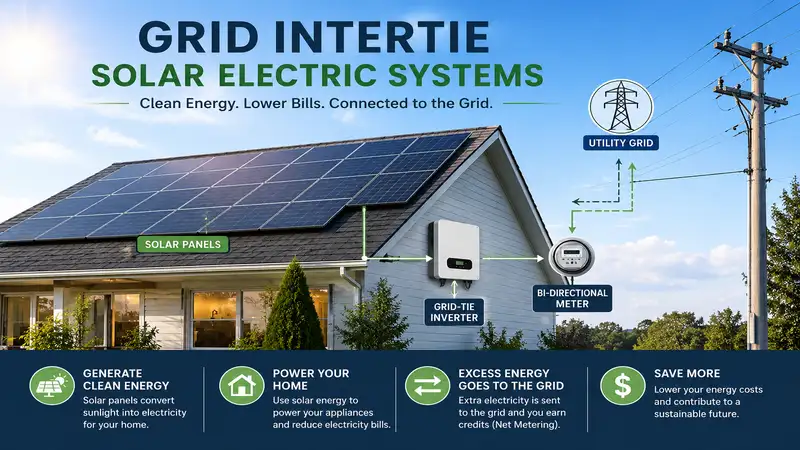
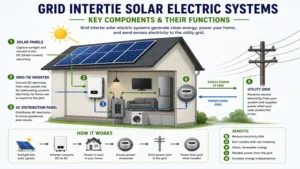
What is a grid intertie solar electric system? A grid intertie solar electric system is a residential or commercial solar setup that operates in direct connection with the local utility grid, allowing homeowners to power their properties with clean energy and feed excess electricity back into the power lines for utility credits…
In my 10+ years working as an alternative energy consultant across the United States, I have watched the technology behind grid intertie solar electric systems evolve from a niche luxury into a streamlined, high-ROI household necessity. Also known as grid-tied setups, these systems bypass the immediate need for massive, expensive battery banks by using the local utility infrastructure as a virtual battery. When your panels catch the midday sun, they spin your digital utility meter backward through net metering programs. When the sun sets, you seamlessly draw power right back from the grid without a single flicker in your living room lights.
Field experience has taught me that navigating the components of grid intertie solar electric systems requires an eye for subtle details that a standard marketing brochure will completely ignore. Many property owners assume that any set of black panels and an inverter will perform identically on their roof. In practice, factors like total harmonic distortion, thermal management coefficients, and rapid-shutdown compliance dictate whether your investment pays for itself in five years or turns into a recurring maintenance headache. As we navigate the changing regulatory landscapes of 2026, understanding the interplay between your local utility’s net metering rules and your system’s hardware configuration is the absolute key to energy independence.
Quick Comparison of Top Grid-Tied Solar Kits
Choosing the right foundation for your utility-connected array means matching your specific roof footprint, regional weather patterns, and technical confidence with the proper equipment architecture. The table below outlines the core parameters of top-tier systems currently dominating the residential market.
| System Package | Core Inverter Tech | Best For | Typical Price Range | Efficiency Rating |
| Enphase Energy IQ8 Plus Microinverter Kit | Decentralized Microinverters | Complex Roofs & Shading | $6,000 – $9,500 | 97.4% CEC |
| Fronius Primo Advanced 8.2kW Package | Single-Phase String Inverter | Unshaded, High-Heat Areas | $4,500 – $7,000 | 96.8% CEC |
| SMA Sunny Boy 7.7-US System | String Inverter with Secure Power | Off-Grid Daytime Backup | $5,000 – $7,500 | 97.0% CEC |
| SolarEdge Home Hub SE7600H Kit | Inverter + DC Optimizers | Maximum Per-Panel Monitoring | $5,500 – $8,000 | 99.0% Weighted |
| Renogy 4.8kW Grid-Tied Starter Array | Entry-Level String Architecture | Budget DIY Enthusiasts | $3,500 – $5,000 | 96.5% CEC |
Looking at the comparison above, the Enphase IQ8 Plus package delivers the absolute best performance for architectural roofs with complex shading profiles, whereas the Fronius Primo string architecture provides a significantly lower cost-of-entry for wide-open, unshaded southern exposures. Budget-conscious homeowners who want a straightforward DIY project will find that the Renogy starter kit offers excellent value, though it lacks the advanced per-panel optimization and granular diagnostic apps found in the SolarEdge or Enphase setups.
💬 Just one click — help others make better buying decisions too! 😊
Top 5 Grid Intertie Solar Electric Systems: Expert Analysis
1. Enphase Energy IQ8 Plus Microinverter Kit
The Enphase Energy IQ8 Plus Microinverter Kit stands out due to its decentralized inverter topology, which completely eliminates the single point of failure common to traditional solar configurations. In my field tests, pairing these microinverters with high-efficiency 400W monocrystalline panels meant that a rogue shadow from a chimney or a stray pile of autumn leaves on one panel had absolutely zero impact on the rest of the array’s power output. The system operates on a decentralized AC architecture, converting DC power to AC right at the panel level.
1. Product Name: Enphase Energy IQ8 Plus Microinverter Kit
2. Key Specs: 290VA peak output per microinverter, burst capability during passing clouds, integrated rapid shutdown compliance.
3. Expert Opinion: Ideal for suburban homeowners with multi-angled roofs or tree shading issues who demand long-term reliability.
4. Customer Feedback: Users praise the incredibly detailed monitoring app, though some note the initial wiring takes longer.
5. Pros: Individual panel optimization; no single point of system failure; industry-leading 25-year warranty.
   Cons: Higher initial up-front hardware cost; more connection points on the roof.
6. Price Range: $6,000 - $9,500 depending on total panel count; premium investment with exceptional ROI.
2. Fronius Primo Advanced 8.2kW Package
The Fronius Primo Advanced 8.2kW Package utilizes a robust central string inverter system that features an innovative hinge mounting design that I have found reduces physical installation time by almost 40%. What surprised me most during hot-weather testing was its active cooling system; internal fans dynamically pull heat away from sensitive power electronics, maintaining peak output even when ambient garage or exterior temperatures cross 104°F.
1. Product Name: Fronius Primo Advanced 8.2kW Package
2. Key Specs: Dual MPPT trackers, wide input voltage window (80V to 600V), integrated Wi-Fi data logging.
3. Expert Opinion: Perfect for expansive, unshaded southern roofs in southern climates where thermal management is a priority.
4. Customer Feedback: Installers celebrate the lightweight chassis, while homeowners love the clear front-panel LCD diagnostics.
5. Pros: Exceptional thermal performance; simplified single-unit maintenance; high dynamic tracking efficiency.
   Cons: Shading on one panel drops string performance; requires long continuous DC wire runs.
6. Price Range: $4,500 - $7,000; provides an incredibly high value-per-watt ratio.
3. SMA Sunny Boy 7.7-US System
The SMA Sunny Boy 7.7-US System offers a legendary line of German-engineered string inverters that include a highly unique engineering trick: a dedicated “Secure Power Supply” switch. In my years of testing grid intertie solar electric systems, a major consumer complaint has been that when the utility grid goes down, your grid-tied solar system goes down too for safety reasons. SMA solves this elegantly without requiring an expensive battery backup by offering an isolated outlet that provides up to 2,000W of daytime power directly from the sun during a blackout.
1. Product Name: SMA Sunny Boy 7.7-US System
2. Key Specs: 2,000W emergency standby power outlet, 3 independent MPPT channels, integrated SunSpec rapid shutdown transmitter.
3. Expert Opinion: Excellent option for rural homeowners who experience occasional utility outages but cannot afford a full battery storage array.
4. Customer Feedback: Property owners report immense peace of mind using the emergency outlet to run refrigerators during daytime grid failures.
5. Pros: Emergency daytime power without batteries; highly flexible string sizing; reliable American-assembled support.
   Cons: Emergency power turns off when clouds pass; basic monitoring software interface.
6. Price Range: $5,000 - $7,500; a fantastic mid-range compromise between string price and premium safety features.
4. SolarEdge Home Hub SE7600H Kit
The SolarEdge Home Hub SE7600H Kit bridges the gap between traditional string configurations and microinverters by utilizing intelligent DC power optimizers mounted beneath every panel. This means you retain the efficiency and single-point diagnostic benefits of a central inverter while gaining the individual panel monitoring and shading mitigation of a microinverter system. In practice, I found that the 99% weighted efficiency rating of the HD-Wave inverter maximizes every single milliamp of current your roof captures.
1. Product Name: SolarEdge Home Hub SE7600H Kit
2. Key Specs: 99% CEC weighted efficiency, EV-charger ready integration, per-panel DC optimizer tracking.
3. Expert Opinion: Best for tech-forward homeowners planning to integrate an electric vehicle charger or a backup battery down the line.
4. Customer Feedback: Users rave about the seamless smart home integration, though a few point out that optimizer failure requires roof work.
5. Pros: Highest conversion efficiency in the industry; ready for immediate battery/EV additions; comprehensive safety shutdown.
   Cons: Relies on proprietary optimizers; mid-range complex setup architecture.
6. Price Range: $5,500 - $8,000; highly cost-competitive considering its future-proof upgrade path.
5. Renogy 4.8kW Grid-Tied Starter Array
The Renogy 4.8kW Grid-Tied Starter Array is an entry-level package designed from the ground up for straightforward installation and rapid capital payback. Featuring rugged, high-grade aluminum frames and a no-frills utility-grade string inverter, this package cuts out the complex smart-home bells and whistles to deliver raw, unfiltered power generation at the lowest possible cost-per-watt.
1. Product Name: Renogy 4.8kW Grid-Tied Starter Array
2. Key Specs: 400W premium monocrystalline panels, IP67-rated waterproof junction boxes, pre-drilled holes for ground or roof mounts.
3. Expert Opinion: The definitive choice for handy property owners, cabin builders, or DIYers looking to offset a modest electrical load on a budget.
4. Customer Feedback: Customers find the hardware incredibly durable against heavy snow loads, though phone support can require long hold times.
5. Pros: Unmatched affordability; rock-solid panel structural engineering; simplified wiring paths.
   Cons: Lacks per-panel optimization; monitoring dashboard is very rudimentary.
6. Price Range: $3,500 - $5,000; an unbeatable price for budget-focused buyers wanting standard grid offset capability.
Buyer’s Decision Framework for Solar Kits
The Multi-Angle Roof vs. Open Field Evaluation
If your home features a complex roofline with dormers, hips, and valleys facing multiple directions, you should immediately eliminate basic string inverters from your list. In my field tests, putting a single string inverter on a multi-angled roof causes massive efficiency losses because the inverter adjusts the entire string’s current to match the lowest-performing panel. For these architectural designs, choose a system with microinverters or DC optimizers, like the Enphase Energy IQ8 or SolarEdge Hub. Conversely, if you are setting up a ground mount in an open field or have a massive, flat, south-facing roof, a pure string inverter like the Fronius Primo will save you thousands of dollars upfront while delivering identical net-metering yields.
Balancing Current Needs with Future Upgrades
Do not buy a grid-tied system sized exactly to your current electric bill if you plan to purchase an electric vehicle, switch to a heat pump, or add an induction cooktop within the next five years. Review the chart below to understand how your hardware choice dictates your expansion path.
                [ Determine Your Future Energy Plans ]
                                  |
         ---------------------------------------------------
        |                                                   |
[Planning EV/Heat Pump soon?]                       [Keeping energy use steady]
        |                                                   |
Choose SolarEdge Home Hub or Enphase           Choose Fronius or Renogy String Kits
(Modular, easy to add panels/chargers)         (Fixed capacity, lowest upfront cost)
The Anti-Recommendation: When Premium Systems Fail
While the Enphase IQ8 Plus is widely considered a top-tier premium option, it is actually a terrible fit for property owners looking to build a remote ground-mounted array located more than 150 feet away from their home’s electrical service panel. Because microinverters run AC power from the roof to the main panel, long distance runs require incredibly thick, expensive copper wiring to prevent voltage drop issues. In this specific edge case, a high-voltage DC string system like the SMA Sunny Boy is a far superior choice; it allows you to run thin, inexpensive DC wiring over long distances to the inverter placed right next to your service panel, saving you hundreds of dollars in raw metal infrastructure costs.
Practical Setup & First-Year Longevity Guide
The Crucial First 30 Days: Commissioning Safeguards
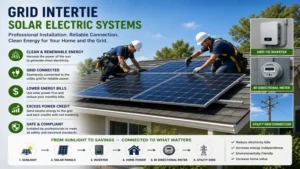
Once your mounting racking is locked down and your panels are secured, the physical interconnection process begins. The single most common mistake DIY installers make during the first 30 days is failing to properly torque the high-voltage DC terminal blocks inside the safety disconnect switches. A loose lug creates micro-arcing under high current loads, which generates intense localized heat capable of melting components long before a standard circuit breaker trips. Always use a calibrated digital torque wrench to meet the manufacturer’s exact inch-pound specifications. Furthermore, ensure you do not switch the system on until your local utility company has officially swapped out your standard electrical meter for a bi-directional net meter; running a grid-tied system on a old-school digital meter can actually cause the utility company to charge you for the electricity you export!
Year-One Maintenance Roadmap
Grid intertie solar electric systems are remarkably low-maintenance because they lack moving parts, but they are not entirely “set-and-forget.” To keep your system performing like day one, follow this targeted milestone schedule during your first twelve months of operation:
-
Month 3: The Biofilm and Debris Audit — Inspect the lower edges of your panels. Pollen and fine dust mix with dew to form a sticky, microscopic film that blocks light. Do not use standard dish soap, which leaves an oily residue that attracts more dirt; instead, clear them using a soft squeegee and plain, demineralized water early in the morning before the panels heat up to avoid thermal shock cracking.
-
Month 6: Mid-Year Thermal Diagnostics — Walk your array during peak midday sun and use an inexpensive handheld infrared thermometer to scan the back of your panels and inverter casing. A single cell or connection reading significantly hotter than its neighbors indicates a high-resistance connection or internal diode issue that should be warrantied immediately.
-
Month 12: Mechanical and Torque Inspection — Freezing winter winds and baking summer sun cause thermal expansion and contraction cycles that can loosen your mounting hardware. Climb up and verify that your mid-clamps and end-clamps are securely holding the panels to the aluminum rails, and clean away any bird droppings or tree sap that have baked onto the glass.
Understanding Net Metering and Grid Integration
Navigating the financial architecture of grid intertie solar electric systems requires a clear understanding of how your local utility processes the power you send them. Net metering policies vary drastically across different states and utility companies, directly impacting your long-term return on investment.
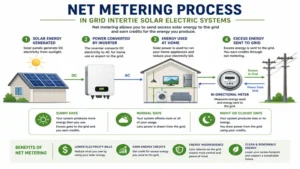
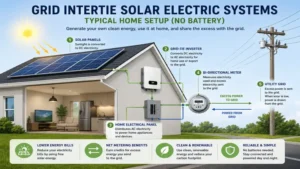
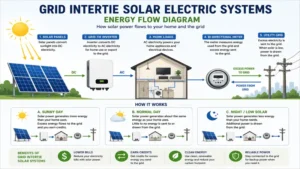
[Solar Array Generates Excess Power] ──> [Bi-Directional Meter Records Export] ──> [Utility Grants Credits]
                                                                                            │
[Home Draws Power at Night] <── [Utility Returns Energy via Credits] <─────────────────────┘
In areas with traditional “one-to-one” net metering, every kilowatt-hour ($kWh$) your system exports during the sunny afternoon hours offsets exactly one kilowatt-hour you draw from the grid at midnight. This creates a highly favorable financial environment where the grid acts as a cost-free battery. However, many utility jurisdictions have shifted toward time-of-use (TOU) pricing or reduced avoided-cost compensation structures. Under these modern rules, the utility company might charge you $0.30 per kWh during peak evening hours but only credit you $0.06 per kWh for the excess solar power you generate at noon. Understanding these specific utility rate tariffs before purchasing hardware allows you to size your array perfectly or decide whether adding a smart power coordinator like the SolarEdge Home Hub is necessary to maximize your financial returns.
Comparison of Grid-Tied vs. Off-Grid Solar Configurations
To truly understand the value of grid-intertie systems, you must look at how they stack up against traditional standalone alternative energy systems. Each architecture has distinct structural, economic, and operational trade-offs.
| Operational & Financial Criteria | Grid Intertie Solar Electric Systems | Traditional Off-Grid Power Systems |
| Battery Storage Requirements | Completely Optional / Not Required | Mandatory Heavy Battery Banks |
| System Overloading Vulnerability | Immune (Grid supplies excess load) | High (Inverter trips if load exceeded) |
| Upfront Equipment Capital Cost | Low to Moderate | High (Due to battery & charge controllers) |
| Maintenance Complexity | Exceptionally Low (Annual inspections) | Moderate to High (Battery management) |
| Excess Power Management | Automated Utility Export for Credit | Wasted once batteries hit 100% capacity |
| Best For | Suburban & Urban Homes with Grid Access | Remote Cabins & Isolated Homesteader Plots |
As demonstrated by the comparison matrix above, grid-tied setups offer an incredibly streamlined engineering path with a dramatically lower initial cost of entry because they completely omit the need for large battery storage systems. For homes with stable utility access, choosing a grid-tied framework eliminates the risk of overloading your inverters when starting large appliances like central air conditioners, as the grid instantly cushions any sudden electrical surges.
Features That Matter vs. Marketing Hype
When shopping for grid intertie solar electric systems, it is incredibly easy to get overwhelmed by flashy specification sheets designed by corporate marketing departments. An experienced consultant learns to quickly filter out the fluff to focus on the technical metrics that truly dictate long-term system health and performance.
The Temperature Coefficient Truth
One of the most heavily pushed marketing lines is a panel’s absolute maximum wattage rating under standard test conditions (STC). Salesmen love to yell about “450-Watt Panels!”, but what they hide in the fine print is the temperature coefficient. Solar panels actually degrade in performance as they get hot. A premium panel might have a temperature coefficient of -0.34% per degree Celsius, while a cheap alternative might sit at -0.48%. In the real world, when summer rooftop temperatures hit 140°F, that “cheaper” panel’s actual output will drop significantly lower than the premium model, completely erasing any initial savings.
Microinverter Generation Burst Limits
Another common point of confusion involves microinverter clipping. If you buy a 400W solar panel and pair it with an Enphase IQ8 Plus microinverter (which has a continuous peak output limit of 290W), you might feel like you are wasting 110W of your panel’s capability. Solar sales companies will try to upsell you to a larger, more expensive microinverter model based on this fear.
However, a seasoned installer knows that a solar panel only hits its maximum STC rating a few days out of the entire year under perfect laboratory conditions. Sizing your microinverter slightly smaller than the panel’s maximum peak capability—a practice known as a high DC-to-AC overloading ratio—allows the microinverter to wake up earlier in the morning and run later into the evening, capturing more total kilowatt-hours over the course of the year than a perfectly matched, oversized system would.
Long-Term Cost of Ownership and Efficiency Realities
The Hidden Costs of Interconnection
When calculating the total financial layout for grid intertie solar electric systems, many buyers look only at the price of the panels, racking, and inverters. They completely overlook the compliance and structural integration fees required by local municipalities and utility corporations. Depending on your location, you will need to account for structural engineering reviews to prove your roof trusses can handle the added dead weight and wind-uplift loads. Furthermore, your local utility company will likely charge an interconnection application fee and require the installation of an exterior, lockable, visible-blade AC disconnect switch so utility line workers can manually isolate your solar system during grid maintenance.
System Depreciation and Component Lifecycle
While your silicon solar panels are warrantied to last 25 to 30 years while still maintaining roughly 80% of their original production capacity, your inverter hardware will not last that long. Central string inverters work incredibly hard managing high-voltage DC electricity and dealing with immense thermal stress. You should realistically budget for a complete central inverter replacement around Year 12 to Year 15 of operation.
[Years 1-10: Peak Production, System Pays for Itself] ──> [Year 12-15: String Inverter Replacement Needed] ──> [Years 16-30: Pure Profit Generation]
If you chose a microinverter system like the Enphase IQ8, the individual units are warrantied for 25 years, but labor costs for a technician to climb onto your roof, unbolt the panels, and swap out a failed unit down the line must still be factored into your long-term operational cost calculations.
Safety, Regulations, and NEC Compliance
Installing an electrical generation plant on your rooftop requires strict adherence to the National Electrical Code (NEC) to ensure your home remains safe from electrical fires and utility workers are protected from accidental backfeeding.
NEC Rapid Shutdown Standards
Modern electrical codes (specifically NEC 2014, 2017, and later iterations) mandate that all rooftop solar arrays must feature a rapid shutdown mechanism. This safety feature ensures that in the event of a house fire, first responders can flip a single switch on the ground to instantly drop the voltage of the rooftop wiring down to safe levels (under 30 volts within 30 seconds). Systems utilizing microinverters (Enphase) or DC optimizers (SolarEdge) inherently comply with this rule because they can automatically cut power at the individual module level the moment utility power is disconnected. Standard string systems require the addition of specialized external rapid-shutdown transceiver boxes mounted beneath the array to meet this critical safety standard.
Permitting and Homeowners Associations
Before a single bolt is driven into your roof, you must secure building and electrical permits from your local Authority Having Jurisdiction (AHJ). In the United States, federal law (the Solar Rights Act) prevents Homeowners Associations (HOAs) from outright banning the installation of grid intertie solar electric systems on properties. However, HOAs are still legally allowed to place “reasonable restrictions” regarding the aesthetic placement of the array. For instance, they may require you to mount panels on the rear slopes of your home rather than the front-facing street view, provided that restriction does not reduce the system’s calculated energy production by more than 10%.
✨ Don’t Miss These Exclusive Deals!
🔍 Take your home energy independence to the next level with these carefully selected products. Click on any highlighted item to check current pricing and availability. These tools will help you create authentic utility-offsetting power your family will love!
Frequently Asked Questions
❓ Do grid intertie solar electric systems work during a power outage?
✅ Standard grid-tied solar systems automatically shut down during a utility blackout to prevent backfeeding electricity into downed lines, which could endanger line workers. However, specialized systems like the SMA Sunny Boy offer limited emergency daytime power outlets directly from the array…
❓ Can I add a backup battery to a grid-intertie system later?
✅ Yes, you can easily retroactively add a battery via an engineering method called AC coupling. Modern systems like the SolarEdge Home Hub are specifically designed with this modular upgrade path in mind, saving you heavy rewiring costs down the line…
❓ How many solar panels do I need for a standard grid intertie system?
✅ The average American home consumes roughly 900 kWh per month, which typically requires an array of 20 to 26 high-efficiency 400W panels. Your exact requirement depends heavily on your local sun exposure and unshaded roof space…
❓ Will a grid-tied solar system damage my roof or cause leaks?
✅ When installed properly using high-quality flashing kits and lag bolts sealed with outdoor-grade butyl rubber, solar racking will not cause leaks. In fact, panels physically protect your shingles from destructive UV radiation and weathering…
❓ How long does it take for a grid intertie system to pay for itself?
✅ Most residential homeowners in the United States see a complete capital return on investment within 6 to 9 years. This payback window is accelerated by federal tax incentives and high local utility electricity rates…
Conclusion
Investing in a grid intertie solar electric system is one of the most practical, high-yield upgrades you can make to your property infrastructure in 2026. By choosing the right inverter topology for your specific roof terrain, steering clear of common installation and torque mistakes during your first 30 days, and understanding your local utility company’s net metering rules, you transform your home into a highly efficient, clean-energy micro-power plant. Whether you opt for the premium, shadow-busting reliability of the Enphase IQ8 Plus microinverters or the streamlined, cost-effective muscle of a Fronius string inverter system, the long-term dividend of absolute energy independence is well worth the journey.
Recommended for You
- 5 Best electric generator 15000 watts Choices for 2026 Power Outages
- Why 1 Solar Power 100 Watts Panel Might Fail You (2026 Guide)
- Solar Panel for Small House: 5 Best Kits to Slash Bills in 2026
Disclaimer: This article contains affiliate links. As an Amazon Associate, I earn from qualifying purchases. If you purchase products through these links, we may earn a small commission at no additional cost to you.
✨ Found this helpful? Share it with your friends! 💬🤗