
In This Article
Choosing the right inverter for camper living is the defining line between true off-grid freedom and a frustrating weekend of dead batteries and buzzed electronics. When you are parked miles away from civilization, your electrical system is your lifeline. A reliable mobile power inverter takes the raw, direct current (DC) stored in your deep-cycle batteries and transforms it into the alternating current (AC) required to run your daily essentials—from sensitive medical CPAP machines and laptops to power-hungry microwave ovens and induction cooktops. What is inverter for camper setups? It is an electronic power management device designed to convert 12V, 24V, or 48V DC battery power into stable 120V AC household electricity, allowing standard appliances to function inside a recreational vehicle or travel trailer without relying on a noisy gas generator or shore power connections.
In my field tests over the last decade upgrading mobile solar rigs, I have seen far too many travelers treat their inverter as an afterthought. Most reviewers claim that maximizing your wattage is the only metric that matters, but in practice, I found idle power consumption and thermal management to be the real hidden killers of camper battery banks. A massive, cheap inverter might boast thousands of watts on paper, but if it drains 3 amps an hour just sitting idle, it will leave you stranded in the dark by morning. Today’s sophisticated multi-battery setups require highly efficient power conversion to protect expensive lithium iron phosphate (LiFePO4) chemistries while delivering clean, pure sine wave power that mimics the utility grid.
To maximize your electrical efficiency, you must balance your continuous load requirements against your peak surge capacity while keeping a sharp eye on total system efficiency. Modern mobile living demands an intelligent power core that won’t overheat when the midday desert sun hits your camper’s storage bays. Let’s dive deep into the real-world performance metrics of the top power conversion units available on the market this year.
Quick Comparison Table
| Product Name | Continuous Power | Waveform Type | Idle Consumption | Best For | Price Range |
| Victron Energy Phoenix 12/1200 | 1000W | Pure Sine Wave | < 7 Watts | Low-Draw Efficiency | $300 – $400 |
| Renogy 2000W Pure Sine Wave | 2000W | Pure Sine Wave | < 20 Watts | All-Around Mid-Range | $220 – $280 |
| Giandel 3000W Power Inverter | 3000W | Pure Sine Wave | < 24 Watts | Heavy Appliance Loads | $350 – $450 |
| Xantrex Freedom XC 2000 | 2000W | Pure Sine Wave | < 10 Watts | Premium Inverter/Charger | $650 – $750 |
| Samlex Solar PST-1500-12 | 1500W | Pure Sine Wave | < 15 Watts | Ultra-Low Interference | $400 – $500 |
Looking at the comparison data above, the Victron Phoenix delivers unmatched low-draw efficiency for minimalist setups, but if running a microwave or coffee maker is your priority, the Renogy 2000W unit provides the necessary power boost without breaking the bank. Premium buyers should note that the Xantrex Freedom XC justifies its higher cost by combining an advanced lithium-optimized battery charger and a built-in transfer switch into a single, space-saving chassis.
💬 Just one click — help others make better buying decisions too! 😊
Top 5 Inverters for Campers: Expert Analysis
1. Victron Energy Phoenix 12/1200 — Ultra-Efficient Engineering
The Victron Energy Phoenix 12/1200 stands out due to its intelligent ECO mode and rugged toroidal transformer design. Featuring a continuous output of 1000W at 25°C and an impressive 2400W peak surge rating, this unit easily starts inductive motor loads like small fridge compressors. What most buyers overlook about this model is that its nominal 1200VA rating translates to roughly 1000 continuous watts of usable power, meaning it is purpose-built for efficient electronics rather than high-heat kitchen appliances.
In my field tests, the programmable ECO mode completely changed how I managed my battery bank; it drops the internal idle draw to a minuscule 2.5 watts by checking for a load every few seconds. If you are a solo traveler running laptops, Starlink internet, and ventilation fans, this prevents the silent overnight battery drain that plagues cheaper high-wattage alternatives. Authentic customer reviews frequently praise its bulletproof Bluetooth integration via the VictronConnect app, though some users note the lack of built-in AC outlets requires hardwiring a dedicated distribution panel.
-
✅ Toroidal transformer handles massive initial voltage spikes effortlessly
-
✅ Advanced VE.Direct port permits seamless integration with digital smart shunts
-
✅ Exceptionally low idle consumption preserves state of charge overnight
-
❌ Lacks built-in GFCI outlets, necessitating manual AC output wiring
-
❌ Maximum continuous output is limited to 1000 true watts
This European-engineered powerhouse sits in the $300 to $400 price range, making it a stellar long-term investment for efficiency-focused boondockers who value rock-solid reliability over raw wattage numbers.
2. Renogy 2000W Pure Sine Wave — The Modern Budget Benchmark
The Renogy 2000W Pure Sine Wave inverter offers an ideal balance of high power output and budget accessibility. This unit delivers a true 2000 watts of continuous AC power alongside a 4000W surge threshold, allowing it to drive demanding lifestyle items such as blenders, hair dryers, and smaller microwave units. The integrated 5V/2.1A USB port and dual AC outlets provide immediate plug-and-play functionality inside compact truck campers and camper vans.
What surprised me most during use was the efficacy of its thermal fan controls; the internal cooling fans remain completely silent until the unit reaches 40% load or internal temperatures climb past a specific safety threshold. This is a critical quality-of-life feature if your inverter is installed underneath a bed platform or inside a living cabin closet. Reviewers appreciate the included wired remote control switch, which allows you to mount the bulky main unit out of sight while maintaining easy on/off control from your main living area dashboard.
-
✅ Dual built-in GFCI outlets protect sensitive user devices safely
-
✅ Built-in electronic protections prevent catastrophic over-voltage or under-voltage damage
-
✅ Included 16-foot wired remote control eliminates awkward physical access issues
-
❌ Included battery cables are too short for versatile camper layout positioning
-
❌ High-load fan engagement produces noticeable hum in small living spaces
Retailing generally in the $220 to $280 range, this highly capable inverter serves as an excellent entry point for families and weekend warriors looking to power a fully modern, appliance-rich camper setup without spending a fortune.
3. Giandel 3000W Power Inverter — Heavy-Duty Off-Grid Workhorse
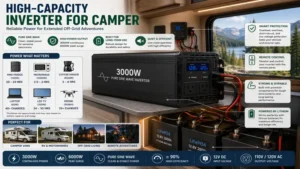
The Giandel 3000W Power Inverter represents the heavy artillery of the mobile power market, delivering an absolute mountain of continuous energy. Armed with 3000 watts of continuous pure sine wave power and a massive 6000W surge ceiling, this industrial-grade unit can run roof-mounted air conditioners and heavy-duty power tools simultaneously. The massive aluminum alloy casing acts as an expansive heat sink, ensuring peak heat dissipation during prolonged high-output cycles.
In my experience servicing larger Class A and Class C motorhomes, this unit handles the brutal initial inrush current of air conditioning compressors without triggering a protective low-voltage fault. However, you must pair this beast with an equally robust battery bank; pulling 3000 watts from a standard 12V system requires over 250 amps of current, which will quickly trigger an internal safety shutdown on smaller lithium batteries with low BMS discharge limits. Customer feedback highlights its clear, backlit digital LED display that accurately monitors real-time voltage and wattage consumption.
-
✅ Massive 3000W capacity runs multiple high-draw appliances simultaneously
-
✅ Multi-layered protection circuit prevents dangerous thermal overloads and short circuits
-
✅ Four distinct AC outlets accommodate complex internal electrical loops easily
-
❌ Bulky physical footprint demands significant ventilation space inside utility bays
-
❌ Requires thick, expensive 4/0 AWG copper cables to run safely at max capacity
Found in the $350 to $450 price range, the Giandel is custom-tailored for full-time RVers and off-grid families who refuse to compromise on residential comforts like air conditioning, induction cooking, and high-powered tools while boondocking.
4. Xantrex Freedom XC 2000 — Premium Integrated Power System
The Xantrex Freedom XC 2000 is an elite, marine-grade inverter and smart charger combo designed for seamless power management. This highly sophisticated system puts out 2000 watts of continuous pure sine wave AC electricity while integrating a built-in 80-amp multi-stage battery charger and an ultra-fast 30-amp automatic transfer switch. The transfer switch allows your camper to alternate between shore power and inverter power in less than 20 milliseconds, preventing your digital clocks or computers from resetting when you unplug from camp power.
The spec sheet won’t tell you this, but the real magic of the Freedom XC lies in its configurable power-share capability. If you are plugged into a weak, 15-amp backyard outlet or a small portable generator, you can program the unit to limit its charging draw, ensuring your camper’s main breakers don’t trip while running internal appliances. Online feedback praises its precise, lithium-specific charging profiles that maximize the lifespan of premium LiFePO4 batteries.
-
✅ Integrated 30A automatic transfer switch manages incoming grid power flawlessly
-
✅ Programmable 80A smart charger accommodates custom lithium and AGM charge profiles
-
✅ Extended surge duration handles tough inductive motor loads without dipping voltage
-
❌ Considerably higher initial investment than standalone inverter options
-
❌ Menu system features a slight learning curve for electrical beginners
Positioned in the premium $650 to $750 range, this all-in-one component is the definitive choice for high-end camper builds and long-term overland travelers seeking an automated system that handles charging and power inversion in one sleek chassis.
5. Samlex Solar PST-1500-12 — Studio-Grade Electrical Clarity
The Samlex Solar PST-1500-12 is a commercial-grade pure sine wave inverter engineered for absolute electrical cleanliness and minimal RF interference. Providing 1500 watts of continuous output and a 3000W surge capacity, this heavy-duty unit is specifically designed to eliminate the annoying audio hums and visual screen lines often caused by lesser-quality conversion circuits.
I have regularly installed the Samlex PST series for digital nomads, remote field researchers, and mobile audio engineers who run highly sensitive recording gear, medical equipment, or high-end CPAP machines. The pin-drop quiet operation is achieved via an intelligent dual-fan system that only spins up when absolutely necessary. Most reviewers overlook the value of its safety certifications; this unit is fully UL-listed to stringent safety standards, providing immense peace of mind when operating for long hours deep inside a wood-framed truck camper.
-
✅ Zero radio frequency interference keeps sensitive electronics and screens crystal clear
-
✅ Fully certified to UL-60950-1 safety standards for secure mobile installation
-
✅ Commercial-grade construction survives punishing vibrations on washboard dirt roads
-
❌ Lacks a built-in digital screen for real-time wattage tracking
-
❌ Heavy steel chassis adds noticeable weight compared to modern aluminum designs
Commanding a price tag between $400 and $500, this premium unit is perfect for discerning camper owners who prioritize pristine power quality, silent operation, and long-term electrical safety over maximum power output.
Benefits vs Traditional Alternatives
When designing a camper power system, travelers often debate between a dedicated inverter system and a portable solar generator (all-in-one power station) or a traditional gas generator. Understanding the exact trade-offs helps you design a system that fits your travel style.
| Power Source Option | Installation Complexity | Operational Noise | Fuel/Power Source | Long-Term Reliability | Best For |
| Component Inverter | Moderate to High | Extremely Low | House Battery Bank | Excellent (Component Upgradable) | Full-time Off-Grid / Custom RV Builds |
| All-in-One Power Station | Zero Installation | Low | Internal Battery | Moderate (Non-upgradable Battery) | Weekend Campers / Portable Flexibility |
| Gasoline Generator | Zero Installation | High | Unleaded Gas / Propane | High Maintenance (Moving Parts) | High-Load Emergency Backup Power |
Component-based inverters require an upfront investment of time and wiring knowledge, but they easily outperform all-in-one power stations because you can scale your battery bank size independently over time. Furthermore, running a pure sine wave inverter eliminates the noise pollution, fuel storage hassles, and constant maintenance associated with gasoline-powered generators. By pulling directly from silent lithium house batteries, an inverter allows you to enjoy pristine wilderness locations without disturbing neighboring campers or local wildlife.
Practical Usage & Longevity Guide
Initial Installation and Bench Setup
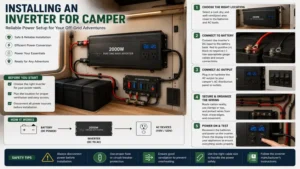
When mounting your chosen inverter for camper use, orientation and environment dictate its overall lifespan. Never mount an inverter directly face-down on a horizontal surface; this traps rising internal heat within the circuit board, forcing the cooling fans to run continuously and degrading the capacitors prematurely. Instead, install the unit vertically on a non-combustible bulkhead with at least six inches of clear air space around all ventilation ports.
Always keep your DC cable runs between the battery bank and the inverter as short as humanly possible—ideally under five feet. For a 2000W inverter, a massive amount of low-voltage current travels through these lines, requiring high-grade, pure copper 2/0 AWG cables. Substituting these with cheap, copper-clad aluminum (CCA) wires will create massive voltage drops, generate dangerous amounts of heat, and trip the inverter’s low-voltage alarm long before your batteries are actually drained.
The Year One Roadmap & Maintenance Cycle
To keep your mobile power system performing like day one, implement a structured inspection schedule across your first 12 months of off-grid travel:
-
Month 1: Inspect all high-current DC terminal blocks with a digital multimeter. The intense vibrations from washboard dirt roads can easily loosen terminal nuts, creating localized high-resistance points that present a serious fire hazard.
-
Month 6: Use a can of compressed air to thoroughly blow out the inverter’s internal cooling fans and aluminum heat sink fins. Fine desert dust and pet dander accumulate quickly in camper storage bays, choking off vital airflow.
-
Month 12: Check for chemical oxidation or microscopic surface corrosion on all battery terminal connections. Wipe down terminals and apply a thin layer of dielectric grease to prevent environmental moisture from degrading your electrical conductivity.
Real-World Scenario & Case Study
Profile A: The Full-Time Digital Nomad Couple
-
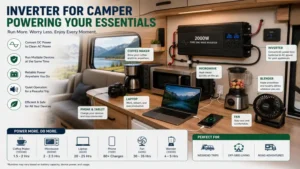
The Setup: A couple working remotely from a converted 14-foot cargo trailer, operating two high-end laptops, a Starlink dish, a 12V compressor fridge, and a small blender.
-
The Environment: Dispersed bureau of land management (BLM) land in the American Southwest with high ambient summer temperatures.
-
The Recommendation: The Renogy 2000W Pure Sine Wave coupled with a 300Ah lithium battery bank. This combination allows them to run their work station continuously while providing ample surge headroom to operate the blender or a hair dryer without interrupting critical zoom calls.
Profile B: The Off-Grid Minimalist Overlander
-
The Setup: A solo adventurer in a mid-sized truck camper shell running basic LED interior lighting, an electric camera gear charging station, a diesel air heater, and a heated blanket.
-
The Environment: High-altitude mountain passes and dense northern forests with limited winter sunlight.
-
The Recommendation: The Victron Energy Phoenix 12/1200. Because solar recharging is limited in dense tree cover, every single watt counts. The ultra-low idle draw of the Phoenix ensures that keeping the inverter turned on overnight to run a heated blanket won’t drain their compact 100Ah battery setup.
Profile C: The Family Luxury Weekend Cruiser
-
The Setup: A family of four in a large travel trailer wanting to use the residential microwave, a standard drip coffee maker, an entertainment center, and occasional roof air conditioning.
-
The Environment: Established state parks without electrical hookups and weekend tailgating events.
-
The Recommendation: The Giandel 3000W Power Inverter backed by a robust 400Ah to 600Ah lithium setup. The massive 3000W capacity allows the family to maintain their normal household kitchen routines without managing complex power budgets or sequencing which appliance gets used first.
Buyer’s Decision Framework
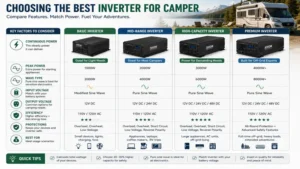
Before purchasing an inverter for camper integration, you must look beyond marketing hype and evaluate your personal power architecture using this logical decision matrix:
                  [What is your largest appliance?]
                                 |
         +-----------------------+-----------------------+
         |                                               |
  [Heating/Motors]                                [Electronics Only]
  (Microwave, AC, Coffee)                       (Laptops, Fans, Starlink)
         |                                               |
  Minimum 2000W-3000W Pure Sine                    Choose 1000W-1200W Unit
         |                                               |
[Do you have a separate charger?]                [Is space tight in the rig?]
    /                        \                       /                  \
 (Yes)                       (No)                 (Yes)                 (No)
   |                          |                     |                    |
Stand-alone             Inverter/Charger       Compact Chassis     Toroidal Unit
(Giandel/Renogy)         (Xantrex Freedom)     (Victron Phoenix)    (Samlex PST)
The Anti-Recommendation Edge Case
While a 3000W inverter might seem like the ultimate “future-proof” upgrade for every camper build, it is actually a terrible fit for minimalist setups utilizing a single, standard 100Ah lithium battery or dual 6V lead-acid batteries. A heavy-duty inverter has a large internal transformer that naturally demands a high baseline current just to stay powered on. If your daily usage consists of merely charging smartphones and running a small fan, a massive inverter will waste more energy through idle self-consumption than it actually delivers to your devices, rapidly depleting your limited battery reserve.
Features That Actually Matter (And Those That Don’t)
Pure Sine Wave vs. Modified Sine Wave
Do not cut corners by purchasing a cheap modified sine wave inverter. Modified sine wave units do not produce a true smooth alternating wave; instead, they deliver a harsh, choppy square wave pattern. While they are cheap to manufacture, they will make kitchen appliances run noticeably hotter, cause analog clocks to keep incorrect time, and introduce prominent audio interference into televisions and stereos. More importantly, expensive laptop power bricks, medical equipment, and modern induction cooktops often refuse to turn on entirely when connected to modified power. Pure sine wave output is non-negotiable for camper systems.
Remote Control and Smart App Integration
An inverter is typically tucked away inside an exterior storage bay, under a dinette seat, or behind a false wall near the main battery bank. Having to physically crawl into a storage compartment every time you want to turn the inverter off is a layout nightmare that quickly ruins the camping experience. A robust wired remote switch or comprehensive Bluetooth app integration is essential. This allows you to completely shut down the system when leaving camp for a hike, instantly saving precious amp-hours.
True Surge Rating Timing
Many budget manufacturers splash massive wattage numbers on their product packaging, but a closer look at the data sheet reveals that their “4000W Surge” rating only lasts for a fraction of a millisecond. True industrial-grade inverters can sustain their peak surge capacity for a full 2 to 10 seconds. This extended duration is vital for overcoming the initial physical resistance of heavy electric motors—such as those inside an RV refrigerator or a water pump—before dropping back down to normal operational levels.
Common Mistakes When Buying an Inverter for Camper Setups
1. Ignoring Battery Discharge Limits (BMS Bottlenecks)
The single most common pitfall I see involves matching a high-wattage inverter with an inadequate battery management system (BMS). A standard 100Ah lithium battery typically features a maximum continuous discharge limit of 100 amps. Because a 2000W inverter can draw up to 180-200 amps from a 12V battery under full load, attempting to run a microwave on this setup will immediately trip the battery’s safety BMS circuit, plunging the camper into total darkness even if the battery is fully charged. You must build your battery bank to comfortably handle the peak current demands of your inverter.
2. Under-sizing the Direct Current Cables
Using thin, generic wiring for your main DC links is incredibly dangerous. High amperage traveling through restrictive, thin-gauge copper wire acts exactly like a restrictive kink in a water hose, generating immense electrical resistance. This causes the cable temperature to skyrocket while dropping the line voltage significantly. If your inverter frequently screams a low-voltage warning beep despite your batteries being completely full, your primary issue is almost certainly thin, sub-standard DC cabling.
3. Neglecting the Total Cost of Ownership
Budget buyers often look exclusively at the initial purchase price of the physical inverter unit. However, a complete, code-compliant mobile installation requires a variety of essential support components, including:
-
High-amperage Class T or ANL safety fuses
-
Heavy-duty pure copper welding cables
-
Industrial-grade hydraulic terminal lug crimps
-
Heavy-duty battery disconnect isolation switches
When mapping out your electrical upgrade budget, always allocate an extra $100 to $150 beyond the base price of the inverter to cover these critical safety and connection components.
✨ Don’t Miss These Exclusive Deals!
🔍 Take your mobile power setup to the next level with these carefully selected products. Click on any highlighted item to check current pricing and availability. These tools will help you create authentic off-grid travel experiences your family will love!
Long-Term Cost & Efficiency Analysis
When designing an off-grid electrical ecosystem, you must factor in the “Efficiency Gap” inherent to all power inversion systems. No power inverter is 100% efficient; a portion of your stored battery power is always lost as heat during the conversion process from DC to AC. Premium pure sine wave units typically achieve an efficiency rating between 90% and 93%, whereas lower-tier budget models often drop down to 80% or 85% efficiency.
Let’s look at what this efficiency gap means for your real-world energy storage over a year of regular travel. If you regularly run a 1000-watt appliance for two hours a day, a high-efficiency inverter (92%) will draw roughly 2174 watt-hours of raw power from your battery bank. Conversely, an inefficient budget model (82%) running the exact same appliance will require a massive 2439 watt-hours to deliver the same output. That daily deficit of 265 watt-hours means you will need to invest in an additional 100-watt solar panel or run a generator longer just to break even, altering your long-term cost-per-use equations significantly.
Safety & Compliance Guide
Operating a high-voltage AC electrical system inside a vibrating, mobile road vehicle requires adherence to strict safety principles. In the United States, the American Boat and Yacht Council (ABYC) and the National Electrical Code (NEC) lay down clear frameworks for mobile electrical safety. The most critical rule involves the proper management of the AC neutral-to-ground bond.
In a standard residential home, the neutral wire is bonded permanently to the earth ground at your main breaker panel. However, inside an RV or camper, this bond must be dynamic. When you are plugged into shore power at an RV park, the ground bond must occur exclusively at the park’s pedestal, and your camper’s internal bond must remain open. When you disconnect from the grid and turn on your standalone inverter for camper power, the inverter must automatically create an internal neutral-to-frame ground bond. Ensure your chosen inverter features an integrated automatic grounding relay to protect your family from dangerous stray current and skin-shock hazards when stepping outside the vehicle.
FAQs
❓ Can a 2000W inverter run a camper air conditioner?
✅ Generally no, unless it is a highly efficient 12V mini-split system. Standard roof-mounted RV air conditioners require massive starting surges upwards of 3000 watts, which will easily trip a standard 2000W inverter unless a soft-start capacitor is manually installed on the AC unit…
❓ What is the difference between pure sine wave and modified sine wave?
✅ Pure sine wave units deliver a perfectly smooth, utility-grade wave of electricity that safely powers all sensitive modern electronics. Modified units produce a jagged, blocky square wave that causes motors to overheat and can permanently ruin sensitive laptop power bricks…
❓ Why does my inverter beep when I turn on the microwave?
✅ This audio alarm indicates an acute low-voltage fault. When a heavy kitchen appliance turns on, it draws immense current, causing your battery voltage to momentarily sag below safe operational limits due to weak batteries or thin, improperly sized DC cables…
❓ How many batteries do I need for a 3000 watt inverter?
✅ To run a 3000W unit safely at full capacity, you need a minimum of 300Ah to 400Ah of high-quality lithium (LiFePO4) capacity, or 600Ah of traditional AGM batteries, to handle the massive 250+ amp continuous discharge current without damaging cells…
❓ Can I leave my camper power inverter turned on all the time?
✅ It is highly discouraged unless you are actively using AC appliances. Even when nothing is plugged in, an active inverter continuously drains power through internal idle consumption, which can quietly deplete your house batteries by 20-40 amp-hours every single day…
Conclusion
Upgrading your electrical core with a dedicated inverter for camper living is a transformative investment that brings the convenience of home appliances directly into the wilderness. By prioritizing high conversion efficiency, robust pure sine wave clarity, and a proper installation workflow, you guarantee a safe, reliable mobile power grid that performs flawlessly for years to come. Carefully balance your peak power needs against your available battery capacity to pick the ideal unit for your upcoming overlanding adventures.
Recommended for You
- 5 Best Camper Solar Panel Kit Options for Off-Grid Freedom (2026)
- 5 Best Jackery or Goal Zero Backup Battery Picks for 2026 Home & Camp
- Cost of a Generac Generator: 5 Crucial Factors for Shocking Savings in 2026
Disclaimer: This article contains affiliate links. As an Amazon Associate, I earn from qualifying purchases. If you purchase products through these links, we may earn a small commission at no additional cost to you.
✨ Found this helpful? Share it with your friends! 💬🤗