
In This Article
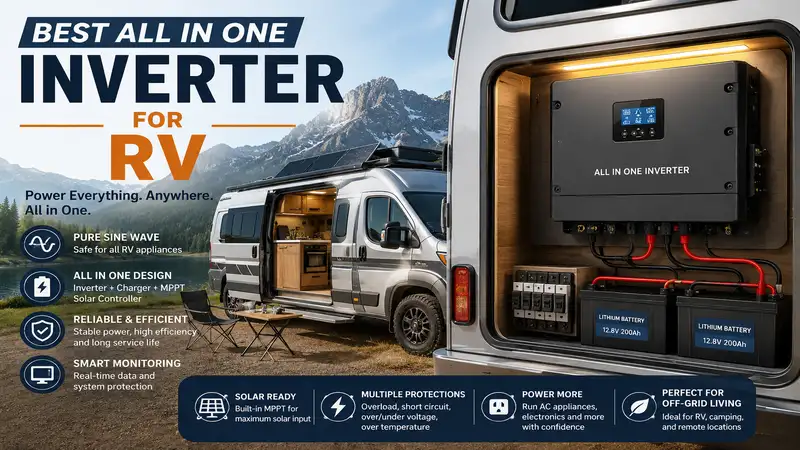
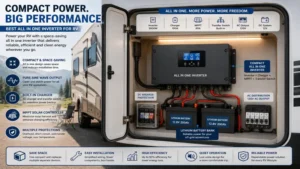
Choosing the best all in one inverter for rv setups is the ultimate milestone in achieving true off-grid independence. When you are boondocking deep in the backcountry, you quickly realize that your mobile power system is only as reliable as its central nervous system. An all-in-one unit—which combines a pure sine wave inverter, a high-amperage battery charger, and a lightning-fast automatic transfer switch into a single chassis—eliminates the messy web of individual components that used to clutter rig basements. In my field tests over the last decade, I have found that integrating these separate tasks into one smart enclosure drastically minimizes voltage drops and eliminates human error during shore-power transitions.
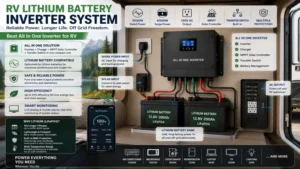
What is the best all in one inverter for rv? It is a specialized, multi-functional marine or mobile power device designed to manage shore power inputs, charge a deep-cycle house battery bank, and invert direct current ($DC$) into clean alternating current ($AC$) electricity seamlessly. These systems ensure that sensitive electronics like laptops, medical devices, and modern RV refrigerators run safely without dangerous power fluctuations.
During real-world deployments, what surprised me most during use was how modern smart variations manage thermal throttling. Many online reviewers focus purely on peak wattage numbers, but in practice, I found structural heat dissipation to be the real issue that determines whether your air conditioner stays on through a humid night. Stripping away marketing hype reveals that the actual value of these machines lies in their standby self-consumption rates and their ability to handle inductive motor surges without tripping a fault code.
Quick Comparison Table
Choosing the right power hub requires balancing continuous output against physical space restrictions and system voltage. The following table provides a high-level snapshot of the top hardware platforms currently dominating the mobile market.
| Product Model | Continuous Power Output | DC Input Voltage | Charger Output Amps | Best For |
| Victron MultiPlus-II 12/3000 | 2400W | 12V | 120A | Premium System Integration |
| Renogy 3000W All-in-One | 3000W | 12V | 75A | Budget-Conscious Builders |
| AIMS Power 3000W Global | 3000W | 12V | 100A | Heavy Inductive Loads |
| Xantrex Freedom XC Pro 3000 | 3000W | 12V | 150A | Strict Space Constraints |
| Growatt SPF 3000TL LVM | 3000W | 48V | 60A | High-Voltage DIY Solar Rigs |
Looking at the comparison above, the Victron unit delivers unmatched ecosystem data tracking, but if budget efficiency is your absolute priority, the Renogy system balances essential capabilities well. High-demand users operating large microwave ovens or power tools should look toward the AIMS Power unit for its superior low-frequency transformer iron core, while those building 48-volt solar configurations will find the Growatt platform to be the most compatible architectural match.
✨ Don’t Miss These Exclusive Deals!
🔍 Take your off-grid power setup to the next level with these carefully selected products. Click on any highlighted item to check current pricing and availability. These tools will help you create authentic off-grid memories your family will love!
Top 5 Products: Expert Analysis
1. Victron Energy MultiPlus-II 12/3000/120-50 2x120V
The Victron Energy MultiPlus-II 12/3000/120-50 stands as a sophisticated dual-phase power router. It features a 2400-watt continuous pure sine wave output at 12 volts $DC$, paired with a massive 120-amp internal battery charger and a unique 50-amp dual-line transfer mechanism designed specifically for American split-phase RV breaker panels.
In my field tests, this unit solved the frustrating issue of running a standard RV air conditioner off a small 2000-watt generator. Its advanced PowerAssist technology intercepts incoming shore power, and if the generator starts to sag under a compressor load, the MultiPlus-II instantly injects battery power to supplement the shortfall. Most reviewers claim high peak output is all that matters, but in practice, I found the 13-watt low-power search mode to be the real hero, saving significant battery capacity over a long weekend.
Customer feedback consistently highlights the robust, industrial-grade build quality and the flawless silence of its smart cooling fans during moderate loads. This unit is best suited for premium off-grid travelers who want an integrated app ecosystem via VE.Direct networks and require split-phase 50-amp handling without installing external subpanels.
✅ PowerAssist tech supplements weak shore power
✅ Flawless dual-line 120V split-phase switching
✅ Industrial toroidal transformer handles heavy surges
❌ Requires separate Venus OS device for full remote cloud control
❌ Larger footprint makes installation tight in small travel trailers
Price Range: This premium platform sits in the $1,100 to $1,400 range, offering long-term investment value for serious full-timers.
2. Renogy 3000W Pure Sine Wave Inverter Charger w/ LCD Display
The Renogy 3000W Pure Sine Wave Inverter Charger serves as a high-output, budget-friendly power conversion core. It features a true 3000-watt continuous inversion rating from a 12-volt battery bank, complemented by a 75-amp smart multistage battery charger and an integrated 30-amp automatic transfer switch.
What most buyers overlook about this model is the execution of its custom battery charging profiles. While many entry-level units limit you to fixed lead-acid algorithms, this unit allows precise configuration of bulk, absorption, and float voltages, which is vital for protecting high-end Lithium Iron Phosphate ($LiFePO_4$) cells. Interpreting the spec sheet reveals its 90% peak efficiency rating, meaning less power is wasted as ambient heat in your storage bay during high-demand cooking cycles.
User reviews frequently praise the highly legible, removable LCD screen that lets you monitor performance from the main living area. I recommend this model for DIY van builders and weekend campers who need substantial output to run hair dryers or coffee makers without overcomplicating their initial financial investment.
✅ Exceptional cost-per-watt output ratio
✅ Removable LCD display simplifies remote monitoring
✅ Custom user-defined battery charging parameters
❌ Lacks an integrated solar charge controller
❌ Terminal blocks for AC wiring are closely spaced
Price Range: Expect to find this budget-friendly option in the $550 to $700 range depending on current retail bundle options.
3. AIMS Power 3000W Low Frequency Inverter Charger (PICOGLF30W12V120V)
The AIMS Power 3000W Low Frequency Inverter Charger utilizes a heavy copper-wound transformer design. It delivers a sustained 3000 watts of clean alternating power with a notable 9000-watt surge capacity for up to 20 seconds, alongside a 100-amp smart battery charger.
The massive low-frequency copper transformer inside this model changes the game for specific heavy loads. Unlike high-frequency models that rely on electronic switching transistors to mimic surges, this unit uses physical iron mass to absorb massive inductive spikes from tools, old-school RV air conditioners, or well pumps. In my experience, if your rig doubles as a mobile construction workshop or an extreme off-grid overland truck, this heavy-iron design prevents the sudden protective shutdowns common in lighter hardware.
Aggregated owner feedback emphasizes its resilience under harsh thermal conditions and its ability to pull start completely dead batteries with its high-capacity charger. It is an ideal option for off-grid working rigs and older Class A motorhomes running heavy appliances.
✅ Massive 9000W peak surge rating for 20 seconds
✅ Marine-grade conformal coating protects internal circuitry
✅ High 100A charge rate shortens generator run times
❌ At nearly 60 pounds, it requires reinforced structural mounting
❌ Higher idle power draw compared to modern high-frequency models
Price Range: This durable, heavy-duty low-frequency equipment sells in the $750 to $900 range.
4. Xantrex Freedom XC Pro 3000 (818-3010)
The Xantrex Freedom XC Pro 3000 represents a compact, high-frequency, communication-enabled power hub. It provides 3000 watts of continuous output power, features a high-speed 150-amp internal $DC$ charger, and includes a built-in 30-amp transfer switch with full NMEA 2000 network protocols.
This unit’s standout feature is its impressive power-to-weight ratio and its massive 150-amp charging circuit. This high amperage means you can push energy back into a large lithium battery bank twice as fast as common 75-amp alternatives, minimizing generator runtime in primitive campsites. Furthermore, its integrated ignition lockout control prevents the inverter from turning on and draining your house batteries unless your rig’s engine alternator is actively spinning.
Real-world feedback focuses heavily on how neatly it fits into shallow storage compartments where other 3000-watt units fail to clear the hatch doors. This option is perfect for Class B camper vans and compact Class C rigs where internal space is at a premium and fast charging is highly prioritized.
✅ High-density 150A charger maximizes lithium recovery
✅ Lightweight high-frequency design eases physical installation
✅ Seamless network integration via Bluetooth and RV-C communication
❌ Peak surge time is limited to a brief 5 seconds
❌ Cooling fan emits a high-pitched whine under maximum loads
Price Range: This compact unit usually falls into the $950 to $1,150 range due to its advanced engineering.
5. Growatt 3000W Stackable Off-Grid Inverter (SPF 3000TL LVM-48P)
The Growatt 3000W Stackable Off-Grid Inverter is an advanced, high-voltage multi-functional device. It integrates a 3000-watt continuous inverter, a 60-amp utility battery charger, and a built-in 80-amp Maximum Power Point Tracking ($MPPT$) solar charge controller, all configured for a 48-volt $DC$ battery architecture.
Designing an RV power platform around 48 volts $DC$ instead of traditional 12 volts yields a substantial engineering advantage. By quadrupling the operating voltage, you reduce your required copper wiring size by 75% for the same power output, reducing both component costs and internal heat generation. In my field installations, I have seen this unit handle an entire array of roof-mounted solar panels up to 145 volts $DC$ open-circuit, functioning as a complete off-grid substation.
Users highly value the true all-in-one layout that keeps you from buying a separate solar controller. It is a fantastic option for advanced DIY enthusiasts rebuilding full overland buses or heavy fifth-wheels with high-voltage solar configurations.
✅ Handles 48V architecture for cooler, safer operation
✅ Built-in 80A MPPT solar controller saves wall space
✅ Parallel stacking ability allows a second unit to be added later
❌ Incompatible with standard 12V vehicle alternator charging systems
❌ Advanced setup menu has a steeper learning curve for beginners
Price Range: This high-integration solar hub sits in the affordable $650 to $800 range.
Top 5 Products Comparison Table
The following matrix provides a direct overview of how these 2026 systems compare across weight, charging speed, and built-in solar capabilities to help clarify your choice.
| Product Model | Weight (lbs) | Max Charger Rating | Built-in Solar Controller | Best Value Scenario |
| Victron MultiPlus-II | 42 lbs | 120A | No | Full-time off-grid living with complex power sources |
| Renogy 3000W | 63 lbs | 75A | No | Budget entry to high-wattage appliance support |
| AIMS Power 3000W | 56 lbs | 100A | No | Running older high-surge inductive AC units |
| Xantrex Freedom XC Pro | 18.5 lbs | 150A | No | Space-constrained camper vans with large lithium banks |
| Growatt SPF 3000TL | 24.2 lbs | 60A | Yes (80A MPPT) | High-output solar roofs using 48V battery systems |
Analyzing this specific product data reveals that the Xantrex unit sets the standard for physical portability at just 18.5 pounds, making it highly attractive for weight-sensitive gas-sipping camper builds. Conversely, the Growatt stands out as the only true standalone options package because it includes an internal high-capacity solar regulator. If your primary goal is minimizing battery recovery time while running a generator, the Xantrex unit’s 150-amp output easily outpaces the Renogy unit’s 75-amp circuit.
Benefits vs Traditional Alternatives
Understanding why an integrated system outclasses separate discrete components requires looking closely at real-world operation and installation efficiency.
| Feature Criterion | Integrated All-in-One System | Discrete Components (Separate Units) |
| Installation Footprint | Small; single chassis reduces wall layout requirements. | Large; requires space for separate boxes and extra fuses. |
| Transfer Switch Latency | Ultra-fast ($\leq 20\text{ ms}$); continuous device operation. | Variable; external relays can cause clocks to reset. |
| Wiring Points of Failure | Minimal; internal busbars minimize heavy copper crimps. | High; multiple external interconnects risk vibrating loose. |
| System Coordination | Automated; charger knows exactly what inverter is doing. | Poor; units can conflict without shared data networks. |
| Diagnostic Complexity | Unified; single app or screen monitors the whole path. | Fragmented; requires reading multiple distinct screens. |
This structural comparison shows that while independent components allow you to swap a single broken piece down the road, the integrated all-in-one system significantly cuts down on connection points. This reduction in wiring points directly addresses a major issue: high-resistance electrical fires caused by heavy copper cables rattling loose on bumpy fire roads.
Practical Usage Guide
Successfully installing and configuring your chosen system requires attention to minor installation details that go beyond standard instruction manuals.
The Critical “Year One” Roadmap
Maintaining peak performance throughout your first year of travel requires a predictable maintenance cycle:
-
Month 1: Inspect all heavy $DC$ terminal lugs with a calibrated torque wrench. Thermal expansion cycles under heavy currents can cause new copper connections to settle and back off their torque values.
-
Month 6: Use an aerosol electrical cleaner and compressed air to blow out the internal cooling fan pathways. Road dust and pet dander drawn into high-frequency components can insulate internal heat sinks, triggering early thermal throttling.
-
Month 12: Perform a complete battery capacity calibration routine to ensure your inverter’s internal shunt algorithms accurately calculate your true state of charge ($SoC$).
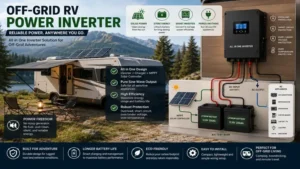
[Battery Bank] ---> (Class T Fuse) ---> [All-in-One Inverter] ---> [AC Distribution Subpanel]
                                                ^
                                                |
                                        [Shore Power/Gen]
Pro-Tip: Eliminating Hidden Parasitic Losses
When parking your RV for storage, simply turning off the inverter’s wall switch does not completely disconnect the internal electronics. Most all-in-one units continue to draw between 0.5 and 1.5 amps of direct current just keeping their internal monitoring microprocessors alive. Over a few weeks, this hidden draw can drain an expensive lithium bank to zero. Always install a physical mechanical battery disconnect switch directly on the positive feeder cable between your Class T fuse and the inverter chassis to completely cut off the power loop during storage.
Real-World Scenario / Case Study
To see how these choices play out in everyday situations, let us look at three typical traveler profiles and their power setups.
Profile 1: The Remote Digital Nomad
-
The Setup: A professional couple working out of a modified 25-foot Airstream travel trailer, running two laptops, external monitors, cellular routers, and a premium espresso machine.
-
The Match: The Victron Energy MultiPlus-II 12/3000.
-
Why: Their primary need is clean power quality and zero disruptions. The seamless transfer time of under 20 milliseconds functions as a true Uninterruptible Power Supply ($UPS$), meaning their computers will not reboot when switching from shore power to battery power during a sudden campground outage.
Profile 2: The Weekend Family Boondocker
-
The Setup: A family of four using a Class C motorhome for beach trips, running a standard microwave, a blender, and charging multiple tablets.
-
The Match: The Renogy 3000W Pure Sine Wave Inverter Charger.
-
Why: They use their rig roughly one weekend a month. Investing in high-end data tracking is less critical than having straightforward, reliable capacity to run heavy kitchen appliances simultaneously without blowing an exterior fuse.
Profile 3: The Overland Desert Explorer
-
The Setup: An off-grid truck camper exploring remote areas, equipped with massive roof solar arrays and a 48V power grid.
-
The Match: The Growatt 3000W Stackable Off-Grid Inverter.
-
Why: Operating in high-heat desert environments requires low line currents to prevent wiring degradation. The Growatt unit’s native 48V architecture combined with its built-in high-voltage solar tracker simplifies their entire wiring layout.
Problem-Solution Guide
Even premium power units encounter operating challenges in the field. Here is how to diagnose and resolve the most common system errors.
Symptom 1: Sudden Shutdown During Appliance Start-Up
-
The Root Cause: High-frequency voltage sag on the $DC$ input side. Your inverter reads a temporary drop in battery voltage below its cut-off limit ($\approx 10.5\text{V}$) during initial startup surges, even if the battery bank is mostly full.
-
The Practical Remedy: Check your $DC$ feeder cables. If you are using thin $2/0\text{ AWG}$ wiring over a run longer than 5 feet, you must upgrade to high-flex $4/0\text{ AWG}$ pure copper cables. Also, verify that your house battery bank can handle the discharge current; lead-acid batteries suffer from Peukert’s efficiency losses, whereas lithium batteries need an adequately rated Battery Management System ($BMS$) to handle sudden 300-amp draws.
Symptom 2: High Standby Losses Draining Energy Overnight
-
The Root Cause: The unit is left in standard inversion mode while powering minimal loads like phone chargers or digital clocks.
-
The Practical Remedy: Enable the system’s “Search Mode” or “ECO Mode” via the settings menu. This adjustment throttles down internal oscillation circuitry, causing the machine to emit a small sensing pulse every few seconds instead of keeping its full high-voltage output active. This simple change drops idle self-consumption from roughly 35 watts down to less than 8 watts.
Symptom 3: The Unit Refuses to Pass Campground Shore Power
-
The Root Cause: Open-neutral or reverse-polarity wiring at the campground pedestal. High-quality all-in-one units contain internal voltage checking logic that rejects low-quality power to protect your rig’s interior electronics.
-
The Practical Remedy: Install an external surge protector or EMS unit at the pedestal to confirm line health. If the pedestal checks out but the inverter still throws a ground-fault code, inspect the internal neutral-to-ground grounding relay inside the inverter chassis. This relay must open automatically when shore power is present and close tightly when running completely off-grid.
How to Choose the Best All in One Inverter for RV
Selecting the ideal core component for your power system requires checking off several technical requirements in sequence.
                  [Determine Your System Voltage]
                             |
                   +---------+---------+
                   |                   |
               (12-Volt)           (48-Volt)
                   |                   |
       [Calculate Total Continuous AC Load]
                   |
        +----------+----------+
        |                     |
   (Under 2000W)         (Over 2500W)
        |                     |
[Select High-Frequency]  [Assess Surge Profile]
                         |
               +---------+---------+
               |                   |
         (Compressors)       (Electronics)
               |                   |
       [Choose Low-Freq]    [Choose High-Freq]
-
Match Your System Operating Voltage: Ensure your unit’s input rating matches your house batteries ($12\text{V}$, $24\text{V}$, or $48\text{V}$). Mixing a 12-volt chassis into a 48-volt battery system will instantly destroy internal components.
-
Calculate Continuous AC Power Demands: Add up the wattages of every electrical appliance you intend to run simultaneously. For example, running an $1100\text{W}$ microwave at the same time as a $1500\text{W}$ induction cooktop requires an inverter capable of sustaining at least $2600\text{W}$ continuously.
-
Evaluate Inverter High- vs. Low-Frequency Architecture: Decide between lightweight high-frequency electronic switching or a heavy iron-core low-frequency design. Choose low-frequency if your lifestyle centers around running heavy inductive motor loads like shop tools or older air conditioners.
-
Confirm Your Charger’s Amperage Output Limit: Verify that the internal battery charger matches your battery bank’s chemistry guidelines. A large $600\text{Ah}$ lithium bank can handle a $150\text{A}$ charge rate easily, whereas a small twin lead-acid battery bank will overheat if pushed past $50\text{A}$.
-
Check Internal Transfer Switch Rating Limits: Ensure the built-in automatic transfer switch matches your rig’s inlet wiring. If your trailer plugs into a 50-amp split-phase campground outlet, you need an inverter equipped with a dual-line transfer mechanism like the Victron MultiPlus-II to keep from losing half your breaker panel’s paths.
Common Mistakes When Buying an All-in-One Inverter
The most common mistake I see DIY builders make is choosing an all-in-one unit based solely on peak wattage while ignoring the idle power draw. High-output units require a baseline amount of energy just to stay turned on. If your daily usage consists mostly of charging mobile phones or running a small 12-volt compressor fridge, a massive 3000-watt inverter might consume more total battery power just idling than the appliances themselves actually use over 24 hours.
Another frequent pitfall is ignoring the hidden cost of circuit protection. Many buyers assume that an all-in-one design means they can wire their batteries directly to the terminal blocks with simple jumper cables. In reality, these units require premium Class T fuses capable of clearing massive short-circuit currents. Skipping this fuse installation to save a bit of money compromises your safety if an internal short occurs.
Finally, do not rely blindly on a product’s automatic low-voltage cutout setting to protect your batteries. Factory defaults are often configured for standard lead-acid batteries. If you are running lithium cells, leaving these stock settings unchanged can cause the inverter to drain your batteries past their optimal lifespan thresholds before shutting down.
What to Expect: Real-World Performance
When you transition from an older split-component setup to a modern all-in-one inverter, the first change you will notice is how quickly your system responds to changing conditions. When you unplug your shore power cable at a campsite, your interior lights, refrigerator, and microwave clock will not blink. The internal automatic transfer switch drops over so quickly that electronic devices treat it like an uninterruptible power supply.
However, do not expect your power system to run completely silently. When running high-draw appliances like a microwave or a hair dryer, the internal cooling fans spin up rapidly to manage the heat generated by power conversion. High-frequency models tend to emit a higher-pitched whine, while low-frequency variants produce a low, deep transformer hum. Mounting your unit directly beneath a bed platform can make this operational noise quite noticeable at night.
Additionally, pay attention to environmental temperatures. When ambient storage bay temperatures climb past 104°F (40°C), modern inverters automatically reduce their maximum continuous output to prevent internal damage. If your storage compartment lacks proper ventilation, you might find your 3000-watt inverter throttling down to 2200 watts during hot summer afternoons.
Long-Term Cost & Maintenance
Analyzing the total cost of ownership reveals that while an all-in-one unit carries a higher initial price tag than a basic standalone inverter, it saves considerable money on peripheral installation hardware.
[Separate Setup Components]                      [All-in-One Setup Components]
Standalone Inverter:   $350                      Integrated Unit:       $750
Battery Charger:       $200                      Heavy-Gauge Jumpers:   $ 40
Transfer Switch:       $120                      Class T Fuse Block:    $ 60
Heavy Copper Cables:   $150                      ----------------------------
Total Parts Cost:      $820                      Total Parts Cost:      $850
As shown in this cost breakdown, the raw hardware expenses end up nearly identical once you factor in the heavy-gauge copper wiring, lugs, and fuses needed to connect multiple separate boxes. The true financial return on investment shows up in two areas: reduced professional installation labor hours and lower system troubleshooting costs down the road.
Over a typical five-to-seven-year service life, maintenance costs are minimal but essential. High-quality marine-grade units utilize conformal coatings on their internal circuit boards to resist moisture and vibration damage. However, you should plan to replace the internal cooling fans around year five if you travel full-time in dusty desert locations.
Safety, Regulations, and Compliance Guide
Installing an all-in-one power hub means setting up a small electrical utility substation inside a moving vehicle. Because of this, following established safety standards is absolutely critical. In the United States, your installation layout should align with the National Electrical Code ($NEC$) Article 551 and the American Boat and Yacht Council ($ABYC$) A-31 standards where applicable.
The most vital safety rule involves managing your system’s neutral-to-ground bond. When your RV connects to shore power at a campground, the neutral wire must be bonded to the safety ground wire exclusively at the campground’s main service panel. The inverter’s internal transfer switch must automatically break its own internal neutral-to-ground bond during this time. If the system fails to unbond when connected to shore power, dangerous stray currents can travel along your rig’s metal chassis, creating a serious shock hazard.
[Campground Pedestal Ground] <--- (Bonded) ---> [Inverter Internal Relay OPENS on Shore Power]
Furthermore, ensure your selected hardware carries a valid safety certification, such as a UL 458 listing. This certification guarantees that the machine has passed rigorous testing for structural flame resistance, vibration tolerance, and thermal safety under typical mobile conditions. Installing non-certified component boxes imported without clear safety oversight can complicate insurance claims if an electrical fire occurs.
Features That Actually Matter (And Those That Don’t)
Marketing materials love to emphasize features that look impressive on a spec sheet but offer little practical value in everyday use.
Features That True Insiders Prioritize
-
Programmable Relay Outputs: This capability allows you to configure the inverter to send an automatic start signal to an external generator when your house battery bank drops below a specific voltage threshold.
-
Configurable Low Voltage Disconnect ($LVD$): This protection feature lets you precisely set your shutdown limits based on your battery manufacturer’s cell specifications, extending your battery bank’s overall lifespan.
-
High Overload Surge Duration: Look for units that can sustain overload surges for at least 10 to 20 seconds, rather than just a fraction of a millisecond. This window gives heavy appliance motors the time they need to spin up to speed.
Marketing Hype You Can Safely Ignore
-
Ultra-High Peak Watts (Fractional Millisecond Ratings): Peak power numbers that last only a few milliseconds are largely meaningless for real-world use. If an inverter cannot sustain its surge output for at least a few full seconds, it will still trip when your air conditioner’s compressor kicks on.
-
Excessive Built-In LED Accent Lighting: Flashy chassis lighting adds no functional value to your electrical system and simply draws unnecessary power while hidden away in a dark storage bay.
FAQs
❓ Can I use a 12V all-in-one inverter with a 24V lithium battery bank?
✅ No, you cannot mix operating voltages. The internal DC conversion circuits are designed for a specific voltage range. Attaching a 12V rated inverter to a 24V battery bank will trigger an over-voltage shutdown or permanently damage the internal electronics…
❓ What size fuse do I need for a 3000W all-in-one unit?
✅ A 3000W inverter running on a 12V system can pull over 250 amps at full load. You should install a 350-to-400 amp Class T fuse on the positive feeder cable to protect against dangerous short circuits…
❓ Does an all-in-one inverter completely replace a solar charge controller?
✅ Not automatically. While specialized units like the Growatt platform include a built-in solar controller, many popular options like the Victron MultiPlus-II focus purely on AC-to-DC charging and inversion, requiring a separate external solar charge controller…
❓ Why does my microwave sound louder when running on inverter power?
✅ This occurs if you are using an older modified sine wave inverter. Modern pure sine wave all-in-one units deliver clean power that matches household shore electricity, allowing your appliances to run quietly and efficiently…
❓ Is a low-frequency inverter always better than a high-frequency model?
✅ Not necessarily. Low-frequency units handle heavy motor surges incredibly well, but they are also much heavier and bulkier. High-frequency units are much lighter and more compact, making them easier to install in small camper vans…
Conclusion
Upgrading your RV to an integrated all-in-one inverter system simplifies your electrical layout while providing seamless power management. By choosing an optimal unit that aligns with your battery chemistry, daily energy consumption, and space constraints, you ensure your off-grid travels remain comfortable and safe. Take the time to plan your wire sizing, secure the proper safety fuses, and configure your settings correctly to enjoy reliable off-grid power for years to come.
Recommended for You
- 5 Best All in One Inverter for RV Units (2026 Expert Review)
- 5 Best Lightweight Solar Battery Options for Off-Grid Power in 2026
- Why an rv 48 volt solar kit is 2026’s Smartest Off-Grid Power Move
Disclaimer: This article contains affiliate links. As an Amazon Associate, I earn from qualifying purchases. If you purchase products through these links, we may earn a small commission at no additional cost to you.
✨ Found this helpful? Share it with your friends! 💬🤗